
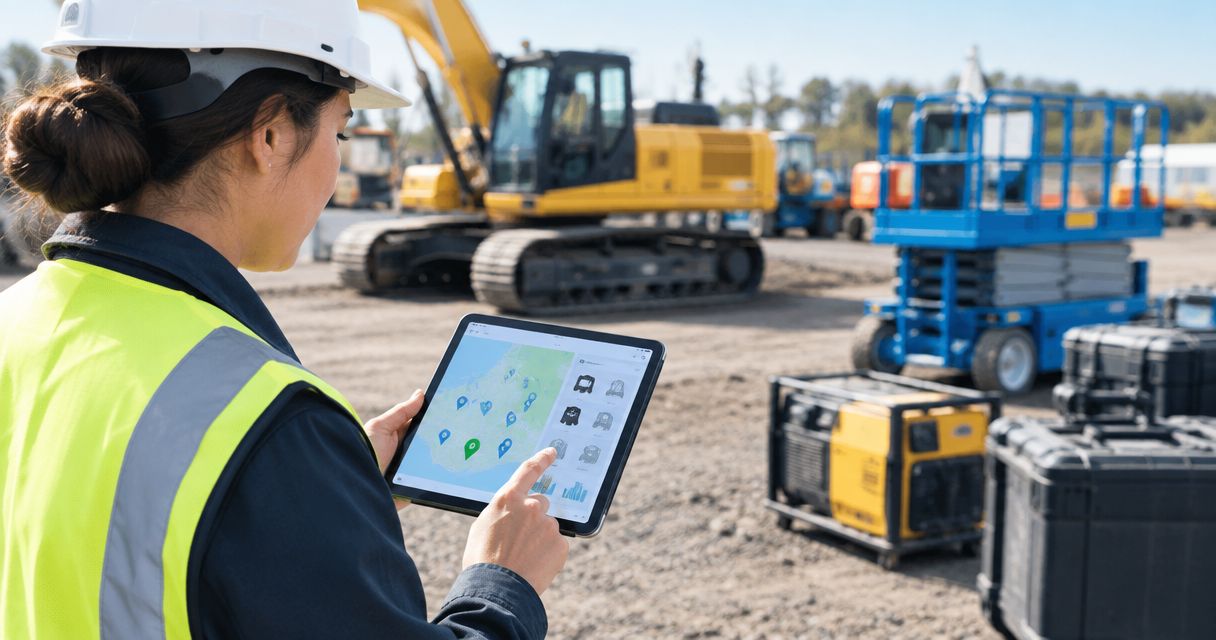
The best choice depends on what your rental business needs to track: shortlist Trackunit for construction-equipment telematics, Tenna for construction asset management, and Samsara for equipment alongside road vehicles. Choose the Kilo IoT Platform when you need a configurable IoT layer connecting equipment data, monitoring and automation rather than a ready-made rental management system.
- Compare IoT asset tracking platforms for equipment rental firms by equipment coverage, data freshness and rental-system integration.
- Shortlist Trackunit for construction telematics, Tenna for construction asset management, and Samsara for mixed vehicle-and-equipment fleets.
- Kilo suits integrators building rental-equipment monitoring workflows around supported devices, dashboards, rules and alarms.
- Test missing telemetry and returned-equipment workflows before committing to a fleet-wide rollout.
What makes an asset tracking platform useful for rental firms?
A location report tells you where equipment was observed; it does not tell you whether that equipment is ready to rent. Your rental system holds contracts and reservations. Your tracking platform supplies observations that help dispatchers, branch managers and technicians make decisions.
Keep those responsibilities separate. A returned compressor can be inside the yard while still awaiting inspection, and a stationary excavator can remain legitimately on hire.
Use these criteria before comparing vendors:
- Equipment coverage: Match each tracker or data source to powered machines, trailers, attachments and small tools. A fleet-wide software license does not solve incompatible hardware.
- Data freshness: Show when a measurement was taken, not just when someone opened the dashboard. Old coordinates must remain distinguishable from recent observations.
- Useful equipment data: Request the specific location, runtime, battery or condition fields you need. Their presence depends on the device and integration.
- Rental-system connection: Match telemetry to your equipment identifier and contract workflow without creating a second, conflicting asset register.
- Action ownership: Define who investigates missing reports, unexpected movement and maintenance exceptions. An alert without an owner creates another inbox.
- Deployment responsibility: Establish who installs trackers, maps payloads, maintains integrations and replaces damaged devices.
The strongest platform is the one that supports your actual decisions with dependable inputs. A longer feature list is not a substitute for that fit.
Equipment rental platform shortlist at a glance
These are workflow-based shortlist positions, not measured performance rankings. Trackunit, Tenna and Samsara are established equipment or fleet technology providers; the comparison below identifies the buying question each should answer during evaluation.
| Platform | Best for | Relevant focus | Key limitation to resolve |
|---|---|---|---|
| Kilo | Integrator-built monitoring across supported equipment and sensors | Device data, dashboards, automation and alarms in a configurable platform | Rental contracts and billing require a separate system and defined integration |
| Trackunit | Construction-equipment telematics evaluation | Connected construction equipment | Validate coverage and required data for every equipment class |
| Tenna | Construction asset-management evaluation | Managing equipment within construction workflows | Prove that construction workflows fit your rental handoffs |
| Samsara | Evaluating equipment alongside road vehicles | Connected fleet operations | Validate equipment-specific depth separately from vehicle requirements |
Hardware, connectivity, software and implementation are separate purchasing decisions. Ask each supplier to explain those responsibilities against the same equipment list rather than comparing packages with different assumptions.
1. Kilo: best fit for configurable equipment monitoring
Kilo brings connected-device data, dashboards, rules, alarms and permissions into a platform that an integrator or developer can configure around a deployment. For rental equipment, the useful starting point is a supported tracker or sensor supplying identifiable, timestamped observations.
Kilo suits rental-equipment integrators who need configurable monitoring rather than a replacement rental management system. That distinction matters: equipment observations belong in the monitoring layer, while reservations, invoices and contractual status remain the responsibility of the rental application.
An illustrative workflow would connect a supported equipment data source, associate its device record with the rental asset identifier, and present relevant measurements to staff. Any transfer into another business application needs a defined integration; a dashboard alone does not update a contract.
Kilo pros:
- Combines device management, monitoring, rules and alarms around supported inputs.
- Supports configurable workflows rather than requiring every project to follow a rental-specific template.
- Provides permissions for controlling access to connected deployments.
Kilo cons:
- Payload mapping and equipment integration still require technical ownership.
- A supported protocol does not establish compatibility with every tracker or machine.
- Rental billing and reservation functionality are not established by the platform capabilities described here.
Best for: Integrators, developers and rental firms building equipment monitoring with clearly assigned implementation responsibilities.
Verdict: Hold fleet-wide purchasing until a representative device-to-decision workflow passes your pilot.
2. Trackunit: best fit for construction-equipment telematics
Trackunit belongs on the shortlist when construction equipment is the center of your rental business. Its construction-telematics focus makes it relevant to evaluating how connected machine information supports equipment visibility and fleet decisions.
Start with the machines you already own. Ask Trackunit to demonstrate the required data path for each representative equipment class, including equipment that lacks an existing telematics connection.
The decision is not simply whether a machine appears on a map. Your branch needs to know what information is available, how recent it is, and how that observation reaches the person responsible for dispatch or service.
Trackunit pros:
- Construction-equipment focus aligns directly with an important rental fleet category.
- Provides a relevant specialist option when machine telemetry drives the project.
- Gives construction-focused buyers an alternative to starting with a general-purpose IoT build.
Trackunit cons:
- Construction focus does not prove coverage for every attachment, small tool or legacy machine.
- Required data fields and rental-system handoffs still need equipment-specific validation.
Best for: Rental firms prioritizing connected construction machinery over a broader custom sensor application.
Verdict: Hold until Trackunit demonstrates the required observations from your representative machines, not just demonstration equipment.
3. Tenna: best fit for construction asset-management evaluation
Tenna is a construction asset-management provider worth evaluating when your question extends beyond equipment coordinates. The relevant buying question is how equipment information supports the people managing assets and their work.
For a rental business, that means demonstrating the boundaries between tracking, inspection, maintenance and rental status. Ask for a walkthrough using your own handoff: equipment leaves a branch, changes location, returns, and awaits a decision about its next assignment.
Do not assume a construction-oriented workflow is automatically a rental workflow. Your team must prove that identifiers, responsibilities and business-system updates remain consistent throughout that handoff.
Tenna pros:
- Construction asset-management focus makes it relevant to equipment-heavy businesses.
- Offers a useful evaluation path when asset processes matter alongside location.
- Provides a specialist comparison against vehicle-led fleet platforms.
Tenna cons:
- Construction asset management is not proof of rental contract or billing suitability.
- Your equipment mix and required integrations need their own demonstration.
Best for: Rental firms evaluating construction asset processes rather than treating tracking as an isolated map application.
Verdict: Hold until Tenna demonstrates your return-to-branch workflow with clear responsibility for every status change.
4. Samsara: best fit for equipment alongside road vehicles
Samsara belongs on the shortlist when delivery vehicles and equipment are part of the same evaluation. Its connected-operations and fleet focus makes it relevant to a rental business considering both road transport and off-vehicle assets.
Keep the requirements separate during the demonstration. A strong vehicle workflow does not establish that a battery-powered attachment, unpowered trailer or intermittently connected machine will provide the observations you need.
Ask the supplier to demonstrate the equipment side independently, then show how staff use vehicle and equipment information together. The goal is a useful operational view, not a single vendor name across unrelated purchases.
Samsara pros:
- Relevant to businesses evaluating road vehicles and equipment together.
- Provides a fleet-oriented alternative to construction-only evaluation.
- Fits a buying process that includes dispatch and transport stakeholders.
Samsara cons:
- Vehicle requirements can distract from gaps in equipment tracking requirements.
- Equipment compatibility and rental-system integration need separate proof.
Best for: Rental businesses whose delivery fleet is a substantial part of the tracking project.
Verdict: Hold until Samsara passes distinct vehicle and equipment acceptance tests.
How these platforms were shortlisted
The shortlist follows the criteria above: equipment fit, useful observations, rental-system handoffs and implementation responsibility. It does not claim comparative accuracy, onboarding speed, reliability or financial return.
Choose a specialist construction evaluation when machine telemetry leads the project. Choose a mixed-fleet evaluation when transport and equipment share the buying brief. Choose a configurable IoT approach when an integrator will build workflows around supported devices and additional sensors.
Test the rental handoff before expanding the deployment
A pilot should reproduce the awkward moments in a rental cycle, not just prove that a tracker can transmit. Use equipment that represents different power sources, mounting conditions and operating environments.
For illustration, assume a pilot covers 10 assets for 14 days, with a 5-minute reporting interval while moving wherever the selected hardware supports that configuration. These are planning assumptions, not vendor capabilities, battery-life promises or recommended universal settings.
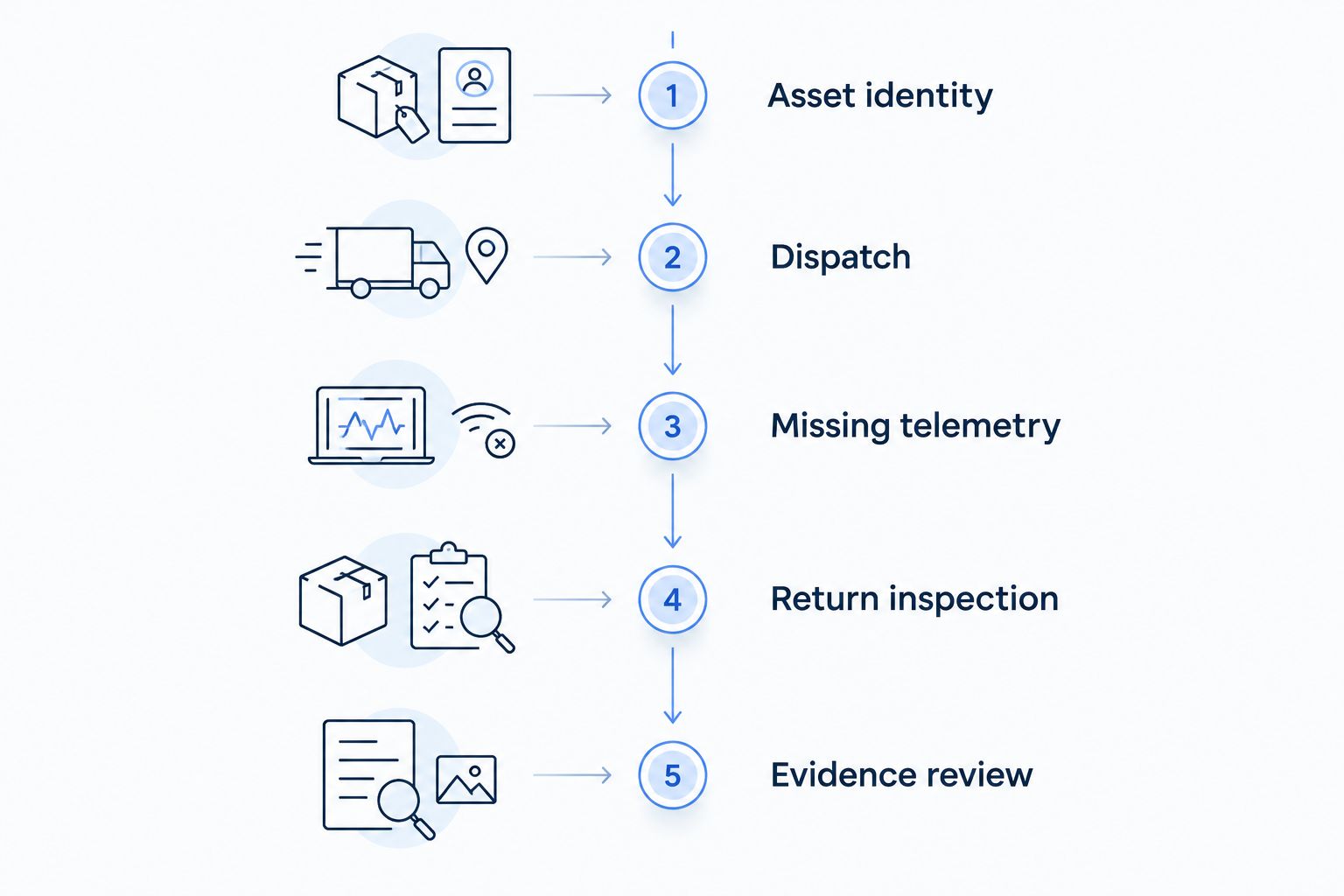
Work through this sequence:
- Asset identity: Match the tracker identifier to the rental asset record. Confirm that a replacement tracker does not create a duplicate machine.
- Dispatch: Record the outgoing asset and compare its subsequent observations with the expected handoff. Identify who investigates a mismatch.
- Missing telemetry: Interrupt the reporting path deliberately. Confirm that staff see stale information rather than interpreting the last position as current.
- Return inspection: Bring the asset back and leave its rental readiness unresolved until the responsible person completes the required check.
- Evidence review: Compare timestamps, observations and staff actions. Record what the platform established and what still required physical inspection.
Keep the evidence useful. A location observation establishes reported position at a particular time; it does not establish mechanical condition, customer responsibility or readiness for the next rental.
For a deeper implementation discussion, read the guide to tracking high-value tools and equipment across job sites.
Choose hardware around the equipment, not the dashboard
A tracker on a powered excavator faces different installation and energy constraints from a tag on a hand tool. Establish mounting, power, environmental exposure, reporting behavior and communication coverage before treating a platform demonstration as a deployment design.
Satellite positioning and data transmission are separate functions. A device needs both a way to determine useful location information and a way to deliver observations to the application; performance in a covered yard does not establish performance inside a workshop.
For hardware sourcing, Kilo Electronics is a separate online authorised dealer serving individual and business buyers. Hardware purchasing is distinct from platform software, and any selected device still needs a supported integration for the intended workflow.
Which platform should your rental firm choose?
Start with Trackunit if construction-machine telematics defines the project, Tenna if construction asset processes lead it, or Samsara if delivery vehicles and equipment share the brief. Use the configurable platform option when your team needs an IoT layer and has an integrator responsible for connecting it to rental operations.
For an undecided buyer, the next move is not a fleet-wide commitment. Prepare a representative equipment list, select the most relevant shortlist candidate, and make the rental handoff pilot the purchasing gate.
FAQ
What's the best IoT asset tracking platform for equipment rental firms?
The best fit depends on the workflow: evaluate Trackunit for construction telematics, Tenna for construction asset management, Samsara for mixed fleets, and Kilo for configurable IoT monitoring. Require a pilot using your equipment before selecting a platform.
Can an asset tracking platform replace rental management software?
Tracking functionality alone does not replace rental management software. Contracts, reservations, billing and rental readiness need an explicit system of record, with any telemetry integration defined separately.
Can I track rental equipment without connecting to machine electronics?
Independent tracking hardware can supply observations without a machine-data connection. The information available depends on the tracker, so location reporting does not automatically include runtime or diagnostic data.
Does GPS tracking work inside a rental workshop?
Satellite positioning is not a dependable assumption inside every workshop. Test the actual environment and select an indoor locating approach if room-level or zone-level information is required.
Does a geofence alert prove equipment was stolen?
A geofence alert does not prove theft. Investigate the observation time, positioning quality, authorized movements and rental contract before deciding what happened.
Should rental firms remotely disable equipment through a tracking platform?
Remote disabling requires a compatible control path and an equipment-specific safety assessment. Tracking support alone does not establish control capability, and a delivered command is not proof that the physical action occurred.
How should I compare asset tracking proposals without relying on package labels?
Give each supplier the same equipment list, required observations and acceptance tests. Separate hardware, connectivity, software and implementation responsibilities so the proposals describe equivalent work.
Keep return detection separate from rental readiness
The most useful acceptance test is deliberately simple: return a tracked machine to the yard without completing its inspection. Your workflow should show that the location changed while leaving the readiness decision with the responsible person.
Equipment being back is an observation; equipment being ready is a business decision. Choose the platform and integration that preserve that distinction.
Written by Tim Kravchunovsky


