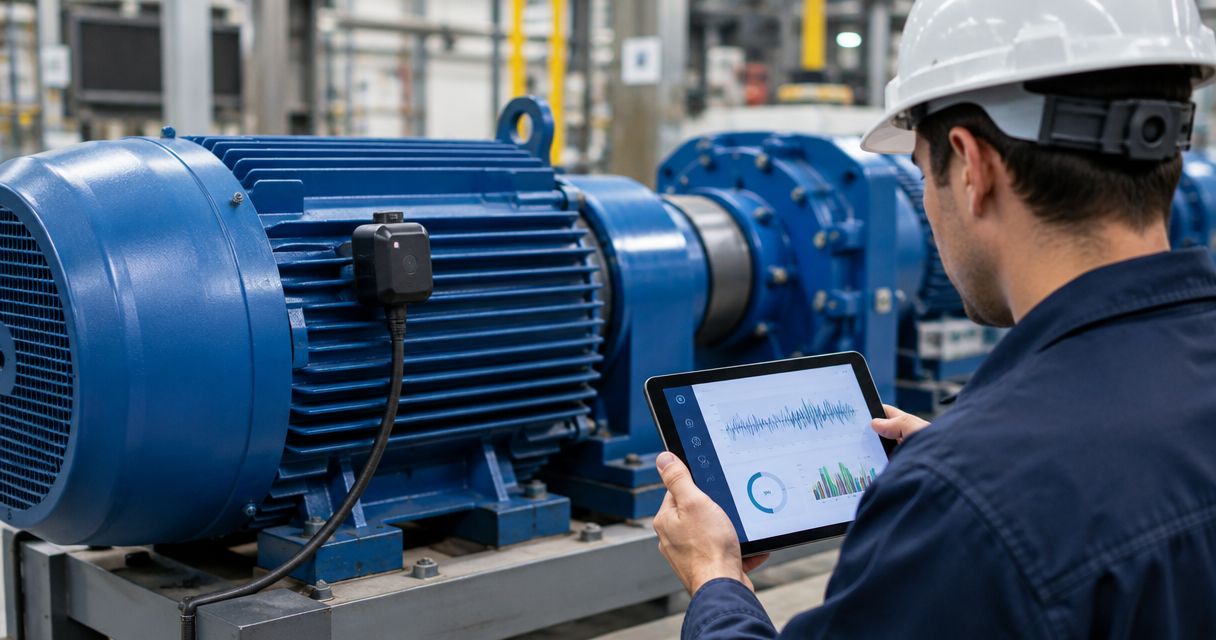
Wireless vibration-and-temperature sensors are the best starting point for routine monitoring of pumps, fans and motors; wired piezoelectric accelerometers suit deeper vibration analysis, and proximity probes suit shaft-motion measurements. The Kilo IoT Platform provides the software layer for connected-device data, dashboards, rules and alarms—not the sensing hardware or a substitute for machinery diagnostics.
- For IoT condition monitoring sensors for rotating equipment, start with the fault you need to detect—not the radio protocol.
- Wireless vibration-and-temperature sensors suit retrofit trending; wired piezoelectric accelerometers suit detailed vibration analysis.
- Proximity probes measure shaft motion; current, temperature and ultrasound provide different supporting evidence.
- Kilo connects supported device data with monitoring workflows; threshold alarms alone do not establish predictive maintenance.
Choose the measurement before the wireless protocol
A connected sensor is useful only if its measurement reveals the condition you care about. A temperature sensor can identify a rising housing temperature, but it cannot replace vibration measurements when you need to investigate mechanical vibration.
This guide ranks sensor types by application, not manufacturers by unverified specifications. The default recommendation assumes you want to retrofit routine condition monitoring onto accessible pumps, fans, motors or similar machines. Critical shaft monitoring and specialist diagnostics require a different selection process.
What makes the best rotating-equipment monitoring sensor
Use these criteria before comparing devices:
- Fault relevance: Match the measurement to the suspected problem, such as imbalance, bearing deterioration, overheating or changing load.
- Measurement detail: Distinguish an overall vibration value from a waveform, frequency spectrum or processed bearing indicator.
- Mounting quality: Choose a repeatable measurement position and attachment appropriate to the required frequency response.
- Operating context: Record speed, load and operating state so normal changes do not look like faults.
- Integration access: Confirm the actual payload, units, timestamps and data-export path—not just a shared protocol name.
- Maintenance practicality: Account for power, access, environmental exposure and the person responsible for investigating alarms.
Rotating-equipment sensors at a glance
| Rank and sensor type | Best for | Standout measurement | Key limitation |
|---|---|---|---|
| 1. Wireless vibration-and-temperature sensor | Retrofitting routine machinery trending | Vibration indicators with local temperature | Some devices export summaries rather than diagnostic waveforms |
| 2. Wired piezoelectric accelerometer | Detailed bearing and gearbox vibration analysis | Dynamic acceleration across its specified frequency range | Requires suitable acquisition hardware and installation |
| 3. Eddy-current proximity probe | Shaft-motion monitoring on suitable machines | Shaft displacement relative to the probe | Needs an engineered probe installation and suitable target |
| 4. Electrical current sensor | Motor operating-state and load context | Current draw and changes in electrical behavior | Basic current readings do not identify a mechanical fault |
| 5. Contact temperature sensor | Tracking thermal changes at selected locations | Local surface or embedded temperature | Temperature alone provides limited diagnostic specificity |
| 6. Ultrasound sensor | Targeted friction and lubrication investigation | High-frequency acoustic activity | Interpretation depends on repeatable measurement and expertise |
1. Wireless vibration-and-temperature sensors: best for retrofits
Wireless vibration-and-temperature sensors combine a vibration measurement with a local temperature reading and a communications interface. Depending on the device, you receive overall indicators, selected frequency information or access to captured waveforms. These are different levels of evidence.
For a general-purpose retrofit, this combination gives you a practical starting point without installing a signal cable to every measurement location. Specify the exported measurements before choosing the network.
Wireless vibration-and-temperature sensor pros:
- Combines mechanical and thermal observations at one location.
- Reduces signal-cable installation at the sensor location.
- Supports repeatable trending when mounting and operating conditions remain consistent.
Wireless vibration-and-temperature sensor cons:
- Summary-only payloads restrict later diagnostic analysis.
- Battery maintenance and radio coverage become part of the monitoring design.
Best for: Accessible pumps, fans and motors where the first objective is identifying changes for investigation.
Verdict: Buy for routine retrofit trending; skip summary-only devices when your required diagnosis depends on raw vibration data.
2. Wired piezoelectric accelerometers: best for vibration diagnostics
A piezoelectric accelerometer measures dynamic acceleration and sends its signal to compatible acquisition equipment. An IoT deployment therefore needs more than the sensor: signal conditioning, acquisition, processing and a route into the monitoring software must work together.
This is the stronger choice when a vibration specialist needs detailed measurements rather than a single overall value. Specify the complete measurement chain, including frequency response, filtering and mounting.
Wired piezoelectric accelerometer pros:
- Supplies a dynamic signal for waveform and frequency analysis.
- Supports measurement chains designed for bearing and gearbox investigation.
- Avoids a battery at the sensing element in conventional wired installations.
Wired piezoelectric accelerometer cons:
- Cable routing and acquisition equipment add installation work.
- Useful interpretation still requires machinery context and diagnostic expertise.
Best for: Machines where detailed vibration evidence is necessary to investigate developing problems.
Verdict: Buy when diagnostic detail justifies a dedicated acquisition system; hold if you only need basic fleet-wide trends.
3. Eddy-current proximity probes: best for shaft-motion measurements
An eddy-current proximity probe measures the distance between its tip and a conductive target. In suitable rotating machinery, paired probes and associated instrumentation provide information about shaft motion relative to the stationary probe locations.
This is not an interchangeable alternative to a wireless sensor attached to a motor housing. Probe position, target characteristics, installation clearances and the machine's monitoring requirements determine whether it belongs in the design.
Eddy-current proximity probe pros:
- Measures shaft displacement rather than housing acceleration.
- Supports shaft-motion analysis on appropriate machinery.
- Provides non-contact measurement at the probe tip.
Eddy-current proximity probe cons:
- Requires an engineered installation and compatible instrumentation.
- Target material and geometry affect measurement suitability.
Best for: Suitable journal-bearing machines and other applications with an explicit shaft-displacement requirement.
Verdict: Buy against an engineered shaft-monitoring specification; skip as a general-purpose retrofit default.
4. Electrical current sensors: best for motor operating context
Current sensors measure electrical current feeding a motor. Basic readings help distinguish stopped, running and changing-load conditions; more advanced motor-current analysis requires an acquisition and analysis system designed for that purpose.
Use current data to explain vibration changes, not to label every increase as bearing damage. A motor working harder can produce different measurements without developing a new fault.
Electrical current sensor pros:
- Adds operating-state information to mechanical measurements.
- Supports comparisons between similar load conditions.
- Offers installation options at electrical measurement points rather than bearing housings.
Electrical current sensor cons:
- Basic current trends do not isolate a mechanical failure mechanism.
- Electrical installation requires appropriate competence and safety procedures.
Best for: Adding run-state and load context to a rotating-equipment monitoring system.
Verdict: Buy as supporting context; skip as the sole bearing-health measurement.
5. Contact temperature sensors: best for thermal trending
Contact temperature sensors track temperature at the selected measurement location. An embedded bearing measurement and an external housing measurement do not represent the same physical point, even when both readings use degrees Celsius.
Temperature is useful when overheating is part of the problem you need to detect. Interpret changes alongside ambient conditions, load and the sensor's thermal contact.
Contact temperature sensor pros:
- Produces an easily understood thermal trend.
- Adds evidence alongside vibration or current readings.
- Supports targeted monitoring of known thermal concerns.
Contact temperature sensor cons:
- A surface reading does not directly measure an inaccessible internal bearing temperature.
- A rising value does not identify its cause without further investigation.
Best for: Tracking thermal changes at documented, repeatable measurement locations.
Verdict: Buy for thermal evidence; skip as a replacement for mechanical-condition measurements.
6. Ultrasound sensors: best for targeted lubrication investigation
Ultrasound instruments detect high-frequency acoustic activity. Contact measurements can support investigation of friction and lubrication conditions when the instrument, measurement point and interpretation method suit the machine.
Distinguish a handheld inspection instrument from a permanently installed connected sensor. Both can support a maintenance program, but only a documented integration supplies automated data to your IoT workflow.
Ultrasound sensor pros:
- Adds acoustic evidence to vibration and temperature observations.
- Supports focused lubrication and friction investigations.
- Can form part of a repeatable inspection procedure.
Ultrasound sensor cons:
- Measurement consistency and interpretation require training.
- A handheld instrument is not automatically an unattended IoT endpoint.
Best for: Maintenance programs with a defined ultrasound inspection or monitoring method.
Verdict: Buy for a specific acoustic investigation; hold if nobody owns the interpretation process.
Sampling rate and reporting interval answer different questions
Sampling rate describes how frequently the measurement system captures the underlying signal. Reporting interval describes how often it sends a result. A sensor can sample vibration locally at a high rate while transmitting only an occasional summary.
Speed provides useful context. 1,800 rpm corresponds to 30 Hz, while 3,600 rpm corresponds to 60 Hz: divide revolutions per minute by 60 seconds per minute. These are mathematical examples, not recommended machine settings or alarm thresholds.
The rotational frequency does not define the entire required measurement bandwidth. Bearing and gear-related analysis can require information beyond the shaft's rotational frequency, and the acquisition system needs appropriate filtering and sampling.
Ask the supplier exactly what reaches your application: acceleration, velocity, displacement, a spectrum, a waveform or a proprietary indicator. Values expressed in g, mm/s and µm are not interchangeable. Record the measurement method and frequency band alongside the units.
Turn sensor readings into a maintenance decision
The useful workflow connects a credible measurement to an accountable response. Kilo is a fit for teams connecting supported condition-monitoring data with dashboards, rules and alarms; the measurement and diagnostic method still need to suit the machine.
Use this sequence to design the deployment:
- Measurement: Identify the sensor location, mounting method and exported values.
- Context: Associate readings with the correct asset, speed, load and operating state.
- Alarm: Define what change warrants attention and who receives it.
- Inspection: Have the responsible person investigate using the available evidence.
- Verification: Compare subsequent measurements under comparable operating conditions.
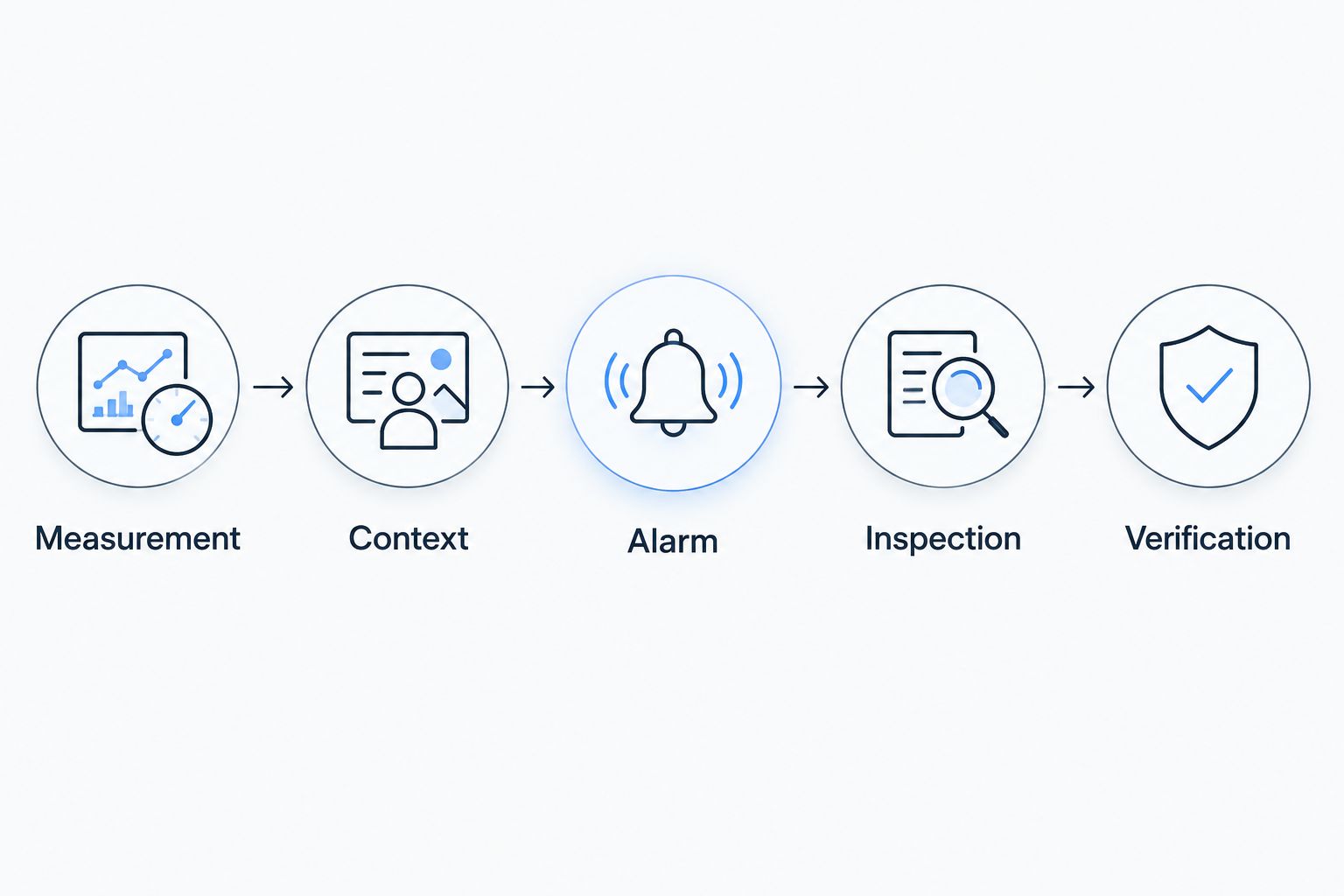
Illustrative workflow: A pump's vibration trend rises during its normal running state. The configured alarm directs a maintenance technician to inspect the mounting, coupling and bearing condition; after any intervention, the technician compares measurements at a comparable speed and load. This is a proposed workflow, not a reported customer result.
Kilo's dashboards, rules and alarms can support the monitoring process using supported device data. That does not establish automatic fault diagnosis, machine-learning failure prediction or work-order integration. Keep those requirements separate when specifying the solution.
For hardware sourcing, Kilo Electronics is a separate online authorised dealer serving individual and business buyers. Hardware selection remains separate from platform software, and a shared radio protocol does not prove that every measurement or device function is supported.
How these sensor types are ranked
The ranking prioritizes fault relevance, measurement detail, mounting, operating context, integration access and maintenance practicality. Wireless vibration-and-temperature sensing leads for the stated retrofit use case—not because it replaces specialist instruments.
An engineered shaft-monitoring requirement moves proximity probes to the front. A detailed bearing investigation favors an appropriate accelerometer and acquisition chain. Choose the required evidence first, then choose the device that can deliver it.
Which condition-monitoring sensor should you choose?
Start with wireless vibration-and-temperature sensing if you need routine trends across accessible pumps, fans and motors. Require clear measurement definitions and a usable export path before committing.
Choose wired piezoelectric accelerometers when detailed vibration analysis is the objective. Use proximity probes for a specified shaft-motion requirement, and add current, temperature or ultrasound when each answers a distinct maintenance question. You don't need every sensor type on every asset.
FAQ
What's the best sensor for monitoring a rotating machine?
A vibration sensor is the starting point when the objective is monitoring mechanical vibration. Wireless vibration-and-temperature sensors suit routine retrofit trending, while detailed diagnostics require an appropriate sensor and acquisition system.
Is a three-axis vibration sensor always better than a single-axis sensor?
No. Additional axes provide measurements in more directions, but mounting, frequency response and the diagnostic objective still determine usefulness. Select the measurement directions your analysis requires.
Can I compare vibration readings from different sensor brands?
Only when the measurement definitions are comparable. Check units, frequency bands, processing methods, mounting positions and operating conditions before treating readings as equivalent.
Can a wireless vibration sensor replace a machine protection system?
Do not assume a condition-monitoring sensor can replace a machine protection system. Protection requires an engineered assessment of response, reliability and the applicable machinery requirements.
Does an overall vibration alarm identify a failing bearing?
No. An overall vibration alarm identifies a change or threshold crossing, not a confirmed bearing diagnosis. Investigation needs suitable measurements and machine context.
Should I use the same alarm threshold on every motor?
Not without establishing that the machines and measurement methods are comparable. Machine design, mounting, operating speed, load and the applicable evaluation guidance affect threshold selection.
What should happen when a condition-monitoring sensor stops reporting?
Treat missing data as a monitoring issue, not evidence that the machine is healthy. Define a separate response for stale measurements and investigate the sensor, power and communications path.
Keep a record of the sensor mounting
Photograph the measurement location and record the attachment method before establishing a baseline. Moving a sensor or changing its mounting can change the measured response, so a step in the trend does not automatically mean the machine deteriorated.
That record gives the next technician something concrete to check before escalating an alarm.
Related guides
Written by Tim Kravchunovsky