
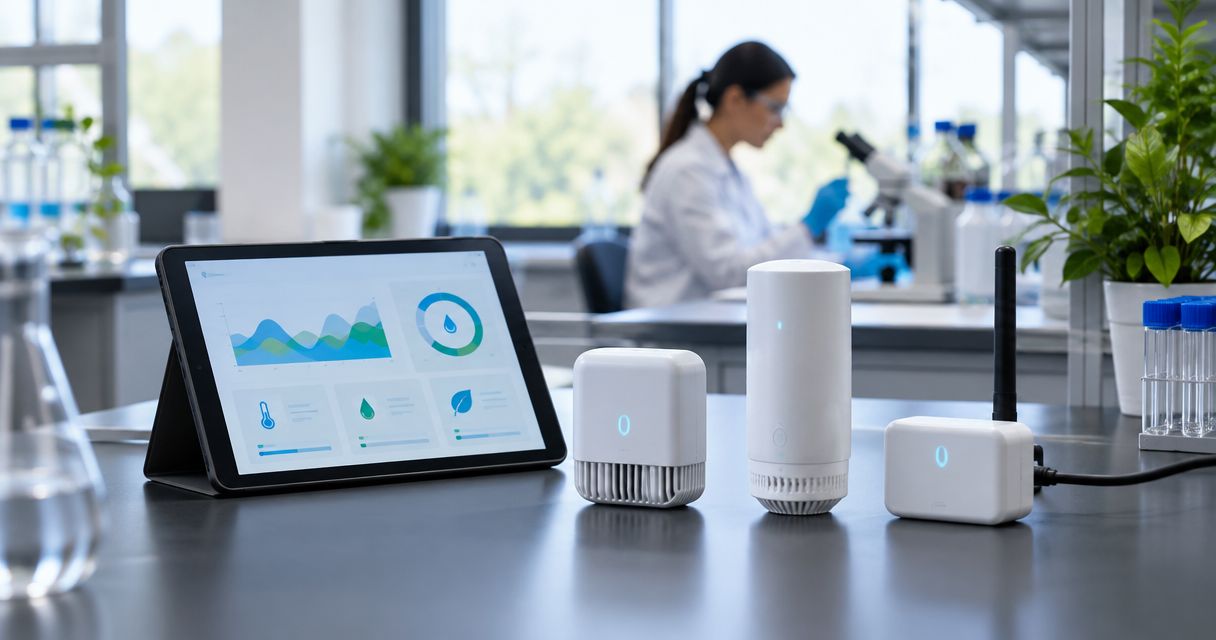
Best starting point: temperature-and-humidity sensors for general laboratory rooms; best for cold storage: an external temperature probe; best for pressure-controlled spaces: a differential-pressure sensor. The Kilo IoT Platform brings compatible device data, dashboards and alarms into an IoT platform so you can connect those measurements to a response workflow rather than just collect readings.
- Choose IoT environmental monitoring sensors for laboratories by measurement purpose, calibration requirements and installation conditions—not radio protocol alone.
- Temperature-and-humidity sensors suit room monitoring; external probes suit refrigerators, freezers and other temperature-controlled equipment.
- Differential-pressure sensors measure pressure relationships; CO₂ monitors and particle counters answer different air-quality questions.
- Kilo connects compatible laboratory sensor data with dashboards and alarms; hardware selection still requires device-level verification.
What makes a laboratory environmental sensor useful?
The right sensor measures the condition that changes your decision. A room monitor cannot establish a freezer's internal temperature, and a general air-quality monitor cannot establish that a controlled laboratory meets its environmental requirements.
This guide ranks sensor types by laboratory use case, not manufacturers by unverified specifications. Start with the measurement you need, then compare individual devices against these criteria:
- Measurement fit: The measured variable, operating range and probe arrangement match the room, equipment or process.
- Calibration evidence: You can obtain suitable calibration documentation and maintain it through the sensor's service life.
- Installation suitability: Placement, enclosure, cleaning exposure and cable routing suit the actual laboratory environment.
- Data continuity: You understand sampling, transmission, timestamps and what happens during a connection failure.
- Integration fit: The device's payload, units and connection method work with your chosen platform.
- Response ownership: Every actionable condition has a named responder and a defined follow-up procedure.
Don't treat accuracy as a single headline specification. Read the conditions attached to it, including the range over which it applies and whether it describes the sensing element or the complete measurement assembly.
Laboratory environmental sensors at a glance
The table separates measurement jobs that are often bundled under environmental monitoring. Its order follows a general laboratory selection sequence, not a claim that every laboratory needs every device.
| Sensor type | Best for | Standout capability | Key limitation |
|---|---|---|---|
| Temperature-and-humidity sensor | General laboratory rooms | Measures ambient temperature and relative humidity together | Does not represent conditions inside separate equipment |
| External temperature probe | Refrigerators, freezers and incubators | Places the sensing point inside the monitored space | Probe suitability and installation determine measurement usefulness |
| Differential-pressure sensor | Pressure-controlled rooms | Measures pressure difference across a boundary | Does not directly establish containment or airflow performance |
| NDIR CO₂ sensor | Occupied-room ventilation trends | Measures carbon dioxide concentration | Is not a general chemical-exposure detector |
| Optical particle counter | Airborne-particle monitoring | Measures particles in defined size channels | Does not identify microorganisms or establish sterility |
| Water-leak sensor | Localized water-release detection | Detects liquid at a selected point or along a sensing cable | Only detects liquid that reaches its sensing area |
1. Temperature-and-humidity sensors: best for laboratory rooms
A combined temperature-and-humidity sensor is the practical starting point when you need to understand ambient conditions around benches, instruments or stored materials. It measures air temperature and relative humidity at its installation point, giving you a shared view of changes across a room.
Placement matters. A sensor beside a supply-air outlet, sunny window or heat-producing instrument describes that local exposure, not necessarily the conditions affecting your work.
Temperature-and-humidity sensor pros:
- Combines complementary ambient measurements in one device.
- Supports comparisons between laboratory zones.
- Provides context for investigating room-condition changes.
Temperature-and-humidity sensor cons:
- A single location does not describe every part of a room.
- The enclosure and sensing element need appropriate protection from contamination and cleaning exposure.
Best for: General laboratory rooms where ambient conditions affect storage, equipment use or working procedures.
Before choosing a model, define where the reading will influence a decision. If different benches have different environmental exposures, compare those locations before deciding how many permanent sensors you need.
Verdict: Buy for room-level visibility; skip as a substitute for equipment-specific probes.
2. External temperature probes: best for laboratory cold storage
An external probe separates the sensing point from the transmitter. That arrangement lets you measure inside a refrigerator, freezer or incubator while locating the electronics where their operating conditions and radio connection are suitable.
Choose the probe and its installation together. A sensor's advertised temperature range does not prove that its cable, connector, transmitter and complete assembly suit the same environment.
External temperature probe pros:
- Places the measurement point inside the equipment being monitored.
- Separates probe location from transmitter placement.
- Supports equipment-specific monitoring rather than relying on room temperature.
External temperature probe cons:
- Cable routing requires attention to seals and approved access points.
- Air measurements and buffered measurements respond differently to changing conditions.
Best for: Temperature-controlled equipment whose internal conditions matter independently of the surrounding room.
Decide whether you need rapid visibility of air changes or a measurement arrangement intended to represent a slower thermal response. Base that choice on your materials, equipment and approved procedure—not a generic recommendation to buffer every probe.
Verdict: Buy for equipment-specific temperature monitoring; hold until the complete probe assembly and placement are suitable.
3. Differential-pressure sensors: best for pressure-controlled rooms
A differential-pressure sensor measures the pressure difference between two locations. In a laboratory, that usually means a defined relationship between a room and an adjacent reference space.
The reference location is part of the measurement. Reversing connections, obstructing tubing or changing the reference space changes how you should interpret the result.
Differential-pressure sensor pros:
- Measures the pressure relationship directly.
- Makes changes across a room boundary visible over time.
- Supports investigation alongside door events and ventilation-system information.
Differential-pressure sensor cons:
- Tubing, ports and installation affect measurement quality.
- A pressure reading alone does not prove containment or correct airflow throughout the space.
Best for: Laboratories with an established pressure-control requirement and a defined reference location.
Have the responsible facilities or ventilation specialist establish the intended relationship and response procedure. Don't copy another laboratory's pressure limits: different room purposes and ventilation designs require different decisions.
Verdict: Buy when pressure relationships are part of the laboratory design; skip for ordinary ambient monitoring.
4. NDIR CO₂ sensors: best for occupied-room ventilation trends
A nondispersive infrared, or NDIR, CO₂ sensor uses infrared absorption to measure carbon dioxide concentration. It is useful when you want to examine how occupied-room conditions change alongside ventilation and activity.
Keep the measurement purpose clear. A room-ventilation sensor is not automatically appropriate for an incubator's internal atmosphere or for a safety application involving a potential gas release.
NDIR CO₂ sensor pros:
- Measures CO₂ rather than estimating it from unrelated gas responses.
- Adds context to occupied-room ventilation investigations.
- Supports trend comparisons when placement and operating conditions remain consistent.
NDIR CO₂ sensor cons:
- Does not measure solvent vapors or other laboratory contaminants.
- Automatic baseline correction requires operating conditions compatible with the manufacturer's assumptions.
Best for: General occupied laboratory areas where CO₂ trends inform ventilation assessment.
Distinguish a ventilation-monitoring project from an exposure-protection project before procurement. Safety applications need an assessment of the specific hazard and suitable protective systems; a general connected room monitor is not an interchangeable replacement.
Verdict: Buy for a defined CO₂ monitoring purpose; skip as a universal laboratory air-quality detector.
5. Optical particle counters: best for airborne-particle monitoring
An optical particle counter detects particles through their interaction with light and reports results in defined size channels. It answers a different question from temperature, humidity or CO₂ monitoring: what particles are present in the sampled air?
Select the sampling arrangement as carefully as the instrument. Sampling location, airflow and the measurement procedure affect the meaning of the resulting data.
Optical particle counter pros:
- Provides size-specific airborne-particle information.
- Supports comparisons under a consistent sampling procedure.
- Makes particle trends visible alongside other environmental observations.
Optical particle counter cons:
- Does not distinguish viable microorganisms from nonviable particles.
- A general-purpose dust monitor is not interchangeable with every cleanroom particle-counting instrument.
Best for: Laboratories with a defined airborne-particle monitoring requirement and an appropriate sampling method.
If your procedure references ISO 14644-1, select equipment and sampling methods against the applicable requirements. A connected counter does not independently classify a room, establish sterility or replace microbiological monitoring.
Verdict: Buy for a specified particle-measurement program; hold if the sampling method is still undefined.
6. Water-leak sensors: best for localized water-release detection
A water-leak sensor detects liquid where its sensing element is installed. Point sensors suit specific collection points; sensing cables cover a route where compatible liquid can contact the cable.
Start with the likely liquid path. A sensor beside a machine adds little protection if escaping water flows behind it toward an unmonitored drain or floor penetration.
Water-leak sensor pros:
- Targets a clear event at a defined location.
- Supports monitoring beneath equipment and near water connections.
- Complements environmental measurements without trying to replace them.
Water-leak sensor cons:
- Does not detect liquid that misses the sensing area.
- Water detection does not establish compatibility with solvents or other laboratory chemicals.
Best for: Localized water-release monitoring around equipment, plumbing connections and vulnerable floor areas.
Inspect the route water would actually take, including slopes and obstructions. Choose a point sensor or cable arrangement accordingly, and make cleaning procedures part of the alarm design.
Verdict: Buy where water has a credible path to sensitive equipment; skip claims of universal chemical-spill detection.
How to connect laboratory measurements to a useful response
A connected sensor becomes useful when its reading leads to a clear decision. Kilo provides device management, dashboards, rules and alarms for compatible deployments; the integration still needs correct payload mapping, units and device identification.
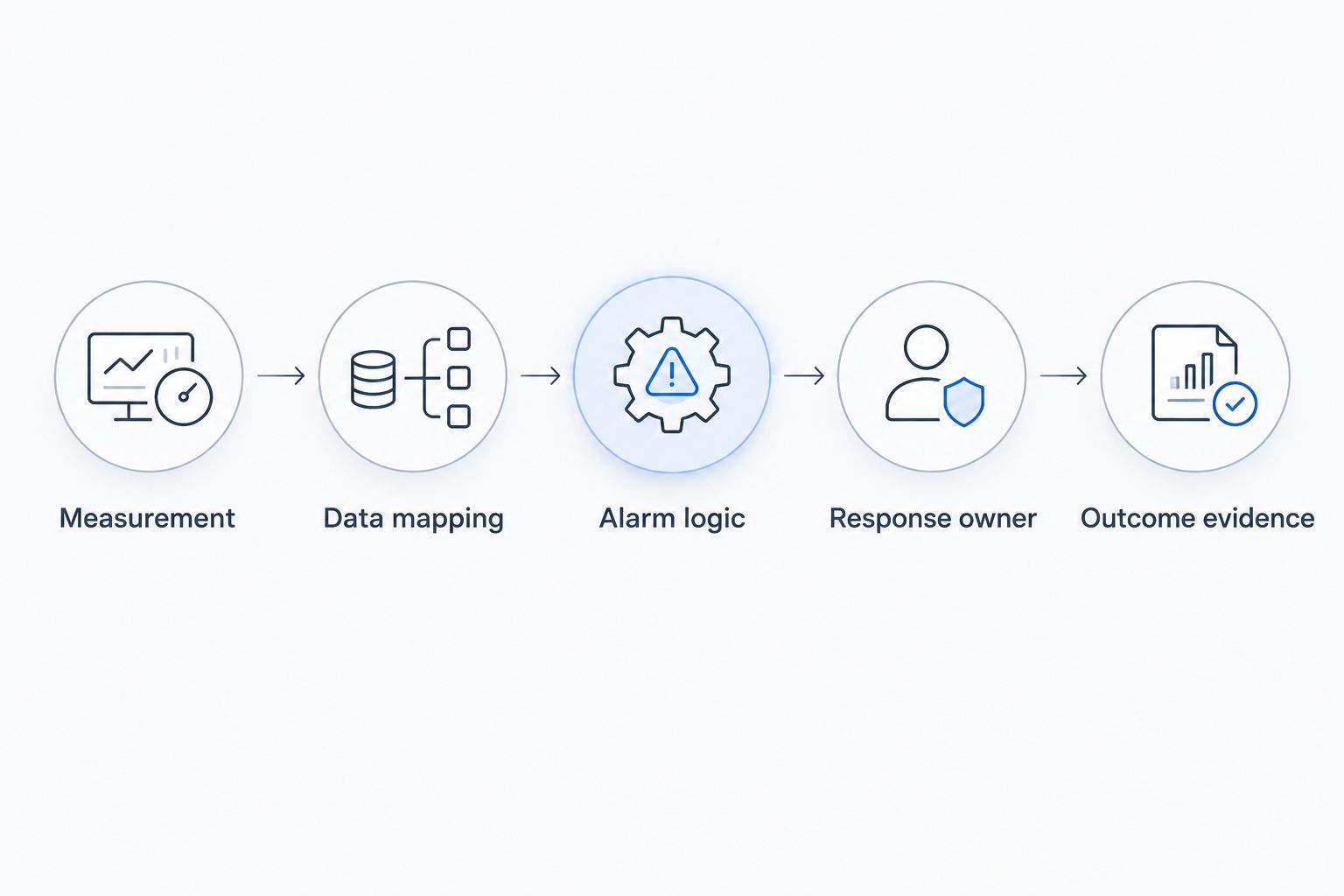
Use this sequence to define the workflow before expanding the installation:
- Measurement: Identify the physical variable, sensing location and calibration record.
- Data mapping: Confirm device identity, timestamps, units and the meaning of missing readings.
- Alarm logic: Define the condition that needs attention and distinguish it from communication failure.
- Response owner: Assign the person responsible for checking the situation and following the laboratory procedure.
- Outcome evidence: Record the relevant subsequent measurement or inspection result.
Illustrative scenario: A refrigerator probe reports a condition outside the laboratory's approved operating limits. The configured workflow raises an alarm, the designated responder checks the equipment and materials, and subsequent readings show whether conditions recovered.
That example describes a monitoring design, not a customer deployment. An alarm does not establish whether stored material remains usable; the responsible person applies the relevant procedure and evidence.
For hardware sourcing, Kilo Electronics is a separate online authorised dealer serving individual and business buyers. Hardware procurement is distinct from the platform, and any proposed device still needs measurement and integration checks.
How these sensor recommendations were ranked
The ranking follows measurement fit, calibration evidence, installation suitability, data continuity, integration and response ownership. Temperature-and-humidity sensors come first because they address general room conditions; specialist instruments follow the distinct questions they answer.
This is not a manufacturer performance ranking or a claim of comparative testing. Each recommendation identifies a measurement job, its advantages and the limitation most likely to change your buying decision.
Which laboratory monitoring sensors should you choose?
Start with the condition that would trigger action. Choose room temperature and humidity for ambient visibility, an external probe for cold-storage equipment, and differential pressure only where the room has an established pressure requirement.
Add CO₂, particle counting or water-leak detection when each addresses a separate documented need. More channels don't repair poor placement, missing calibration evidence or an alarm that nobody owns.
Kilo suits laboratory builders and integrators who need compatible sensor data, dashboards and alarms in one IoT platform. It is the software layer, not a replacement for selecting the right instrument or establishing laboratory procedures.
FAQ
What's the best starting sensor for a laboratory room?
A temperature-and-humidity sensor is the starting choice for general ambient monitoring. Use equipment-specific probes when the condition inside a refrigerator, freezer or incubator matters independently of room conditions.
Can one environmental sensor monitor an entire laboratory?
One sensor measures conditions at its own location, not everywhere in a laboratory. Assess spatial differences before deciding where permanent monitoring points belong.
Do laboratory IoT sensors need Wi-Fi?
Laboratory IoT sensors do not necessarily need Wi-Fi. Devices use different connection methods, and the complete device-to-platform path must support the selected hardware and payload.
Does a CO₂ sensor detect chemical fumes?
A CO₂ sensor does not measure chemical fumes generally. Select instrumentation for the specific substance and purpose, and distinguish routine monitoring from exposure-protection systems.
Can an optical particle counter detect bacteria?
An optical particle counter does not identify bacteria or determine particle viability. Microbiological monitoring requires an appropriate separate method.
Does connecting a sensor make laboratory records compliant?
Connecting a sensor does not by itself establish compliant records. Calibration, procedures, access controls, record handling and applicable requirements need separate assessment.
Should a laboratory buy sensors before choosing its platform?
Define measurement requirements before committing to either sensors or a platform. Then verify the complete integration, including device support, payload interpretation and the response workflow.
Test missing data before you expand the installation
A flat trend can mean stable conditions—or a reading that stopped updating. Before accepting the installation, deliberately test a communication interruption and confirm that responders can distinguish stale data from normal conditions.
Use the sensor calibration guide when planning measurement maintenance. Keep that maintenance plan alongside the installation record, so a working connection never becomes a substitute for a trustworthy measurement.
Written by Tim Kravchunovsky


