
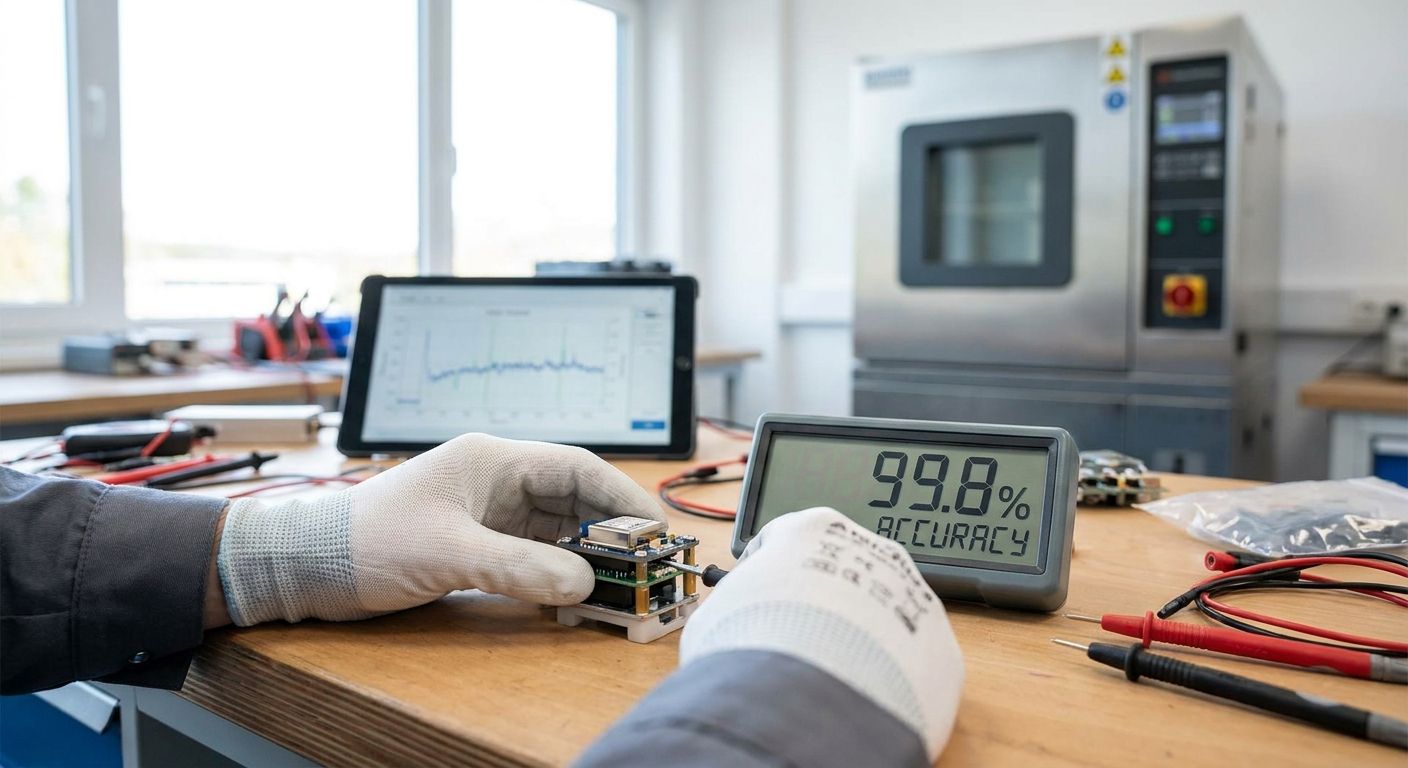
Calibrating an IoT sensor means comparing its live reading against a known reference under controlled conditions, then applying an offset or two-point correction so the sensor matches that reference within a stated tolerance. For temperature and humidity sensors monitoring cold storage, buildings, or industrial equipment, the reference has to be a device with its own current, traceable calibration certificate — not another field sensor. A sensor that's drifted doesn't announce itself: it can read 4°C in a room that's actually 8°C, and nothing on a dashboard looks wrong until product spoils or an auditor asks for the calibration record.
- Calibrate IoT sensors against a NIST-traceable reference, then apply an offset or two-point correction to close the gap.
- One-point calibration fixes a flat offset; two-point calibration corrects offset and span across the full range.
- IEC 60751 sets RTD accuracy classes and ASTM E230 sets thermocouple tolerance classes — check the sensor's class before trusting a reading.
- A CEL rule can flag a sensor that drifts outside its calibration tolerance and escalate the alarm automatically.
- Log every calibration date, offset, and technician — auditors and cold-chain guidance both expect a certificate trail.
Why does sensor calibration matter for IoT monitoring?
The Kilo IoT Platform can display a sensor reading in real time, but it can't tell you whether that reading is true — only calibration against a reference does that. A sensor's raw output is a voltage or resistance run through a formula set at the factory. Ship it into a cold room, a rooftop unit, or a chiller for a year, and the formula stops matching reality: condensation reaches the housing, the sensing element ages, and the reading slides off true. By 2026, most facilities running IoT sensors at scale have found this the hard way — a freezer sensor reporting -18°C while a handheld reference thermometer reads -14°C, months after the last check.
Get the calibration wrong and the cost isn't abstract. A cold-chain audit that finds an out-of-tolerance sensor can invalidate weeks of temperature logs, and a building's energy monitoring numbers become useless if half the humidity sensors are reading 8 percentage points off. For building automation sensors specifically, ASHRAE Guideline 0-2019 folds calibration verification into the commissioning process, treating it as part of functional performance testing rather than a one-off task. Kilo's digital twin per device keeps the calibration record next to the live reading, so a facilities manager or calibration technician isn't digging through a spreadsheet to find the last certificate date.
How do you calibrate IoT sensors for accurate readings?
Calibrating a field sensor follows the same seven steps whether it's a wired RTD on a chiller or a battery-powered LoRaWAN node on a warehouse rack:
- Pull the accuracy class from the datasheet. RTDs are usually classed under IEC 60751 — Class A tolerance is ±(0.15 + 0.002|t|)°C, Class B roughly double that. Thermocouples follow ASTM E230/ANSI MC96.1 tolerance classes instead.
- Get a reference instrument with a current certificate. The reference needs its own traceable calibration, ideally back to NIST or an equivalent national metrology institute. A second field sensor doesn't count as a reference.
- Stabilize both instruments together. An ice bath at 0°C, a calibrated dry-block, or a walk-in chamber held at a known setpoint works. Give both instruments the soak time the datasheet specifies before recording anything.
- Record the offset. Subtract the sensor's reading from the reference reading at that single point.
- Repeat at a second point for span correction. A single offset only fixes a flat error; a second point near the top of the sensor's working range catches slope error too.
- Apply the correction and log it. Whether the correction happens in firmware, in a signal conditioner, or in the platform's data pipeline, record the date, the offset, the technician, and the reference certificate number.
- Set a rule that watches for future drift. A CEL rule can compare the corrected sensor against a fixed setpoint or a co-located reference sensor and alarm when the gap grows again.
If you don't own a reference-grade thermometer or hygrometer, Kilo Electronics ships pre-calibrated reference sensors and hardware worldwide, which covers step two without sending a unit out to a lab.
One-point calibration vs two-point calibration: which one do you need?
| Method | What it corrects | Best for | Verdict |
|---|---|---|---|
| One-point (offset) | A constant offset across the sensor's range | Quick field checks on sensors with flat drift | Use for routine spot-checks |
| Two-point (offset + span) | Offset at one end plus slope error across the range | Cold-chain, cleanroom, and other compliance-grade deployments | Use for anything an auditor will read |
| Multi-point (3+) | Non-linear drift across a wide range | Lab-grade reference instruments | Skip for most field IoT sensors |
A one-point calibration is faster and cheaper to run, but it assumes the sensor drifts the same amount at every temperature or humidity level, which isn't always true. Two-point calibration is the one to budget time for if the sensor feeds a report someone outside the building will read — a health inspector, an insurance auditor, or a pharmaceutical cold-chain log.
What causes IoT sensor drift over time?
Drift isn't a defect — it's a predictable property of every sensing element, and a few conditions make it worse:
- Thermal cycling and condensation inside the sensor housing, especially on units that move between a chilled space and ambient air repeatedly.
- Chemical or dust exposure that coats the sensing element, which affects capacitive humidity and gas sensors more than RTDs.
- Mechanical shock during shipping or mounting, which can shift a MEMS element just enough to change its baseline.
- Battery voltage sag in cold temperatures, which skews the reference voltage an analog sensor uses to convert its raw signal.
- Firmware or measurement-formula updates pushed after installation, which can change the reported value without changing the physical sensor at all.
- Normal aging of the sensing element — this is why most manufacturer datasheets publish a long-term drift figure in the first place, rather than claiming the sensor holds forever.
None of these mean the sensor is broken. They mean the correction from the last calibration has a shelf life, and that shelf life is shorter in a freezer or a boiler room than it is on a desk.
Which IoT sensors need the tightest calibration tolerance?
Not every deployment needs two-point calibration on a strict schedule. Cold storage and vaccine or biorepository monitoring sit at the tight end, because a few degrees of drift can mean an unusable batch and a mandatory excursion report. Cleanroom pressure differential sensors and lab environments sit close behind, since a small calibration error can mask an actual compliance failure. HVAC and building automation sensors feeding an energy audit tolerate more slack day-to-day, but a drifted temperature sensor there still skews the numbers a facilities manager uses to justify equipment spend. Tank and water-level sensors calibrated for a fixed range tend to drift the least, since they're rarely subjected to the same thermal cycling as a walk-in cooler.
How often should you recalibrate IoT temperature sensors?
Recalibrate on the interval set by the manufacturer or the reference certificate — many ISO/IEC 17025-accredited labs default to a 12-month certificate, and cold-chain guidance follows the same rhythm. The CDC's Vaccine Storage and Handling Toolkit calls for calibrated thermometers with a valid, current certificate and periodic verification against a traceable reference, which is the model most compliance-driven facilities copy for 2026 deployments even outside pharmaceutical storage. Sensors in harsher environments — outdoor enclosures, boiler rooms, anything with heavy vibration — often need a shorter interval than the certificate's default.
Do LoRaWAN and mioty sensors need calibration after installation?
Yes — factory calibration on a LoRaWAN or mioty temperature and humidity sensor is a starting point, not a permanent state, once the unit is deployed for months at a time. Most of these sensors apply the offset or two-point correction in firmware or in the platform's data pipeline, so there's no need to physically pull the unit off the wall to recalibrate it. The correction gets logged against the device record, which is what keeps a multi-site deployment's temperature and humidity sensors for warehouse monitoring audit-ready instead of just internally consistent.
Can a rules engine catch a sensor that's drifted out of calibration?
A CEL-based rule can flag drift indirectly by comparing a sensor's reading against a fixed setpoint, a co-located reference sensor, or another sensor in the same zone, then firing an alarm when the gap crosses a threshold you define. That's different from the platform diagnosing calibration itself — it's a rule doing exactly what a technician would do with a handheld thermometer, just continuously. On Kilo, that rule can escalate through email, SMS, or push across five severity tiers, and the built-in AI assistant can build the rule from a plain-language request instead of requiring someone to write the CEL expression by hand.
A sensor that's drifted 2 degrees off its reference doesn't trip an alarm by itself — a rule built to compare it against something else does.
“A sensor that's drifted 2 degrees off its reference doesn't trip an alarm by itself — a rule built to compare it against something else does.”
Set up drift alerts on your sensors
Build a threshold rule that flags calibration drift before it reaches a report.
FAQ
What does it mean to calibrate an IoT sensor?
Calibrating an IoT sensor means comparing its reading against a known reference and correcting any offset or slope so the two agree within a stated tolerance. The reference itself needs a current, traceable calibration certificate, or the correction has no real anchor.
Is factory calibration enough for long-term IoT deployments?
Factory calibration is a starting point, not a guarantee for the life of the deployment. Most manufacturer datasheets specify a long-term drift figure, which is why cold-chain and compliance-grade deployments recalibrate on a set interval instead of trusting the factory reading indefinitely.
What's the difference between accuracy and calibration?
Accuracy is how close a sensor's reading is to the true value, expressed as a class or tolerance, such as IEC 60751's +/-(0.15 + 0.002|t|) degrees C for Class A RTDs. Calibration is the process of checking and correcting a sensor against a reference to keep it inside that accuracy class over time.
Can a LoRaWAN sensor be calibrated after it's already deployed?
Yes, most LoRaWAN and mioty temperature and humidity sensors apply the offset or two-point correction in firmware or in the platform's data pipeline, so there's no need to pull the sensor to recalibrate it. The correction is logged against the device record so the history stays auditable.
How does Kilo detect a sensor that's drifted?
A CEL rule on the Kilo IoT Platform compares a sensor's reading against a fixed setpoint or a co-located reference sensor and fires an alarm when the gap exceeds the tolerance band you set. The alarm escalates through email, SMS, or push per the severity tier assigned to that rule.
Do humidity sensors drift faster than temperature sensors?
Capacitive humidity sensors are generally more prone to drift than resistance temperature detectors, because the sensing polymer absorbs contaminants and moisture cycles over time. That's why many manufacturer datasheets list a separate long-term drift spec for RH sensors, distinct from the temperature channel on the same device.
What's a NIST-traceable reference and why does it matter?
A NIST-traceable reference is an instrument whose calibration can be traced through an unbroken chain of comparisons back to the National Institute of Standards and Technology. Without that chain, a field calibration only tells you two sensors agree with each other, not that either one is correct.
Should you recalibrate a sensor after a firmware update?
Check the calibration after any firmware or measurement-formula update, since a formula change can shift the reported value without changing the physical sensor at all. A quick one-point check against a reference confirms the update didn't introduce a new offset.
What calibration check do most facilities skip?
Most teams calibrate the sensor and forget to calibrate the alarm threshold sitting on top of it. If a freezer sensor was drifting 1.5°C high and gets corrected, but the alarm rule still fires at the old uncorrected number, the alarm goes quiet or fires constantly — neither is safe. Whenever a sensor gets recalibrated, check the rule that watches it and confirm the threshold still matches the corrected reading, not the old one. That five-minute check, repeated every time a calibration record updates in 2026, closes a gap that a lot of otherwise well-run cold-chain and building programs leave open.