
Yes—an IoT platform can test a rule before deployment, but testing the logic and preventing real actions are separate decisions. In the Kilo IoT Platform, supported side-effect nodes offer Execute, Skip and Mock behavior; Execute is selected initially and performs the real operation, so you must deliberately choose Skip or Mock when you don't want that operation to run.
- To simulate IoT rule before deployment in Kilo, deliberately choose Skip or Mock for supported side-effect nodes.
- Execute performs real operations; opening a debugger does not create an isolated sandbox.
- Mocked results test downstream logic, not device delivery or physical outcomes.
- Restoring a rule creates a draft that needs a separate build and deployment.
Can an iot platform simulate a rule before it goes live?
Yes. A pre-deployment test lets you examine how a rule handles inputs and decisions before releasing that rule into normal operation. The important question is what happens when the test reaches an action: evaluating a condition is different from sending a notification or issuing a device command.
Kilo suits integrators who need to test IoT rule logic while explicitly controlling supported side effects. Its debugger is not automatically an isolated sandbox. For supported side-effect nodes, the selected behavior determines whether the operation executes, is skipped or uses a mock.
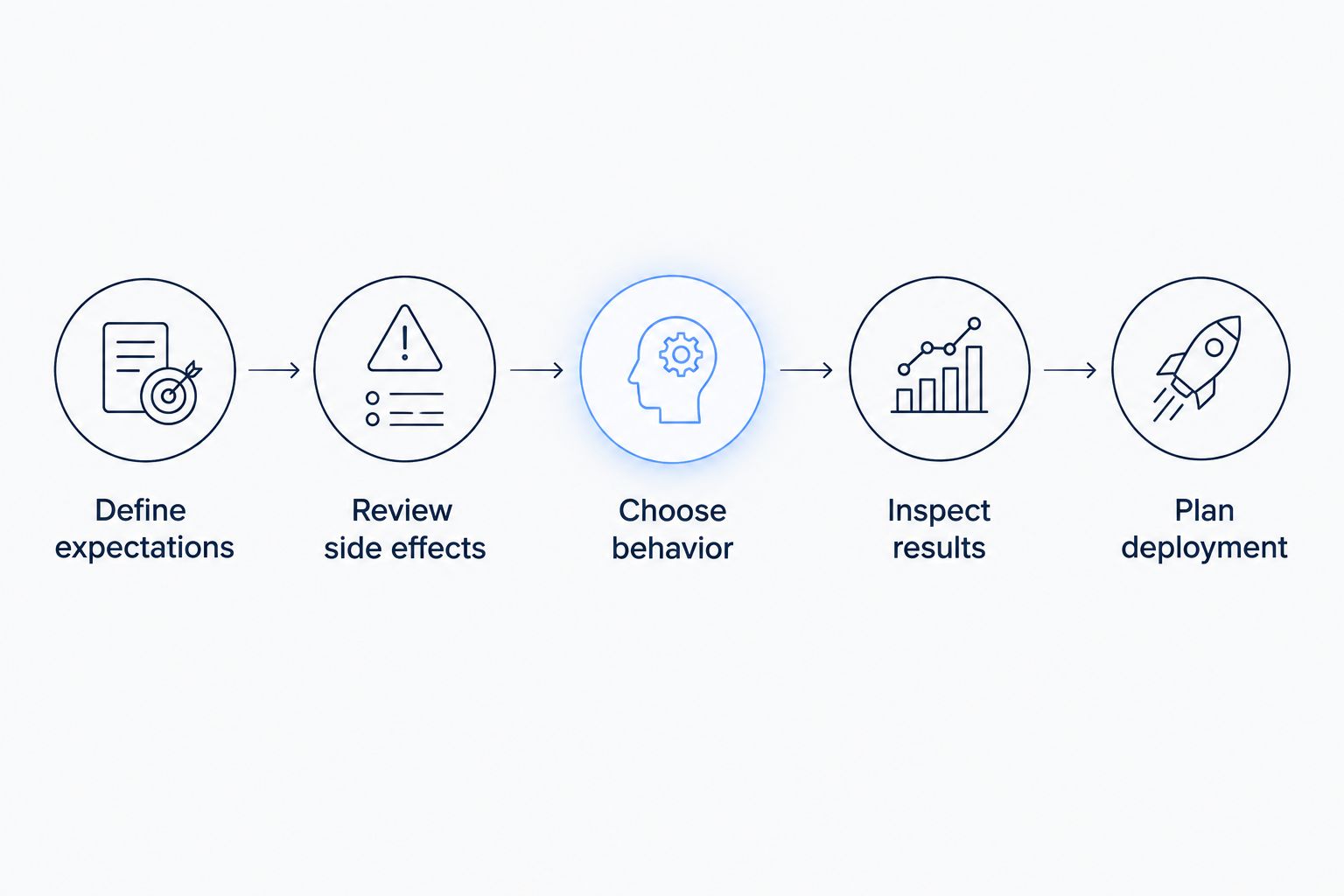
Use this sequence before running a test:
- Define expectations. Write down the input, the expected decision and the action that must not happen.
- Review side effects. Identify operations that can change equipment, contact people or affect an external system.
- Choose behavior. Deliberately select Skip or Mock for supported side-effect nodes you don't want to execute.
- Inspect results. Compare the observed path and values with your expectations, including cases that should do nothing.
- Plan deployment. Treat releasing the tested rule and checking its physical outcome as separate tasks.
This sequence gives you a useful test boundary. It does not establish that every integration is isolated or that every node supports the same testing behavior.
Execute, Skip and Mock test different things
Choose a mode according to the question you're trying to answer. A successful test is useful only when you know which operations were real and which were substituted. The following distinctions apply to supported side-effect nodes, not automatically to every part of a deployment.
| Behavior | Best for | What happens | Main limitation |
|---|---|---|---|
| Execute | A deliberately controlled integration test | The node performs the real operation | Testing can affect real systems or equipment |
| Skip | Checking logic without performing that operation | The supported operation is skipped | The omitted operation remains untested |
| Mock | Testing downstream handling of an assumed response | A mock substitutes for the operation's result | The assumed response does not prove real integration behavior |
Execute: test a real operation deliberately
Execute is appropriate when your goal is to exercise the actual integration and you've prepared the receiving system or equipment. Arrange supervision and a recovery procedure where the action requires them. Don't use Execute merely because it is already selected.
A real command test also needs a clear success criterion. An accepted, queued or delivered status describes command handling; it does not establish that a valve moved or a relay changed state.
Skip: leave the operation out
Skip is useful when you want to inspect the surrounding logic without performing a supported side effect. Its strength is also its limitation: skipping an operation provides no evidence that the operation itself works.
Review what later steps expect from that operation. If the rest of the rule depends on a response, omitting the operation is not equivalent to testing its success or failure.
Mock: examine an assumed response
Mock is useful when downstream logic needs a result but you don't want to perform the supported operation. Make the assumption explicit so the test remains understandable later.
A mocked success shows how the rule handles that assumed success. It doesn't show that the endpoint is reachable, that permissions are correct or that equipment will respond.
How to test threshold boundaries without touching equipment
Illustrative assumptions, not operating recommendations: consider a temperature rule with a condition of strictly greater than 8°C. Use assumed inputs of 7°C, 8°C and 9°C to examine the condition. These values explain the comparison; they are not storage limits, compliance thresholds or recommended settings.
The expected decisions are straightforward:
- 7°C: the condition is false, so the temperature-triggered action should not be selected.
- 8°C: the condition is still false because the comparison is strictly greater than the threshold.
- 9°C: the condition is true, so the action branch should be selected.
This catches a common configuration mistake: confusing greater than with greater than or equal to. Review the actual input field and unit as well. A correct comparison against the wrong measurement is still a wrong rule.
For this illustrative test, select Skip for a supported operation you want omitted, or Mock when you need an assumed result to inspect later logic. Don't treat either choice as evidence that a notification reached a person or that an actuator responded.
Write the expected outcome before running each case. Otherwise, it's easy to accept whatever the debugger displays as the intended result rather than compare it against a requirement.
Why IoT rule test results vary
A rule test answers a narrower question than a complete deployment test. The result depends on both the supplied information and the parts of the workflow you actually exercise.
Review these factors when a test passes but the live behavior differs:
- Input mapping: confirm that the rule receives the intended measurement, field type and unit.
- Comparison boundaries: test the exact threshold as well as values on either side of it.
- Timing and sequence: where the rule depends on elapsed time or event order, test those conditions rather than a single isolated reading.
- Side-effect behavior: record whether each supported operation used Execute, Skip or Mock.
- Permissions and interfaces: a mocked result doesn't establish that the real command path is authorised or supported.
- Outcome feedback: decide which subsequent measurement or device response will demonstrate the physical result.
Keep the limitation beside the conclusion. For example, record that the high-temperature branch selected the intended action, but the operation was mocked. That is a precise result, not a failed test.
What should you include in an IoT rule test plan?
Test the cases that distinguish correct behavior from plausible-looking behavior. A normal input and a triggering input are useful, but they don't cover malformed data, repeated events or recovery.
Start with a short set of questions:
- What should happen when the input is normal?
- What should happen exactly at the boundary?
- What should happen when the required field is missing?
- What should happen if the triggering event repeats?
- What should happen when the measurement returns to normal?
- What should happen when the action fails or its outcome remains unknown?
For each case, record the input, expected branch, expected operation and actual observation. Keep assumed responses distinct from real responses. This makes the test useful to the developer building the rule and the person responsible for operating it.
Don't assume an invalid payload will automatically produce your preferred fallback. Define the intended handling, then check the behavior available in the rule and integration. If no supported path addresses the case, resolve that design gap before deployment.
Can you test an IoT rule without the final hardware?
Yes, you can test logic and assumed responses without proving the final hardware integration. That is valuable during development because it separates decision errors from device and connectivity problems.
The boundary is physical evidence. An assumed actuator response cannot establish that the eventual device accepts the command, interprets it correctly or reports its state. A shared protocol name alone doesn't establish compatibility with the required action.
When you reach hardware selection, Kilo Electronics is a separate online authorised dealer for compatible hardware, serving individual and business buyers. Hardware sourcing is separate from the platform software, and buying a device does not remove the need to verify its interface and configured command path.
Before a controlled hardware test, define who can authorise the action, who observes the equipment and what feedback counts as success. Choose an initial test whose consequences are understood rather than starting with the most consequential command.
Does a successful dry run prove the device will respond?
No. A successful dry run proves only the behavior exercised under its test conditions. If a command operation was skipped or mocked, the test did not establish successful delivery or physical execution.
For equipment control, separate the evidence into distinct questions:
- Did the rule select the intended command?
- Did the real command path accept and handle it?
- Did supported feedback show the intended equipment state?
- Did subsequent measurements show the expected process response?
These answers need not arrive together. A system can accept a command while the equipment remains unavailable, and an equipment state report can still be different from the process outcome you care about.
This distinction also matters when a rule is part of a Physical AI workflow. AI assistance does not turn an accepted command into proof of a real-world result. Verify the outcome through available device feedback or subsequent measurements.
How do you move from testing to deployment?
Treat deployment as a release decision, not the automatic consequence of a passing debugger session. Confirm the tested draft, intended inputs, action targets and permissions before building and deploying it.
Review the intended production behavior separately from the test behavior. A mock was useful for testing, but it isn't evidence that a real operation is ready. Conversely, a deliberately configured automation can execute commands autonomously; don't assume every action will wait for a person simply because direct assistant commands have a confirmation flow.
For workflows that send commands, the guide to automatic device commands from a rules engine addresses that separate execution question.
After deployment, check the actual behavior against the same expectations used during testing. Identify the person responsible for responding if feedback is missing or the equipment doesn't reach the intended state.
Does restoring a rule undo its previous actions?
No. In Kilo, restoring a rule creates a new draft version, which must be built and deployed separately. It does not reverse a physical action performed by an earlier version.
Keep software recovery and equipment recovery separate. Restoring previous logic does not itself reopen a closed valve, reset a machine or retract a notification already sent.
Before release, define how to recover both the rule configuration and the affected process. Where physical intervention is necessary, assign that responsibility explicitly rather than describing version restoration as a physical rollback.
FAQ
Is an IoT rule debugger automatically a sandbox?
No. In Kilo, Execute is initially selected for supported side-effect nodes and performs the real operation. Choose Skip or Mock deliberately when that operation must not run.
Should I use Skip or Mock when testing an IoT rule?
Use Skip to omit a supported operation and Mock to test downstream logic against an assumed result. Neither choice proves that the real operation succeeds.
Can a rule test send a real device command?
Yes, a test can perform a real operation when a supported side-effect node uses Execute. Review the selected behavior before starting the test.
What should I record after a rule test?
Record the input, expected decision, observed result and side-effect behavior. Distinguish mocked responses from evidence produced by real integrations.
Does a delivered command mean the equipment changed state?
No. Delivered command status is not proof of a physical outcome. Use supported device feedback or subsequent measurements to verify the result.
Does restoring a previous rule version make it live immediately?
No. Restoring a Kilo rule creates a new draft that needs a separate build and deployment. Restoration does not undo earlier physical actions.
Make the first test check the test boundary
Before checking whether your rule makes the right decision, check whether its actions are actually prevented from running. That small ordering change matters: a test that accidentally operates equipment has already crossed the boundary you're trying to inspect.
Start with explicit expectations, choose side-effect behavior deliberately and release only after separating tested logic from untested assumptions.
Written by Tim Kravchunovsky