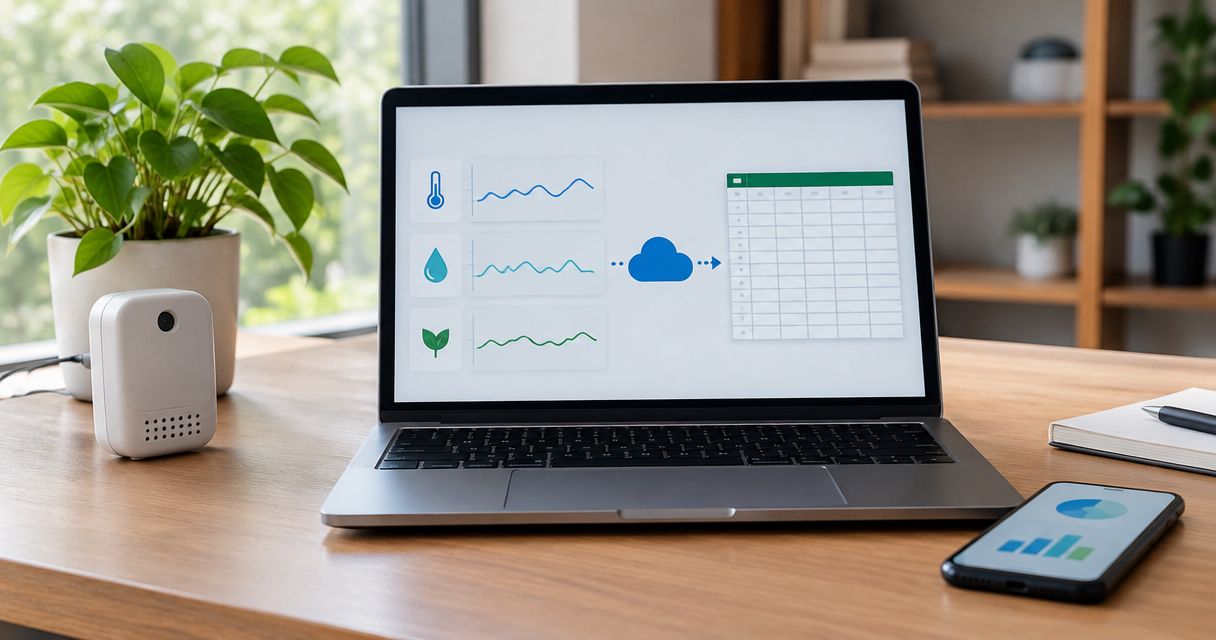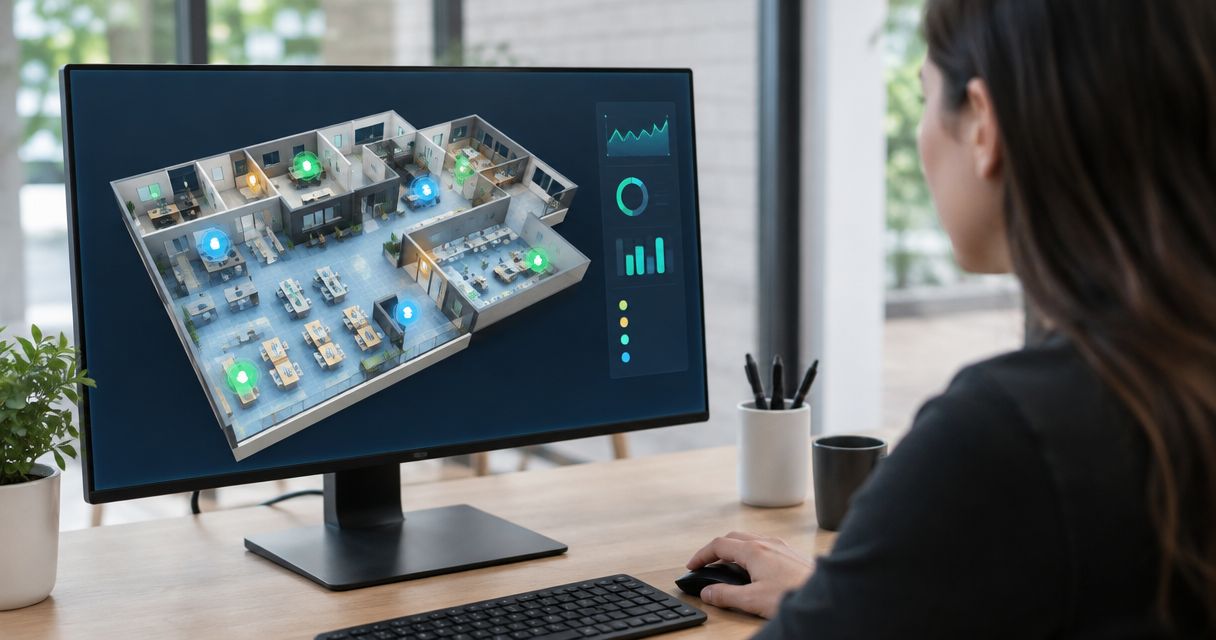
Yes—a configured rules engine can trigger a supported device command automatically when its conditions are met, without asking someone to approve every execution. In the Kilo IoT Platform, deliberately configured rules can execute commands autonomously. The command still needs a compatible device, a configured command path and appropriate permissions; a successful send does not prove the equipment changed state.
- Can a rules engine trigger a device command automatically? Yes, when the device command and execution path are supported.
- Kilo supports autonomous rule execution; built-in assistant commands follow a separate confirmation flow.
- A delivered command is not proof of physical success. Verify device feedback or subsequent measurements.
- Test side effects deliberately: debugger Execute performs real operations for supported nodes.
Can a rules engine trigger a device command automatically?
Yes. Automatic execution is a configured workflow, not a requirement for someone to approve each command. You define what should trigger the rule, what conditions must hold and which supported action the rule should request.
The useful distinction is between deciding to send a command and proving its outcome. A rules engine handles the configured decision and execution path. The device, connection and available feedback determine what happens beyond that boundary.
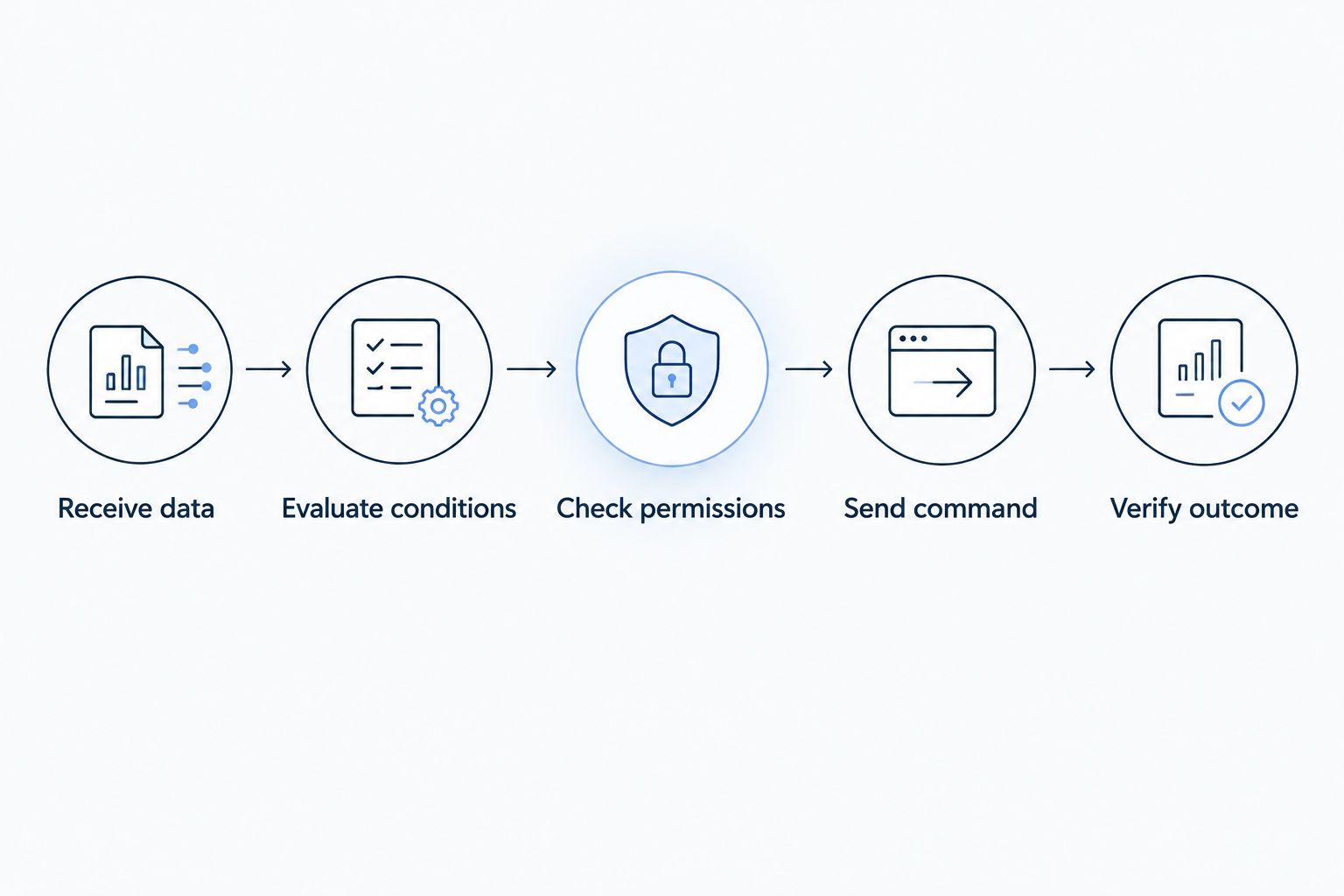
A practical implementation follows this sequence:
- Receive data. Identify the device observation or event that should start evaluation, including its source and timestamp.
- Evaluate conditions. Decide whether the input represents a situation that warrants action, rather than reacting to every incoming message.
- Check permissions. Establish that the configured execution context is allowed to act on the intended device.
- Send command. Request an explicitly supported action with the correct target and parameters.
- Verify outcome. Use available device feedback or subsequent measurements to establish what actually happened.
For integrators, this means that device onboarding alone is not enough. A sensor sending measurements into a dashboard proves the observation path works; it does not establish an outbound control path to an actuator.
What must exist before a rule can control a device?
Start with the equipment's actual command interface. A measurement-only sensor cannot become an actuator because you add an automation rule, and a supported protocol does not establish support for every device using that protocol.
Before enabling automatic execution, establish the following:
- A controllable target: The equipment must expose the action you need, directly or through a compatible integration.
- A defined command: The command needs an understood meaning, valid parameters and the correct device destination.
- A supported delivery path: The platform, connector and device interface must support the requested operation.
- An authorized execution context: Permissions must permit the intended action against the intended resource.
- An outcome signal: Decide which feedback or measurement will distinguish a completed action from an unverified request.
Keep the last requirement beside the command definition. If you cannot observe the result remotely, write that limitation into the operating procedure rather than presenting a delivery status as confirmation.
Hardware selection belongs here, before you commit to the workflow. Kilo Electronics is a separate online authorised dealer for compatible hardware serving individual and business buyers; hardware sourcing is distinct from the platform software. Choose equipment against the command interface and feedback your application needs, not simply its ability to transmit readings.
Automatic rules and assistant commands have different approval behavior
Automatic execution does not mean every route to device control behaves identically. A deployed rule, a direct request to a built-in assistant and a request through an external client are different execution paths.
| Execution path | Suitable use | Approval behavior | Main benefit | Limitation |
|---|---|---|---|---|
| Configured rule | A repeatable response to defined conditions | Deliberately configured rules can execute commands autonomously | Removes repeated manual initiation | Incorrect conditions can repeatedly request an unwanted action |
| Built-in assistant | A user initiating a supported direct device command | Direct device commands have a confirmation flow | Keeps confirmation attached to the interactive request | Does not establish the approval behavior of an autonomous rule |
| External MCP client | A compatible external client using exposed tools within permissions | The external client has its own approval behavior | Connects an external assistant to supported platform operations | Tool coverage and approvals must be checked for that client |
MCP means Model Context Protocol, an interface through which compatible clients can access exposed tools. Claude is one example of such a client, not a requirement for automatic rule execution.
Kilo suits integrators who need an IoT platform connecting configured automation with supported device commands. Its usefulness in a particular deployment still depends on the device interface, permissions and feedback available for that deployment.
Do not assume that an operation available to the built-in assistant is exposed through every external client. Equally, do not assume a confirmation shown during an assistant conversation will appear whenever an autonomous rule runs.
How would an automatic shut-off workflow work?
Consider an illustrative water-leak response, not a customer deployment or a recommended safety design. Assume you have a leak sensor, a compatible actuated valve, a documented close command and valve-position feedback.
The sensor reports a leak condition. The rule checks that the event belongs to the intended location and meets the configured conditions, then requests the valve's supported close action. Available valve feedback establishes whether the valve reports a closed position.
The person responsible for the site needs a response for an unverified result. A queued command with no valve-position update is not the same situation as a confirmed closed valve, so the operating procedure should distinguish them.
This example makes the boundaries visible:
- The sensor supplies evidence of the triggering condition.
- The rule decides whether to request the configured action.
- The actuator performs the physical operation.
- Feedback supplies evidence about the resulting state.
- The responsible person handles exceptions the automation cannot resolve.
The platform alone cannot close a valve. The compatible actuator and configured command path are essential, and a reported valve position does not by itself prove that every consequence of the leak has been resolved.
Why automatic command behavior varies between deployments
The same rule logic can produce different operational results when the underlying device or integration changes. Compare the complete observation-to-action workflow, not just whether a platform has a rules engine.
- Device capabilities: Equipment differs in the commands it accepts and the feedback it provides.
- Payload mapping: A condition depends on interpreting incoming fields correctly, including their units and meaning.
- Command definitions: The requested action must match the target interface and valid parameters.
- Permissions: Access to measurements does not automatically imply permission to control equipment.
- Connection behavior: A request's acceptance or delivery status does not establish when the device acted.
- Feedback coverage: Some outcomes are observable through device state; others require subsequent measurements or inspection.
For a LoRaWAN actuator, review the configuration of downlink commands for actuators and relays as a separate implementation task. The automation condition and the device's command configuration answer different questions: when to act, and how to request that action.
Avoid promising a fixed response time without evidence from the actual deployment. A rule evaluation, a command request and a physical state change are distinct events.
How do you test a rule without accidentally operating equipment?
Choose how side effects are handled before running the debugger. In Kilo, debugger Execute performs the real operation for supported side-effect nodes and is selected initially. Skip or Mock must be chosen deliberately; debugging is not automatically an isolated sandbox.
That distinction changes the test plan. Testing whether a condition evaluates correctly should not inadvertently become a live actuator test.
Separate your checks into these stages:
- Validate input interpretation. Confirm that the rule reads the intended fields, devices and values.
- Inspect decision logic. Exercise conditions that should request an action and conditions that should not.
- Choose side-effect handling. Deliberately select Execute, Skip or Mock as appropriate for supported nodes and the test's purpose.
- Plan live execution. Identify the equipment, responsible person, expected effect and response to an unexpected result.
- Observe feedback. Compare the requested action with the available evidence of the actual device state.
A mocked command helps inspect the software path; it does not establish that a physical actuator works. Conversely, a successful live command does not prove that every branch of the rule handles unexpected input correctly.
Keep those test results separate. You need evidence for both the decision logic and the equipment interaction before treating the workflow as ready for unattended operation.
What happens if the trigger remains active?
A condition that remains true needs an explicit repeat-action policy. Define whether the workflow should request an action on every qualifying event, only on a state transition or after another documented condition permits it.
This is an implementation decision, not a universal promise about every rules engine. Check how the selected engine represents state and which mechanisms the integration actually supports.
Prefer an explicit target state over an ambiguous toggle when the device supports it. Repeating a request to reach a defined state has a different meaning from repeatedly switching between states, so command semantics belong in the review of repeat behavior.
Also decide what clears the condition. A sensor returning to normal does not necessarily justify reversing the action: reopening a valve after a leak, for example, requires its own operating decision rather than an assumed mirror of the shut-off rule.
Does a command marked delivered mean the action succeeded?
No. Accepted, queued or delivered command status is not proof of a physical outcome. Verification depends on device feedback or subsequent measurements where supported.
Choose evidence that matches the claim you intend to make. A reported relay state supports a claim about that reported state; it does not independently prove that a connected motor is running or that a room has reached its target temperature.
When feedback is absent or inconsistent, preserve the uncertainty in the workflow's status and response procedure. Do not turn an unverified command into a successful action merely because the request encountered no reported transport error.
Can restoring a rule undo a command it already sent?
No. Restoring a rule does not reverse a past physical action. In Kilo, restoring a rule creates a new draft version, which must be built and deployed separately.
Configuration recovery and physical recovery are different jobs. If equipment needs to return to another state, that requires an appropriate supported action and an assessment of the current conditions—not an assumption that restoring software restores the physical world.
FAQ
Do I need an AI model to trigger a device command automatically?
No. A configured condition-and-action rule can trigger a supported device command without an AI model. A threshold rule is automation, not automatically AI.
Can a sensor send data but still be impossible to control?
Yes. Receiving measurements does not establish that the device accepts commands. Verify the device's outbound control interface separately from its telemetry integration.
Should I use automatic control or just send an alarm?
Use an alarm when a person must assess the situation before action; use automatic control when the response is explicitly configured and supported. The decision depends on the consequences of acting incorrectly and the available verification.
Can one automatic rule control equipment at different sites?
That depends on the engine's supported targeting and permissions. Define the intended device scope explicitly so an event from one location cannot accidentally request an action at another.
Does an execution record prove every interaction was audited?
No. An execution record does not automatically establish an immutable audit trail or complete recording of every user interaction. Describe only the documented recording scope.
Can a cloud automation rule replace local equipment protection?
Do not treat a cloud automation rule as a replacement for required local equipment protection. Assess the command path, failure conditions and applicable equipment requirements separately.
Define success before enabling the command
Write the acceptance statement before deploying the automation: what observation permits the action, what command is authorized, what evidence confirms the result and who responds when that evidence is missing. This exposes gaps that a simple successful-execution indicator can hide.
The most useful final test is not merely whether the rule can send a command. It is whether you can distinguish requested, physically confirmed and unresolved outcomes without guessing.
Written by Tim Kravchunovsky