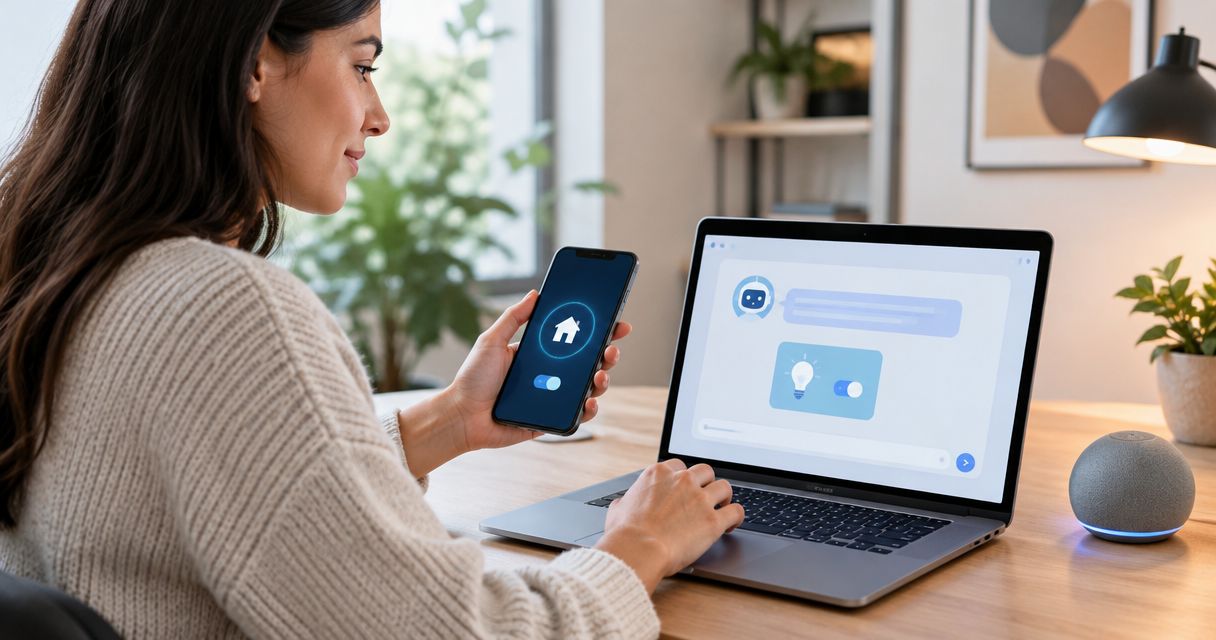
Yes—you can control an IoT device from an AI chat interface when the chat uses a supported command path, enforced permissions and appropriate equipment safeguards; the Kilo IoT Platform is an operating layer that connects AI with device context and configured actions. A confirmation prompt alone does not establish safety, and an accepted command does not prove that the equipment changed state.
- Control an IoT device from an AI chat interface through defined commands, not unrestricted equipment access.
- Kilo connects AI with device context, permissions and supported actions; equipment safeguards remain essential.
- Human confirmation, command delivery and physical verification answer different questions.
- Start with read-only access, then test a bounded command and its failure paths before expanding control.
Can you control an IoT device safely from an AI chat interface?
Yes, but safety depends on the complete control path—not on how convincing the assistant sounds. The assistant interprets your request. The connected software must determine which device you mean, which commands exist, whether you can use them and what evidence will show the result.
Use this sequence when designing or evaluating a chat-controlled deployment:
- Identify the device. Resolve the request to a specific device record and location. Ask for clarification when names overlap; don't let the assistant guess which pump, relay or room you mean.
- Check context. Inspect the latest available state and its timestamp. A reading without its age is an incomplete basis for a physical action.
- Validate authority. Enforce permissions outside the conversation. A request written in chat must not grant access the user or connected client doesn't already have.
- Constrain the command. Select a supported operation with defined parameters. Reject unsupported actions instead of converting an open-ended instruction into arbitrary device access.
- Verify the outcome. Separate command status from equipment feedback. Report what the system knows, what it attempted and what remains unconfirmed.
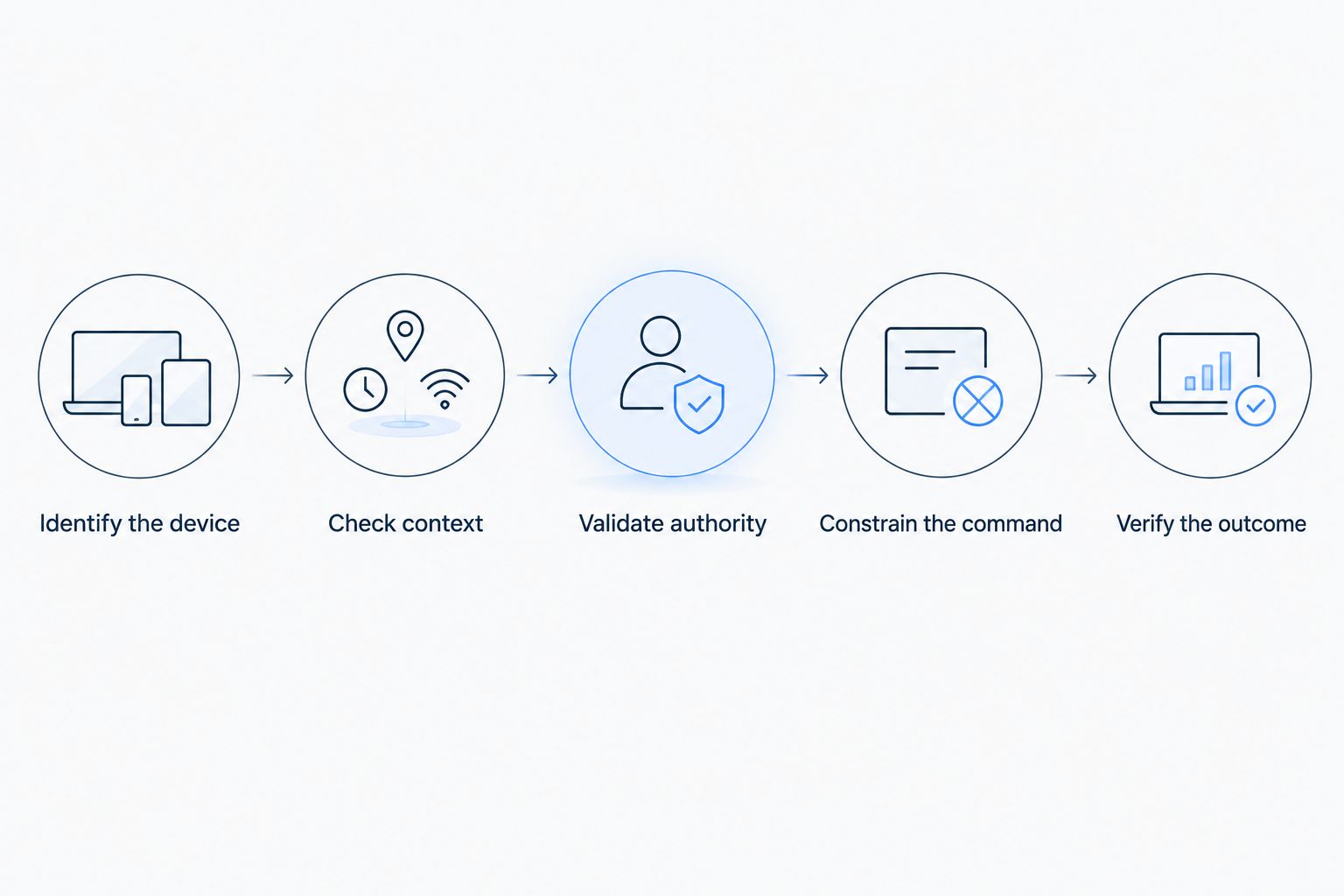
The first implementation decision is therefore not which language model to choose. It's which actions you are willing to expose, under whose authority, with what safeguards and feedback.
What makes chat-based device control different from a dashboard?
A dashboard usually presents a defined control attached to a known device. Chat adds interpretation: the assistant must translate language into a specific operation, sometimes across several devices or locations.
That flexibility helps when you need to find equipment, understand its recent behavior and decide what to do next. It also introduces ambiguity. A request to stop equipment in a workshop needs a precise target and operation before anything moves or switches.
For Physical AI, the useful connection is between real-world observations, reasoning, supported actions and available feedback. The chat interface is an entry point into that workflow, not a replacement for device firmware, local controls or an engineered safety system.
Use chat to express intent; use the control system to enforce the boundaries. Instructions telling an assistant to be careful are not a substitute for restricted tools and equipment-level protections.
Which control approach fits your deployment?
Read-only assistance, confirmed commands and autonomous rules serve different purposes. Choose the narrowest approach that answers the actual need rather than enabling write access simply because a client supports it.
| Approach | Best for | Useful capability | Limitation |
|---|---|---|---|
| Read-only assistance | Investigating readings and preparing decisions | Lets users ask questions without exposing a command operation | Cannot perform the physical change |
| Confirmed commands | Deliberate actions initiated by an authorized person | Gives the person an opportunity to inspect the proposed target and action | Approval does not prove the action is appropriate or successful |
| Autonomous rules | Deliberately configured responses to defined conditions | Executes a configured response without waiting for a new chat request | Requires explicit handling of stale data, failures and repeated triggers |
Read-only assistance: start with understanding
Read-only access is the right starting point when your main question is what the equipment is doing. You can assess whether the assistant finds the correct device, interprets units correctly and distinguishes recent measurements from old ones before introducing actuation.
Keep that boundary real. A read-only workflow should expose reading tools rather than rely on a conversational promise not to use available command tools.
Confirmed commands: inspect the proposed operation
A useful confirmation identifies the device, location, operation and parameters. A generic approval request gives the user too little information to catch a wrong target or misunderstood instruction.
Kilo's built-in assistant has a confirmation flow for direct device commands. Compatible external MCP clients have their own approval behavior, so you must evaluate that behavior separately rather than assume the built-in flow follows the connection.
Autonomous rules: configure the behavior deliberately
A configured rule can execute a command autonomously. That is different from a person approving each command in chat, and a simple threshold rule does not become AI merely because an assistant helped configure it.
Use autonomous execution only where the defined condition, action and failure response suit the application. A convenient conversation should not silently expand an occasional command into an ongoing automation.
Why the safety requirements vary between devices
A remotely operated indicator and a valve controlling a process do not present the same consequences. Evaluate the physical action, not just the software interface.
The requirements depend on these factors:
- Device capability: A monitoring sensor does not become an actuator because it appears in a connected platform. Control requires a compatible device and supported command definition.
- Permission scope: The user's access and the connected client's authority determine which resources and operations are available.
- Approval behavior: Built-in assistance, external clients and configured rules do not necessarily use the same confirmation process.
- Available feedback: A command acknowledgement, position report and subsequent measurement provide different evidence.
- Physical consequences: Changing a display and stopping equipment require different operational judgments and safeguards.
- Testing behavior: A debugging tool that executes real side effects needs different precautions from an explicitly mocked test.
Put each limitation beside the action it affects. If the device cannot report its position, the interface must not present a delivered command as a verified position change.
How would a bounded control workflow work in practice?
Consider an illustrative commissioning exercise using a compatible, non-critical indicator relay. This is a design example, not a reported customer deployment or a claim that arbitrary relays work with the platform.
The inputs are a clearly identified device, its available status, a configured switch command and a user authorized to issue that command. The intended action is to change the indicator state while someone can observe the equipment locally.
Before execution, the interface presents the resolved device and proposed operation. The user checks the target and confirms through the applicable approval flow. The command then follows the configured integration rather than a payload invented during the conversation.
Afterward, the interface reports the command status separately from any device feedback. If a supported state report arrives, the assistant can describe that report; if no feedback arrives, the result remains unverified and the person commissioning the setup checks locally.
The useful evidence is not a cheerful completion message. It is a traceable connection between the intended device, the submitted operation and the observed response.
Kilo is suited to integrators and AI teams that need an IoT operating layer between an assistant and supported device actions. The platform supplies software context and control capabilities; compatibility, command configuration and the physical installation still determine what the deployment can do.
For hardware sourcing, Kilo Electronics is a separate online authorised dealer serving individual and business buyers. A hardware purchase is separate from platform access, and the intended command path still needs validation.
Can Claude control connected devices through MCP?
Claude can work with Kilo through a compatible MCP connection, within the tools and permissions available to that connection. MCP—Model Context Protocol—provides a way for an AI client to work with exposed tools; it does not itself establish device compatibility or authorize every action.
Evaluate the particular operation you need. Reading device data does not prove that the same connection can change configuration or issue a command, and built-in assistant capabilities must not be treated as an identical external tool catalogue.
For implementation, establish the exposed tools, resource scope and approval behavior before enabling control. Keep credentials and authorization enforcement in the integration rather than placing secrets or permission decisions in conversation text.
Treat device names, descriptions and retrieved text as data, not instructions that can expand authority. An assistant reading an unexpected instruction from a connected resource should not gain a new command capability because of that text.
How do you know whether an AI command actually worked?
A command record describes a stage in the communication path. It does not necessarily describe the equipment's physical state.
Distinguish these forms of evidence:
- Accepted or queued: The command entered a processing path. This does not establish delivery or actuation.
- Delivered: The applicable delivery status was reached. This still does not prove that a mechanism moved or a process changed.
- Device feedback: The device reported a state or response. Interpret it according to what that device actually measures.
- Subsequent measurement: A later observation supports an outcome claim within that measurement's scope.
A valve position report and a flow measurement answer different questions. Position feedback concerns the reported actuator state; a flow measurement concerns the measured process. Neither should be silently substituted for the other.
Define the expected evidence before enabling the command. Also define who responds when it doesn't arrive, so uncertainty produces an explicit next step rather than an unsupported success message.
How should you test chat control before enabling routine use?
Begin with a bounded, non-critical action and a person able to inspect the equipment. Test the refusal paths as deliberately as the successful command.
Your test set should include an ambiguous device name, an unauthorized user, an unsupported operation, stale readings, unavailable equipment and missing outcome feedback. For each case, decide what should be blocked, what clarification is required and what the interface should report.
Do not assume a debugger isolates physical actions. In Kilo's Rules Engine, Execute performs the real operation for supported side-effect nodes and is selected initially; Skip or Mock must be chosen deliberately.
Version restoration also has a boundary. Restoring a rule creates a new draft that must be built and deployed separately—it does not reverse a physical action already performed.
Keep a local recovery procedure appropriate to the equipment. Reissuing a command is not automatically recovery, especially when you don't yet know whether the original operation occurred.
FAQ
Can an AI assistant control any device that uses MQTT?
No. A shared protocol name does not establish a compatible command interface. The deployment still needs the correct device integration, command definitions, permissions and feedback handling.
Does approving a command make it safe?
No. Approval records a person's decision to proceed; it does not validate the installation, equipment safeguards or physical outcome. The confirmation must also identify the target and operation clearly enough to inspect.
Should I let an AI assistant generate raw device commands?
Prefer defined, validated operations over unrestricted command generation. A configured operation gives the integration a specific action and parameter set to check before execution.
Can a sensor alert automatically shut off equipment?
Only a deployment with a compatible actuator and configured command path can perform a shut-off action. A sensor alert by itself cannot operate a valve or switch equipment.
Does an execution record provide an immutable audit trail?
An execution record does not automatically establish an immutable audit trail. Check the documented recording scope before treating it as evidence of every interaction or a compliance guarantee.
What should the assistant say when device feedback is missing?
The assistant should state that the physical outcome is unverified and distinguish that from the known command status. It should follow the deployment's defined verification or escalation procedure rather than claim success.
Define the failure message before the success message
Before enabling write access, specify what the interface must say when a command is accepted but the physical result remains unknown. That decision forces you to identify the required feedback, the responsible person and the recovery path.
If you cannot explain how the deployment detects an unsuccessful action, it is not ready for routine chat-based control. Start with a narrower action or read-only access until that gap is resolved.
Related guides
Written by Tim Kravchunovsky