Yes—you can roll back a rule change when your IoT platform supports restoring earlier rule versions. In the Kilo IoT Platform, restoration creates a new draft that you must build and deploy separately; it does not immediately replace the running rule or undo a physical action. Treat recovery as two jobs: restore the intended automation, then verify what happened to the connected equipment.
- To roll back rule change IoT platform logic in Kilo, restore a version, then build and deploy the new draft.
- Restoring automation does not reverse commands already executed or return equipment to its previous physical state.
- For supported debugger side-effect nodes, Execute performs the real operation; choose Skip or Mock deliberately.
- Verify recovery through available device feedback or subsequent measurements, not command delivery status alone.
Can you roll back a rule change on an IoT platform?
Yes, but the meaning of rollback depends on what you are restoring. A rule definition, the deployed automation and the equipment affected by that automation are different things. Recovering one does not automatically recover the others.
Use this sequence to plan a rule restoration. It describes the recovery decisions, not a click-by-click interface walkthrough.
- Identify the unwanted change. Establish which condition, target or action changed and which behavior you want back.
- Assess the current deployment. Check whether the rule has already sent commands or triggered other effects that need attention.
- Restore the intended earlier version. In Kilo, restoration creates a new draft rather than immediately changing the deployed rule.
- Review and test the restored draft. Check its inputs, conditions and actions against the deployment as it exists now.
- Build and deploy the draft. Restoration alone is not activation; the restored logic needs these separate release steps.
- Verify operation and physical state. Confirm the intended rule behavior, then inspect available device feedback or subsequent measurements.
A restored draft is a recovery candidate, not evidence that recovery is complete. Keep the person responsible for the equipment involved whenever automation can change its operation.
What does a rule rollback actually restore?
The useful distinction is between restoring software logic and correcting the consequences of that logic. This matters even for monitoring-only rules: changing an alarm condition cannot retract a notification that someone already received.
| Recovery task | Best suited to | What it addresses | What it does not establish |
|---|---|---|---|
| Restore an earlier rule version | Returning to previously intended logic | Creates a draft from the earlier rule | That the draft is active or still fits current devices |
| Edit the current rule | Correcting a specific fault while retaining other changes | Changes the logic you intend to release | That the correction has passed testing or been deployed |
| Take a corrective device action | Addressing an equipment state after an unwanted command | Sends a separate, supported command through a configured path | That the equipment reached the intended state |
| Verify device feedback | Checking the outcome of recovery | Supplies available evidence about reported state or measurements | That missing feedback means the equipment is unchanged |
Restoration is useful when the earlier logic remains appropriate and you need to recover it without reconstructing the change manually. Its limitation is equally important: an earlier version reflects earlier assumptions. Device assignments, operating conditions or the desired response might now differ.
Editing the current rule is more appropriate when you need to retain valid changes made alongside the faulty one. The trade-off is that you must review the correction carefully rather than assuming the old configuration provides the complete answer.
How do you test a restored rule without repeating the problem?
Start by identifying every operation in the rule that has an effect outside the test itself. A condition check and a device command deserve different treatment. Reading an input does not carry the same consequence as operating connected equipment.
For supported side-effect nodes in Kilo's debugger, Execute performs the real operation and is selected initially. Choose Skip or Mock deliberately when that is the intended test behavior. Debugging is not automatically an isolated sandbox.
Review the test path before running it:
- Inputs: Use data that exercises the condition you are trying to restore, including the boundary between triggering and not triggering.
- Targets: Confirm that the rule refers to the intended device or deployment.
- Actions: Identify commands and other side effects before selecting how to test them.
- Feedback: Decide what evidence would demonstrate the expected result.
- Release: Keep test completion separate from the decision to build and deploy.
A mocked operation helps you inspect a logic path without performing that operation. It does not prove that the real device will respond. Keep the logic test and the equipment check distinct so a successful test does not become an unsupported claim about physical behavior.
Why rule-change recovery varies between deployments
The restoration workflow is only part of recovery. The work around it depends on the rule's purpose and what happened while the unwanted version was running.
- The rule's actions: A monitoring condition and an actuator command have different recovery consequences. Review the actions, not just the condition that triggered them.
- The version's current suitability: Earlier logic can refer to assumptions that no longer match the deployment. Review the restored draft before treating it as the answer.
- Device and command support: A corrective action requires a compatible device interface and a configured, supported command path.
- Permissions: The person or client performing recovery needs the appropriate permissions. Access to device data does not establish permission to change automation or operate equipment.
- Available feedback: Reported state or subsequent measurements determine what you can verify. A command status alone cannot establish a physical outcome.
- The response owner: Someone must decide whether equipment needs inspection or intervention. Software restoration does not replace that responsibility.
These factors explain why there is no universal recovery duration. Define completion through evidence: the intended logic is deployed, its behavior is checked and any physical consequences have been assessed.
What should you check before deploying the restored draft?
Review the restored rule as a new release. That does not mean starting the whole project again; it means checking the assumptions that connect the saved logic to the current deployment.
Confirm the intended behavior
Describe the condition and response in plain language before reviewing the configuration. For example: a monitored state should trigger an alarm for the responsible person, rather than issue a device command. That statement gives the reviewer something concrete to compare with the rule.
Also identify valid behavior introduced after the earlier version. Restoring a version that fixes one issue but removes another required change is not a complete recovery.
Separate testing from release
A test answers whether the selected inputs follow the expected path. Deployment determines which logic runs in the connected environment. Neither step should be used as shorthand for the other.
For the restoration behavior described here, Kilo requires the restored draft to be built and deployed separately. Keep that distinction explicit in your recovery procedure so nobody stops after restoring the version and assumes the running automation has changed.
Define the acceptance evidence
Before deployment, state what you will inspect afterward. That might be the rule's observed response to incoming data, an available device-state report or a subsequent measurement relevant to the action.
Keep the claim as narrow as the evidence. An execution record supports conclusions within its recorded scope; it does not automatically establish an immutable audit trail or a record of every user interaction.
How does rollback work when a rule controls equipment?
Consider an illustrative scenario, not a customer deployment: a monitoring rule is changed to send a command to a compatible actuator. The command path is configured, but the new behavior was not intended for normal operation. The integrator needs to restore the monitoring behavior and determine whether the actuator moved.
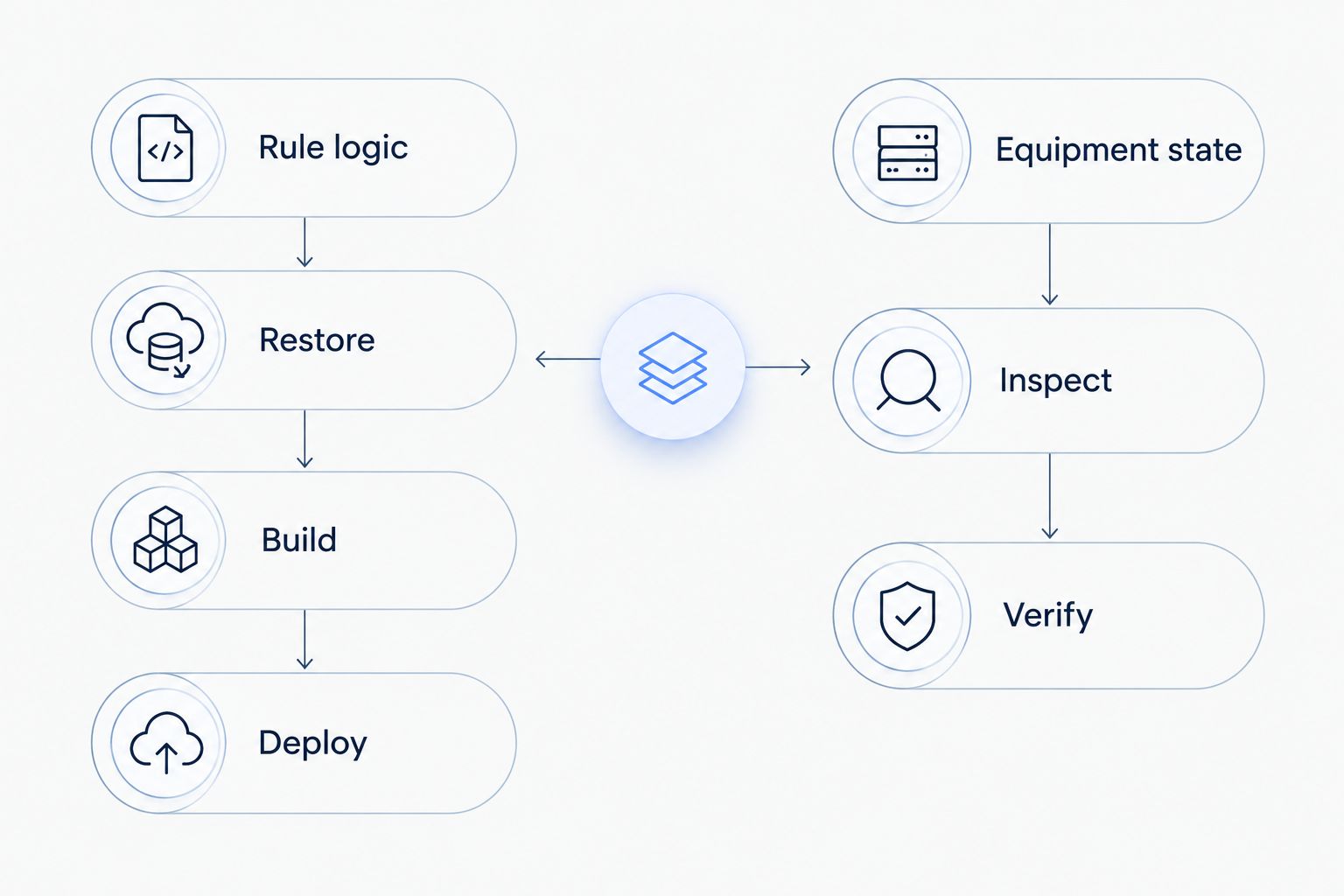
The recovery has separate paths:
- Rule logic: Restore the earlier version, review the resulting draft, test it, then build and deploy it.
- Equipment state: Inspect available feedback, determine whether corrective action is needed and use an appropriate supported command or on-site procedure.
Restoring the earlier rule addresses future automation after deployment. It does not reverse an action that already occurred. If a corrective command is appropriate, treat it as a new operation with its own permissions, device requirements and verification.
The person responsible for the equipment should receive the result of the physical check, not merely confirmation that a version was restored. If feedback is unavailable, report the outcome as unverified and arrange the appropriate inspection rather than inferring success.
Hardware compatibility belongs in the original integration design as well as the recovery plan. Kilo Electronics is a separate online authorised dealer for compatible hardware, serving individual and business buyers; it is not the platform itself. Sourcing an actuator does not establish a working command path or prove that its physical state can be read back.
Does restoring a rule cancel a command already sent?
Restoring a rule does not reverse a command already executed. Do not treat restoration as a command-cancellation mechanism: inspect the command's state and the supported device behavior separately.
Accepted, queued or delivered status is not proof of a physical outcome. Use available device feedback or subsequent measurements to establish what happened, and assess any corrective action against the equipment's current condition.
Does an automated device action always wait for confirmation?
Deliberately configured rules can execute commands autonomously. The built-in assistant's confirmation flow for direct device commands is a different workflow; external MCP clients have their own approval behavior.
Do not transfer an approval assumption from a chat interface to deployed automation. Review the rule's configured actions before testing or releasing a restored version.
Can you restore an older version without losing useful changes?
An older version is not automatically the right final configuration. Compare the intended earlier behavior with the valid changes you still need, then decide whether restoration or a targeted correction provides the right draft.
The release decision remains the same: review the resulting logic, test its relevant paths and verify operation after deployment. The version's age does not establish its suitability.
FAQ
Is rolling back a rule the same as rolling back device firmware?
No. Restoring platform rule logic changes automation configuration; it does not establish that device firmware has changed. Treat firmware recovery as a separate device-specific process.
Should I restore a rule if the original problem was a bad sensor reading?
Restore rule logic only if the logic needs changing. Investigate the input and its interpretation separately so a rule change does not conceal a data problem.
Who should approve an IoT rule restoration?
Assign approval to someone responsible for the automation's intended behavior and involve the equipment owner when physical actions are possible. The person performing the change also needs appropriate platform permissions.
Does a successful mocked test prove a device will respond?
No. A mocked operation helps test the selected logic without performing that operation; device response requires a separate check through the real supported integration.
Can I assume a restored rule uses the correct current devices?
No. Review the restored draft's targets against the current deployment before release. An earlier configuration does not prove that its device assumptions still apply.
What should I record after recovering an IoT rule?
Record the intended behavior, the released configuration, the checks performed and any unresolved physical outcome. Keep those recovery notes distinct from claims about the scope or immutability of platform records.
Write the recovery decision before the next rule release
Add an acceptance statement to your change procedure: what should happen, what must not happen and which evidence will demonstrate the result. This gives an integrator, developer or site owner a usable recovery target without relying on memory during an incident.
Kilo suits IoT builders who need to restore rule logic through a draft, build and deployment workflow. The boundary is physical recovery: restored software cannot undo an earlier action, and a delivered command cannot substitute for evidence from the device.
Related guides
Written by Tim Kravchunovsky