
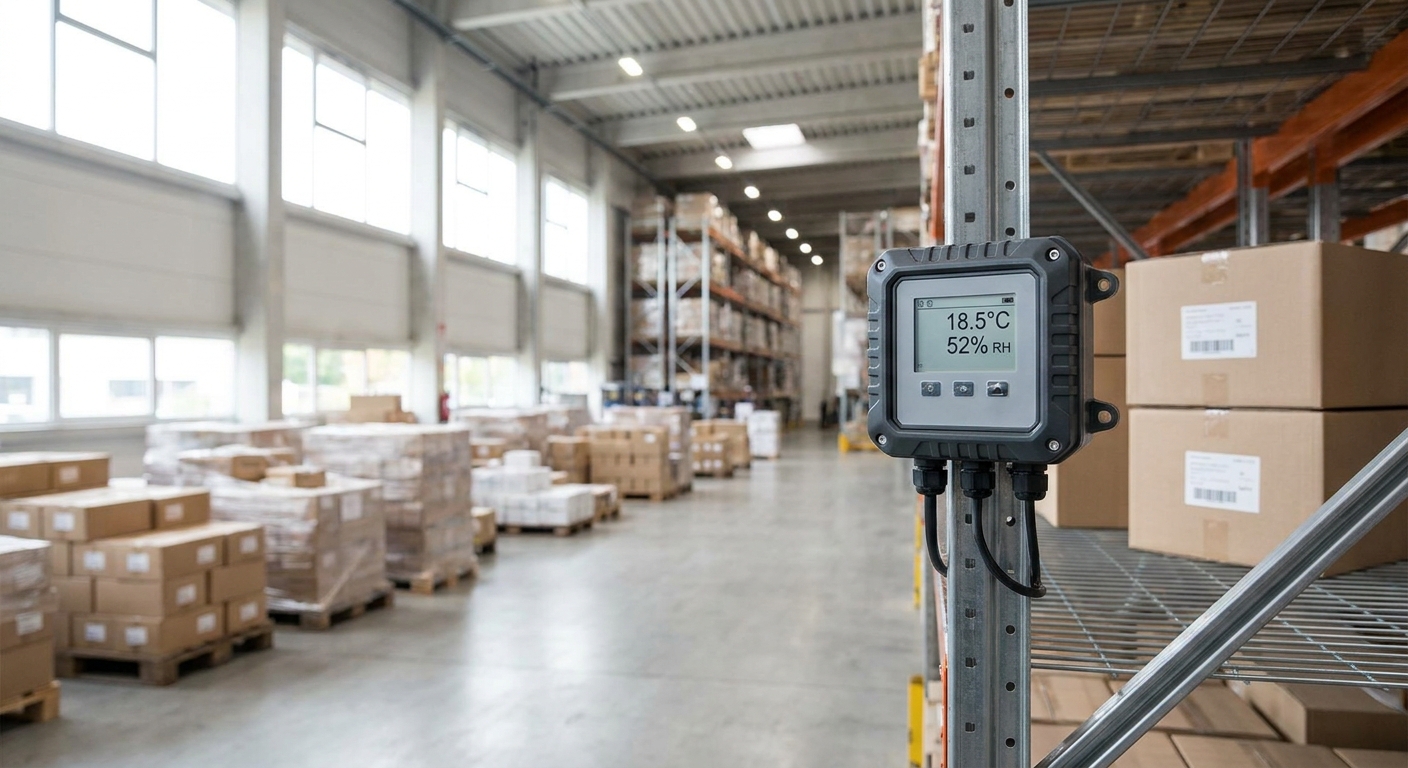
A warehouse doesn't spoil in a dramatic moment — it drifts. Humidity creeps from 50% to 68% over a weekend, a rooftop unit fails on a Friday, and by Monday the pallets nearest the dock doors are soft. This guide ranks the sensor types that actually hold up on a warehouse floor in 2026, by connectivity protocol and real deployment behavior, not by spec-sheet marketing.
- LoRaWAN sensors are the best temperature and humidity sensors for warehouse monitoring in 2026 for most single-site operations — buy them.
- mioty-based sensors win in steel-heavy or RF-dense warehouses running thousands of nodes — buy for scale.
- Wi-Fi sensors drain batteries in months and choke on warehouse network congestion — skip.
- Bluetooth mesh works for single-zone pallet tracking but degrades past two or three concrete walls — consider only for small footprints.
Why this matters
A 2°C swing in a cold storage zone can push product outside spec long before anyone walks the aisle to check a wall thermometer. Food and pharma operations commonly track excursions in minutes, not hours — a pallet sitting above threshold for 10 minutes matters as much as one sitting there for a full shift. Warehouses without continuous monitoring find out about the excursion when the damage is already done.
The fix isn't a smarter thermometer. It's a sensor network that reports on a schedule, survives a warehouse's steel racking and concrete walls, and feeds an IoT monitoring platform that fires an alarm before the product is a write-off. Sensor choice is the first decision, and it's the one most operations teams get wrong by defaulting to whatever showed up first on a marketplace search.
How we ranked
This ranking sorts sensor categories by connectivity protocol — LoRaWAN, mioty, wired/MQTT, Bluetooth mesh, cellular, and Wi-Fi — because protocol determines the three things that actually break warehouse deployments: battery life, penetration through racking and walls, and how the network holds up as node count scales past a few hundred sensors. Density, building material, and existing infrastructure decide which protocol wins for a given site, not brand name.
Each category below is scored on the same four criteria: typical battery life, effective range in a warehouse environment, behavior at scale (50 sensors vs. 5,000), and total cost of ownership including gateway infrastructure. None of this is lab-perfect — warehouse RF environments vary by racking height, wall material, and dock door count — but the pattern holds across facility types in 2026.
The ranked list
LoRaWAN sensors — the default pick
LoRaWAN is the protocol most warehouse deployments should start with in 2026. A single gateway covers a typical distribution center footprint, penetrating multiple interior walls and steel racking that would kill a Wi-Fi signal.
Battery-powered LoRaWAN temperature and humidity sensors commonly run 5 to 10 years on a single battery, because the radio only transmits for a fraction of a second per reading interval. That's the entire economic case: no wiring, no battery swaps for years, no gateway sprawl. A private LoRaWAN network server also keeps sensor data off shared spectrum shared with neighboring buildings, which matters in dense industrial parks. Verdict: Buy for most single-site and multi-zone warehouses.
mioty-based sensors — the interference killer
mioty uses telegram splitting, which breaks a single reading into fragments transmitted across different frequencies and times. That design lets a single gateway handle thousands of nodes without the packet collisions that degrade dense LoRaWAN deployments.
For a warehouse running several thousand sensor points — multi-tenant cold storage, large-format distribution centers, steel-heavy manufacturing floors — mioty holds up where standard LoRaWAN starts dropping readings under congestion. It's a narrower use case than LoRaWAN, but it's the right answer when node count gets into the thousands. Verdict: Buy for large-scale or RF-dense sites.
Wired sensors on MQTT — the legacy holdout
Wired temperature and humidity probes tied into a building management system over MQTT are the most reliable option in raw uptime terms — no battery, no radio dropout. But cabling a warehouse costs real labor, and retrofitting an existing facility to add wired points means conduit runs through racking aisles that were never designed for it.
Wired sensors make sense for a handful of critical points already near existing BMS infrastructure — a loading dock, a single cold room. Beyond that, the cost per additional point climbs fast. Verdict: Hold — keep what's already wired, don't expand it.
Bluetooth mesh sensors — the short-range specialist
Bluetooth mesh sensors hop node to node to extend range, which works well for tracking conditions around a specific pallet cluster or a single climate-controlled room. Past two or three concrete or steel walls, mesh reliability drops noticeably compared to LoRaWAN's single-hop-to-gateway design.
This category earns a spot for asset-level monitoring inside one zone, not for a multi-zone warehouse spanning tens of thousands of square feet. Verdict: Consider for single-room or pallet-level use only.
Cellular sensors — the standalone option
Cellular (NB-IoT/LTE-M) sensors skip the gateway entirely and report straight to the cloud over the carrier network. That's useful for a satellite warehouse with no existing IoT infrastructure and no appetite to install a gateway.
The tradeoff is recurring cost: every sensor carries its own data plan, which adds up fast past a few dozen points, and coverage inside a steel warehouse interior isn't guaranteed the way it is outdoors. Verdict: Wait unless the site has zero existing gateway coverage and a small sensor count.
Wi-Fi sensors — the one to skip
Wi-Fi sensors look cheap on paper because they piggyback on existing office networks, but the radio draws enough power that battery life often lands under six months against years for LoRaWAN. Warehouse Wi-Fi networks also weren't built to carry hundreds of always-connected sensor endpoints without congestion.
Unless a facility already has dense Wi-Fi coverage designed for IoT load and a maintenance team willing to swap batteries quarterly, this category creates more work than it solves. Verdict: Skip.
Comparison table
| Protocol | Typical battery life | Effective range | Best at scale | Verdict |
|---|---|---|---|---|
| LoRaWAN | 5-10 years | Multiple interior walls, 1-2 km outdoor | Hundreds of nodes per gateway | Buy |
| mioty | 5-10 years | Multiple walls, steel-tolerant | Thousands of nodes per gateway | Buy |
| Wired/MQTT | N/A (powered) | Cable length only | Handful of fixed points | Hold |
| Bluetooth mesh | 1-3 years | Single zone, 2-3 walls max | Dozens of nodes per room | Consider |
| Cellular | 3-5 years | Carrier coverage dependent | Small, scattered sites | Wait |
| Wi-Fi | Under 6 months | Same-room, congestion-prone | Poor past 50 nodes | Skip |
Get warehouse alarms live this week
Connect LoRaWAN or mioty sensors to a dashboard with automated alarms.
Where to source sensors
Don't buy sensors before you know the network they'll run on. Three rules keep the purchase from becoming a second problem:
- Match protocol to gateway plan first. A LoRaWAN sensor bought before deciding on a network server is a paperweight until the gateway side is settled.
- Check the IP rating for cold storage condensation. Sensors moving between a 22°C loading dock and a -18°C freezer need an enclosure rated for condensation cycling, not just splash resistance.
- Confirm the dashboard side before the hardware side. A sensor is only as useful as the alarm it triggers — verify the platform can turn a raw reading into a threshold alert before committing to a specific sensor SKU.
FAQ
What's the best temperature and humidity sensor for warehouse monitoring in 2026?
LoRaWAN sensors are the best fit for most warehouses in 2026 because they run 5 to 10 years on a battery and penetrate steel racking and interior walls that block Wi-Fi. mioty-based sensors take over when a site runs thousands of nodes and needs more headroom against RF congestion.
Is LoRaWAN better than Wi-Fi for warehouse sensors?
Yes, for battery-powered warehouse monitoring LoRaWAN outperforms Wi-Fi on every practical metric. LoRaWAN sensors last years on a battery and hold signal through racking, while Wi-Fi sensors often need battery swaps within six months and struggle with network congestion at scale.
How much does a warehouse sensor network cost to run?
Cost depends on sensor count and protocol, but LoRaWAN and mioty avoid the recurring data plan fees that cellular sensors carry per unit. The bigger cost driver is usually gateway placement and the platform running alarms, not the sensor hardware itself.
How many sensors does a warehouse need for humidity monitoring?
Sensor count depends on how many distinct climate zones the warehouse has, not just square footage. A warehouse with a dry storage zone, a cold room, and a loading dock needs at least one sensor per zone, with more added near doors and HVAC returns where drift shows up first.
Can Bluetooth sensors cover a full warehouse?
Bluetooth mesh sensors work well within a single room or pallet cluster but lose reliability past two or three concrete or steel walls. For a multi-zone warehouse, LoRaWAN or mioty cover the full footprint more consistently than Bluetooth mesh.
Do cellular sensors work inside a warehouse?
Cellular sensors can work inside a warehouse, but coverage isn't guaranteed the way it is outdoors, and steel construction can weaken signal. They fit best for a standalone satellite site with no existing gateway rather than as the primary sensor network for a large facility.
How often should warehouse temperature sensors report readings?
Most warehouse deployments in 2026 report readings every 5 to 15 minutes, which balances battery life against how fast an alarm needs to fire. Cold storage zones handling sensitive product often shorten that interval to catch excursions faster.
What happens when a warehouse sensor detects an excursion?
A sensor on its own doesn't do anything beyond report a number — the alarm logic lives in the platform receiving the data. A properly configured rule fires a notification the moment a reading crosses threshold, rather than waiting for someone to check a dashboard.
One last thing
The sensor is the cheapest, most-discussed part of this decision and the least likely thing to fail. Gateways drop out, dashboards get ignored, and alarm rules get set once and never revisited as the warehouse layout changes. Pick a protocol that fits the building, then spend the real attention on the alarm logic that turns a reading into action before the pallet is a loss.