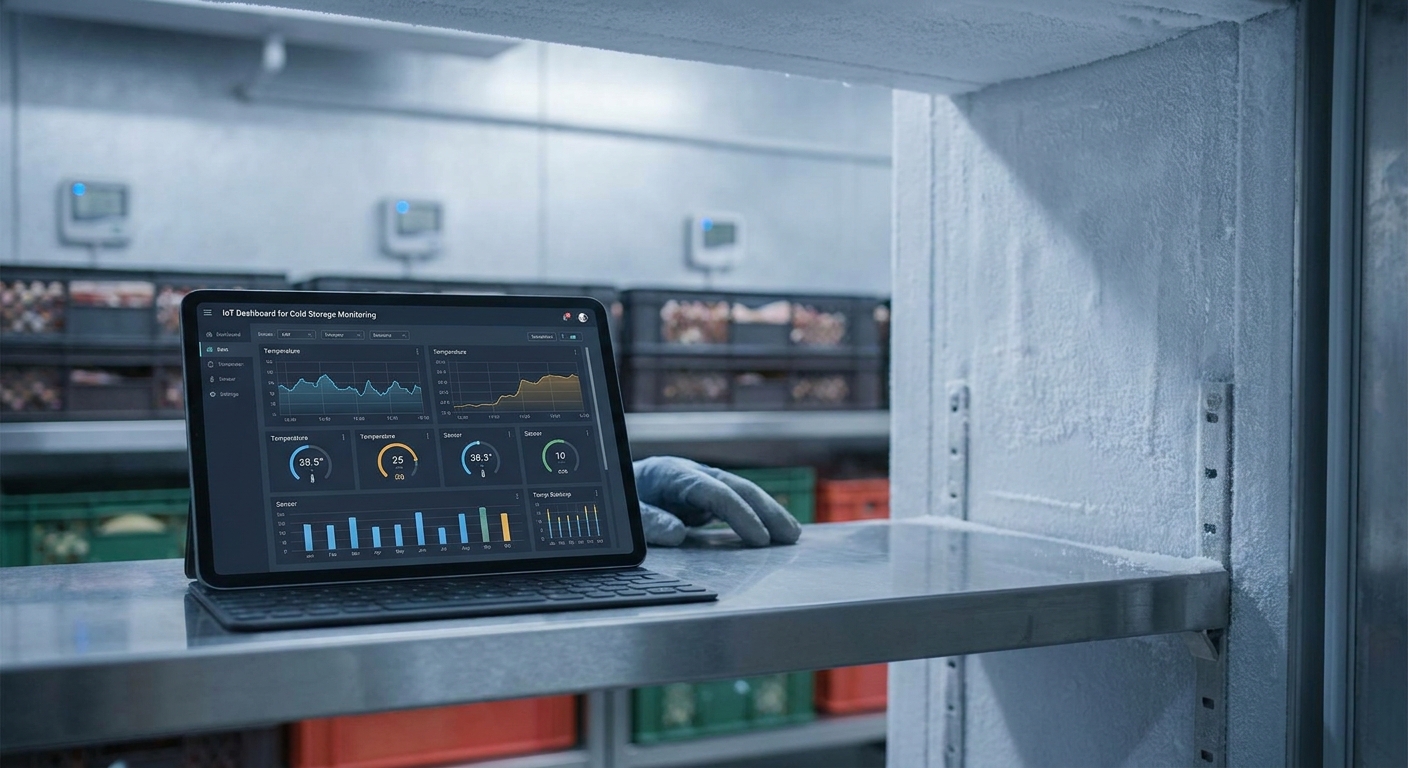
Cold storage temperature monitoring in 2026 means picking a dashboard that catches a compressor failure at 2 a.m., not one that just plots pretty charts during business hours.
- Kilo IoT's AI-first platform wins the iot dashboard for cold storage monitoring pick for multi-site operators running LoRaWAN or mioty sensors — Buy.
- Single-purpose temperature loggers work for a single freezer but stall past 3-4 zones — Consider only for small sites.
- BMS retrofit modules make sense only if you already sank capital into that system — Consider.
- DIY MQTT stacks are a Skip unless you have a dedicated engineer maintaining uptime.
- Any dashboard without offline buffering loses data exactly when you need it most — Skip.
Why this matters
A walk-in freezer that drifts from -20\u00b0C to -8\u00b0C for 40 minutes during a defrost cycle can spoil an entire pallet, and most facilities teams find out after the fact from a smell, not a sensor. HACCP and FSMA audits in 2026 expect continuous digital logs, not a clipboard someone forgot to sign on a Friday. The dashboard is the layer that decides whether you catch the excursion at minute five or minute fifty.
Compliance auditors also want retention, not just real-time graphs — most food safety programs ask for at least 12 months of temperature history on file, and pharma cold chain requirements often push past that. A dashboard built for cold storage monitoring needs to hold that data and make it queryable, not just display the last 24 hours and drop the rest.
Who this is for
This guide is for operations and facilities managers running cold storage — whether that's a single distribution center freezer, a multi-site food service chain, or a pharma cold chain with regulatory reporting on the line. If you're comparing a spreadsheet-and-clipboard process against an actual iot dashboard for cold storage monitoring, or evaluating whether your current setup scales past one building, this is your buyer's guide.
What to look for in an IoT dashboard for cold storage
Sensor connectivity range and battery life
Cold storage facilities have thick insulated walls and metal racking that kill Wi-Fi signal fast. LoRaWAN and mioty connectivity solve this because they're built for long-range, low-power transmission through obstructions that Wi-Fi can't handle. A sensor with a 3-year battery life means you're not climbing into a -20\u00b0C freezer to swap batteries every quarter.
Alarm escalation and offline buffering
A dashboard that only sends one email alert isn't an alarm system, it's a notification. You need tiered escalation — SMS to the on-call tech at minute five, a phone call at minute fifteen, a manager alert at minute thirty — because a missed email during a shift change is how a $40,000 pallet of frozen product gets written off.
Multi-site and multi-zone rollups
If you're running more than one facility, a dashboard that forces you to log into separate portals per site is a liability, not a convenience. You want a single view that rolls up every freezer, cooler, and dock door across every location, with drill-down by zone when something trips.
Audit-ready data retention
HACCP and FSMA audits want a continuous record, not a snapshot. A platform that retains 12+ months of logged readings and exports them cleanly saves your compliance team hours during every audit cycle in 2026.
Rules engine flexibility
Static thresholds miss real problems — a freezer running at -19\u00b0C during a normal defrost cycle isn't an emergency, but the same reading holding for two hours is. A configurable rules engine lets you set conditional logic instead of a single trip-wire number.
Integration with the building's digital twin
Temperature is one signal among many — door open time, compressor runtime, humidity. A dashboard tied to a digital building twin correlates all of it, so a temperature spike that coincides with a door left open thirty minutes gets flagged as a different problem than a compressor failure.
Top picks for cold storage temperature monitoring
The full-stack platform pick — Kilo IoT. Kilo IoT runs an AI-first IoT/AIoT cloud platform with LoRaWAN, mioty, and MQTT connectivity in one dashboard, backed by a rules engine, alarm escalation, and a digital building twin for correlating temperature with door and equipment events. The one spec that matters here: it handles multi-protocol sensor fleets under a single pane, which means you're not stitching together three vendor portals to watch one cold storage site. Buy for any operation running more than one freezer zone or more than one site.
The single-purpose data logger. These are standalone Wi-Fi or cellular loggers with a basic app — no rules engine, no cross-site rollup, usually a single threshold alarm. They cost less upfront and take 10 minutes to install per unit. Consider if you're monitoring exactly one freezer at one location and don't need audit-grade retention beyond a few months; Skip past three or four zones because the per-unit app model doesn't scale.
The BMS retrofit module. If your facility already runs a building management system, an add-on temperature module can plug into existing infrastructure without a new platform login. The tradeoff is inflexibility — most BMS rules engines weren't built for cold chain logic and alarm escalation is often limited to a single contact list. Consider only if you've already sunk capital into that BMS and aren't ready to replace it.
The DIY MQTT stack. Self-hosting a broker with off-the-shelf sensors gives you full control and the lowest hardware cost, but every alarm rule, dashboard view, and retention policy is something your team builds and maintains. Uptime becomes your responsibility, not a vendor SLA. Skip unless you have a dedicated engineer who owns this full-time — a defrost-cycle false alarm at 3 a.m. that nobody built escalation logic for defeats the entire point.
What to avoid
- Consumer smart-home thermometers. They look identical to industrial sensors in marketing photos but aren't rated for sustained -20\u00b0C exposure and typically report over Wi-Fi only, which fails inside a metal-walled freezer.
- Dashboards with no offline buffering. If the sensor loses connectivity during an outage and the platform doesn't cache readings locally, you get a data gap exactly during the event you most need logged.
- Single-threshold alarms with no escalation tiers. A one-and-done email alert during a night shift is functionally the same as no alarm at all if nobody's watching their inbox.
Verdict comparison
| Solution | Multi-site rollup | Alarm escalation | Audit retention | Verdict |
|---|---|---|---|---|
| Kilo IoT platform | Yes | Tiered (SMS/call/manager) | 12+ months | Buy |
| Single-purpose logger | No | Basic single alert | Limited | Consider (single freezer only) |
| BMS retrofit module | Partial | Limited | Varies by BMS | Consider (existing BMS only) |
| DIY MQTT stack | Custom-built | Custom-built | Custom-built | Skip (unless dedicated engineer) |
FAQ
What's the best iot dashboard for cold storage monitoring in 2026?
For multi-site or multi-zone cold storage, a full-stack platform like Kilo IoT that combines LoRaWAN/mioty connectivity, alarm escalation, and a digital building twin outperforms single-purpose loggers. For a single freezer, a standalone logger can be enough.
Is LoRaWAN better than Wi-Fi for cold storage sensors?
Yes, for facilities with thick insulated walls and metal racking. LoRaWAN and mioty transmit over long range at low power through obstructions that block standard Wi-Fi signals.
How much does cold storage temperature monitoring cost?
Costs vary by sensor count, connectivity type, and whether you need multi-site rollups versus a single-zone logger, so check current pricing directly with the platform you're evaluating.
How long should temperature data be retained for HACCP compliance?
Most food safety programs expect at least 12 months of continuous logged data on file for audits. Pharma cold chain reporting requirements often extend beyond that.
Can one dashboard monitor multiple cold storage sites?
Yes, platforms built for multi-site rollups let you view every freezer, cooler, and zone across locations in a single pane instead of separate per-site logins.
What causes false alarms in cold storage temperature monitoring?
Normal defrost cycles briefly raise freezer temperature and trigger static single-threshold alarms. A configurable rules engine that accounts for duration, not just a single reading, cuts down false positives.
Do I need a digital building twin for cold storage monitoring?
Not strictly, but correlating temperature readings with door-open events and compressor runtime through a digital twin makes root-cause diagnosis faster when an excursion happens.
What happens if a sensor loses connectivity during an outage?
With offline buffering, the sensor caches readings locally and syncs once connectivity returns. Without it, you get a data gap during the exact window you most need logged.
One last thing
The detail that trips up most facilities teams isn't the sensor or the dashboard — it's the defrost cycle. A freezer running a scheduled defrost will legitimately climb 10-15\u00b0C for a short window, and a dashboard with a static alarm threshold will fire a false alarm every single cycle until someone tunes it out entirely, which is the exact moment a real excursion gets ignored. Build the rules engine around duration and pattern, not a single number, before you go live in 2026.