
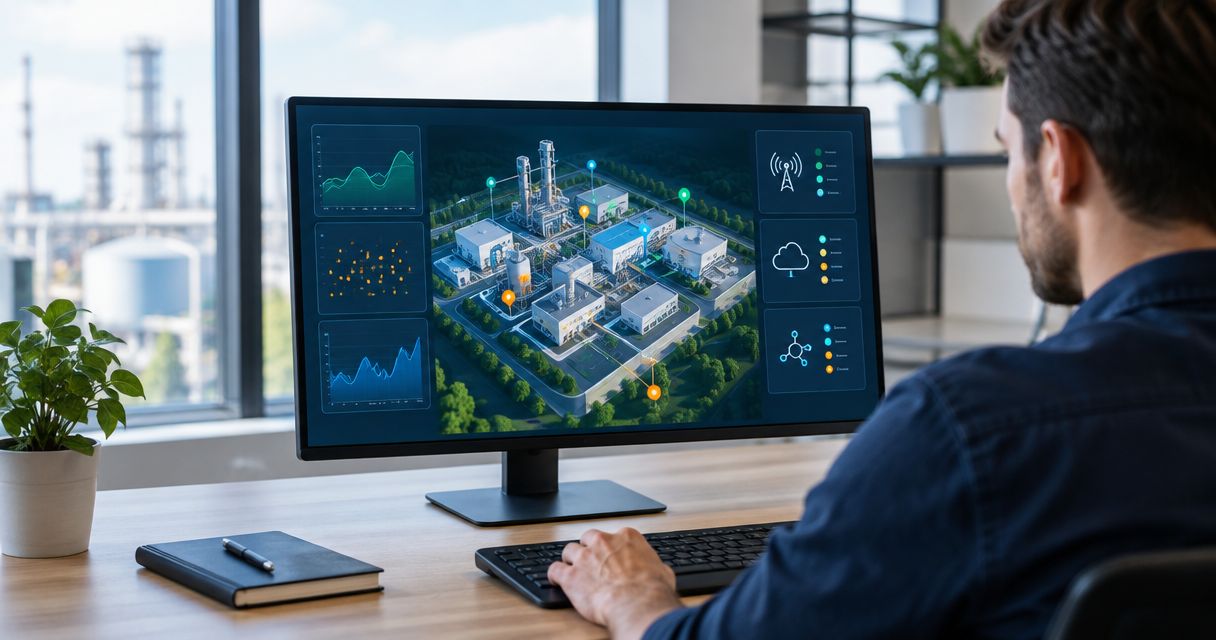
Yes. A digital twin can combine LoRaWAN and MQTT data in one view when an IoT platform connects both sources and maps their readings to shared buildings, rooms or equipment. The important condition is that device identity, units and timestamps remain meaningful after integration; putting readings beside each other doesn't automatically make them comparable.
- Digital twin multiple protocol data integration combines LoRaWAN and MQTT readings through shared asset context, not identical transport.
- LoRaWAN and MQTT can appear in the same data path; they aren't competing equivalents.
- Normalize units, preserve timestamps and associate each measurement with the correct physical asset.
- Kilo combines platform connectivity and digital twins; individual device mappings still need validation.
Can a digital twin combine LoRaWAN and MQTT data in one view?
Yes—the twin needs a common asset model, not a common device protocol. A wireless temperature sensor and an MQTT-connected equipment gateway can contribute different observations about the same room or machine. Their original connections don't need to change simply because you want a shared view.
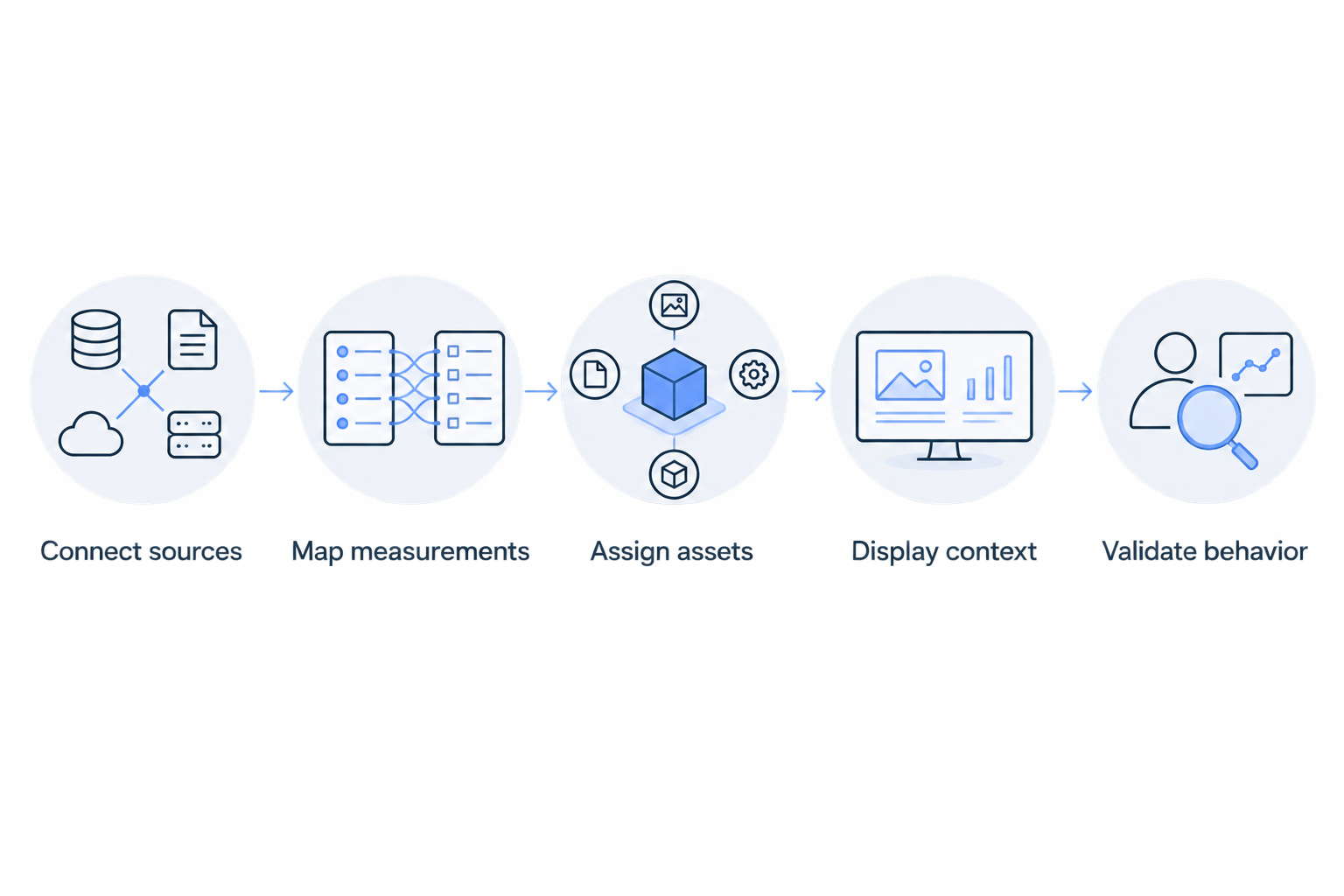
The integration follows a practical sequence:
- Connect sources. Receive LoRaWAN application data through a supported network-server integration and receive MQTT messages through an appropriate broker or connector arrangement.
- Map measurements. Decode payloads and translate fields into named measurements with known units.
- Assign assets. Associate each source with the room, equipment or other physical entity it describes.
- Display context. Present those measurements together while retaining their individual timestamps and source identities.
- Validate behavior. Confirm that updates, interruptions and unexpected payloads produce understandable results.
A shared view is the output of that work, not a substitute for it. The same principle applies whether your interface uses a floor plan, an equipment page or a conventional dashboard.
How LoRaWAN and MQTT fit into the same architecture
LoRaWAN and MQTT solve different connection problems. LoRaWAN supports communication between end devices and a network through gateways; MQTT is a publish-and-subscribe messaging protocol used between connected software and devices.
They can also form parts of the same path. A LoRaWAN network server can expose application messages through MQTT, depending on its integration configuration. In that arrangement, MQTT carries data that originally traveled over LoRaWAN.
| Data path | Best fit | What it contributes | Integration advantage | Limitation to address |
|---|---|---|---|---|
| LoRaWAN application integration | Wireless sensor observations | Decoded measurements and device identity | Keeps the sensor network separate from the asset view | Device payloads and network-server interfaces still need compatible handling |
| MQTT-connected equipment or gateway | Equipment telemetry published through a broker | Measurements, states or events defined by the publisher | Gives existing publishers a messaging path into the platform | Topic names don't establish units, asset relationships or trustworthy timestamps |
| LoRaWAN data transported through MQTT | Networks using MQTT for application delivery | LoRaWAN-origin observations inside MQTT messages | Connects the network-server output to an MQTT ingestion workflow | Requires both message-envelope handling and sensor-payload interpretation |
Don't create duplicate device records just because the same measurement appears through different interfaces. Decide which path is authoritative before building charts, alarms or calculations around it.
What a shared digital twin data model needs
A digital twin connects measurements to something recognizable in the physical world. For a building, that context might include the site, room and equipment served; for a machine, it might include components and the sensors associated with them.
Start with stable asset identities rather than transport addresses. An MQTT topic or a LoRaWAN device identifier helps locate a source, but neither should become the sole definition of the physical asset it describes.
Keep these fields explicit in your integration design:
- Source identity: Which device or integration produced the observation?
- Asset relationship: Which room, machine or component does it describe?
- Measurement meaning: Is the value air temperature, surface temperature, electrical demand or equipment state?
- Unit and scale: What does the raw value mean after decoding?
- Observation time: When was the measurement taken, if that information is supplied?
- Receipt and quality context: When did it arrive, and is it missing, invalid or stale?
These are requirements for your data model, not a claim that every platform exposes identical fields. Establish how your selected platform represents them before relying on a combined view.
Preserve the original meaning before simplifying the presentation. A clean label is useful only when you can trace it back to the correct source and interpretation.
How to combine the readings without losing their meaning
Treat ingestion, normalization and visualization as separate responsibilities. That separation makes faults easier to locate: a missing chart value could originate in the device, transport, decoder, asset mapping or display binding.
Connect sources
For LoRaWAN, identify the network-server integration and obtain a representative application message. Confirm where decoding happens and whether the platform receives raw payload bytes, decoded fields or an envelope containing both.
For MQTT, establish the broker connection, authentication, permitted topics and expected payload structure. A successful connection proves transport access; it doesn't prove the message describes the asset you intend to monitor.
Map measurements
Translate source fields into consistent measurement names and units. If sources express temperature differently, convert them deliberately and retain enough context to explain the displayed result.
Don't merge measurements just because their names look similar. Ambient temperature and equipment surface temperature describe different conditions, even when both use the same unit.
Assign assets
Associate the measurements with the correct physical entities. A room sensor belongs to its location, while a compressor's operating state belongs to the compressor; a relationship between those assets lets you interpret them together without pretending they are the same thing.
Display context
Show the measurements with their own freshness information. Place related observations together, but keep missing data distinguishable from a valid normal reading.
Validate behavior
Test representative messages, interrupted connections and changed payloads. Record the expected interpretation before testing so that a plausible-looking value doesn't pass merely because it appears on screen.
The useful test is whether someone unfamiliar with the integration can explain what each value measures, where it came from and how current it is. If that requires guessing, improve the data model before adding more devices.
An illustrative cold-room workflow
Consider an illustrative design, not a customer deployment: a LoRaWAN sensor measures room air temperature, while an equipment gateway publishes refrigeration operating state through MQTT. You want a technician to inspect both in the context of the same cold room.
First, decode the temperature message and map it to the room's air-temperature measurement. Separately, interpret the gateway's operating-state field and associate it with the refrigeration equipment serving that room.
The shared view then shows the room measurement alongside the equipment state. The technician checks whether the readings are current and uses their timing to investigate an excursion. A running indication doesn't prove effective cooling, and a temperature change alone doesn't establish the cause.
Define the response as carefully as the display. Your design should identify who receives an alarm, what evidence they inspect and what action they take; a threshold notification is not a diagnosis or a compliance guarantee.
For hardware sourcing, Kilo Electronics is a separate online authorised dealer serving individual and business buyers. Select compatible equipment for the required measurements and integration path; hardware purchasing is separate from the platform software.
Why multi-protocol digital twin integration varies
The protocol pair doesn't determine the entire implementation. The work depends on how clearly the sources describe their observations and how much context the shared view requires.
- Payload interpretation: A documented decoded message needs different handling from an undocumented binary payload.
- Asset structure: A room-level overview requires fewer relationships than a model connecting equipment, components and the spaces they serve.
- Reporting behavior: Periodic measurements and event-driven updates need different freshness expectations.
- Time handling: Device observation time and platform receipt time answer different questions, especially after connection interruptions.
- Identity management: Device replacements and renamed MQTT topics need mappings that preserve the intended asset relationship.
- Access boundaries: Users and integrations need permissions appropriate to the assets and actions they handle.
A prototype that displays readings establishes the connection path. A dependable operational view also needs clear ownership of mappings, credentials and changes to device payloads.
Do LoRaWAN and MQTT readings need the same update rate?
No. LoRaWAN and MQTT readings can update at different rates, provided the view makes each observation's age clear. Displaying them together doesn't make them simultaneous.
This matters when you compare equipment behavior with environmental changes. Evaluate the reporting schedule and event timing before interpreting an apparent relationship; use observation timestamps where supplied, and distinguish them from arrival times.
A retained MQTT message also needs careful interpretation. Receiving a retained value when a subscriber connects doesn't establish when the underlying physical condition was measured.
Does a digital twin need a 3D model to combine protocols?
No. Combining protocol data depends on asset relationships and measurement mapping, not on a 3D model. A structured equipment page can answer the integration question without spatial graphics.
A floor plan or spatial model helps when location changes the decision, such as finding an affected room or identifying nearby equipment. It doesn't resolve incompatible units, incorrect source mappings or stale readings.
Where Kilo fits in a mixed-protocol deployment
The Kilo IoT Platform brings supported LoRaWAN and MQTT connectivity, digital twins, dashboards, rules and alarms into a platform for connected deployments. Kilo fits integrators building a shared operational view across supported device connections.
That is a useful starting point, not proof that an arbitrary sensor payload or equipment interface works without configuration. For a Kilo digital twin project, validate the specific connector, decoded fields, asset relationships and display requirements before treating the integration as complete.
Keep monitoring and control separate in the design. A shared view can inform a decision without issuing commands; adding control requires a compatible device, a configured command path and appropriate permissions. An accepted or delivered command is not evidence of the physical outcome—verification depends on supported feedback or subsequent measurements.
For a related implementation question, see connecting an MQTT edge gateway to the cloud platform. Establishing that connection is one part of the wider mapping and validation workflow.
FAQ
Can I keep my existing LoRaWAN network server?
You can retain an existing LoRaWAN network server when its application integration is compatible with the receiving platform. Confirm the authentication method, message format and decoding responsibility rather than assuming compatibility from the protocol name.
Does MQTT automatically standardize my sensor data?
No. MQTT transports messages but doesn't establish a shared measurement schema. You still need to interpret fields, units, device identity and timestamps.
Can different sensor brands describe the same room?
Yes, sensors from different brands can contribute observations about the same room when their integrations and payloads are supported. Keep distinct measurements separate and define which source is authoritative when measurements overlap.
What happens to the digital twin when a sensor disconnects?
A disconnected sensor stops supplying fresh observations through that path. Design the view to distinguish its last known value from current data, and validate how your platform detects and presents missing updates.
Do I need AI to combine LoRaWAN and MQTT data?
No. Combining LoRaWAN and MQTT data requires connectivity, decoding and asset mapping, not AI. AI assistance is a separate capability and doesn't replace correct measurement definitions.
Can I move a sensor to another room without losing its meaning?
You need to update the sensor's asset association when its physical location changes. Establish how the platform handles historical relationships so earlier readings aren't mistakenly interpreted as observations from the new room.
Test a stale reading before expanding the deployment
Before adding more assets, interrupt a test source and inspect the combined view. Can the person using it tell which measurement stopped updating without opening an integration console?
A shared view should make uncertainty visible, not hide it behind a tidy layout. Proving that behavior gives you a stronger foundation than adding another chart to an otherwise ambiguous twin.
Written by Tim Kravchunovsky


