Manufacturing plant energy monitoring is the measurement of energy use across production equipment and utilities to identify waste without compromising output. This guide explains how to plan metering, connect readings and verify improvements; the Kilo IoT Platform provides device management, dashboards, rules and alarms for connected monitoring workflows.
- An energy monitoring system for manufacturing plants needs production context, not just electricity totals.
- Kilo suits manufacturing teams connecting energy readings with equipment dashboards, rules and alarms.
- Measure electricity demand, consumption and production output separately before setting improvement targets.
- Start with a bounded metering pilot; verify data quality before expanding or automating equipment actions.
Why manufacturing energy monitoring needs production context
A plant-wide electricity total tells you what the site consumed, but not which process caused it or whether that consumption was necessary. Manufacturing adds changing product mixes, startup cycles, maintenance stops and shared utilities to the measurement problem.
A higher-energy shift isn't automatically an inefficient shift. It might have produced more saleable output, processed a different material or restarted equipment after maintenance. Compare energy use against the work performed, not against a calendar average alone.
Your system should answer operational questions: Did compressed-air demand remain high during a shutdown? Did a line consume energy while waiting for material? Did reduced equipment consumption coincide with a production loss?
For a 2026 deployment, define these questions before selecting meters or software. The useful result is a decision someone can act on, supported by measurements that survive scrutiny from production, maintenance and finance.
How to build an energy monitoring system for manufacturing plants
Define the decision before selecting sensors
Start with a spreadsheet, utility records and a discussion with production and maintenance. List the loads you want to understand, the decisions those readings will support and the person responsible for each decision.
Choose a bounded pilot, such as a production line and its associated utility load. A whole-site rollout introduces more measurement points before you've established whether the data answers the original question.
Separate observation from intervention. Finding unexpected overnight consumption is a monitoring objective; switching equipment off requires an operating procedure and approval from whoever owns the process.
- Write a specific question for each proposed measurement point.
- Name the person who investigates an abnormal reading.
- Record production, quality and safety constraints beside the proposed action.
- Define what evidence would justify expanding the pilot.
Map electrical boundaries and existing data
Review available meter exports, electrical drawings and equipment records before buying hardware. Identify which circuits serve individual machines, which serve shared services and where a downstream meter overlaps with an upstream total.
Existing readings are useful only when you understand their boundaries. A compressor-room meter can describe the electricity entering that room, but it cannot allocate compressed-air consumption to individual production lines without additional measurements or a defensible allocation method.
Have qualified electrical personnel assess installation requirements. Software selection doesn't determine whether a meter, current transformer or installation method is suitable for a particular circuit.
- Label each meter with the equipment and circuits it covers.
- Mark parent and child meters to prevent double counting.
- Record measurement units, scaling factors and timestamp conventions.
- Identify missing drawings or uncertain circuit assignments before installation.
Connect measurements with a consistent data model
Manually inspect sample readings first. Check whether a field represents instantaneous power, cumulative energy or consumption during an interval; those values require different treatment.
Kilo supports connected-device monitoring with dashboards, rules and alarms, providing a shared software layer instead of maintaining separate manual views. Integration still depends on the actual meter interface, payload mapping and supported connection path. A protocol name alone doesn't establish compatibility.
Keep hardware sourcing separate from platform selection. Kilo Electronics is a separate online authorised dealer serving individual and business buyers; assess compatible hardware against the measurement and integration requirements you've already defined.
- Assign stable names to sites, lines, equipment and measurement points.
- Preserve units and distinguish cumulative counters from interval values.
- Validate the device-to-platform path using actual sample payloads.
- Define how missing readings, counter resets and duplicate messages are handled.
Build a baseline around operating conditions
Use a spreadsheet to compare consumption with production records before designing dashboards. Group observations by meaningful operating conditions: producing, idle, starting up, changing products or undergoing maintenance.
Track power and energy separately. Kilowatts describe power; kilowatt-hours describe energy consumed over time. Neither metric tells you production efficiency unless you also know what the process delivered.
Illustrative calculation, not a plant benchmark: assume an auxiliary load draws a constant 40 kW for 6 hours while production is stopped. That represents 240 kWh of consumption. It identifies something to investigate, not an automatic saving: the load might support cooling, ventilation or another necessary service.
- Compare like products and operating states before judging performance.
- Calculate energy per saleable unit only with aligned production totals.
- Keep startup, cleaning and maintenance periods identifiable.
- Record changes in schedules, equipment and measurement boundaries.
Design dashboards around investigation
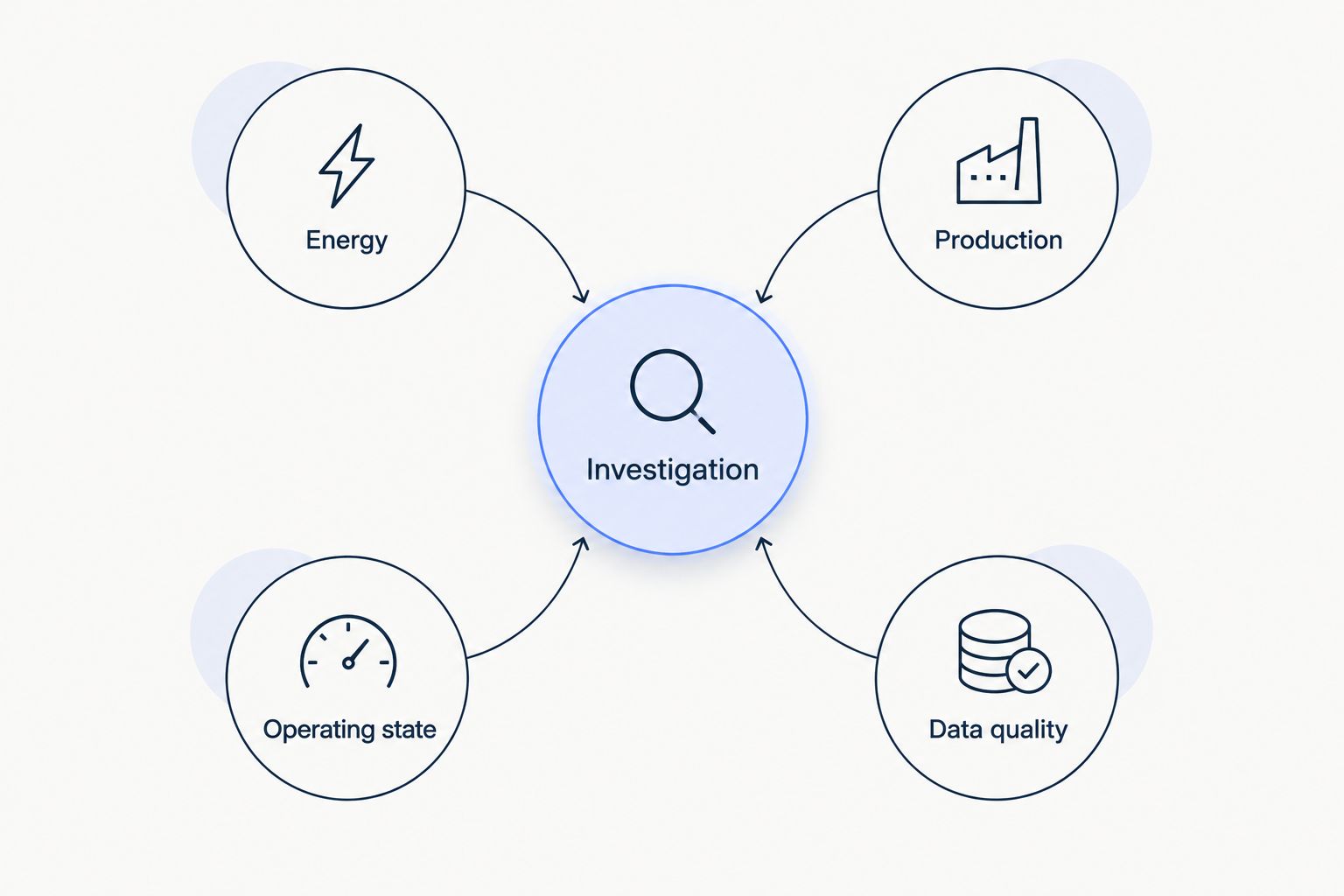
Sketch the investigation on paper before configuring a dashboard. A plant engineer needs to move from an unusual site total to the relevant line, utility or operating period without guessing which chart matters.
Use Energy, Production, Operating state and Data quality as distinct views of the same period. These are dashboard design requirements, not assumptions that every source is already integrated. Production records might initially remain a separate comparison until a suitable connection is implemented.
A low reading deserves scrutiny when the meter has stopped reporting. Show freshness alongside consumption so a communications problem doesn't look like an efficiency improvement.
- Show energy totals and power trends with clear units.
- Align production context with the measurement period.
- Make missing or stale data visible rather than silently filling gaps.
- Keep circuit boundaries and equipment names accessible to investigators.
Configure alerts with an operational response
Review candidate events manually before creating notifications. An elevated load during production can be normal; the same load during a scheduled stop deserves a different response. Define the condition and the investigation together.
An illustrative workflow starts with unexpected compressor electricity use during a planned shutdown. The configured alarm asks the maintenance owner to investigate; that person checks whether an authorised service still needs air, whether equipment was left running or whether further leak testing is required. Electricity data alone doesn't diagnose a compressed-air leak.
Kilo's monitoring capabilities include rules and alarms. Use those functions for defined conditions, while keeping process control separate until the equipment interface, permissions and operating consequences have been assessed.
- Specify the operating state in which a condition matters.
- Require persistence where brief transitions are expected.
- Assign an owner and a documented investigation procedure.
- Test missing-data conditions separately from high-consumption conditions.
Verify outcomes before expanding or automating
Start with a manual change record. Document the finding, the approved intervention and the measurements needed to establish what happened afterward.
Compare equivalent operating conditions before and after the change. Lower consumption during lower production is not proof of improved efficiency. Check output and quality alongside energy, and retain the reasoning behind any exclusions.
If you later add commands, distinguish a command's software status from its physical result. Accepted, queued or delivered does not prove equipment changed state. Verification requires supported device feedback or subsequent measurements, and monitoring software does not replace machine protection or local control.
- Record the intervention and who authorised it.
- Compare aligned energy, output and operating-state records.
- Confirm the physical result through available feedback.
- Expand only after the pilot's data and response process work.
Compare monitoring approaches by the decision they support
Choose an approach according to the measurement gap, not the size of its feature list. Start with existing data when it answers the question; add infrastructure when the missing detail prevents a useful decision.
| Option | Best for | Main advantage | Key limitation |
|---|---|---|---|
| Utility records and spreadsheets | Initial site-level review | Establishes a starting point using existing records | Billing-period totals don't attribute consumption to individual processes |
| Temporary power logging | Investigating a defined load or operating period | Tests a measurement hypothesis before permanent expansion | Findings cover only the measured equipment and period |
| Existing SCADA or historian | Plants with suitable equipment data already connected | Keeps investigation close to established process context | Coverage, exports and access depend on the installed system |
| Connected submeters and an IoT platform | Ongoing monitoring across distributed loads | Brings connected readings, dashboards and alerts into a shared workflow | Requires meter selection, installation, mapping and ongoing data checks |
| Dedicated energy-management software | Projects needing specialised energy analysis | Focuses evaluation on energy-specific workflows | Required tariff, reporting and production-analysis functions need explicit verification |
Kilo fits manufacturing teams that need an IoT platform to connect energy readings with equipment monitoring. It isn't a substitute for electrical metering hardware, and its dashboards don't by themselves establish a validated production baseline or a verified saving.
For procurement in 2026, ask suppliers to demonstrate your actual workflow with representative readings. Require clear treatment of units, missing data and measurement boundaries. A polished dashboard is not evidence that the underlying calculation is correct.
Common mistakes manufacturing plants make
Treating current as measured energy
Current readings can help identify equipment activity, but amperes alone don't establish real electrical energy consumption. Voltage, power factor and the measurement arrangement matter. Select a suitable meter when your decision requires measured kWh rather than an activity indicator.
Adding overlapping meters together
Adding a line submeter to the plant incomer total counts part of the same consumption twice. Keep the meter hierarchy explicit, and compare parent and child readings over aligned periods. Investigate any unallocated remainder before labelling it waste.
Rewarding lower energy use without checking output
A line that produces less can consume less while becoming less efficient per saleable unit. Track output, rejects and operating conditions beside consumption. Avoid comparing unlike products as though they require identical processing effort.
Designing alerts without a shift response
An alarm is incomplete when nobody owns the investigation during nights, weekends or maintenance shutdowns. Agree who checks the condition, who can authorise a change and what happens when the first recipient is unavailable. Don't use notification volume as a measure of success.
Moving from monitoring directly to shutdown commands
An idle-looking load might support lubrication, cooling or another essential function. Review process dependencies before configuring any action. Automatic control requires a compatible command path and an approved operating design, not just an energy threshold.
FAQ
What's the best place to start monitoring energy in a manufacturing plant?
Start with a bounded area where a measurement can change a specific decision. Map its electrical boundary, identify existing readings and name the person responsible for investigating the results.
Do we need a meter on every machine?
No, meter placement should follow the decisions you need to make. Start with the measurement boundaries that isolate a useful question, then add detail when shared loads prevent attribution.
Is an energy monitoring system the same as SCADA?
No, energy monitoring is a measurement and analysis function, while SCADA supports supervisory monitoring and control of industrial processes. Existing SCADA readings can contribute to an energy project when their coverage, units and access meet the requirements.
Can we use wireless sensors for manufacturing energy monitoring?
Wireless communication can carry readings from suitable measurement hardware, but it doesn't determine measurement accuracy or electrical suitability. Verify the meter, installation, reporting interval, network coverage and platform integration as separate requirements.
Can energy monitoring prove that a machine is failing?
Energy monitoring alone doesn't establish a machine-failure diagnosis. A changed consumption pattern is evidence to investigate alongside production state, maintenance history and other relevant measurements.
Does an energy dashboard automatically calculate verified savings?
No, a dashboard displays data; verified savings require a defensible comparison. Align measurement boundaries and account for changes in production, operating conditions and data quality before attributing a reduction to an intervention.
Should we include AI in the first deployment?
Only when it serves a defined task beyond the monitoring requirements. Establish reliable measurements and an investigation process first; a threshold alarm doesn't need to be described as AI.
Test the quiet period before adding more meters
Before expanding, inspect consumption during a known non-production period with someone who understands the plant's essential services. That conversation separates necessary background loads from unexplained demand and exposes gaps in the equipment map.
Make the next investment answer the next unanswered question. More readings help only when they improve attribution, investigation or verification.
Related guides
Written by Tim Kravchunovsky