
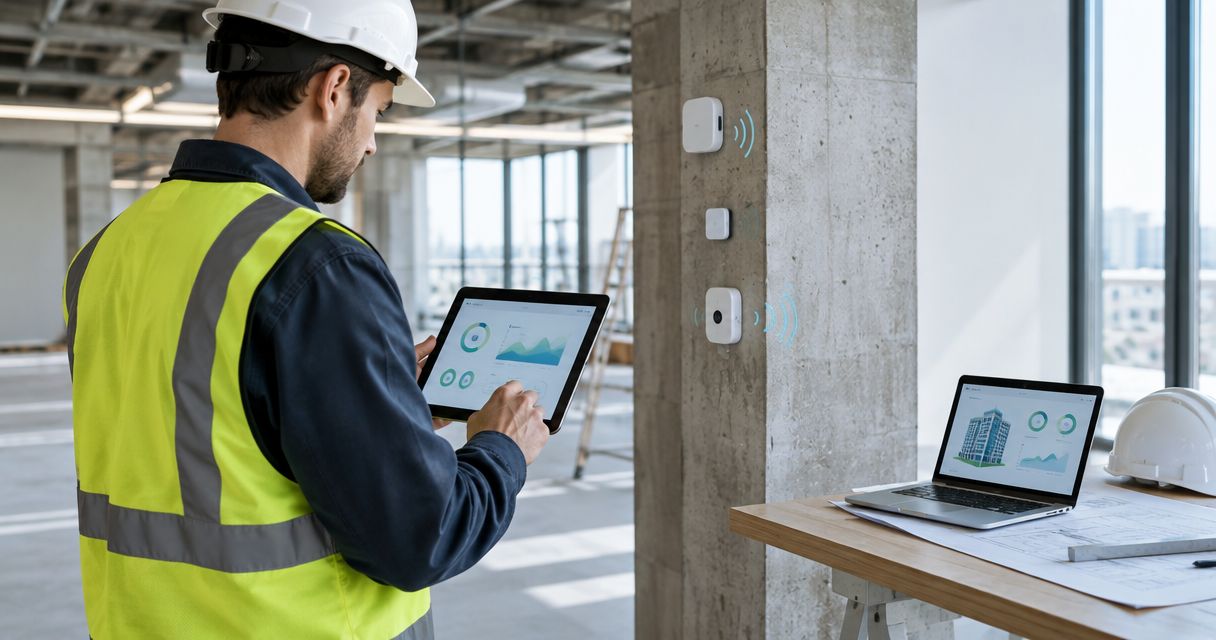
The cost to retrofit a building with IoT sensors depends on the installed scope: devices, network infrastructure, installation, commissioning and ongoing software—not just the sensor purchase. The platform pricing for the Kilo IoT Platform is one part of that budget; a usable project estimate also needs a site survey, an itemized hardware schedule and a defined handover standard.
- The cost to retrofit building with IoT sensors requires an installed-scope estimate, not a sensor-only quote.
- Separate initial installation from recurring software, connectivity and maintenance commitments.
- Kilo provides IoT platform software; hardware sourcing and installation belong in separate budget lines.
- Test representative installation locations before committing to a building-wide rollout.
How much does it cost to retrofit a building with IoT sensors?
A defensible retrofit budget is the sum of the equipment, installation, commissioning and operating commitments needed to deliver your monitoring requirements. There isn't a building-wide total you can calculate from floor area alone. You first need to specify what you will measure, where you will measure it and what someone must do with the information.
A temperature-monitoring project and a project that also measures electricity, detects leaks and controls equipment have different scopes. Even when both cover the same building, their installation methods, integration work and acceptance tests differ.
Use this breakdown to request comparable quotations. Each supplier should identify what is included, what is optional and what remains your responsibility.
| Budget component | What the quotation should cover | What to clarify |
|---|---|---|
| Site assessment | Measurement locations, access conditions and connectivity testing | Whether difficult locations are tested before equipment selection |
| Sensors and accessories | Devices, probes, mounting materials and suitable protection | Whether accessories and configuration are included |
| Network infrastructure | Required gateways, power, backhaul and network setup | Which existing infrastructure can actually be reused |
| Installation | Mounting, wiring where needed, access arrangements and labeling | Who supplies access equipment and specialist labor |
| Commissioning | Device identification, payload mapping, dashboards and alarm testing | What evidence establishes successful handover |
| Software and services | Platform subscription, support and any integration work | Billing basis, service scope and renewal conditions |
| Ongoing upkeep | Battery replacement, calibration where required and fault investigation | Who performs the work and how site visits are handled |
Compare complete scopes before comparing totals. A quotation that excludes commissioning isn't equivalent to one that includes tested alarms and a trained responder.
Define the monitoring decision before counting sensors
Start with the question your building team needs answered. “Where are temperatures drifting?” requires a different measurement plan from “Which electrical circuits account for overnight consumption?” A generic request to make a building smart leaves too much room for inconsistent proposals.
For each proposed measurement, record the location, the physical quantity, the required reporting behavior and the person who will use it. Also specify what happens when readings stop arriving. A dashboard without an owner for missing data leaves a maintenance gap.
Treat coverage as an engineering requirement rather than a purchasing target. Room layouts, equipment placement and environmental differences determine useful measurement positions; buying a device for every room doesn't automatically produce meaningful data.
An electrical measurement also needs a defined purpose. Operational energy monitoring and measurements used for tenant billing are different requirements, so identify the intended use before selecting equipment or requesting installation work.
Compare monitoring, integration and control scopes
These are scope choices, not fixed-price packages. Select the simplest approach that answers the building's actual question, then ask suppliers to quote any expansion separately.
| Retrofit approach | Best for | Main advantage | Main limitation |
|---|---|---|---|
| Add-on wireless monitoring | Adding measurements without extensive new signal cabling | Flexible placement where coverage and device suitability are confirmed | Battery upkeep and radio coverage remain design responsibilities |
| Reuse existing measurements | Buildings with accessible, suitable meter or control-system data | Avoids duplicating measurements that already meet the requirement | Interface access, data mapping and permissions still need work |
| Hybrid monitoring | Buildings with useful existing data and gaps requiring new sensors | Lets each measurement use an appropriate source | Requires consistent naming and management across different sources |
| Monitoring with equipment control | Projects that require supported actions as well as observations | Connects a detected condition to a configured response | Adds actuator compatibility, command-path testing and outcome verification |
Wireless monitoring removes the need for a signal cable at suitable measurement points, but it doesn't remove every infrastructure requirement. Gateways still need an appropriate installation location and the power and backhaul their design requires.
Reusing existing data is valuable only when that data is accessible and fit for purpose. A meter on the wall doesn't establish that its readings can be obtained at the required interval or integrated into your chosen software.
Keep control separate from basic monitoring in the quotation. Sending an alert about a leak is not the same scope as closing a valve. Automatic shut-off requires a compatible actuator, a configured command path and a way to verify what happened.
Why building sensor retrofit costs vary
The largest differences between quotations often come from assumptions about the building and the work—not from the sensor specification alone.
- Measurement requirements: Temperature, water presence and electrical consumption need different equipment and installation methods. Specify the decision each measurement supports.
- Physical access: Ceiling access, occupied rooms, plant spaces and restricted areas affect how installation and later maintenance are organized.
- Network conditions: Building materials, equipment and gateway placement affect radio performance. Test the intended locations rather than assuming coverage from a floor plan.
- Existing infrastructure: Usable power, network access and accessible measurement interfaces change what must be installed. Confirm ownership and permission to use them.
- Integration depth: Displaying measurements, linking them to building locations and exchanging data with another system are separate deliverables.
- Operating responsibilities: Calibration where required, battery changes, alarm review and fault investigation need assigned owners. Include those responsibilities in the operating budget.
Ask suppliers to attach their assumptions to the proposal. If a quote assumes unrestricted daytime access but your building requires supervised access outside normal hours, resolve that difference before approval.
Build an estimate that survives installation
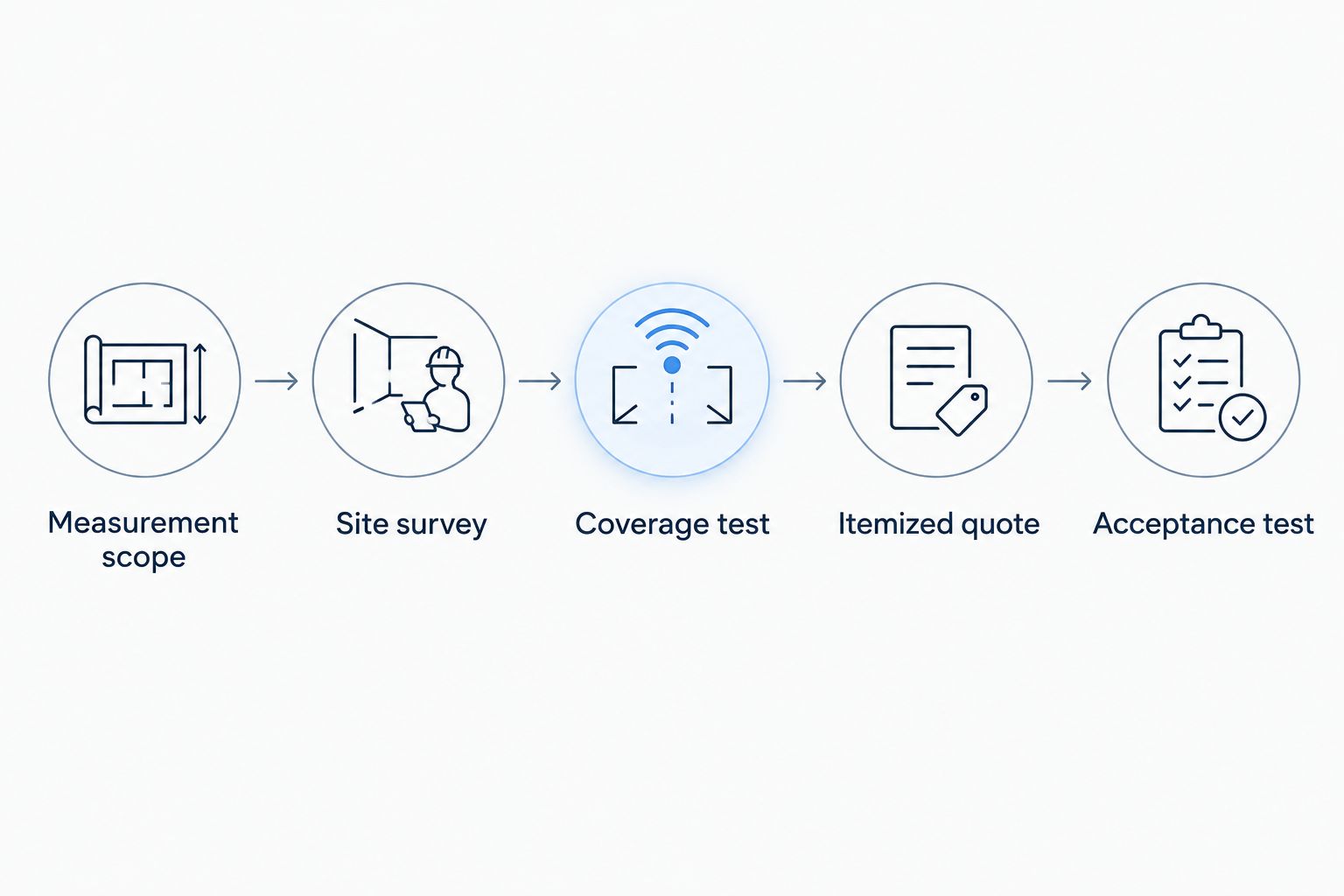
A useful estimate follows the deployment sequence. Each stage should resolve uncertainty before the next commitment, rather than leaving all testing until after the hardware arrives.
- Measurement scope: Identify the locations, quantities and decisions the project must support. Separate essential measurements from later additions.
- Site survey: Inspect mounting positions, access restrictions, power and available backhaul. Record conditions that affect both installation and servicing.
- Coverage test: Test representative difficult locations using the proposed network approach. Agree how failed locations will be addressed.
- Itemized quote: Request equipment quantities, installation tasks, configuration work and recurring commitments as separate lines. Make exclusions explicit.
- Acceptance test: Define how the installer will demonstrate correct measurements, location labels, alarms and access permissions.
Use the same scope sheet for every bidder. Otherwise, one supplier might quote installed devices while another quotes boxed hardware, and the apparent comparison tells you little about the finished system.
Set acceptance criteria around observable results. A device appearing in an inventory is not enough: its measurement should reach the correct location record, display with the correct unit and support the intended workflow.
Where alarms are included, test who receives them and what the recipient is expected to do. Keep the test appropriate to the application; a threshold alert alone doesn't establish regulatory compliance or safe conditions.
Separate installation spending from operating commitments
Your initial budget should cover the work needed to reach accepted operation. Your operating budget should cover the work and services needed to keep it useful. Mixing these categories hides future responsibilities.
For installation, include site assessment, equipment, mounting, infrastructure, configuration, testing and training. If your staff perform part of the work, record that effort instead of treating it as absent from the project.
For ongoing operation, identify software subscriptions, applicable network services, support, maintenance visits and device upkeep. Ask who investigates a missing measurement and who decides whether the fault belongs to the sensor, network or application.
Use the same operating horizon when comparing proposals. A hardware purchase and a managed-service proposal can't be compared fairly if one includes continuing support and the other stops at delivery.
Also define how configuration and records will be handed over if the installer changes. Device identifiers, locations, mounting details and agreed operating procedures are useful project assets, not incidental paperwork.
Where the platform fits in a retrofit budget
Kilo is an IoT platform for teams that need connected-device data, dashboards, alarms and automation in one operating layer. For a retrofit, the practical question is which of those functions the project needs at handover—not whether every available feature should be included.
An illustrative monitoring workflow starts with a compatible sensor reporting a measurement. The deployment associates that measurement with the correct building location, presents it to users and applies configured conditions for an alarm; the assigned person then investigates and records the response through the agreed process.
Kilo supports that platform layer, but it doesn't replace sensor placement, network engineering or installation. Device interfaces, payload mapping and permissions must match the actual deployment. A shared protocol name alone doesn't prove compatibility.
Source hardware separately from software. Kilo Electronics is a separate online authorised dealer for compatible hardware, serving individual and business buyers; purchasing there is not an additional requirement for using the platform.
Does a wireless retrofit eliminate installation work?
Wireless sensing eliminates signal cabling at suitable sensor locations, not commissioning or maintenance. You still need mounting, device identification, coverage checks and a working path from the measurement to the person using it.
Ask for installed and commissioned scope rather than equipment supply alone. Where gateways are required, include their power, network access and placement in the design.
Is adding sensors cheaper than replacing a building management system?
Adding sensors and replacing a building management system are different scopes, so compare the required outcomes first. An add-on monitoring project doesn't automatically replace scheduling, equipment control or other functions your existing system performs.
If you only need missing measurements and alerts, quote that scope separately. If you also need control-system replacement, define the equipment interfaces and operational requirements before comparing proposals.
How do you reduce the budget without weakening the project?
Reduce unnecessary scope before removing testing. Start with measurements tied to a clear decision, reuse suitable existing data where accessible and standardize naming and configuration across repeated locations.
Keep a representative difficult area in the pilot. A pilot limited to convenient locations doesn't answer whether the proposed design works in the spaces that create installation risk.
FAQ
Can I estimate a building sensor retrofit from square footage?
Square footage alone doesn't establish the retrofit scope. Measurement locations, building layout, network conditions and installation access determine what the project needs.
What should I ask an installer to include in the quote?
Ask for equipment, mounting, network infrastructure, configuration, commissioning and handover responsibilities as separate items. Require explicit exclusions and acceptance criteria.
Can I reuse sensors that are already in the building?
You can reuse existing sensors when their measurements, interfaces and condition meet the project requirements. Confirm access to the data and compatibility before removing replacement equipment from the scope.
Do all wireless building sensors need a gateway?
Gateway requirements depend on the selected device and network architecture. Confirm the complete communication path, including power and backhaul where required, before purchasing.
Who should maintain the sensors after installation?
Assign maintenance to a named internal team or service provider before handover. The agreement should cover device faults, battery replacement and calibration where the application requires it.
Will installing sensors automatically lower my energy use?
Installing sensors provides measurements; it doesn't establish energy savings. Savings require a useful finding, an effective intervention and evidence that consumption changed under comparable conditions.
Should I include AI in the first retrofit phase?
Include AI only when it serves a defined workflow. Basic measurement collection and threshold alarms don't require AI, and adding it doesn't remove integration or verification work.
Put maintenance access in the acceptance criteria
Before approving a mounting position, ask how someone will reach that sensor again. A location that works for measurement but requires difficult access for routine servicing creates an obligation that lasts beyond installation day.
Make the handover demonstrate both use and upkeep: where the device is, what it measures, how its data is identified and who responds when it stops reporting. The finished project is a maintainable monitoring workflow, not a collection of installed sensors.
Related guides
Written by Tim Kravchunovsky


