
An open-source IoT platform is worth it when you need control over the software and have a team accountable for running it; managed is the better fit when you want to focus on connected-device workflows rather than platform infrastructure. In 2026, compare an open-source deployment with a managed option such as the Kilo IoT Platform by who owns upgrades, recovery, security and integration work—not by the software license alone.
- Open source versus managed IoT is an ownership decision: choose who will maintain, secure and restore the platform.
- Open source is worth it when software control serves a concrete requirement and an accountable team supports it.
- Managed IoT suits teams prioritizing deployment workflows, but device integration and response planning remain your responsibility.
- Kilo brings device data, dashboards, automation and alarms together; evaluate its supported interfaces against your actual deployment.
Is an open-source iot platform worth it versus managed in 2026?
Choose open source for a specific control requirement, not simply because you can install it. Choose managed when operating the platform itself is work you want a provider to handle. Neither approach removes the need to understand your devices, data and response procedures.
The distinction isn't quite open source versus managed. Open source describes software licensing; managed describes an operating arrangement. Open-source software can be operated by your team or by a service provider, while proprietary software can also have different hosting arrangements. Compare the actual deployment and service boundaries, not just the labels.
| Decision area | Self-operated open source | Managed IoT platform |
|---|---|---|
| Best for | Teams with a concrete need for software control and an accountable operating team | Teams that want a provider to operate the platform infrastructure |
| Main advantage | You can inspect and modify code within the license terms | Infrastructure operation is assigned to the provider within the service scope |
| Main drawback | Your organization owns the deployment, maintenance and recovery work | You depend on the provider's supported features, interfaces and service terms |
| Device integration | Your team implements or maintains the required integration | You configure supported integrations and resolve any remaining gaps |
| Security responsibility | Your team maintains the deployed stack and its configuration | Responsibilities are divided between provider and customer |
| Exit planning | Preserve deployable code, configuration, data and operating knowledge | Establish what data and configuration you can export and reuse |
Before choosing, write down the requirement that changes the decision. Needing a particular deployment location is a requirement; wanting to avoid dependence on anyone is not a complete architecture. You still depend on hardware, libraries, infrastructure and people.
When self-operated open source earns its maintenance burden
Best for: developers and integrators who need software-level control and can sustain the resulting operating work. An open-source IoT platform makes sense when modifying the platform is part of the solution rather than a distraction from it.
For example, your product might require application behavior that an available managed service doesn't expose. Access to source code gives your team a route to implementing that behavior, subject to the license and the software's architecture. It does not establish that the change will be simple or easy to maintain.
The benefit is strongest when you can name the change, explain why configuration or an external integration won't solve it, and assign responsibility for maintaining it. Without that explanation, source access is an option you possess rather than a benefit you use.
The corresponding drawback is ongoing ownership. A working installation still needs dependency updates, backup procedures, monitoring and recovery testing. Changes to your own code also need to remain compatible with future upstream releases, or your team must maintain a separate version.
Ask who takes over when the original developer leaves. If the answer is nobody, the deployment has a staffing dependency that source availability alone cannot fix.
When managed IoT is the more practical choice
Best for: teams whose main work is building and using connected-device solutions, not operating platform infrastructure. Managed IoT is a practical choice when supported configuration and integrations meet your requirements and you want a provider responsible for the underlying service.
That changes where your team spends effort. Instead of maintaining the application stack, your developers and integrators can concentrate on payload mapping, useful dashboards, alarm logic and connections to other business systems. Those tasks remain part of the project.
A managed service also introduces boundaries. You work within its supported interfaces, permission model and product behavior. If a critical workflow requires an unsupported capability, the provider's operating responsibility doesn't resolve that functional gap.
Evaluate the service agreement separately from the feature list. Establish which incidents the provider handles, which conditions your team must diagnose, and how responsibility changes when the problem sits in a gateway, network connection or device.
Managed hosting transfers defined infrastructure tasks; it does not transfer ownership of your entire deployment. Someone still needs to respond when a sensor stops reporting or an alarm reveals a real equipment problem.
Why the operational workload varies
The useful comparison in 2026 is the work required to keep your particular deployment functioning. Device count alone doesn't describe that work: a deployment with uniform payloads and simple monitoring has different needs from one with custom integrations and remote commands.
These factors change the workload on either side:
- Integration depth. Standard supported interfaces require different work from custom payload decoding, application changes or connections to legacy systems.
- Recovery requirements. Decide what must be restored, who performs recovery and how you establish that the recovered system works.
- Security ownership. Assign responsibility for credentials, user access, software updates and deployment configuration.
- Data requirements. Identify which measurements, timestamps, device records and configuration you need to retain or export.
- Workflow complexity. A display-only dashboard has different testing requirements from automation that sends commands to equipment.
- Team continuity. Documentation and shared operating knowledge determine whether another person can maintain the system.
Use these factors to request comparable proposals. If one proposal includes platform operation and another assumes your team supplies it, they are not describing the same scope.
Compare total ownership without inventing a break-even point
There is no defensible universal break-even device count for open source versus managed IoT. The answer depends on your implementation, staffing and service scope. A platform comparison that ignores engineering time leaves out part of the decision.
Build an ownership worksheet covering implementation, routine operation, incident response, change management and eventual migration. For each activity, record the responsible organization, the required skills and the evidence that the work has been completed.
Separate infrastructure operation from application configuration. Maintaining a database is not the same task as deciding which temperature condition should trigger an alarm, even if the same engineer currently does both.
Also separate software from the rest of the deployment. Hardware purchases, connectivity, installation and any external model-provider usage belong in their own categories. Choosing a managed platform does not make these requirements disappear, and choosing open source does not automatically reduce them.
The deciding question is whether maintaining the platform advances your product or consumes time needed to deliver it. Use your own estimates and supplier terms rather than a generic savings claim.
Test the whole monitoring workflow before choosing
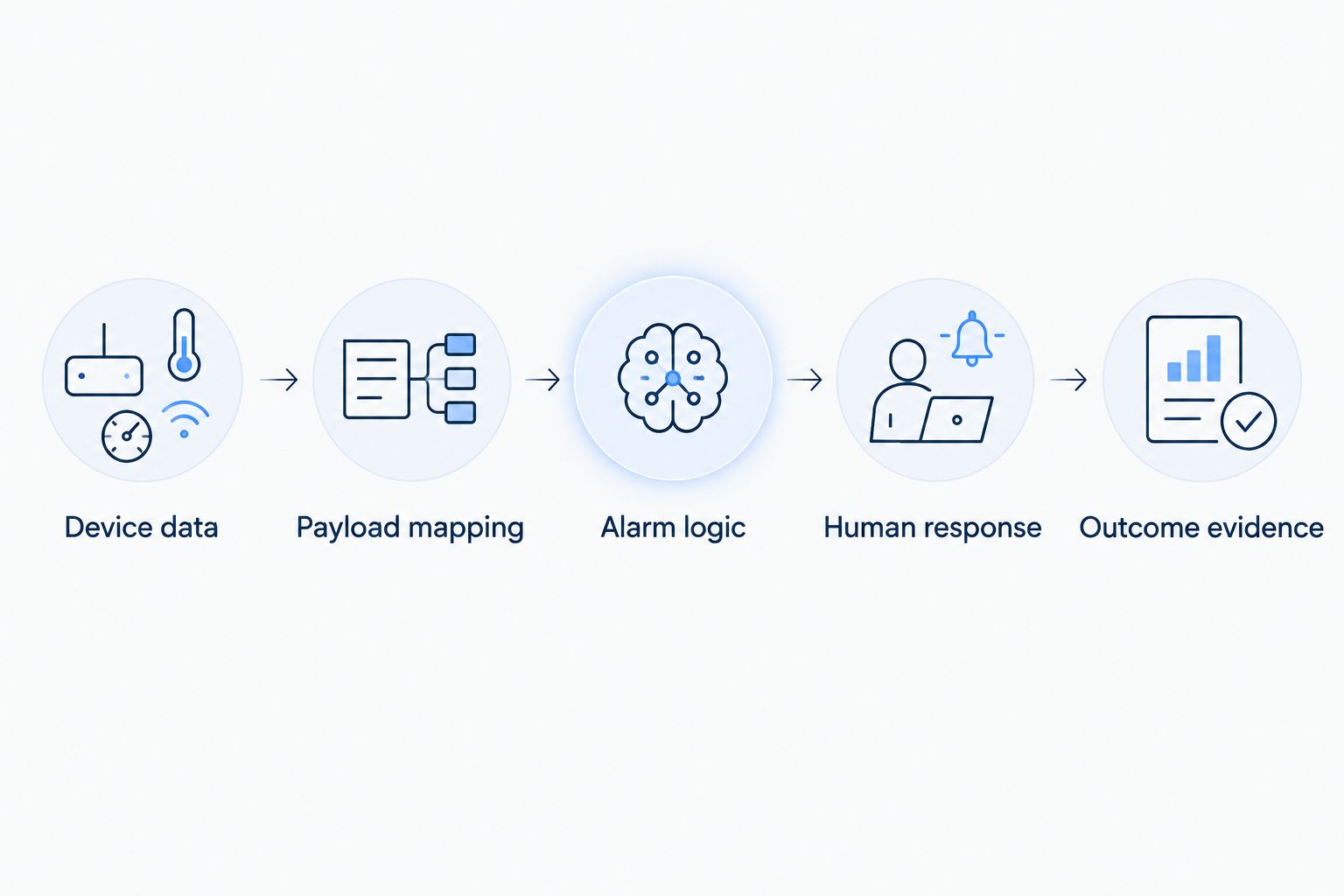
A useful evaluation follows a measurement from the device to the person who acts on it. This exposes gaps that a dashboard demonstration can hide. Run the same workflow against both candidates so the comparison stays fair.
Illustrative scenario: an integrator is configuring temperature monitoring for a storage room. This is an evaluation example, not a customer deployment or a recommended storage threshold.
- Device data. Receive a reading and establish its device identity, timestamp, unit and location. Confirm that an old reading cannot be mistaken for a current measurement.
- Payload mapping. Convert the incoming message into the fields your application needs. Document the decoder or configuration so another integrator can understand it.
- Alarm logic. Apply the site's approved condition and confirm what happens when data is missing, delayed or outside the expected range.
- Human response. Identify the person responsible for investigating the alarm. Establish how that person distinguishes a sensor problem from an actual room condition.
- Outcome evidence. Inspect subsequent readings and the relevant response information. An alarm being generated is not evidence that the underlying problem was resolved.
The test evaluates application behavior as well as operating responsibility. For self-operated software, establish who diagnoses each failure. For managed software, establish which evidence your team can inspect and what the provider needs to investigate.
Where Kilo fits in the managed-platform evaluation
Kilo is a relevant IoT platform option for integrators and developers connecting device data with dashboards, automation and alarms. Its stated scope also includes digital twins, permissions and AI assistance, so evaluate the parts that serve your project rather than treating every feature as a requirement.
The advantage is having these functions in one platform. The limitation is that your deployment still depends on supported device interfaces, correct configuration and an appropriate response process; a shared protocol name does not establish compatibility with every device or action.
For a monitoring project, start with data interpretation and alarm behavior. If you also need device control, evaluate the command path and feedback separately. Accepted, queued or delivered command status does not prove that the equipment reached the intended physical state.
For an AI-assisted workflow, Kilo supports a built-in assistant and compatible external clients such as Claude through MCP. Do not assume that every client exposes the same functions or uses the same approval behavior. Evaluate the actual permissions and supported tools needed for your task.
Hardware remains a separate purchasing decision. Kilo Electronics is a separate online authorised dealer for compatible hardware, serving individual and business buyers; buying hardware is not the same as selecting or configuring platform software.
Does open source actually reduce vendor lock-in?
Open source provides source-code access, but it does not automatically make your application portable. Your deployment can still depend on custom data models, modified code, undocumented configuration and the people who understand them.
Managed services create different dependencies, including their APIs, configuration formats and export capabilities. Evaluate those directly instead of assuming that every managed service creates the same migration burden.
Ask whether you can preserve device identities, measurement units, timestamps and historical data. Then ask what happens to alarm definitions, permissions, dashboards and integration credentials. Exporting measurements alone does not recreate a working application.
If a move becomes necessary, treat migration from an open-source IoT platform to a managed one as a separate implementation project. The selection decision comes first; migration needs its own validation and cutover plan.
Can a managed platform remove the need for an IoT engineer?
A managed platform removes only the work included in its service scope, not the need for deployment expertise. Someone must still understand the devices, configure the application and verify that its behavior matches the intended use.
Your staffing requirement changes rather than vanishes. You might need less application-stack maintenance while still needing an integrator to map payloads, manage credentials and test alarms. Assign those tasks before approving the project.
FAQ
Can I use open-source IoT software with a managed service?
Yes. Open source describes licensing, while managed describes who operates the service. Evaluate the provider's actual responsibilities and the license terms separately.
Is an open-source IoT platform automatically more secure?
No. Source availability alone does not establish the security of a deployed system. Configuration, access management, updates and incident response still require accountable owners.
Should I choose managed IoT if I already have cloud engineers?
Choose based on the work your engineers should own, not just the skills they possess. Having the ability to operate a platform does not establish that doing so is the best use of their time.
Can I keep my sensors when switching IoT platforms?
You can keep sensors when the new integration supports their connectivity, payloads and required behavior. Check device identity, credentials, decoding and any command requirements before committing to the move.
Does managed IoT mean every device command needs approval?
No. Approval behavior depends on the platform, client and configured workflow. In Kilo, the built-in assistant has a confirmation flow for direct device commands, while deliberately configured rules can execute commands autonomously.
What should I ask about data exports before signing?
Ask which measurements, timestamps, device records and configuration can be exported in usable formats. Also establish how you would rebuild integrations and alarm behavior outside the service.
Make the final decision with a handover test
Before approving either approach, ask someone other than the original implementer to explain how the deployment is maintained and recovered. Give that person the documentation and access they would actually receive—not an informal walkthrough that exists only for the evaluation.
Can they identify a stale reading, find the relevant configuration and explain who handles a platform incident? Can they distinguish a notification from a resolved physical problem? These questions test operational ownership without assuming that one hosting model is inherently better.
Choose open source when control is necessary and supported by an accountable team. Choose managed when its supported workflows meet your requirements and platform operation belongs with the provider. That is the useful decision—not whether running the software yourself is technically possible.
Written by Tim Kravchunovsky