

Choose the Kilo IoT Platform if you need application software to turn connected-device data into dashboards, alarms, automation and supported AI-assisted workflows; choose TEKTELIC if your immediate requirement is LoRaWAN gateways or sensors. The useful distinction in this 2026 comparison is application software versus physical network and sensing equipment—not a claim that either company replaces every layer of an IoT deployment.
- Kilo vs Tektelic is primarily an IoT platform versus LoRaWAN equipment decision, not a like-for-like software contest.
- Kilo fits teams building monitoring, automation and Physical AI workflows around connected devices.
- TEKTELIC fits buyers selecting LoRaWAN gateways and sensors for a deployment.
- Combining equipment and application software requires verified interfaces, payload decoding and command support—not just matching protocol names.
At a glance: compare the layer you actually need
An IoT deployment has several jobs: measure a condition, transport the reading, interpret it and help someone respond. Buying a gateway does not automatically deliver the application workflow, while selecting application software does not establish radio coverage.
| Dimension | Kilo | TEKTELIC |
|---|---|---|
| Best for | Integrators, developers and teams building connected-device applications | Buyers selecting LoRaWAN gateways and sensors |
| Standout capability | Bringing device context, dashboards, alarms, automation and AI assistance into an operating layer | Designing and supplying physical LoRaWAN equipment |
| Physical hardware | Platform software; hardware sourcing is separate | Gateways and sensors are central to the offering |
| Connectivity decision | Supported LoRaWAN, mioty and MQTT connections at the platform layer | LoRaWAN equipment selection at the device and gateway layers |
| Integration work | Configure supported connections, data interpretation and application behavior | Select equipment and establish its network and application integration path |
| Monitoring acceptance | Prove that readings become useful information and alarms | Prove that selected equipment measures and communicates as required |
| Outcome verification | Command status alone does not prove a physical result | Radio delivery alone does not prove a physical result |
| Pricing model comparison | Separate software access from equipment and other services | Separate equipment procurement from software and service scope |
Kilo is an IoT platform for teams that need to operate connected-device applications, not manufacture the devices themselves. TEKTELIC belongs on your shortlist when the equipment is the purchase decision.
Kilo fits application workflows rather than equipment procurement
Start here if you already have sensors, are evaluating several device types or need to decide what happens after a reading arrives. The application layer gives measurements their operational meaning: which asset produced them, how to display them, what condition requires attention and who is allowed to act.
The platform brings device data, digital twins, dashboards, automation, alarms, permissions and supported commands together. Its built-in assistant and compatible external clients can help users configure and operate connected deployments within their permissions. That makes the relevant evaluation a workflow demonstration, not a comparison of gateway specifications.
Illustrative workflow: a building integrator receives temperature readings from connected sensors. The integrator associates each reading with the correct location, configures an alarm condition and gives the responsible person a dashboard for investigating it. The evidence of success is a correctly interpreted measurement and a useful response path—not merely a connected-device indicator.
For Physical AI, the workflow extends from observations and context to supported actions and available feedback. Claude through a compatible MCP connection is one possible external client; exact operations depend on current tool coverage and permissions. Do not assume every function of a built-in assistant is exposed through an external client.
The limitation is equally practical: application software cannot compensate for an unsuitable sensor, missing network access or an undocumented command interface. Select the platform for the application work it performs, while assigning the physical installation and integration work explicitly.
TEKTELIC fits LoRaWAN gateway and sensor selection
TEKTELIC is the more relevant choice when your unresolved requirement is physical LoRaWAN equipment. Gateways receive radio traffic from end devices and connect into a network architecture; sensors produce the measurements your application needs.
That equipment decision deserves its own evaluation. A gateway shortlist should address installation conditions, the applicable regional radio configuration, network connectivity and the intended network-server connection. A sensor shortlist should address the measured variable, installation method, environmental suitability and how its payload is interpreted.
The advantage is a direct match to an equipment requirement. The limitation is that purchasing hardware does not, by itself, define your complete dashboard, alarm, permissions or automation workflow. Evaluate any proposed software or managed service separately rather than assuming it comes with the physical device.
Keep the purchasing channels distinct. Kilo Electronics is a separate online authorised dealer for compatible hardware, serving individual and business buyers; it is not the platform itself or a required additional platform purchase. Equipment selection still depends on the documented requirements of your deployment.
Neither connectivity label proves end-to-end compatibility
LoRaWAN, mioty and MQTT describe different communication technologies and roles. Their names are useful starting points, but they are not evidence that a particular sensor, gateway, network service and application will work together without configuration.
For a LoRaWAN project, distinguish these layers:
- Sensor: produces a measurement and encodes it into a payload.
- Gateway: receives radio traffic and forwards it toward the network infrastructure.
- Network server: performs LoRaWAN network functions and exposes an application integration path.
- Application: interprets data and supplies the monitoring or operating workflow.
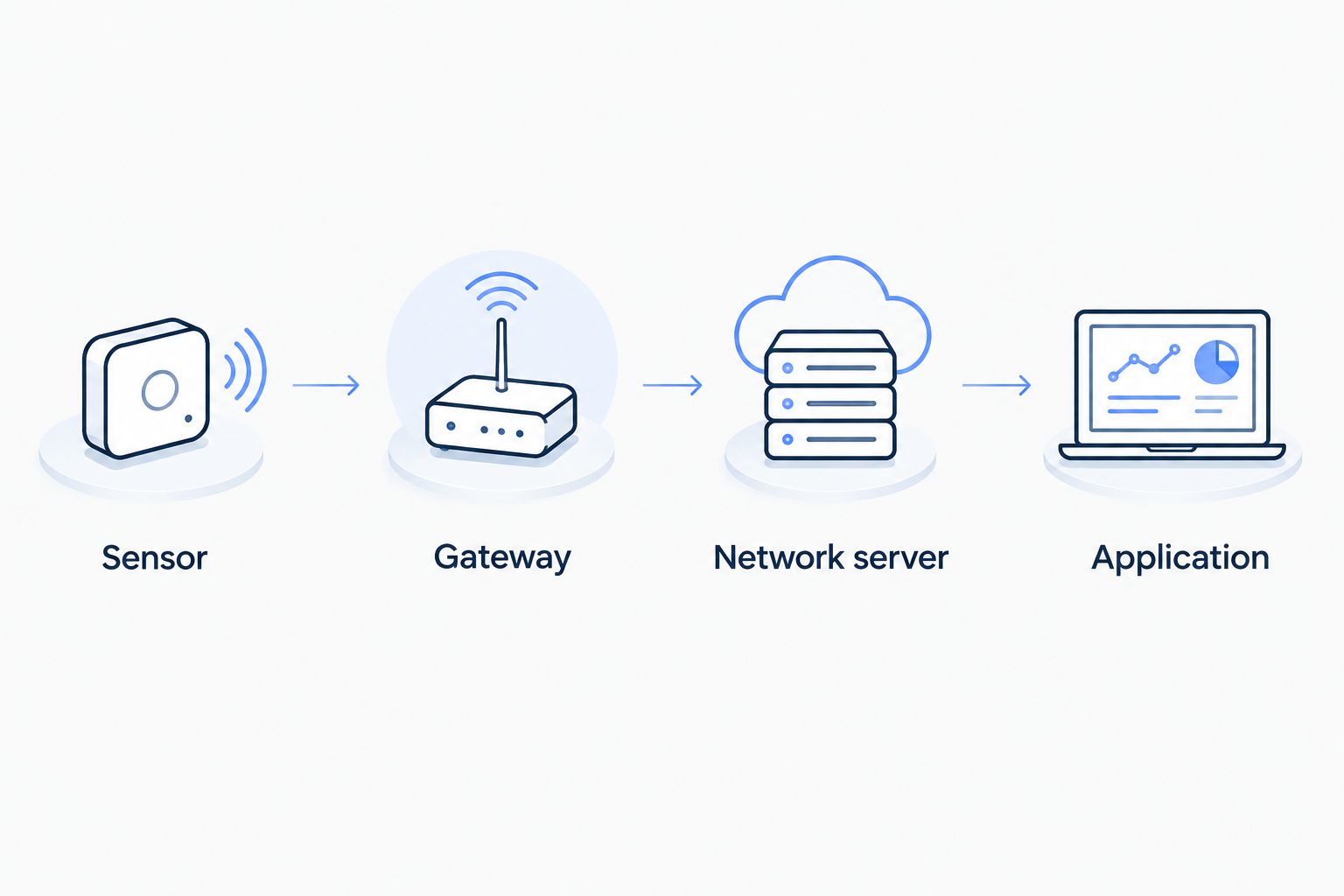
An application platform's LoRaWAN support does not mean it accepts every gateway connection directly. Equally, a gateway manufacturer's LoRaWAN support does not establish that every application can decode each sensor payload or issue every command.
The related architecture question is whether an IoT platform needs its own network server. Resolve that boundary before assigning integration responsibilities.
Treat compatibility as a documented path through the deployment, not a shared word on two specification sheets. Neither side wins this dimension without the actual equipment and integration design.
Application-led and equipment-led projects start differently
An application-led project starts with the decision you need to make. You identify the relevant measurements, define their meaning and then select compatible equipment and connections. This is the stronger starting point when the difficult part is coordinating information, alarms and actions across a deployment.
An equipment-led project starts with a physical requirement. You need to measure a condition in a particular location or establish LoRaWAN coverage, then connect that equipment to the remaining system. TEKTELIC fits that purchasing conversation directly.
Neither starting point eliminates engineering work. The sequence changes, but someone must still own data mapping, device identity, permissions and acceptance testing.
Use a short integration brief before requesting a demonstration:
- State the exact equipment and its intended role.
- Identify the network service and application connection.
- Define measurement names, units and timestamps.
- Describe the alarm or action the application must support.
- Assign responsibility for configuration and fault diagnosis.
For an equipment-led project, ask the supplier to demonstrate the relevant device and gateway behavior. For an application-led project, ask the platform provider to demonstrate the resulting user workflow. Comparing those demonstrations as though they test the same product would produce a misleading winner.
Both need a monitoring test beyond receiving data
Receiving a payload is an integration milestone, not the end of commissioning. A useful monitoring system must attach the reading to the correct asset, preserve its meaning and expose conditions that require attention.
Illustrative acceptance test: use a temperature sensor in a controlled test environment, change the measured condition and observe the resulting application behavior. The test owner checks the displayed value, unit, timestamp, configured alarm and recovery behavior. These are test requirements, not claims about a customer deployment or recommended operating thresholds.
Include an interruption test as well. If readings stop arriving, your team needs to distinguish an unchanged condition from missing information. Define the expected behavior before testing rather than treating a quiet dashboard as evidence that everything is normal.
This dimension is a tie in responsibility, not a claim that both offerings have identical monitoring features. Equipment must produce usable data, and the application must turn that data into the agreed workflow. Neither contribution substitutes for the other.
Neither command delivery nor automation proves a physical outcome
Monitoring tells you what a device reports. Control adds a separate question: did the requested change actually happen?
A supported command path requires compatible equipment, a defined command and the necessary permissions. An accepted, queued or delivered command is not proof that an actuator moved or a measured condition changed. Verification depends on device feedback or subsequent measurements where supported.
The built-in assistant has a confirmation flow for direct device commands, while external MCP clients have their own approval behavior. Deliberately configured rules can execute commands autonomously. Those are different operating paths; do not describe all automation as waiting for a person.
For either supplier evaluation, ask what evidence closes the loop. A relay-state report and a downstream measurement answer different questions, so select feedback that matches the intended outcome.
There is no automatic winner on physical-outcome assurance. That result belongs to the complete design, including device behavior, integration, permissions and feedback—not to the vendor name alone.
Compare software and equipment costs on the same scope
A useful pricing comparison separates what you buy, what you operate and what another supplier provides. Comparing a software subscription with an equipment purchase without normalizing scope tells you little about total project cost.
Request these categories separately:
- Platform access: the software features, usage basis and support included in the agreement.
- Equipment: sensors, gateways and installation accessories required by the design.
- Network services: the network-server and connectivity arrangements your architecture needs.
- Integration: payload mapping, configuration, testing and connections to other systems.
- Additional services: model-provider usage, maintenance or other separately supplied work where applicable.
Recurring software charges and equipment purchases create different budget obligations. Neither model is inherently cheaper: the useful comparison is the complete scope over the same operating period, with exclusions made explicit.
For the platform proposal, establish the applicable plan and billing basis. For the TEKTELIC proposal, establish which equipment, software and services the quotation includes. Do not infer bundled services from the presence of hardware, or assume a platform agreement covers the physical installation.
Choose the winner by the job you are buying
Choose Kilo if you are building the connected-device application
Best for: integrators, developers and teams whose main requirement is monitoring, automation and supported AI-assisted operation. Choose this route when you need to organize device context, present information, configure responses and manage who can act.
The tradeoff is that equipment suitability and integration remain real project tasks. Make them part of the implementation plan rather than expecting software to remove them.
Choose TEKTELIC if you are selecting LoRaWAN equipment
Best for: buyers and engineers whose immediate requirement is gateways or sensors. Choose this route when the purchase decision concerns the physical measurement or radio-infrastructure layer.
The tradeoff is that the complete application workflow still needs a defined solution. Evaluate the proposed network, application and services together without assuming they are all included in the equipment purchase.
| Dimension | Winner |
|---|---|
| Application-led buyer fit | Kilo |
| Integrated application operating layer | Kilo for the stated software requirement |
| Gateway and sensor procurement | TEKTELIC |
| Connectivity compatibility | No default winner; verify the complete path |
| Integration starting point | Application-led or equipment-led, according to the requirement |
| Monitoring acceptance | Tie: equipment and application must both pass |
| Physical-outcome verification | Tie: requires suitable feedback |
| Pricing | Compare equivalent scope; no price winner established |
FAQ
Is Kilo better than TEKTELIC for an IoT dashboard project?
Kilo is the more direct fit when your requirement is an IoT application with dashboards, alarms and automation. TEKTELIC is relevant when the unresolved purchase is LoRaWAN gateways or sensors; evaluate the proposed application separately.
Is TEKTELIC just a software alternative to Kilo?
No. TEKTELIC supplies physical LoRaWAN equipment, including gateways and sensors, while the Kilo comparison here concerns platform software. Compare the specific proposed products and services rather than treating the company names as interchangeable.
Can TEKTELIC equipment connect to the platform?
Compatibility must be established for the specific equipment and integration path. Confirm the network-server connection, payload interpretation and any required command support rather than assuming a shared LoRaWAN label proves integration.
Do I need new sensors when changing an IoT application platform?
Not automatically. Existing equipment needs a compatible network and application integration path, including usable payload decoding; assess those requirements before replacing working hardware.
Can an AI assistant control any connected device?
No. Control requires supported commands, compatible equipment and appropriate permissions. Approval behavior also differs between the built-in assistant, external clients and deliberately configured automation.
Which option costs less for a complete deployment?
A cost winner cannot be established from an equipment purchase and a software agreement with different scopes. Compare platform access, hardware, network services, integration and ongoing responsibilities over the same operating period.
Ask who owns a missing reading before signing
The most revealing demonstration is not always a successful alarm. Ask each supplier how your team would investigate a reading that never arrives: who checks the sensor, gateway, network service and application, and what evidence identifies the failing layer?
A clear answer gives you an ownership map for the deployment. Buy the software or equipment that solves your actual requirement, then make the handoffs between them explicit.
Written by Tim Kravchunovsky


