Yes—an IoT platform can run without hosting its own network server by receiving device data from an externally operated network service through a supported integration. The Kilo IoT Platform provides the application layer for connected-device monitoring and automation; network infrastructure and application software are separate architectural responsibilities. For LoRaWAN, the network-server function still exists somewhere, even when neither you nor your application-platform provider operates it.
- An IoT platform without hosting network server infrastructure still needs a supported path from devices to applications.
- LoRaWAN requires network-server functions, but an external provider can operate them separately from the IoT platform.
- Kilo provides IoT application capabilities; verify the specific connector, payload mapping and command path before deployment.
- MQTT is an application messaging protocol, not a replacement for LoRaWAN network-server functions.
Can an IoT platform run without hosting its own network server?
Yes. Hosting a network server is not a prerequisite for running the IoT application layer. The platform needs access to usable device data and, when remote control is required, a supported route for commands. Those interfaces can connect independently operated services.
The distinction is easiest to understand with LoRaWAN. A sensor transmits a radio message, a gateway forwards it, and network-server functions handle network-level processing. Application-side services then interpret the payload and make the measurement useful to people or software.
These functions do not have to live in the same product, account or hosting environment. The LoRa Alliance's published architecture separates network-server and application-server responsibilities; commercial products can package those responsibilities differently.
| Architectural layer | What it does | What separating it changes |
|---|---|---|
| Device | Measures a condition or performs a supported action | Hardware compatibility remains a separate decision |
| Gateway | Connects the radio network to an IP network | Gateway ownership does not determine application ownership |
| LoRaWAN network server | Handles LoRaWAN network-level processing | Another provider or team can operate this layer |
| Application processing | Decodes payloads and associates measurements with devices | Decoding needs an explicitly assigned owner |
| IoT platform | Presents data, applies application logic and supports user workflows | It can consume data from an external network service |
The practical question is therefore not whether every component belongs to the same vendor. It is whether the boundaries between components are documented, supported and testable.
What happens between the sensor and the dashboard?
A separate network server works when each handoff preserves the information the application needs. A temperature reading without a device identity, measurement unit or useful timestamp is not enough to support dependable monitoring.
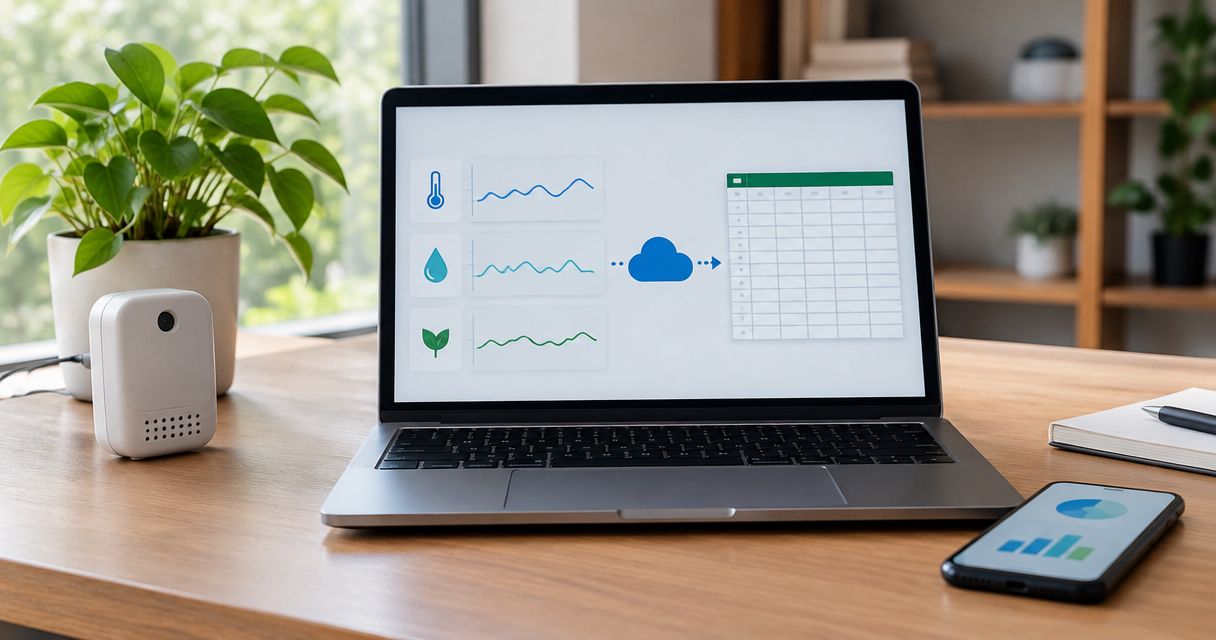
A typical LoRaWAN monitoring path follows this sequence:
- Device transmission. The sensor measures a condition and sends its encoded payload over LoRaWAN.
- Gateway forwarding. A gateway receives the radio transmission and forwards it toward the configured network service.
- Network processing. The network service performs its protocol responsibilities and passes application traffic through the configured integration.
- Payload mapping. Application processing converts the payload into named fields, units and device records. Its location depends on the integration.
- Application response. The IoT platform displays the reading or evaluates configured rules and alarms.
For an illustrative cold-room workflow, a wireless sensor supplies temperature measurements through an externally operated LoRaWAN service. The application receives the measurements, associates them with the correct cold room and evaluates a configured alarm condition. A designated person investigates the equipment when the alarm requires attention.
That is an architectural example, not a reported customer deployment. Evidence that the workflow works includes a traceable sensor message, a correctly interpreted reading, the expected alarm behavior and subsequent measurements after the person responds.
Which hosting arrangement fits your deployment?
You can separate application software from networking under several operating models. Choose the model according to who can maintain the network service and who must control its configuration. Moving infrastructure elsewhere changes the responsibility split; it does not remove the work.
| Arrangement | Best for | Main advantage | Main limitation |
|---|---|---|---|
| Externally managed network service | Teams that want to avoid operating network-server infrastructure | A provider handles the contracted network-service responsibilities | You depend on its supported interfaces, terms and service behavior |
| Separately self-hosted network server | Integrators with infrastructure skills and a need for network-level control | Network administration stays under the operator's control | Updates, backups, monitoring and recovery remain the operator's responsibility |
| Combined network and application offering | Teams that prefer fewer service boundaries | Network and application configuration can be packaged together | Moving either layer later depends on available interfaces and export options |
Externally managed network service
An external service operates the network-server layer while your IoT application consumes its output. This fits a facilities team that wants monitoring workflows without administering the underlying server software.
The trade-off is dependency. Establish who handles gateway connectivity, device registration, integration failures and service incidents before assuming that a managed service covers the entire deployment.
Separately self-hosted network server
You can operate a private network server and connect it to an independently hosted IoT platform. This suits an integrator that already maintains infrastructure or needs direct control over network administration.
Self-hosting the network does not require self-hosting the application. However, your team still owns the infrastructure tasks assigned to it, including credentials, updates and recovery testing.
Combined network and application offering
A combined offering puts more of the workflow behind the same commercial or administrative boundary. That can simplify initial configuration, particularly when device onboarding and application setup are closely connected.
The limitation appears when requirements change. Confirm how you would export device information, reconnect gateways and preserve application history before treating a bundled arrangement as interchangeable with a separated architecture.
Why integration effort varies
The network server's hosting location is only part of the implementation effort. These factors determine how much work remains between receiving packets and delivering a useful application:
- Protocol and connector support. Both ends must support the actual integration, not merely mention the same protocol.
- Payload interpretation. Someone must maintain the device-specific decoder, field names and measurement units.
- Identity mapping. Network-side identifiers must resolve to the correct application device, asset and location.
- Permissions and credentials. Integration accounts need the required access without unrelated administrative privileges.
- Command requirements. Monitoring needs an incoming data path; control also needs a supported outgoing path and suitable device behavior.
- Failure handling. Retry behavior, data freshness, buffering and recovery must be established for the services actually deployed.
A shared protocol name is not proof of a working integration. Ask for the supported message format, authentication method and operational boundaries, then test them together.
Does MQTT remove the need for a LoRaWAN network server?
No. MQTT does not replace LoRaWAN network-server functions. MQTT carries application messages between clients through a broker; LoRaWAN provides a different set of radio-network and protocol functions.
The OASIS MQTT specification describes a publish-and-subscribe messaging protocol. In a LoRaWAN deployment, MQTT can carry messages between a network service and an application, but that transport sits alongside the network-server responsibilities rather than eliminating them.
A device that connects directly over an IP network using MQTT follows a different architecture. It does not need a LoRaWAN network server because it is not using LoRaWAN, although it still needs messaging infrastructure, authentication and application processing.
This distinction matters when evaluating proposals. Ask whether MQTT describes the device connection, the network-to-application integration or both; the answer determines which components you still need.
Can you keep an existing network and change the IoT platform?
Yes, when the existing network service exposes a supported application interface. You can change the application layer without automatically replacing sensors, gateways or the network server.
Start by documenting what crosses the current interface: device identifiers, payloads, timestamps, units and any command messages. Then establish which information the replacement application needs and where transformations belong.
Historical data is a separate migration task. Connecting a new live feed does not automatically transfer previous measurements, alarm history, location assignments or user permissions.
For a broader application transition, the related guide on migrating from an open-source IoT platform to a managed one addresses that distinct migration question. Keep the live network integration and the historical-data migration as separate acceptance tests.
Can remote commands work through an external network service?
Yes, if the platform, integration, network service and device all support the command path. Receiving telemetry does not establish that the same integration can send commands in the opposite direction.
For LoRaWAN, downlink behavior also depends on the device's operating class and receive opportunities. Do not promise immediate execution merely because an application accepted a request.
Define the command payload, destination, authorization and available status information before enabling control. Then distinguish the evidence at each boundary: a platform request, network acceptance and device feedback are different observations.
A delivered command is not proof of a physical outcome. A relay-state response or a subsequent measurement can provide stronger evidence where the device supports it. Restoring software configuration likewise does not undo a physical action that has already occurred.
Where Kilo fits in a separated architecture
Kilo is an IoT platform for teams that need device context, dashboards, alarms and automation above supported connectivity integrations. Its role is to turn connected-device information into an application people can operate, rather than make every network component part of the same hosting arrangement.
For this architecture, evaluate the connector and data contract before the dashboard. Confirm how incoming identifiers map to devices, where payloads become measurements and which permissions govern access. If commands matter, assess that route independently from telemetry.
The benefit of using Kilo as the application layer is the ability to organize monitoring and response workflows around connected equipment. The boundary is equally important: application capabilities do not establish compatibility with an arbitrary sensor, network service or actuator.
Hardware sourcing remains separate from platform software. Kilo Electronics is a separate online authorised dealer serving individual and business buyers; a hardware purchase still needs a compatibility check against the intended network and application integration.
How do you test the architecture before rolling it out?
Test the service boundaries, not just the finished dashboard. A correct-looking chart does not show who will diagnose the next missing measurement.
Use this acceptance sequence:
- Confirm ownership. Assign responsibility for devices, gateways, network service, integration and application configuration.
- Trace a measurement. Follow a known sensor message through the network interface into the application record.
- Validate meaning. Check the device identity, field names, units and timestamps against the original payload.
- Test disruption. Interrupt the integration deliberately and observe freshness indicators, retries and recovery behavior where supported.
- Exercise the response. Trigger a configured test alarm and confirm that the intended person receives it.
- Verify control separately. If control is required, test a permitted command and inspect the available device feedback.
Record the expected result and responsible owner for each test. That gives your team a usable handover document instead of a diagram that only describes the successful path.
FAQ
Do I need to host a server to use an IoT platform?
No, you do not need to host the application or network server yourself when suitable managed services provide those functions. Someone still operates the infrastructure, and your deployment still needs supported integrations.
Can I own a private LoRaWAN network without hosting its network server?
Yes, owning gateways and devices does not require operating the network-server software yourself. Establish who administers device registration, credentials and gateway connections under the managed arrangement.
Does a LoRaWAN gateway replace a network server?
No, gateway forwarding and network-server processing are different functions. Some products package several functions together, so evaluate their documented roles rather than the appliance name.
Who should decode sensor payloads?
The integration design should assign payload decoding to a specific component and owner. Keep units, field names and decoder versions consistent so applications interpret the measurements correctly.
Will monitoring continue if the application loses its network-service connection?
Continued delivery and later recovery depend on the buffering, retry and retention behavior of the deployed components. Do not assume that messages will be recovered unless that behavior is supported and tested.
Is an external network server automatically less secure?
No, external hosting alone does not determine security. Evaluate authentication, permissions, credential handling, service boundaries and the responsibilities assigned to each operator.
Before choosing a host, choose the failure owner
The most useful architectural question is often: who investigates when the gateway receives traffic but the dashboard stops updating? A separated system needs an answer that crosses the network-to-application boundary.
Choose an architecture your team can diagnose, not merely connect. Clear ownership, a tested data contract and evidence of device behavior matter more than whether every service runs under the same vendor name.
Written by Tim Kravchunovsky