
The Things Network gives developers a community LoRaWAN network for connecting devices and getting their messages into applications. When your project needs operational dashboards, alarms or a privately operated network, the next decision is which layer to add or replace. For 2026, consider the Kilo IoT Platform for the application layer, ChirpStack for a self-hosted LoRaWAN network server, and The Things Stack for another deployment model within the same technology ecosystem.
- Compare The Things Network alternatives by layer: network infrastructure and IoT applications solve different problems.
- Kilo fits projects needing device context, dashboards, alarms and automation above connectivity.
- ChirpStack fits teams prepared to operate their own LoRaWAN network server.
- The Things Stack deserves consideration when you want continuity with The Things Network ecosystem.
- Keep The Things Network when it meets your connectivity needs; add an application platform where needed.
Do you need a different network or a usable application?
The most useful alternative depends on whether you need to move device messages or turn them into decisions. Those are separate jobs, even when a vendor packages them together.
A LoRaWAN network server handles the network side of communication between gateways and end devices. An application platform gives those messages meaning: which asset a reading belongs to, who should see it, what condition deserves attention and what happens next.
The Things Network addresses the network side through its community service. If your missing feature is a temperature dashboard or an alarm workflow, replacing that network is not automatically the answer. You need to examine the application layer first.
Private network ownership is a different requirement. It raises questions about gateway connections, device provisioning, infrastructure administration and responsibility for service operation. An attractive dashboard does not resolve those questions.
The Things Network alternatives at a glance
This 2026 comparison separates application software from network-server options. The entries are not interchangeable replacements, and their order is not a performance ranking.
| Option | Best for | Standout capability | Relationship to The Things Network |
|---|---|---|---|
| The Things Network | Community LoRaWAN projects and learning | Shared community network infrastructure | The starting point; keep it when its service fits |
| Kilo | Turning connected-device data into monitoring and automation | Device context, dashboards, alarms and rules in an IoT application platform | Addresses application requirements rather than replacing a LoRaWAN network server |
| ChirpStack | Teams operating a private LoRaWAN network | Open-source, self-hosted LoRaWAN network-server software | Changes who operates the network-server infrastructure |
| The Things Stack | Projects seeking another deployment model in the same ecosystem | LoRaWAN network-server technology underlying The Things Network | Offers continuity in the technology family rather than an unrelated architecture |
Start with the row that matches your actual problem. If staff cannot tell which equipment needs attention, assess the application workflow; if your organization needs to administer the network infrastructure, assess the network-server options.
1. Kilo: best for connected-device monitoring and automation
Kilo is an IoT application-platform option for teams that need device data, dashboards, alarms and automation in one operating layer. Its role is broader than forwarding LoRaWAN messages: it brings readings together with device context and the workflows people use to act on them.
That distinction matters for integrators, developers and people running connected sites. A successful uplink tells you that a message arrived, but it does not by itself tell a facilities user which room needs attention or establish who should respond.
Where the application platform shines
- It connects device information with dashboards, rules and alarms rather than treating message delivery as the finished application.
- Its supported connectivity includes LoRaWAN, mioty and MQTT, which is relevant when a project extends beyond one network technology.
- Built-in AI assistance and compatible external clients can help users configure and operate supported resources within their permissions.
- Digital twins provide a way to associate device data with the objects or spaces that data describes.
Where the application platform falls short
- Kilo is not a substitute for choosing and operating the underlying LoRaWAN network. You still need a supported path from devices and gateways into the application.
- A supported protocol does not establish compatibility with every device, payload or command.
- Device control requires compatible equipment and configured commands; application software alone cannot operate an arbitrary actuator.
- AI assistance does not remove integration work or make every built-in capability available through every external client.
Application platform versus The Things Network
| Dimension | Application-platform approach | The Things Network |
|---|---|---|
| Main decision | How users monitor and act on device information | How devices communicate through a community LoRaWAN network |
| Deployment work | Map data, configure context and build operational workflows | Register devices and establish the network-to-application data path |
| Useful acceptance test | A reading reaches the correct dashboard and triggers the intended response | A device joins and its messages reach the application integration |
| Relationship | Can sit above a suitable network integration | Supplies the network layer for connected applications |
Best for: projects where receiving messages already works, but users still need an operational application.
Verdict: Hold the network migration; evaluate the application layer first.
2. ChirpStack: best for a self-hosted LoRaWAN network server
ChirpStack is an open-source LoRaWAN network-server option for teams that want to operate their own infrastructure. It belongs on your shortlist when the requirement is network ownership rather than simply better visualization.
Self-hosting changes responsibility. Your team takes on the deployment, maintenance and operational work associated with the server environment, alongside the application work needed downstream.
Where ChirpStack shines
- ChirpStack gives technical teams an open-source network-server foundation they can host and administer.
- Its focus fits private LoRaWAN deployments where the organization wants control of its network infrastructure.
- It separates the network-server decision from the choice of downstream application software.
Where ChirpStack falls short
- Self-hosting requires someone to own installation, updates, backups and incident response.
- A working network server is not the same deliverable as a finished monitoring application.
- Replacing a server does not fix poor radio coverage, incompatible regional settings or a faulty device payload decoder.
ChirpStack versus The Things Network
| Dimension | ChirpStack | The Things Network |
|---|---|---|
| Operating model | Self-hosted network-server software | Community network service |
| Infrastructure responsibility | Your organization or appointed operator | Community-service model rather than your own server deployment |
| Application work | Downstream application integration remains necessary | Downstream application integration remains necessary |
| Decision trigger | You need to administer the network-server environment | The community service meets your network needs |
For a 2026 evaluation, include the people who will maintain the deployment, not just the developer who can demonstrate a successful join. A private network needs an operating owner after the initial setup is complete.
Best for: engineering teams or integrators with a clear private-network requirement and someone assigned to operate it.
Verdict: Buy into self-hosting only when you accept the operational responsibility.
3. The Things Stack: best for continuity within the ecosystem
The Things Network runs on The Things Stack technology. That makes The Things Stack a relevant option when your project has outgrown the community-service model but you want to assess another deployment model without starting from an unrelated technology family.
Distinguish the software from the service. Familiar terminology does not mean that every deployment has identical administration, limits, support arrangements or migration steps.
Where The Things Stack shines
- It provides continuity with the technology underlying The Things Network.
- It keeps the comparison focused on LoRaWAN network infrastructure rather than an application-platform substitution.
- It gives teams a relevant path to investigate before committing to a different network-server architecture.
Where The Things Stack falls short
- You still need to select the deployment and operating arrangements that match your requirements.
- Shared technology does not make device migration or integration changes automatic.
- It does not eliminate the need to design the downstream application your users actually need.
The Things Stack versus The Things Network
| Dimension | The Things Stack | The Things Network |
|---|---|---|
| What you are evaluating | Network-server technology and deployment choice | A community service built on that technology |
| Main reason to consider it | A different operating model within the ecosystem | Community network access remains suitable |
| Migration question | What changes across identities, gateways and integrations? | What can remain in the existing deployment? |
Best for: teams that want to investigate a different network-service arrangement while retaining ecosystem continuity.
Verdict: Hold an unrelated-platform migration until you assess this route.
Why teams consider switching from The Things Network
The defensible reasons to switch are architectural requirements, not assumptions that the community network is inherently inadequate. Write down the requirement before choosing a replacement.
- Private network operation: your organization needs to administer the network-server environment rather than use the community service.
- Different service arrangements: your project requires terms or operating responsibilities that must be assessed outside the community model.
- Application requirements: users need dashboards, alarms, permissions or automation. This often calls for an added application layer, not a network replacement.
- Mixed connectivity: your application needs to bring LoRaWAN readings together with other supported data sources.
There is no reason to infer an outage problem, a pricing change or a missing feature from a search for alternatives. Ask which requirement your current architecture fails to meet, then compare options against that requirement.
Test the whole workflow before moving devices
For a 2026 shortlist, use the same acceptance workflow across every candidate. Comparing one vendor's dashboard with another vendor's network console produces a misleading result because the products are answering different questions.
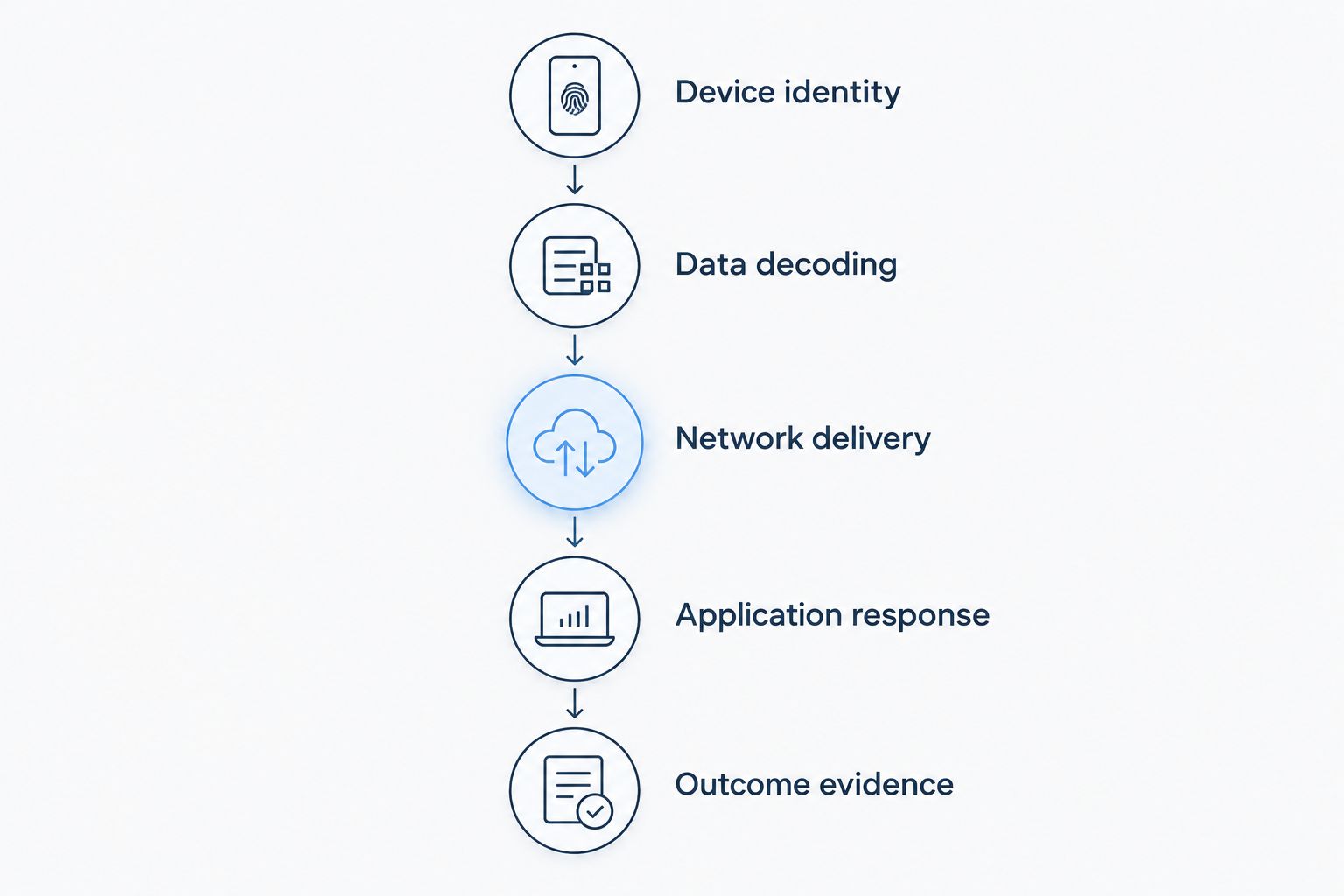
Use these stages to separate message transport from operational usefulness:
- Device identity: establish which device produced the reading and which asset it represents.
- Data decoding: confirm that the payload becomes the intended measurement with the correct unit.
- Network delivery: confirm that messages reach the intended application integration.
- Application response: show the reading to the intended user and exercise the configured alarm or rule.
- Outcome evidence: establish what proves the response happened, including later measurements where relevant.
An illustrative cold-room evaluation makes the distinction concrete. Assume a compatible sensor reports temperature, the network delivers its payload, and the application maps that value to the correct cold room. Configure an alarm against your own operating requirements, assign the responsible person and test both the abnormal reading and the return to normal.
This is an evaluation scenario, not a reported deployment. Its purpose is to expose where work remains: device configuration, decoding, network integration, application configuration or human response.
For command-capable equipment, extend the test to feedback. Accepted, queued or delivered command status does not prove that equipment physically changed state; verification needs supported device feedback or subsequent measurements.
Plan migration around what actually changes
Before moving a LoRaWAN deployment, inventory device identities, activation settings, gateway connections, payload decoders and application integrations. Establish who controls the relevant credentials and how each device will be moved without assuming that an export transfers every part of the deployment.
Historical data is a separate migration task. Moving network registrations does not establish that dashboards, alarm states or earlier readings will appear in the destination application. A guide to migrating historical sensor data addresses that distinct part of the transition.
Keep hardware sourcing separate from software selection. Kilo Electronics is a separate online authorised dealer for compatible hardware, serving individual and business buyers; buying equipment there is not an additional platform requirement.
When staying with The Things Network is the right call
Stay with The Things Network when its community service meets your connectivity needs and your application can use the delivered data. Replacing a working network creates migration work without necessarily improving what users see or do.
For a 2026 decision, distinguish a genuine network requirement from unfinished application design. If the missing piece is an alarm workflow, solve that workflow; if the missing piece is ownership of network infrastructure, evaluate network-server alternatives.
FAQ
What's the best way to compare The Things Network alternatives?
Compare the layer you need to change: network infrastructure or the application above it. ChirpStack addresses self-hosted LoRaWAN networking, while application platforms address monitoring and operational workflows.
Is Kilo a replacement for The Things Network?
Kilo addresses the IoT application layer rather than serving as a direct replacement for a LoRaWAN network server. Assess the supported network integration alongside the dashboards, alarms and automation your application needs.
Is ChirpStack better than The Things Network for a private network?
ChirpStack is a relevant choice when your team wants to host and administer its own LoRaWAN network server. The decision depends on whether you want that responsibility, not on an unsupported claim that one option performs better everywhere.
Are The Things Network and The Things Stack the same thing?
No: The Things Network is a community network service, and The Things Stack is the technology it runs on. Evaluating another deployment of that technology is different from continuing to use the community service.
Do I need to replace my sensors when I switch networks?
A network change does not automatically require new sensors. Check each device's regional configuration, activation settings, credential access and compatibility with the destination before planning the move.
Will changing the network server fix missing sensor readings?
Not necessarily: missing readings require diagnosis across the device, radio link, gateway, network integration and application. Replacing a server does not correct a radio-coverage problem or an incorrect decoder.
Can I keep The Things Network and add dashboards or alarms?
Yes, an application layer can consume data delivered through a suitable network integration. Verify the chosen platform's supported connection and payload mapping rather than assuming every integration works identically.
A useful final test: disconnect the dashboard from the decision
Ask your team what would still be missing if every sensor message arrived correctly tomorrow. If the answer is asset context, a responsible person, an alarm workflow or proof of a physical outcome, your next task is application design—not automatically a new network server.
Written by Tim Kravchunovsky


