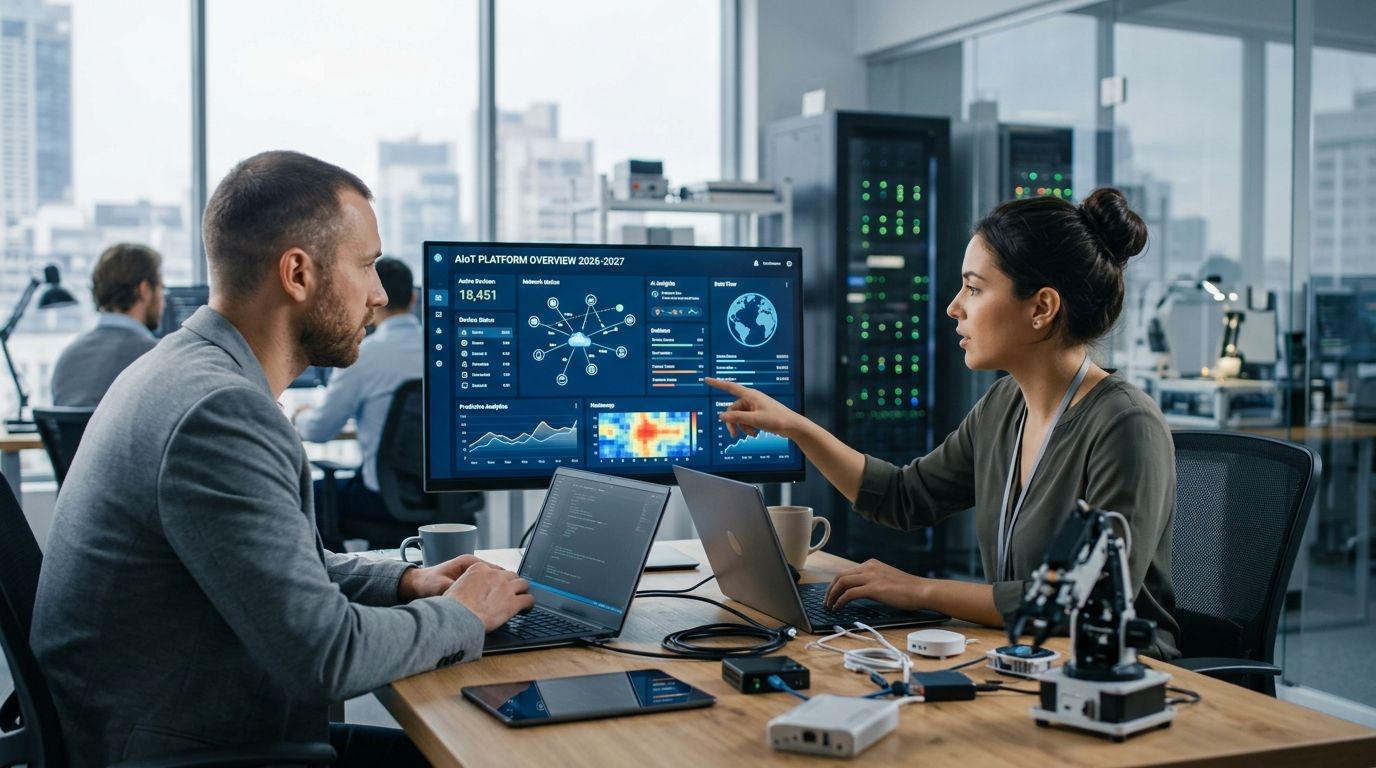
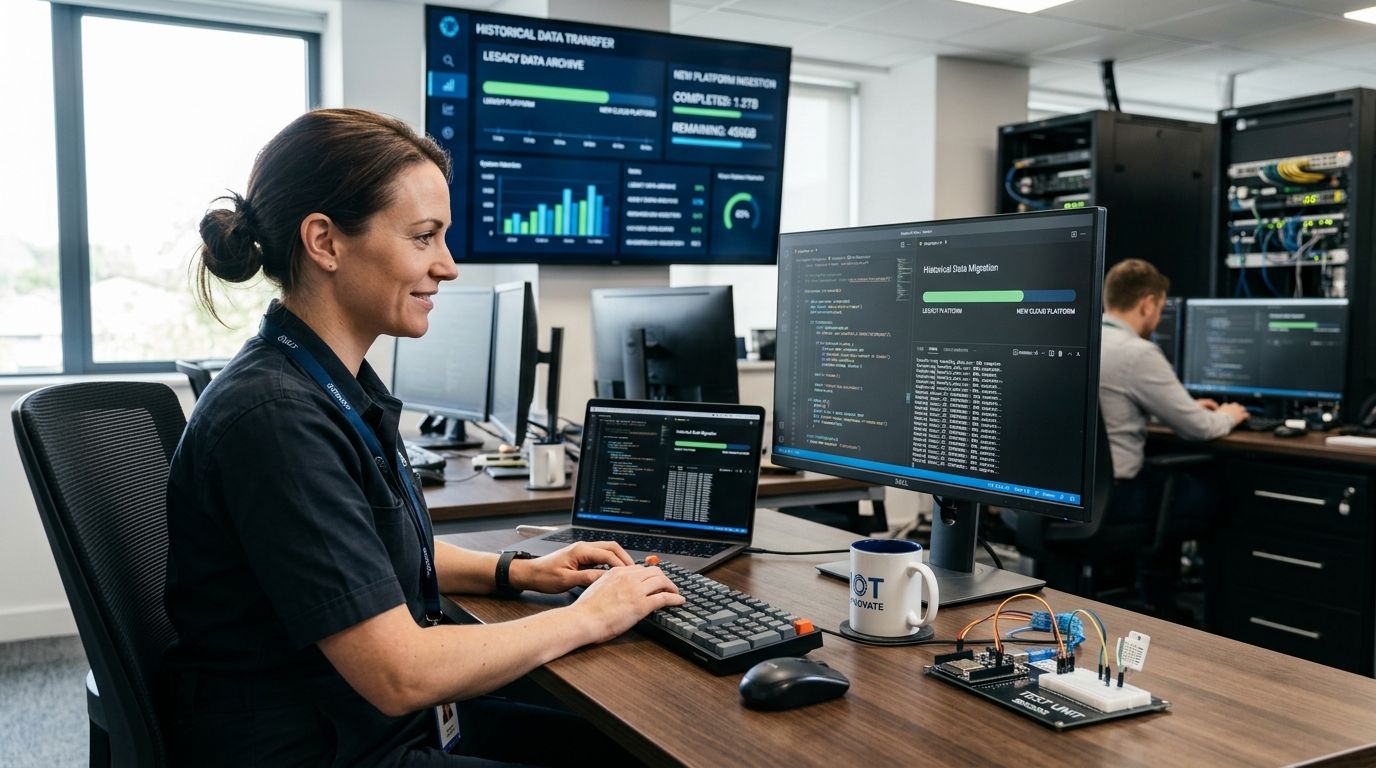
To migrate sensor data switching IoT platforms, export and preserve the old history, document device identities and measurement formats, then validate live readings on the new platform. Confirm any historical import route before relying on it. Kilo's documented history-reading API does not establish a bulk historical-upload feature.
- Keep the original historical export and a documented mapping of device IDs, metric names, units and timestamps.
- Do not assume that an API for reading history also imports old samples.
- Compare a representative period of live data and rebuild the required rules, alarms and response ownership.
- Keep historical archives accessible while you pilot Kilo; hardware and connectivity remain separate costs.
An IoT platform migration therefore needs two plans: preserve the historical record and establish a reliable new live-data path. They can be coordinated without assuming the new platform accepts every old database format.
Kilo IoT Platform provides device management, dashboards, rules, alarms and AI access to authorized deployment data. Its public API documents reading sensor history and last-seen values. That does not by itself establish a general bulk historical-import feature. Before promising a backfill, verify the exact supported ingestion path and its timestamp behavior.
You can still start a useful migration pilot: preserve an accessible source archive, bring one representative device into Kilo and compare its new readings with the source.
IoT platform migration: what should you export before switching?
List the devices, measurements and dependent workflows before moving anything. The record should let another person identify the physical asset behind a value.
For each stream, capture the old device identifier, metric name, unit, data type, reporting interval and timezone conventions. Include calibration records and the dates when mappings or sensor positions changed. Preserve raw and transformed values separately when both are available.
Then list dashboards, rule conditions, alarm recipients and integrations that depend on those identifiers. A sensor-reading export does not automatically include the notification history or automation that surrounded it.
Agree who owns the cutover decision. Someone must verify the new data and the alarm route before the previous workflow is retired. The plan should name that person rather than assume an API response means the migration is complete.
IoT device management: preserve sensor IDs, units and timestamps
Create a mapping between old records and new device and metric identifiers. Keep it alongside the archive.
A simple migration worksheet can contain:
| Source information | Destination decision |
|---|---|
| Physical asset and old device ID | Corresponding Kilo device |
| Metric key and description | Destination metric and mapping |
| Unit and data type | Intended unit, type and documented conversion |
| Reading time and timezone | Preserved timestamp meaning |
| Calibration or location change | Context retained with the archive |
For example, Celsius and Fahrenheit values must not be joined into a single unlabeled series. Keep the source export unchanged and record any transformation in the working copy.
Distinguish the time a sensor measured something from the time an export was produced. If the old system provides only one timestamp, establish what it represents before comparing charts.
Kilo's metric documentation explains the metric definitions used across the deployment. Clear mapping matters for people reading a chart and for an AI assistant interpreting it later.
IoT platform migration: preserve history without assuming bulk import
Ask the source provider for a machine-readable export with the necessary identifiers and timestamps. CSV or JSON can be useful formats, but the correct choice depends on the source and the archive or destination that will consume it.
Verify that the export includes raw readings if the project requires them. Daily averages cannot recover the exact timing of a brief excursion. Check completeness by date range and device, then compare selected values with the source interface.
Keep an unchanged copy in an access-controlled archive and test that the people responsible can retrieve it. Preserve the mapping and explanatory notes with it. A file nobody can interpret is a weak historical record.
If a supported destination backfill has been confirmed, test a small batch first. Check timestamp preservation, duplicate handling, units, precision and what happens when the same batch is submitted again. Do not infer support from the presence of an API.
If no suitable historical-import route is established, keep the archive as the historical source and start Kilo with the verified live stream. Document the boundary so a person or integration knows which system holds each period.
IoT data analytics: validate historical readings against live data
A smooth chart is not sufficient validation. Inspect a few individual observations and the gaps between them. Compare the first and last timestamps, the number of records and representative high, low and ordinary readings.
Investigate any difference in aggregation. One chart may show a daily average while another shows raw points. Both can be valid, yet comparing them directly can suggest a migration fault that does not exist.
Plan any parallel run around what the devices and connections actually support. Do not assume the same physical sensor can register on two independent networks at once. A suitable existing integration may be able to distribute readings to both destinations, but that arrangement needs verification.
Choose a validation period that covers the operating pattern you care about, such as a complete shift or a relevant reporting cycle. Its length is a project decision, not a universal number of days.
IoT automation: rebuild rules and test who receives each alarm
Historical readings and live operations need separate acceptance checks. Recreate the relevant dashboard, condition and notification recipients, then test the response with someone expecting the message.
Suppose an engineer must respond to a temperature condition. Verify that the correct device feeds the rule, the intended engineer receives the alert and the message identifies the right asset. Establish how the old alert route will be retired without a gap or duplicate escalation.
Kilo's Rules Engine supports debugging with Execute, Skip and Mock for side-effect nodes. Execute runs the real handler and is initially selected. Choose Skip or Mock for logic checks, then test real notification delivery deliberately.
Restoring an earlier rule creates a draft to build and deploy. This can help recover the configured logic, but it does not restore an external archive or reverse past physical actions.
Why AIoT needs reliable sensor history after migration
An AI assistant needs to know what a measurement means before it can use it. A temperature history with uncertain units or mixed device identities is a poor basis for an operational recommendation.
This is part of the reason we build Kilo as an operating layer for physical AI. AI can work against organized device context and configured actions. The quality and availability of the underlying measurements remain essential.
A migration is an opportunity to make that context clearer. Explain missing periods, preserve the relationship between an asset and its readings, and distinguish archived history from the live data available in Kilo. Do not tell an assistant it has access to the old archive unless the integration actually provides it.
IoT data analytics: create a migration acceptance sample
Choose a small set of readings you can trace from the old platform to the export and then into the proposed historical access method. Include the device identifier, metric, original timestamp, unit and value. A sample that contains only a column of numbers cannot establish that measurement identity survived.
Keep an untouched copy of the original export. If you normalize units, rename fields or convert timestamps, store that as a separate version and describe the transformation. This lets the next person distinguish original evidence from the processing performed during migration.
For a timestamp, check whether the export represents an absolute time or a local display value. Record the relevant time-zone information where it is available. When it is missing, identify the ambiguity before comparing old and new charts. A visually shifted line can reflect a time interpretation problem rather than a changed physical condition.
Use a representative period to compare live readings too. Check the configured reporting interval and the way each display groups points. An average over a time window and an individual measurement can both be correct without producing identical chart shapes. Compare the underlying meaning rather than judging continuity only by the appearance of a graph.
Document any calibration or replacement information that the old system actually supplies. If that information is unavailable, do not invent it to explain a discrepancy. Ask the person responsible for the installation to help determine whether the sensor, its configuration or its physical location changed.
Set a clear condition for retiring the old live workflow. The intended devices must report through the new connection, the relevant measurements must be understandable, alarms must reach the correct people and historical records must remain accessible through the agreed method. Each incomplete item needs an owner.
Avoid relying on parallel reporting unless the device and connection support it. Some equipment cannot send the same live stream to both systems in the proposed way. In that case, plan a controlled switch and a check afterward, rather than implying that every migration can run both platforms simultaneously.
The acceptance sample gives the team something repeatable to review. It does not turn a reading API into an import API, and it does not make an archive part of Kilo's native history. Those are separate integration questions to settle explicitly.
How to pilot an IoT platform migration with Kilo
Open a Kilo account and connect a representative device. The free plan supports five devices, one dashboard and one rule. Check current plan limits when you expand; hardware and connectivity costs are separate.
Use that pilot to validate live mappings, chart interpretation and the alarm recipient. Keep the original archive available while assessing any supported historical integration.
If the migration also involves replacing equipment, project devices are available from Kilo Electronics. Confirm the replacement's measurement type, connection and reporting behavior before merging its readings with an existing series. Record the replacement date so the next person reviewing the history understands the change.
Current plan details. Hardware and connectivity are separate costs.
IoT platform migration FAQ
How do I migrate sensor data switching IoT platforms without losing context?
Preserve the original export, record device and metric mappings, keep timestamps and units understandable, and validate a representative sample. Confirm the destination's actual import or historical-access route before retiring the old system. A copy of values without measurement identity is not a complete migration.
Can Kilo's history API import my old sensor readings?
The documented public API provides history-reading operations, which do not by themselves establish a bulk historical-upload route. Confirm the exact supported approach with the team before planning an import. Until then, preserve the historical archive and its access method separately from new live Kilo readings.
Should I change device IDs during an IoT platform migration?
You may need new platform identifiers, but preserve an explicit mapping to the old device and physical asset. Record which metric and unit each series represents. This is particularly important when replacing a sensor, because the new device should not silently appear to be the old measuring instrument.
Why can historical and new IoT charts look different?
Check units, timestamp interpretation, reporting interval, aggregation and the selected period before assuming the sensor changed. A chart may show averages where another shows individual samples. Compare traceable measurements and document any transformations; do not invent a calibration event to explain a difference.
Can I keep both IoT platforms running during migration?
Only if the actual device and connection support the proposed arrangement. Do not assume universal parallel reporting. Where it is unsupported, plan a controlled cutover, check live readings promptly afterward and keep the old historical archive accessible through the agreed method.
What happens to alarms when I switch platforms?
Treat each alarm workflow as something to rebuild and test. Confirm the measurement condition, responsible recipient, delivery channel and response process. A successful data connection does not prove that the maintenance contact receives the intended notification or knows which equipment needs attention.
Why does sensor-history migration matter for AIoT?
An AI client needs reliable context to interpret the deployment. Renamed metrics, mixed units or unclear timestamps can make old and new readings difficult to compare. Preserving history and documenting gaps improves the information available to people and AI without creating measurements that were never recorded.