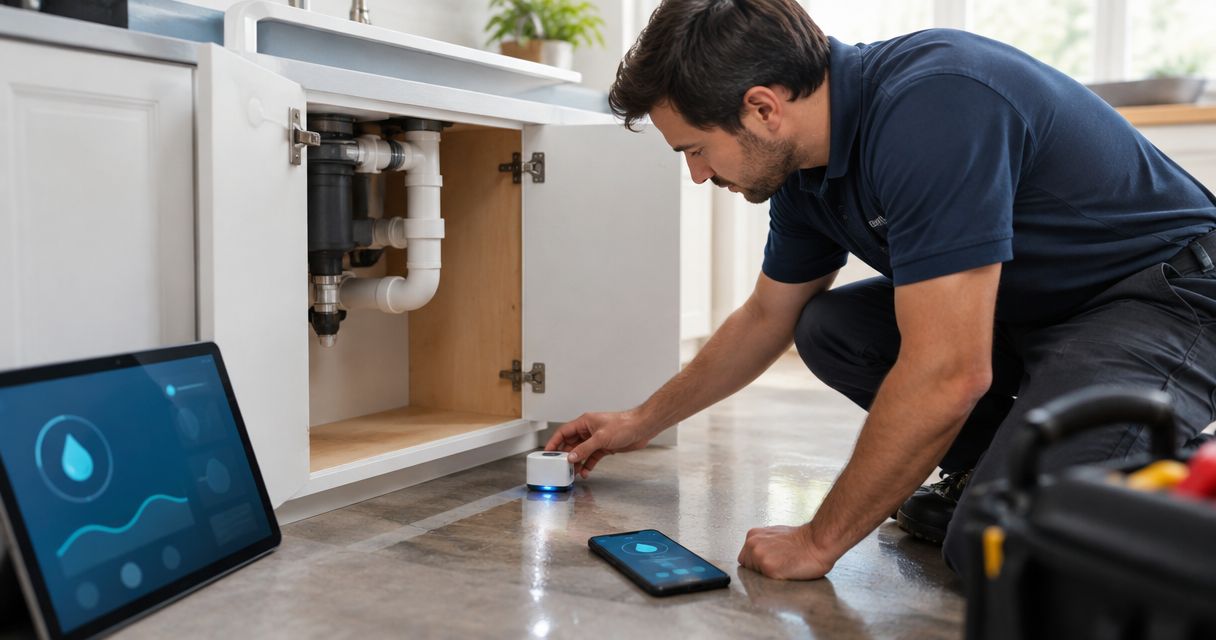
The cost to deploy LoRaWAN sensors in a warehouse is the combined cost of sensors, network coverage, installation, software configuration, and ongoing operation—not just the hardware purchase. Gateway backhaul, commissioning, maintenance access, and alarm setup belong in the budget too. The Kilo IoT Platform provides the software layer for connected-device monitoring; hardware and installation remain separate parts of the deployment.
- Budget warehouse LoRaWAN sensor deployment as a complete monitoring system, not a sensor purchase.
- Validate coverage around loaded racks and enclosed rooms before committing to gateway quantities.
- Separate installation and commissioning from recurring network, software, and maintenance costs.
- Compare proposals against the same monitoring points, reporting requirements, and acceptance tests.
How much does it cost to deploy LoRaWAN sensors in a warehouse?
A defensible warehouse deployment budget starts with a defined monitoring scope and an itemized supplier quote. Multiplying the sensor quantity by a hardware price leaves out the infrastructure and work needed to turn readings into usable monitoring.
Use this structure when requesting proposals:
| Budget component | What the quote should include | What to clarify |
|---|---|---|
| Sensors and accessories | Devices, probes where required, mounts, and protective fittings | Measurement requirements and installation locations |
| LoRaWAN infrastructure | Gateways, antennas, mounting, power, and network access where needed | Existing coverage versus new infrastructure |
| Installation | Device placement, labeling, access equipment, and gateway installation | Who supplies access and completes the work |
| Commissioning | Device registration, payload decoding, field mapping, and coverage checks | What counts as an accepted monitoring point |
| Monitoring software | Device records, dashboards, alarms, and relevant integrations | Included functions and billing basis |
| Ongoing operation | Network services, software subscriptions, support, and maintenance | Ownership, renewal conditions, and exclusions |
Keep initial deployment and ongoing operation separate. Then combine them over your chosen budgeting period without counting an included service twice.
For example, a 12-month budget includes initial deployment plus the recurring services and planned maintenance falling within those 12 months. A 24-month budget and a 36-month budget use the same structure over longer periods. These are planning horizons, not assumptions about device life, contract length, or replacement schedules.
Define what the warehouse needs to measure
Start with the decision each reading supports. Temperature monitoring, dock-door status, water detection, and equipment measurements have different sensor and installation requirements; treating them as interchangeable monitoring points produces misleading proposals.
Write down the location, measurement, required accuracy, reporting behavior, and person responsible for responding. Identify whether the installation needs an external probe, protection from handling equipment, or access to a difficult mounting position.
An illustrative scope might cover temperature and humidity in storage zones plus door-open events at loading bays. That is a proposed design, not a documented customer deployment. The environmental readings help identify changing storage conditions, while door events provide context; neither automatically proves why a temperature change occurred.
Specify the outcome before selecting the device. If the requirement is to notify a supervisor about unsuitable storage conditions, acceptance must include the notification workflow—not merely a reading appearing on a dashboard.
Keep compliance requirements separate from general monitoring preferences. Where calibration evidence or prescribed measurement procedures apply, make those explicit procurement requirements rather than assuming every wireless sensor satisfies them.
Existing LoRaWAN coverage versus a private warehouse network
Network architecture changes which costs belong in your proposal. An existing network can remove some infrastructure work, but only after you confirm that its coverage, device onboarding, and service terms support the intended deployment.
| Network approach | Best for | Budget advantage | Limitation to resolve |
|---|---|---|---|
| Existing compatible coverage | Sites with usable coverage and an agreed network service | Uses infrastructure already available | Indoor reception and service responsibilities still need verification |
| New private network | Sites needing locally planned gateway placement | Lets the project include gateway placement in the warehouse design | Adds infrastructure installation and network-management responsibilities |
| Extension of an existing private network | Sites expanding an established deployment | Reuses compatible infrastructure where coverage permits | Additional zones still require coverage and integration checks |
A LoRaWAN gateway receives sensor transmissions and forwards them toward the network services. Your monitoring application then needs usable measurements, device identities, and timestamps—not just a successful radio transmission.
Ask who supplies and operates each layer. Gateway hardware, the LoRaWAN network server, internet backhaul, and the monitoring platform are distinct responsibilities even when a supplier bundles them commercially.
Choose the network approach after checking the intended sensor locations. A building-wide coverage claim is not a substitute for testing inside the actual storage zones, enclosed rooms, and loading areas you plan to monitor.
Why warehouse LoRaWAN deployment costs vary
Warehouse area alone does not determine the deployment scope. These factors explain what belongs in the estimate:
- Measurement requirements: Accuracy, environmental suitability, probe arrangements, and calibration requirements affect device selection and commissioning.
- Storage layout: Metal racking, stored materials, walls, and enclosed rooms affect radio propagation and the locations that need testing.
- Installation access: High mounting positions, restricted work areas, and operational access arrangements change the installation task.
- Reporting requirements: Measurement frequency, transmission settings, and event reporting affect configuration and battery-use assumptions.
- Integration work: Device payloads must become correctly labeled measurements, dashboards, and alarms within the selected software.
- Operating responsibilities: Network ownership, support, battery servicing, and periodic checks determine what remains after handover.
Avoid a generic allowance that hides these differences. Ask suppliers to identify the specific assumptions behind gateway quantities, labor, and recurring services so you can compare the same scope.
Test warehouse coverage before fixing the installation budget
A useful coverage assessment follows the proposed monitoring locations. Test where sensors will actually be mounted, including representative conditions around stored goods and closed doors, rather than relying only on an empty-building walk-through.
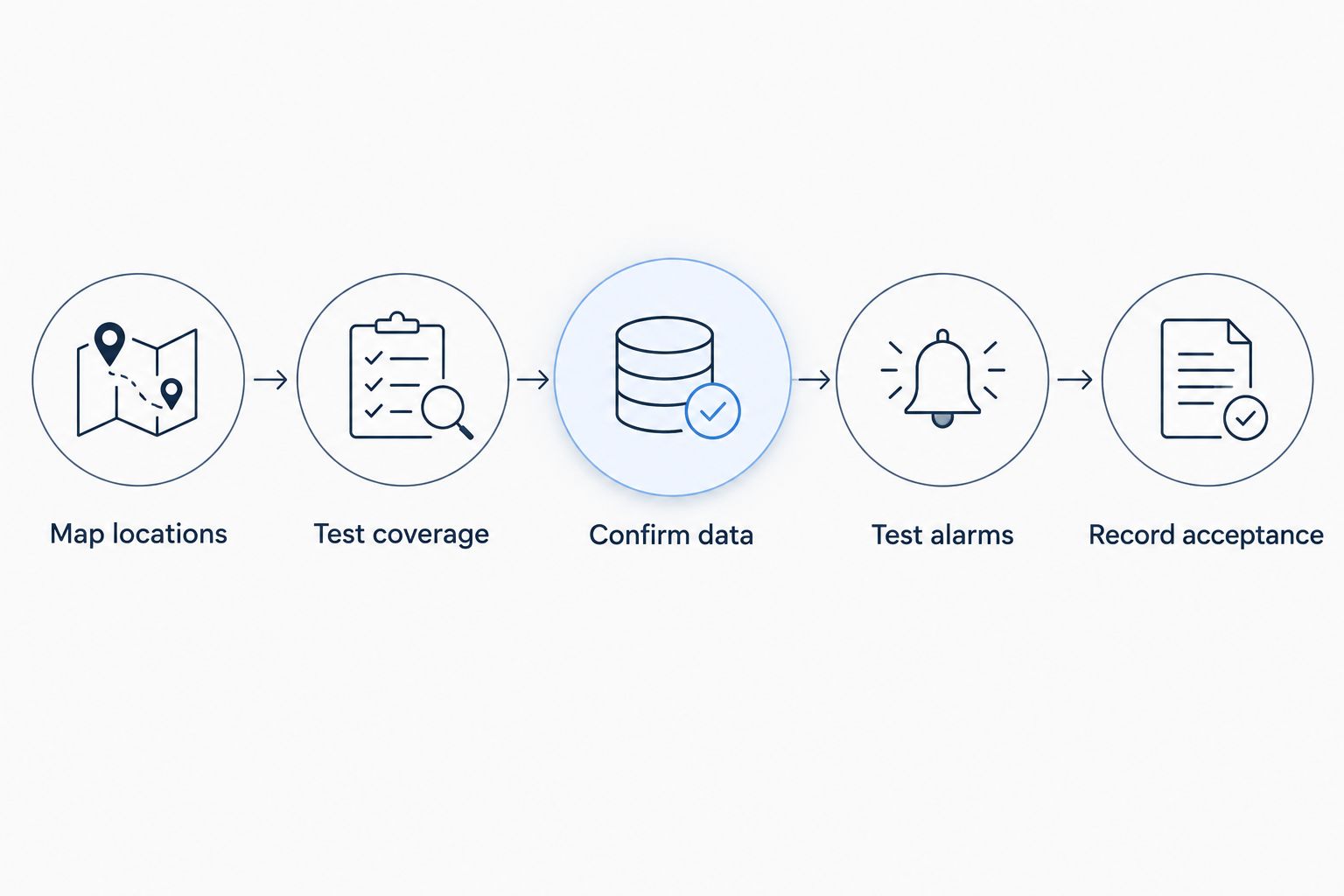
Use a staged process:
- Map locations. Mark the monitoring points and record relevant access constraints.
- Test coverage. Check reception from representative sensor positions using the proposed network arrangement.
- Confirm data. Verify that decoded measurements reach the intended application with correct units and device identities.
- Test alarms. Exercise an agreed condition and confirm that the responsible person receives a usable notification.
- Record acceptance. Keep the location, configuration, test result, and unresolved issues in the handover record.
Define the pass criteria before the test. The criteria should reflect your reporting requirement and application, not an invented universal packet-delivery target.
Coverage testing also informs the labor scope: moving a gateway before permanent installation is a different task from returning after handover to relocate installed equipment. For the measurement checks themselves, the guide to testing LoRaWAN signal strength before a full sensor rollout addresses a distinct part of deployment planning.
Include commissioning, dashboards, and alarms in the software scope
Receiving data is the start of monitoring, not the finish. Your project needs a reliable mapping between a physical sensor, its warehouse location, its measurement fields, and the people who use the information.
Commissioning should cover device registration and credentials, payload decoding, units, naming, and location assignment. A temperature field that appears without a unit or clear location is not an accepted operational handover.
The software setup should then answer practical questions: Which view shows each zone? What condition creates an alarm? Who responds? How does the team distinguish a normal measurement from a device that has stopped reporting?
Kilo fits integrators who need device records, dashboards, and alarms in one IoT platform. Those capabilities serve warehouse monitoring without requiring an AI workflow; a configured threshold alarm is conventional automation, not evidence of AI-based prediction.
The platform does not eliminate device compatibility checks or installation work. Specify the supported sensor integration, decoded fields, required dashboard, and alarm behavior before treating the software portion as complete.
Keep any future control requirement separate. Monitoring a door or detecting water does not establish a supported command path to move equipment or close a valve.
What should you ask a supplier to include in the quote?
Request an itemized quote tied to a monitoring-point schedule and acceptance procedure. A hardware list alone does not show who will deliver a working system or maintain it afterward.
Ask each supplier to answer the same questions:
- Which sensor models and accessories meet each measurement requirement?
- What evidence supports the proposed coverage and gateway arrangement?
- Who handles device credentials, network registration, and payload mapping?
- Which dashboards, alarms, permissions, and integrations are included?
- What installation access, internet connection, and internal staff time must you provide?
- What documentation and operational training are included at handover?
- Which services recur, and what is their billing basis?
- Who owns fault diagnosis when a reading stops arriving?
For hardware sourcing, Kilo Electronics is a separate online authorised dealer serving individual and business buyers. Hardware sourcing is distinct from the platform subscription; confirm compatibility and the installation scope rather than assuming a purchase includes a complete deployment.
How can you reduce deployment costs without losing useful monitoring?
Reduce unnecessary scope before reducing measurement quality. Begin with the locations tied to an actual operational decision, then expand after the initial workflow has passed acceptance.
Reuse existing compatible infrastructure only after testing it. Standardize device names and configuration templates where the devices support them, and prepare location records before installers arrive. Those steps remove avoidable ambiguity without assuming that every device needs identical settings.
Avoid ordering additional sensors simply to compensate for an undefined objective. More readings do not resolve an unclear alarm responsibility, and fewer sensors are not a saving if they leave required areas unmonitored.
Keep optional analysis, additional integrations, and remote control outside the initial scope unless they are necessary for the agreed outcome. This makes the base deployment easier to compare while preserving a clear expansion path.
FAQ
Do warehouse LoRaWAN sensors need Wi-Fi?
LoRaWAN sensors use LoRaWAN radio rather than Wi-Fi to send their readings to a gateway. The gateway still needs a suitable connection to the network services, so include that backhaul arrangement in the deployment plan.
Can I calculate the budget by multiplying the sensor quantity by the device cost?
That calculation covers sensor procurement, not the complete deployment. Add the applicable network infrastructure, installation, commissioning, software, and ongoing operation without counting bundled items twice.
Will a gateway cover my entire warehouse?
Gateway coverage must be tested at the intended sensor positions. Racking, stored materials, enclosed rooms, gateway placement, and the required reporting behavior all matter to the coverage assessment.
Do all sensors require the same battery replacement schedule?
Battery maintenance depends on the selected device, configuration, environment, and manufacturer guidance. Ask for the assumptions behind any battery-life estimate and include physical access for servicing in the maintenance plan.
Does Kilo replace the LoRaWAN network server?
Do not treat the monitoring platform and LoRaWAN network server as interchangeable components. Define the network-server arrangement and supported platform integration in the proposal, including who manages device registration and troubleshooting.
What should happen before I approve the completed installation?
Approve the installation after the agreed monitoring points deliver correctly identified measurements and the required alarm workflow passes testing. The handover should identify device locations, configurations, responsible people, and any unresolved issues.
Budget for missing readings, not just abnormal readings
Before approving the proposal, ask the supplier to demonstrate how your team discovers that a sensor has stopped reporting. An alarm for an out-of-range measurement cannot respond to a new reading that never arrives.
Make missing-data behavior an explicit acceptance requirement. Agree how the deployment identifies stale information, who investigates it, and what evidence closes the issue. That turns a collection of connected sensors into a monitoring system your warehouse team can actually operate.
Written by Tim Kravchunovsky