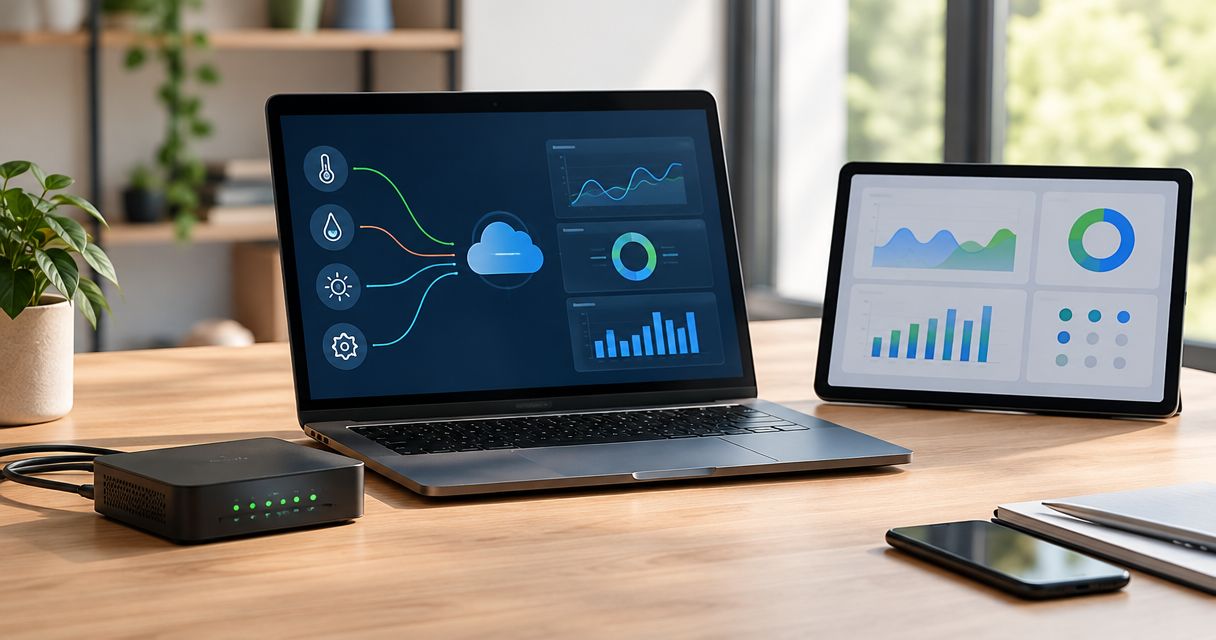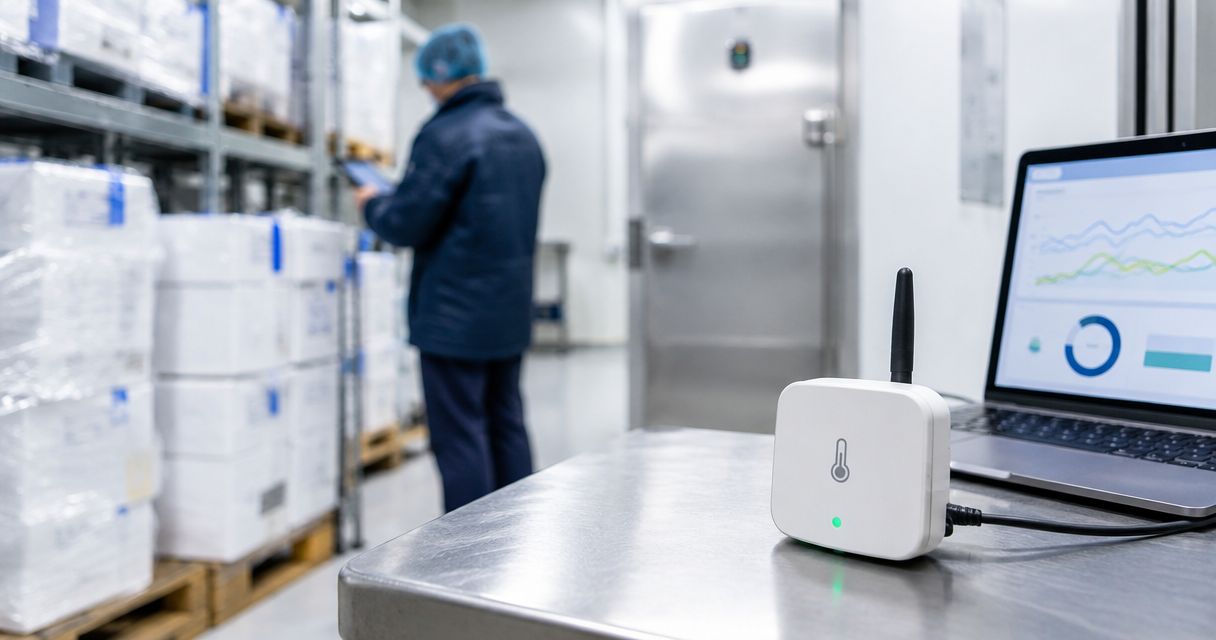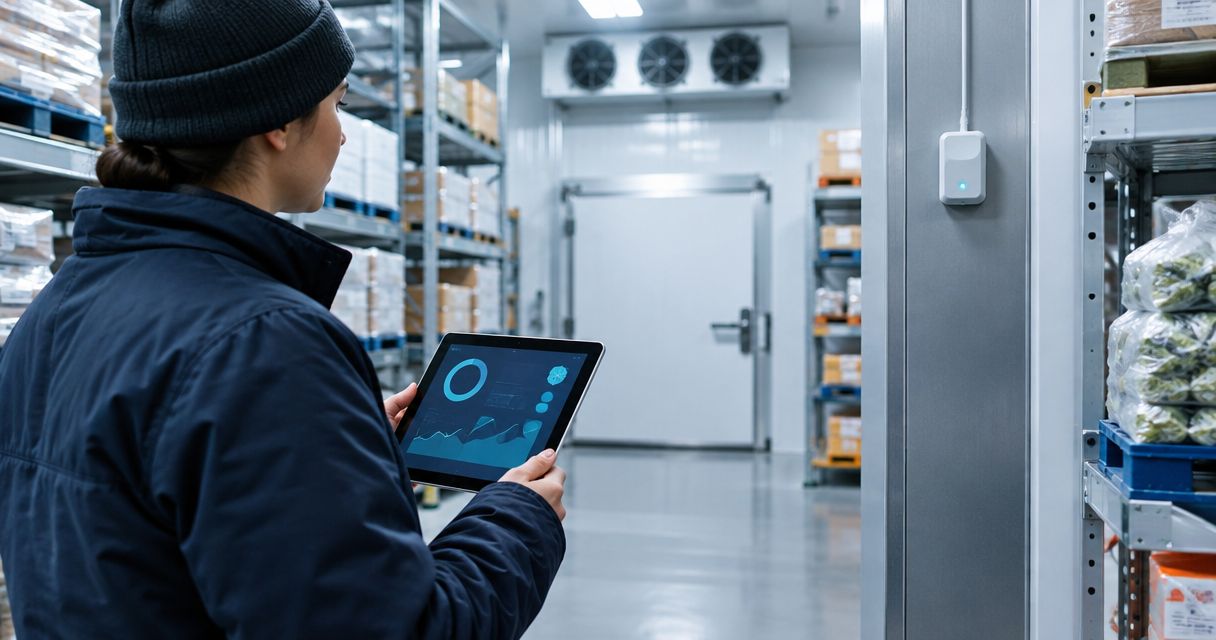
Yes—you can monitor a cold storage facility without new wiring by using battery-powered wireless sensors that send readings through a gateway or an existing compatible network. The caveat is that gateways still need power and a connection upstream, and metal-lined cold rooms require on-site radio testing. The Kilo IoT Platform brings connected-device data, dashboards and alarms together; the sensors and network must still suit the facility.
- You can monitor cold storage facility without new wiring using wireless temperature sensors and a tested network connection.
- Metal-lined rooms require closed-door coverage tests; an open-door demonstration does not establish reliable reception.
- Kilo brings connected-device data, dashboards and alarms together, but does not replace suitable sensors or network infrastructure.
- Choose equipment for the actual temperature, moisture conditions and maintenance access—not just its wireless protocol.
Can you monitor a cold storage facility without new wiring?
Yes. Wireless sensing removes the need to run a new data cable to every measurement point, but it does not remove every infrastructure requirement. You still need somewhere for readings to go, a way to power the receiving equipment and a process for responding when conditions change.
The practical choice is between putting a complete wireless sensor inside the room, using a remote probe with its transmitter outside, or collecting readings from existing refrigeration equipment through a supported interface.
| Approach | Best for | What it avoids | Main limitation |
|---|---|---|---|
| Battery-powered wireless sensor | Adding independent measurement points without long cable runs | New power and data wiring at each sensor | Battery suitability and radio reception must be established inside the room |
| Remote probe with wireless transmitter | Measuring inside a difficult enclosure while keeping electronics outside | A long cable route back to a monitoring panel | The probe still needs a suitable local route through the enclosure |
| Existing controller integration | Reusing accessible temperature readings already available from equipment | Installing duplicate sensors where existing measurements meet the need | Controller access, interfaces and measurement locations determine suitability |
These approaches are not interchangeable. A controller reading used to regulate refrigeration does not automatically represent temperatures throughout the stored goods, and a wireless sensor beside the door does not establish conditions at the back of the room.
Start with the measurement you need. Then choose the installation method.
What “without new wiring” actually means
A wireless retrofit usually means avoiding new cable runs between individual sensors and a central monitoring point. It does not mean the entire system operates without electricity, batteries, internet access or maintenance.
A typical path is a temperature sensor transmitting to a gateway, with the gateway forwarding data through an available network connection to monitoring software. Depending on the selected architecture, a network service sits between the gateway and the application.
LoRaWAN and mioty are possible wireless approaches for sensor telemetry. Neither protocol name proves that a particular sensor, gateway and software configuration work together; payload decoding and device integration still matter.
For a related connectivity question, see whether IoT sensors need a Wi-Fi connection. Sensor radio connectivity and the gateway's upstream connection are separate decisions.
Define the installation boundary before approving equipment: no new room-to-panel cabling, no enclosure penetrations, or no electrical work anywhere. Those are different requirements, and each changes the feasible design.
Battery-powered sensors: the simplest retrofit to evaluate
A complete wireless sensor inside the cold room avoids a probe cable through the wall. You mount the device at an appropriate measurement location and test whether its transmissions reach the receiving infrastructure during normal operation.
Cold conditions affect battery behavior, so use the manufacturer's specifications for the actual operating environment. A battery-life claim measured under different conditions is not a maintenance schedule for your freezer.
Check the whole device, not just the sensing element. The battery, enclosure, mounting method and electronics all need to suit the location, including condensation and cleaning exposure where relevant.
This approach fits sites that need independent readings and accessible sensor locations. Its drawback is that servicing batteries or moving a device requires access inside the controlled space, and the enclosure can obstruct radio signals.
Remote probes: keep the transmitter outside the enclosure
A remote probe separates the measurement point from the transmitter. The probe measures inside the cold room while the radio and, where the design allows, the battery remain outside.
That arrangement can address a difficult radio path, but it introduces a physical installation question: how will the probe cable enter without compromising the enclosure? Use an approved existing access point or a properly designed penetration rather than trapping a cable in a door seal.
A remote probe is not a completely cable-free installation. It replaces a long wiring run with a local probe connection, which can still meet a retrofit brief that prohibits new building-wide cabling.
Choose this approach when transmitter placement matters more than eliminating every short cable. Confirm probe compatibility, cable protection and the enclosure work before installation.
Existing controller data: reuse it only when it answers the question
Existing refrigeration controllers can provide useful readings when they expose an accessible, supported interface. An integrator must establish what data is available and how to transfer it into the monitoring system.
Reusing those readings avoids duplicate measurement equipment where the existing sensor already serves the monitoring objective. However, a control sensor's location, calibration and relationship to the refrigeration equipment determine what its reading actually tells you.
There is also an independence question. If monitoring and refrigeration control depend on the same sensor or power source, consider what evidence remains when that shared component fails.
Use existing controller data where it is suitable, not simply because it is available. Add independent sensing where your monitoring plan requires a separate measurement or a different location.
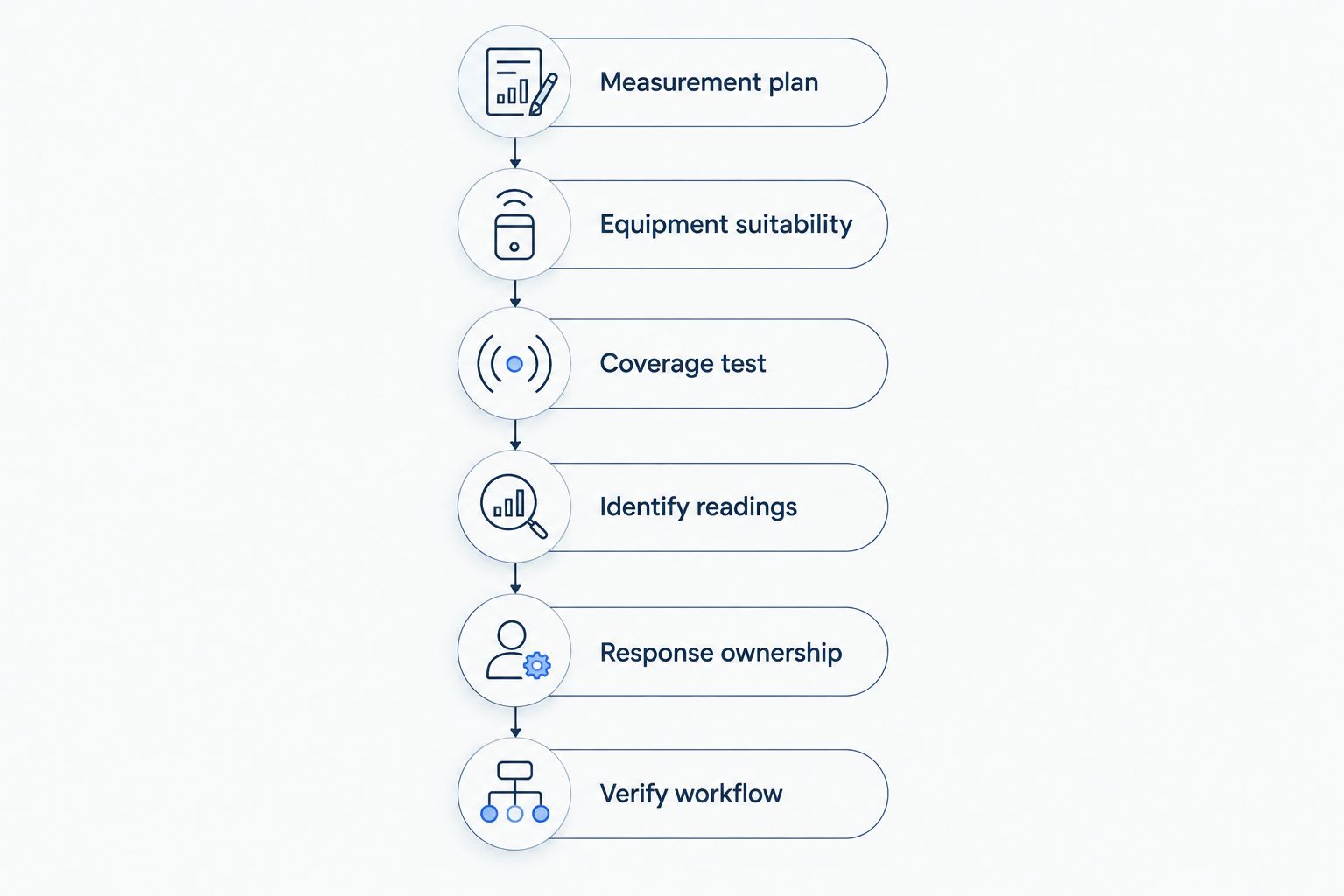
How to retrofit wireless cold-storage monitoring
Establish the measurement plan
List the rooms, storage zones and equipment you need to observe. Define whether you need air temperature, a product-representative measurement, door status or another input; these answer different operational questions.
Use your product requirements and applicable procedures to establish acceptable conditions. Do not adopt a generic alarm threshold simply because it appears in a sensor setup example.
Check equipment and installation suitability
Confirm the sensor's operating range, stated accuracy, calibration requirements and environmental suitability. For a remote probe, establish where the transmitter will sit and how the probe cable will be protected.
Hardware is a separate purchase from platform software. Kilo Electronics is a separate online authorised dealer for compatible hardware, serving individual and business buyers; compatibility still needs to match the chosen deployment.
Test coverage under working conditions
Place test equipment at the intended measurement locations and evaluate reception with doors closed. Include normal stock arrangements and routine facility activity rather than testing only in an empty room.
Metal surfaces and changing obstructions affect the radio path. If reception is inadequate, change the gateway or transmitter position, evaluate a remote probe arrangement, or revise the network design before expanding.
Connect and identify the readings
Verify that incoming values have the right units, device identity and measurement meaning. Give each measurement point a location name that a responding person can recognize without tracing a serial number.
Check timestamps as well as values. A plausible temperature from an earlier transmission is not evidence of the current condition.
Configure alarms and response ownership
Set temperature alarms according to the monitoring plan, then define who responds and what they should do. Treat a threshold breach, missing readings and a device maintenance issue as different events.
Choose supported notification methods and test delivery to the actual recipients. An alarm appearing in software is not proof that someone received it or took action.
Verify the workflow before expanding
Use controlled tests that do not expose stored goods to unsuitable conditions. Confirm the measurement, dashboard interpretation, alarm behavior and response process together.
Record the installed locations and settings. Expansion should repeat a tested design while allowing for differences between rooms, rather than assuming every enclosure behaves alike.
Why wireless retrofit requirements vary between cold rooms
The same sensor design does not establish the same result in every facility. These factors determine the installation work and the evidence you need:
- Enclosure construction: metal lining, insulation assemblies and doors affect the available radio path.
- Operating environment: temperature, condensation and cleaning conditions influence equipment selection and maintenance.
- Measurement purpose: monitoring room air is different from establishing a product-representative temperature.
- Existing infrastructure: available power, upstream connectivity and accessible controller interfaces determine what you can reuse.
- Response requirements: staffing and product-handling procedures determine who needs an alarm and what happens next.
- Maintenance access: sensor placement must allow inspection, calibration and battery service without creating avoidable disruption.
Resolve these during the pilot. A successful transmission proves connectivity at that moment; it does not establish measurement suitability or a complete response process.
What happens after a wireless sensor detects a problem?
Consider an illustrative cold-room workflow, not a customer deployment. A temperature sensor supplies readings, a door contact provides opening status, and a configured alarm identifies a temperature outside the site's approved operating conditions.
The person responsible reviews the temperature history and door information, checks the room and follows the site's product-handling procedure. Subsequent readings show whether measured conditions returned to the required range; the responder records any inspection or corrective action separately as required.
Kilo is a fit for integrators who need cold-storage monitoring data, dashboards and alarms in one IoT platform. Its software brings those elements together, but it does not establish whether a sensor is correctly positioned or whether a refrigeration fault has been repaired.
Monitoring and refrigeration control are separate decisions. Receiving an alert does not automatically adjust equipment, and any control workflow requires a compatible device interface, configured commands and appropriate permissions. A command being accepted is not proof that the physical condition changed.
Can wireless signals pass through insulated freezer walls?
Wireless signals can reach receivers across some freezer installations, but insulated metal enclosures can obstruct them. A protocol's advertised range does not establish reception through your particular room.
Test at the actual sensor position with the door closed. If the path fails, evaluate transmitter relocation, a suitable remote probe arrangement or a different receiving layout rather than assuming a software setting will solve the obstruction.
Will monitoring continue if the internet connection fails?
Continued measurement, local storage and later data recovery depend on the selected sensor, gateway and software architecture. Battery power at the sensor does not establish that the gateway or upstream connection remains available.
Specify outage behavior explicitly. Verify what gets stored, where it gets stored and what happens to notifications while the connection is unavailable; do not assume buffering or backfilling exists.
Does wireless monitoring replace manual temperature checks?
Wireless monitoring can supply readings between manual visits, but replacing a manual procedure requires a decision based on your operating requirements. Installation alone does not establish compliance or remove inspection responsibilities.
Keep the existing process until the replacement workflow has been verified and approved where required. Include measurement suitability, calibration, missing-data handling and response records in that decision.
FAQ
Do I need to replace my refrigeration system to add wireless monitoring?
No. Independent wireless sensors can monitor suitable measurement points without replacing the refrigeration system. Connecting to existing controller data is a separate integration choice, not a requirement for independent sensing.
Can I install a wireless sensor without drilling into the cold-room wall?
A complete wireless sensor inside the room can avoid a probe penetration if its mounting and radio reception are suitable. An external transmitter with an internal probe still needs an approved cable route.
How many temperature sensors do I need in a cold storage facility?
The required sensor count depends on the rooms, measurement objectives and findings from your site assessment or temperature-mapping work. Floor area alone does not establish representative sensor locations.
Is a door sensor enough to monitor a freezer?
A door sensor reports door status, not temperature. Use it as context alongside suitable temperature measurements rather than as proof that stored goods remain within their required conditions.
Can wireless temperature sensors work during a power cut?
Battery-powered sensors can operate without mains power when their design and battery condition support it. End-to-end monitoring still depends on the gateway, upstream connection and any required backup power.
Does cold-storage monitoring require artificial intelligence?
No. Temperature dashboards and configured threshold alarms do not require AI reasoning. Choose the sensing and response workflow first rather than adding AI to a straightforward monitoring requirement.
How do I know a wireless monitoring installation is ready to use?
Verify measurements, closed-door reception, timestamps, alarm delivery and the response procedure before relying on the installation. Confirm how the system identifies missing readings and how staff maintain the devices.
Test for silence, not just high temperature
Before signing off the retrofit, deliberately interrupt a test device's reporting without affecting stored goods. Confirm how the monitoring workflow identifies the missing readings and who investigates.
A normal-looking last reading is not a current reading. Proving that distinction is as important as demonstrating a temperature alarm, because an unnoticed reporting failure removes the evidence you installed the system to obtain.
Written by Tim Kravchunovsky