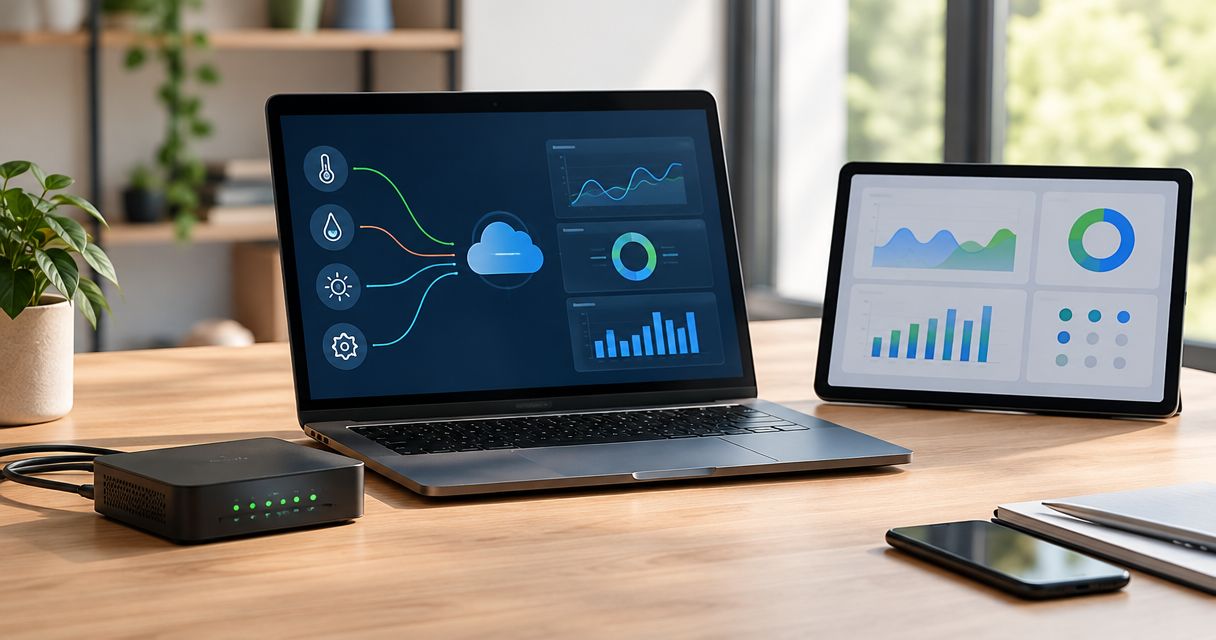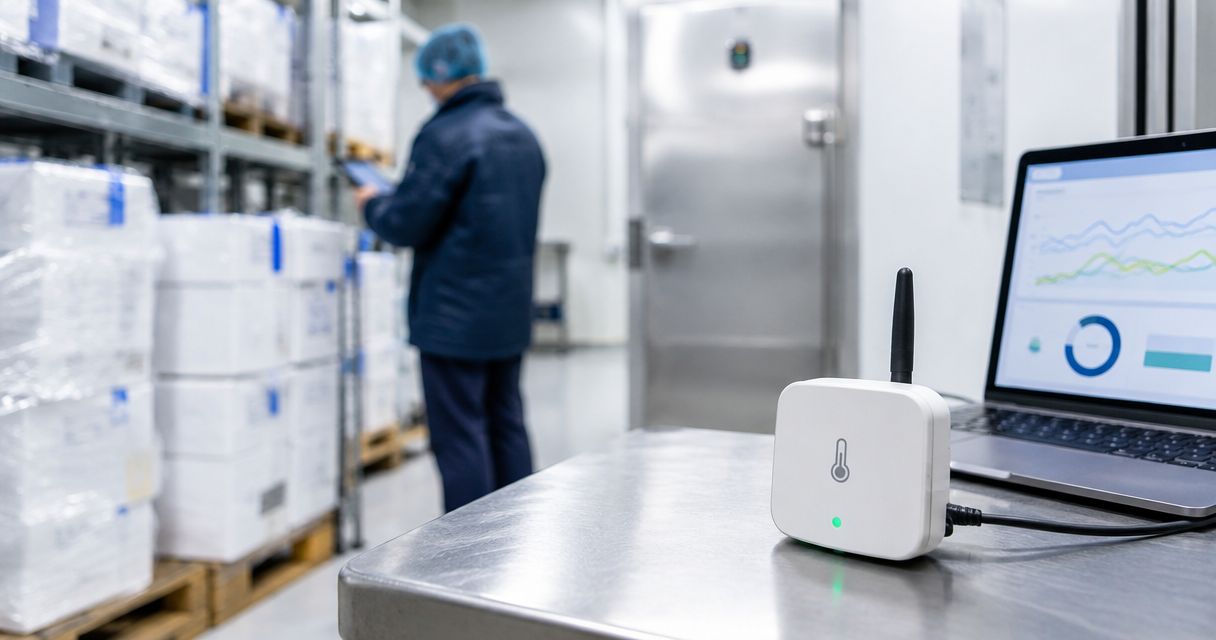
Cold chain monitoring cost per sensor is the full cost of collecting, reviewing and responding to temperature data divided by the number of active monitoring sensors—not just the hardware purchase or software subscription. When evaluating an IoT platform such as the Kilo IoT Platform, include installation, connectivity, shared infrastructure, calibration and ongoing support in the same calculation. Compare first-year cost and recurring cost separately, using the same monitoring requirements for every quote.
- Calculate cold chain monitoring cost per sensor from hardware, connectivity, software, installation and maintenance together.
- Separate shared site costs from charges attached to each temperature sensor.
- Kilo brings connected-device data, dashboards and alarms together; hardware and connectivity remain separate purchasing decisions.
- Compare quotes against the same measurement, notification and data-access requirements.
How much does cold chain monitoring cost per sensor?
There isn't a universal per-sensor figure that describes every cold chain deployment. A quote for temperature logging alone covers a different job from a connected system that sends alarms, supports multiple users and keeps measurements available for review.
The useful answer is a calculation tied to your deployment. Ask suppliers to separate these cost components rather than compressing everything into an unexplained device charge.
| Cost component | What you are paying for | How to allocate it |
|---|---|---|
| Sensor and probe | The measuring device, accessories and required probe | Assign to the relevant monitoring point |
| Installation | Mounting, placement, configuration and commissioning | Separate per-device work from site setup |
| Gateway and backhaul | Shared communications equipment and its upstream connection, where required | Divide among the sensors using that infrastructure |
| Platform software | Device data, dashboards, rules, alarms and user access included in the selected agreement | Use the supplier's actual billing basis |
| Connectivity | Network access and data transport required by the design | Identify device-level and site-level charges |
| Calibration and maintenance | Measurement checks, servicing and replacement work required by your procedure | Allocate over the comparison period |
| Support and response | Technical assistance and the people handling monitoring exceptions | Separate supplier services from internal labor |
First-year cost per sensor = all deployment and operating costs for the first year ÷ active monitoring sensors.
For recurring cost, remove genuinely one-time work and retain the expenses needed to keep the system operating. Don't remove maintenance simply because it doesn't appear on a monthly invoice.
A sensor sitting in a spare-parts drawer isn't an active monitoring point. Include its purchase in the project budget, but don't use spare inventory to make the operational per-sensor figure look lower.
Separate the monitoring job from the sensor purchase
Before comparing quotes, decide what the system must accomplish. Recording a temperature, making that reading available remotely and getting the right person to respond are separate requirements.
For a cold room, your specification might require temperature measurements associated with a named location, a dashboard showing recent readings and an alarm when a configured condition occurs. Someone must then investigate the condition and decide what to do with the stored goods. The software doesn't make that product-disposition decision for you.
Write down what constitutes a working monitoring point. Include the measurement location, required accuracy, reporting behavior, access to historical readings and the response procedure. Otherwise, suppliers can quote different systems while using the same phrase: temperature monitoring.
This distinction also protects the budget. A hardware-only quote isn't directly comparable with an installed service that includes configuration and support, even when both proposals describe a charge per sensor.
Build a comparable cost-per-sensor calculation
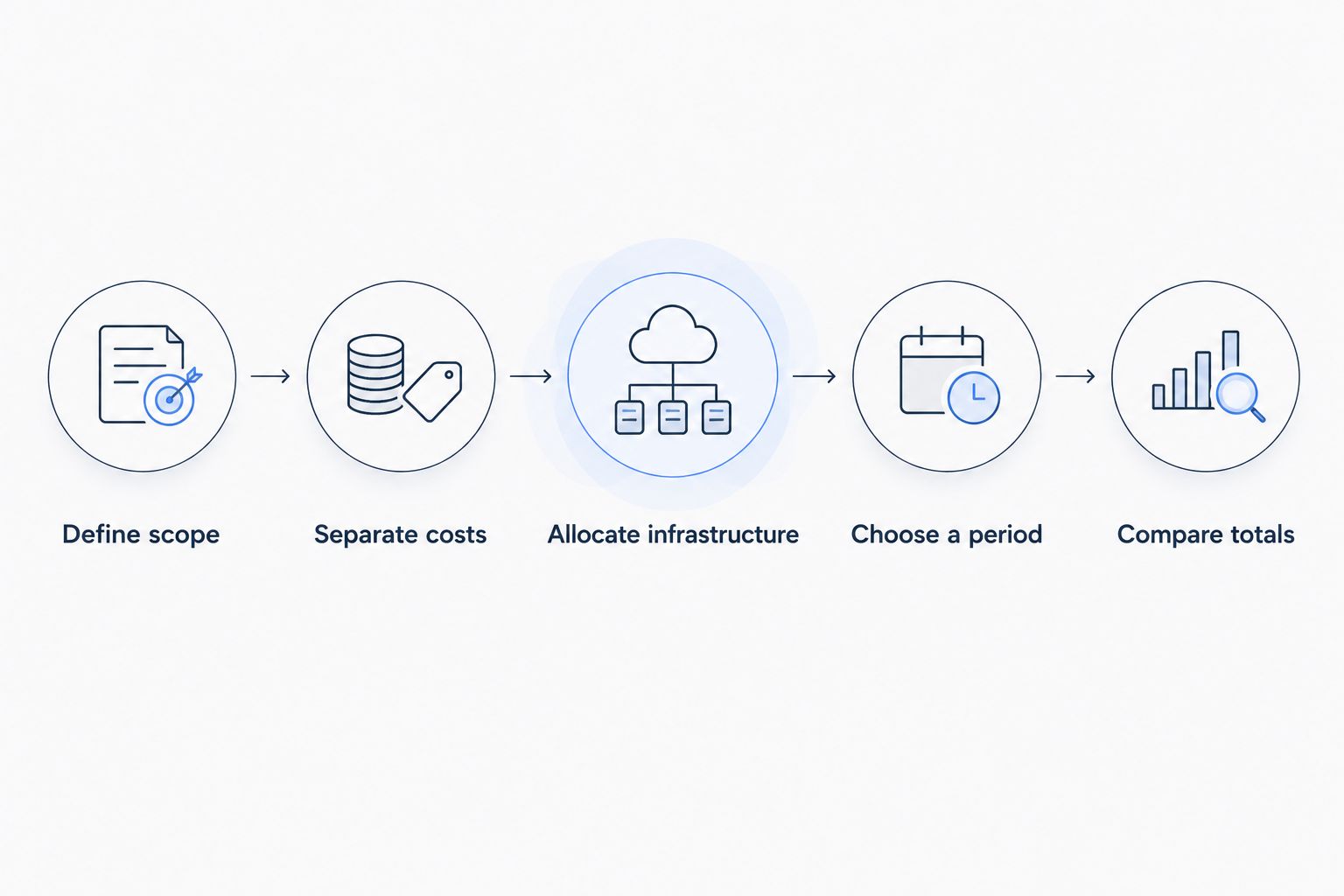
Use a repeatable sequence so each proposal answers the same financial question. Keep the underlying line items visible; the final average should summarize the budget, not conceal it.
- Define scope. List the monitoring locations, measurement requirements, users and expected response workflow.
- Separate costs. Group purchases, installation, recurring services and scheduled maintenance rather than combining them immediately.
- Allocate infrastructure. Assign gateways, backhaul and site setup to the sensors that actually use them.
- Choose a period. Calculate over a stated planning horizon, with the same horizon for every supplier.
- Compare totals. Divide the complete cost by active sensors, then retain the breakdown beside that result.
Use a 12-month planning period to understand launch-year spending. A 24-month planning period can show how the same deployment looks after initial setup is spread over a longer horizon, while a 36-month planning period gives scheduled servicing and replacement assumptions more room to affect the calculation. These are comparison choices, not recommended equipment lifetimes or contract lengths.
Don't assume that every component lasts for the entire planning period. Ask for the relevant maintenance requirements and document which replacement costs are included, excluded or still subject to quotation.
For a 2026 procurement exercise, keep dated supplier proposals with the worksheet. An old quotation and a current quotation aren't equivalent evidence of today's contractual terms.
Compare hardware-only, connected and managed monitoring
These purchasing approaches solve different parts of the monitoring problem. Select the required workflow first; then compare proposals within that scope.
| Purchasing approach | Best for | Useful advantage | Limitation to include in your decision |
|---|---|---|---|
| Hardware-only logging | Workflows where retrieving and reviewing recorded data meets the requirement | Keeps the purchase focused on measurement and recording | Remote notifications and centralized review aren't established by the device purchase alone |
| Connected monitoring | Teams that need remote readings, dashboards and configured alarms | Makes data available through the connected system | Requires a working communications path, configuration and a response owner |
| Managed monitoring service | Buyers seeking a defined package of installation or ongoing assistance | Places the agreed service responsibilities in a supplier contract | Scope, exclusions and the boundary between technical support and operational response need explicit agreement |
Hardware-only logging isn't automatically a poor choice. It is unsuitable when your actual requirement depends on remote notification that the proposed setup doesn't provide.
Likewise, a managed service isn't automatically more complete. Read what the supplier undertakes to do when data stops arriving, a measurement falls outside the configured range or a user needs help investigating an event.
Compare responsibilities as carefully as equipment. A proposal that leaves alarm configuration and commissioning to your integrator needs those tasks in your project budget.
Why cold chain monitoring costs vary
The per-sensor total changes when the measurement requirements, site design or service responsibilities change. These are the main factors to resolve before treating quotes as comparable:
- Measurement requirements. The required temperature range, accuracy, probe arrangement and calibration evidence determine which hardware is suitable. A shared temperature label doesn't establish equivalent measurement performance.
- Communications design. A sensor needs a supported path from the measurement location to the monitoring system. Gateway, network and backhaul requirements belong in the architecture and budget.
- Deployment layout. Sensors grouped within a tested coverage area share infrastructure differently from sensors distributed across separate sites. Don't divide every shared expense across the whole fleet without checking who uses it.
- Data and alarm requirements. Reporting behavior, historical access, notification requirements and user permissions affect the scope you need to purchase and configure.
- Installation and integration. Mounting, device identification, payload mapping, location assignment and testing are real implementation tasks. Establish who performs them and who accepts the result.
- Maintenance and support. Calibration procedures, servicing access, replacement responsibilities and technical assistance determine what remains after commissioning.
A lower total is meaningful only if the proposal still meets your specification. Removing a required task from the supplier's scope transfers the work; it doesn't eliminate it.
Where an IoT platform fits in the budget
The platform sits between connected measurements and the people using them. Kilo brings device data, dashboards, rules, alarms and permissions into one platform, giving you a software layer for organizing a cold chain monitoring workflow.
Kilo fits integrators who need cold chain device data, dashboards and alarms in one IoT platform. The purchasing boundary matters: platform software isn't the temperature probe, the communications service or the person responding to an excursion.
For hardware sourcing, Kilo Electronics is a separate online authorised dealer serving individual and business buyers. Keep that hardware purchase distinct from the platform agreement, and establish compatibility for the proposed device and integration rather than assuming it from a protocol name.
An illustrative workflow starts with a compatible sensor reporting temperature for a named cold room. The configured monitoring setup makes those readings available for review and evaluates the relevant alarm condition; the assigned responder investigates the equipment and stored goods. Subsequent measurements provide evidence of what happened next, but an alarm alone doesn't prove the goods remained acceptable.
Budget for configuring and testing that complete workflow. A temperature threshold rule doesn't require an AI workflow, and describing it as AI doesn't change the monitoring requirement.
Does adding more sensors reduce the cost per sensor?
Adding sensors reduces the shared-cost allocation per sensor only when the same infrastructure serves the additional devices without additional expense. It doesn't remove device purchases, installation work or charges that follow the number of connected devices.
Keep site-level and fleet-level calculations separate. Expanding within an existing coverage area is a different budgeting exercise from opening another location with its own installation and communications requirements.
Ask suppliers to explain what changes when you expand. Look for billing changes, additional infrastructure and configuration work rather than assuming that the initial average applies indefinitely.
Is the cheapest sensor the cheapest monitoring system?
The cheapest sensor isn't necessarily the lowest-cost monitoring system because the measurement device is only part of the workflow. Required accessories, integration work, calibration and maintenance still belong in the comparison.
Start with suitability, not the unit purchase figure. Confirm that the proposed device measures what you need, works through the intended integration and supports the maintenance procedure before comparing the complete deployment totals.
What should a cold chain monitoring quote include?
A usable quote identifies both deliverables and responsibilities. Send each supplier the same requirements and request a line-by-line response.
Your comparison worksheet should record:
- The sensor, probe and accessories included for each monitoring point.
- Installation, configuration and commissioning responsibilities.
- Required gateway, network and backhaul arrangements.
- The software billing basis and included functions.
- Notification channels and any separately charged services.
- Historical-data access and contractual retention terms.
- Calibration, servicing and replacement responsibilities.
- Support scope, exclusions and renewal conditions.
Ask what happens when communications fail, not just when temperature crosses a threshold. Establish how missing data is identified in the proposed design and who investigates it. Don't assume that a continuously displayed dashboard means every expected measurement has arrived.
Before acceptance, test the agreed workflow from measurement through notification and human response. Record the observed result against the requirement; a successful device onboarding step doesn't establish that the entire monitoring process works.
FAQ
Do I need a subscription for every cold chain sensor?
The billing basis depends on the software and connectivity agreements, not on temperature sensing itself. Ask whether the proposal charges by device, site, usage or another contractual unit, and keep those charges separate.
Can I reuse existing temperature sensors?
You can reuse an existing sensor only when it meets the measurement requirements and has a supported integration path. Check the device interface, payload interpretation and maintenance condition before treating reuse as a budget saving.
Should calibration be included in my monitoring budget?
Include calibration and measurement-verification work required by your operating procedure. Ask who performs it, what evidence is supplied and whether servicing interrupts monitoring.
Does a cold chain alarm prove regulatory compliance?
A cold chain alarm does not prove regulatory compliance. Compliance depends on the applicable requirements and the wider procedures, records and actions supporting them.
Should spare sensors count in the per-sensor calculation?
Include spare sensors in the project budget, but distinguish them from active monitoring sensors. Dividing costs by installed monitoring points keeps spare inventory from artificially lowering the operational figure.
How do I budget for replacing a monitoring supplier?
Request the contractual terms for retrieving data, removing integrations and ending service before signing. Include any quoted migration work in the comparison rather than assuming that switching suppliers has no implementation cost.
Test a missing reading before accepting the deployment
A useful acceptance test isn't limited to generating a temperature alarm. Deliberately interrupt a test device's communications under an agreed procedure, then confirm how the proposed system exposes the missing data and how the responsible person responds.
An absent measurement is not evidence of an acceptable temperature. Put that distinction in the monitoring specification before you compare the final cost per sensor.
Related guides
Written by Tim Kravchunovsky