
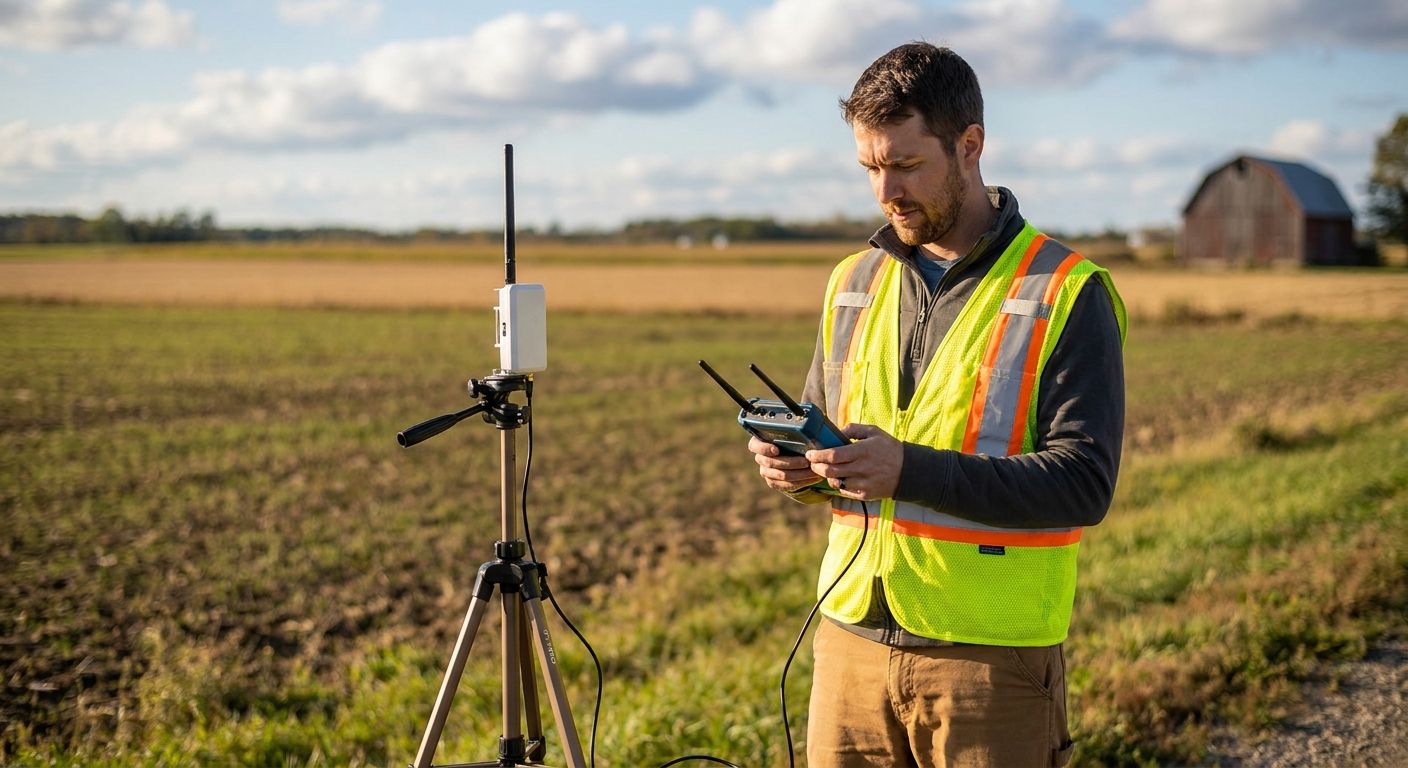
Before you order two hundred sensors, mount two or three at the exact spots they'll live and read what the network server reports back for a few days. That's how you test LoRaWAN signal strength before deployment in 2026 — not a coverage map, not a spec sheet, but real RSSI and SNR numbers pulled from real hardware sitting in the actual building.
- Test LoRaWAN signal strength before deployment by logging RSSI and SNR from pilot sensors at real mounting spots, not a spec sheet.
- SF7 covers short range at high speed; SF12 reaches farthest but demodulates almost at the noise floor.
- A free Kilo pilot runs on up to 5 devices and 1 dashboard at 0 EUR before you commit budget to the full order.
- Weak SNR kills a packet before RSSI even drops low enough to worry about.
- EU868 rollouts also need to confirm the 1% duty cycle limit set by ETSI EN 300 220 holds at scale.
Why LoRaWAN signal strength testing matters before a rollout
A link budget calculation tells you what should happen on paper. A steel mezzanine, a low-E coated window, or a bank of chest freezers tells you something different once hardware is actually mounted. Skipping the pilot and going straight to a 300-sensor purchase order is how facilities teams end up re-mounting gateways or adding repeaters after the fact, which costs far more in labor than a two-week test would have.
This matters more on a large or multi-building site, where a single gateway placement decision affects coverage across an entire floor plan. If you're scoping a campus rather than one building, planning LoRaWAN network coverage for a large campus before the pilot even starts will tell you how many test locations you actually need to cover.
How do you test LoRaWAN signal strength before deployment?
Run a small, real pilot before the full order goes out. The steps:
- Pick your worst-case locations first — the basement electrical room, the walk-in freezer, the far corner behind steel racking. If signal holds up there, it holds up everywhere easier.
- Deploy a handful of real sensors, not a demo unit on your desk. A free Kilo account covers up to 5 devices and 1 dashboard at 0 EUR with no card required, which is enough to cover the worst-case spots without buying a plan first.
- Log RSSI and SNR over time, not a single snapshot. A chart widget on the dashboard plotted against timestamp shows whether signal drops during occupancy, HVAC cycles, or freezer defrost — conditions a one-time reading misses entirely.
- Watch what spreading factor Adaptive Data Rate (ADR) settles on for each location. A sensor stuck at SF12 close to the gateway usually means something in the path is attenuating the link, not distance.
- Check packet delivery rate, not just signal bars. A sensor can show a passable RSSI and still drop uplinks if interference or gateway duty cycle is the actual bottleneck.
- Cross-reference against gateway placement and antenna gain. If two locations 20 meters apart return wildly different SNR, the fix is usually gateway position, not more sensors — see how industrial LoRaWAN gateways are typically sited before assuming a sensor problem.
- Decide before you order: does the pilot data support the planned gateway count, or does it need a second gateway or a repeater first?
If you don't already have spare pilot hardware, Kilo Electronics ships pre-configured LoRaWAN sensors worldwide, which is a fast way to get a small test batch on-site without waiting on a full procurement cycle.
Testing method comparison
| Method | What it measures | Best for | Main limitation |
|---|---|---|---|
| Handheld RF sniffer walk test | RSSI at the point of measurement | Quick first-pass site survey | No SNR or packet delivery rate over time |
| Pilot sensors logged through a network server | RSSI, SNR, packet delivery rate over days | Full rollout planning | Takes days and needs real hardware on-site |
| Link budget calculation | Theoretical max range from gateway sensitivity and antenna gain | Early planning before hardware ships | Ignores walls, multipath, RF noise |
| Vendor coverage prediction tools | Modeled coverage radius | Rough multi-building estimate | A model, not a measurement |
What RSSI and SNR values count as good LoRaWAN signal strength?
RSSI (received signal strength indicator) measures raw power in dBm — closer to 0 is stronger, and it degrades with distance and obstruction. SNR (signal-to-noise ratio) measures how far the signal sits above the local noise floor, and unlike most radio protocols, LoRa's chirp spread spectrum modulation can decode a packet even when SNR is negative, because the signal is spread across a wide bandwidth rather than needing to sit above the noise entirely.
Semtech's SX1276 datasheet lists receiver sensitivity down to -137 dBm at SF12, which is why a LoRaWAN link can still work at RSSI levels that would kill a Wi-Fi or Bluetooth connection outright. The number that actually predicts reliability is packet delivery rate over a real test window, not RSSI or SNR read in isolation — a sensor with weak RSSI but stable SNR can still deliver packets consistently, while a strong RSSI reading paired with collapsing SNR usually means interference, not distance.
“If SNR drops below what the spreading factor needs to demodulate, the packet is gone before RSSI even matters.”
How many gateways do you need before a full LoRaWAN rollout?
There's no fixed sensor-per-gateway number that applies to every site — it depends on building materials, floor count, ceiling height, and which spreading factor the pilot data shows sensors actually landing on. A single-story warehouse with clear sightlines to one gateway behaves nothing like a multi-floor concrete building with steel stairwells.
What the pilot should tell you directly is whether your planned gateway count and placement produce consistent packet delivery across every test location, including the worst-case ones. If two or more pilot locations show marginal SNR even after antenna repositioning, that's the signal telling you to add a gateway before the full rollout, not after installers are already on-site with 200 sensors.
Pilot Your Sensors Before You Order the Fleet
Run RSSI and SNR checks on up to 5 devices free, no card required.
What causes weak LoRaWAN signal strength indoors?
- Steel structures and racking — reinforced concrete floors, steel mezzanines, and dense pallet racking absorb and reflect RF signal far more than drywall or wood framing.
- Low-E coated glass — energy-efficient window coatings used in many commercial buildings block RF the same way they block heat.
- Metal-clad cold storage doors — walk-in freezers and coolers are effectively RF cages when the door is closed.
- Underground or basement placement — mechanical rooms and parking structures below grade lose line-of-sight to any above-ground gateway.
- Gateway antenna position and orientation — a gateway mounted low, indoors, or with the antenna oriented incorrectly underperforms a rooftop or high-wall placement even at identical distance.
- Co-channel interference — other LoRaWAN networks, or dense sensor deployments hammering the same gateway, degrade SNR even when RSSI looks fine.
Does spreading factor change how you test LoRaWAN signal strength?
Yes. LoRaWAN's spreading factors run from SF7 to SF12: SF7 transmits fastest and covers the shortest range, SF12 transmits slowest and reaches the farthest, trading airtime for reach. Adaptive Data Rate (ADR) picks the spreading factor automatically for each sensor based on link quality, so two sensors in the same building can land on completely different SFs depending on what's between them and the gateway.
During a pilot, watch which SF each location settles on rather than assuming ADR will fix a marginal link. A sensor pinned at SF12 close to the gateway is a signal that something in the path — steel, glass, interference — is doing more damage than distance alone would explain. If you're deploying in the EU868 band, also confirm the pilot's traffic pattern fits inside the 1% duty cycle limit set by ETSI EN 300 220, since a rollout with frequent uplinks per device can bump against that ceiling faster than a single pilot sensor reveals.
How long should a LoRaWAN signal test run before ordering the full sensor batch?
Run the test long enough to capture a full operational cycle for the site, not a fixed number of hours picked arbitrarily. For an office, that's a full work week including nights and weekends when HVAC and occupancy patterns shift. For a cold storage room, that's enough defrost cycles to see whether the compressor or door cycling introduces intermittent interference the first few readings missed.
Can you test LoRaWAN signal strength without gateways installed yet?
Yes, using a portable or temporary gateway placed near the planned mounting location, though the readings won't be final until the permanent gateway is mounted in its actual spot. Kilo runs a built-in LoRaWAN and mioty network server, so there's no separate network server software to stand up before you can start logging RSSI and SNR from pilot hardware — devices connect and start reporting to the dashboard directly.
FAQ
What's the best way to test LoRaWAN signal strength before deployment?
The best way is deploying a small batch of real sensors at your worst-case locations and logging RSSI and SNR over several days through a network server dashboard, rather than relying on a link budget calculation alone. Packet delivery rate over that window is the number that actually predicts rollout reliability.
What is a good RSSI value for LoRaWAN?
There's no single universal RSSI cutoff, because LoRa's chirp spread spectrum modulation decodes reliably far below where other radio protocols fail. Semtech's SX1276 datasheet lists receiver sensitivity down to -137 dBm at SF12, so what matters more in practice is stable packet delivery over your test window, not the RSSI number in isolation.
What is a good SNR value for LoRaWAN?
A good SNR is one that stays stable across your pilot test window at the spreading factor the device has settled on, and LoRa can still demodulate at negative SNR values unlike most other wireless protocols. A collapsing SNR trend during testing, even with acceptable RSSI, usually points to interference rather than distance.
Does spreading factor affect LoRaWAN range?
Yes, spreading factor is the main lever between range and speed: SF7 is fastest with the shortest range, SF12 reaches farthest but transmits slowest. Adaptive Data Rate assigns spreading factor automatically per device based on measured link quality.
How many gateways do I need for a LoRaWAN rollout?
There's no fixed number that applies across sites — it depends on building materials, floor layout, and what spreading factor your pilot sensors land on at each test location. If pilot data shows marginal SNR at two or more locations after repositioning antennas, that indicates a second gateway is needed before the full rollout.
Can I test LoRaWAN signal strength without buying gateways first?
Yes, a portable or temporary gateway placed near the planned mounting spot lets you start logging RSSI and SNR before the permanent gateway is installed. The readings will shift once the final gateway is mounted in its actual location, so treat early portable-gateway data as directional rather than final.
Is mioty an alternative to LoRaWAN for weak-signal sites?
mioty is a different low-power wide-area protocol built around telegram splitting, and it's worth testing alongside LoRaWAN on sites where pilot data shows persistently poor SNR at range. Kilo runs a built-in network server for both LoRaWAN and mioty, so the same pilot workflow applies to either protocol.
Does LoRaWAN duty cycle affect signal testing?
Yes, in the EU868 band, ETSI EN 300 220 caps transmit time at a 1% duty cycle per device on most sub-bands, which can throttle uplink frequency during testing if the pilot configuration sends too often. Confirm your test traffic pattern fits inside that limit before assuming a dropped packet is a signal strength problem.
What do experienced LoRaWAN installers check that a spec sheet won't tell you?
The detail beginners miss most often: a dropped packet during a busy hour isn't always a signal problem. It can be a gateway hitting its own duty cycle or channel capacity limit while dozens of pilot and neighboring devices transmit at once, which looks identical to weak signal on a dashboard until someone checks gateway-side logs instead of just the sensor's RSSI. Installers who've run enough of these pilots in 2026 check both sides before ordering the full sensor count, not just the device readings.