An outdoor LoRaWAN antenna has to match three things at once: the regional frequency band your network runs on, the gain needed to close the distance to the nearest gateway, and a housing that survives sun, rain, vibration and temperature swings without degrading the signal. Get the gain wrong and sensors drop packets in bad weather; get the band wrong and the sensor never joins the network at all.
The part installers skip is cable loss and connector corrosion — a 5 dBi antenna on a cheap, unshielded cable run can perform worse than a 3 dBi antenna on a short, properly terminated one.
- Match antenna gain to distance: 0-3 dBi covers sub-1 km sensor clusters, 6-14 dBi handles multi-kilometer or obstructed links.
- US915 (902-928 MHz) and EU868 (863-870 MHz) antennas are not interchangeable across a LoRaWAN deployment.
- IP67-rated housings and UV-stable cable jacketing hold up through a full 2026 outdoor deployment cycle.
- Directional Yagi antennas trade coverage angle for range — they solve point-to-point links, not area coverage.
- Kilo's built-in LoRaWAN network server ingests any standards-compliant antenna and gateway pairing without extra configuration.
What happens if you pick the wrong LoRaWAN antenna for an outdoor sensor deployment?
A mismatched antenna shows up as intermittent joins, not total failure — sensors connect on a clear day and drop off after rain or wind moves foliage into the signal path. Wrong-band antennas (an EU868 antenna on a US915 gateway) simply never establish a link, and the fix looks like a firmware problem when it's a hardware one.
The deployments that fail quietly are the ones using indoor-rated antennas outdoors. A dipole antenna spec'd for an office ceiling has no UV stabilizer in its housing and no gasket at the connector — six months of sun and condensation cracks the radome and lets moisture into the coax, and the antenna's return loss climbs long before anyone notices missed readings. Reviewing outdoor sensor selection for extreme weather deployments alongside antenna choice catches this before install, not after.
How do you choose a LoRaWAN antenna for outdoor sensor deployments?
Start with the frequency plan, then work outward: gain for distance, polarization for orientation, connector type for the radio, and IP rating for the environment. The table below covers the four antenna families used in outdoor LoRaWAN deployments.
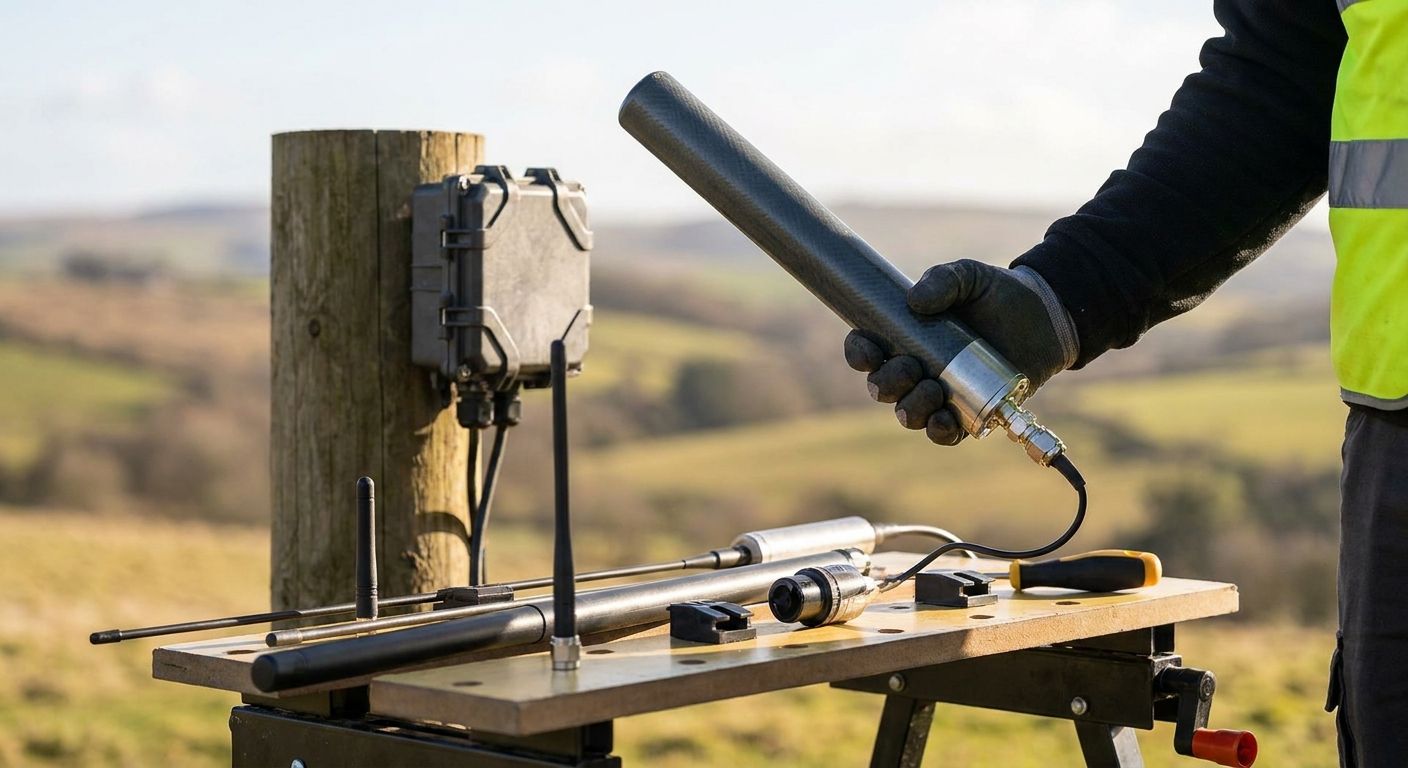
| Antenna type | Typical gain | Radiation pattern | Best for | |---|---|---| | Whip / dipole omni | 0-3 dBi | 360° horizontal | Sensors within a few hundred meters of a gateway, dense obstruction | | Fiberglass omni | 5-8 dBi | 360° horizontal, narrow vertical | Gateway masts covering a wide radius with clear line of sight | | Yagi / panel directional | 8-14 dBi | Narrow beam (30-60°) | Point-to-point links to a remote sensor cluster or backhaul | | Collinear pole-mount | 6-9 dBi | 360° horizontal, extended vertical gain | Long, narrow coverage along a corridor, perimeter or pipeline |
Higher gain concentrates signal into a narrower vertical beamwidth — a 9 dBi omni antenna covers more horizontal distance but loses coverage on sensors mounted much higher or lower than the antenna itself. That tradeoff, not gain alone, is why picking the highest-gain antenna available is often the wrong call.
Omnidirectional LoRaWAN antennas: 0-8 dBi for general outdoor coverage
Omnidirectional antennas radiate in all horizontal directions, which is what most outdoor sensor networks need since sensors are scattered around a site rather than lined up on one bearing.
- 0-3 dBi whip antennas: short range, wide vertical coverage, good for sensors clustered within a few hundred meters and uneven terrain.
- 5-8 dBi fiberglass omnis: standard choice for a gateway antenna on a rooftop or pole, trading some vertical spread for horizontal reach.
- Mounting height matters more than gain past a certain point — a 3 dBi antenna at 15 meters often outperforms an 8 dBi antenna at 2 meters with obstructions in the near field.
Directional Yagi and panel antennas: 8-14 dBi for long-range links
Directional antennas concentrate energy into a beam, which extends range in one bearing at the cost of coverage everywhere else. They solve a specific problem: a remote sensor cluster, a tank farm, or a single building that's too far from the main gateway for an omni to reach reliably.
- Use a Yagi or panel antenna when sensors sit along one line of sight, not scattered across a site.
- Aim requires more care than an omni — a few degrees of misalignment on a 12 dBi antenna can cost more signal than switching to a lower-gain omni.
- Pair with an industrial LoRaWAN gateway that supports external antenna connectors rated for the same frequency plan; internal-antenna gateways can't take advantage of a directional upgrade.
See how Kilo handles antenna and gateway pairing
Built-in LoRaWAN network server, no separate server to deploy.
What factors determine LoRaWAN antenna gain and range requirements?
Gain is the headline spec, but five other factors decide whether an antenna actually performs once it's mounted outdoors:
- Frequency plan — US915 (902-928 MHz), EU868 (863-870 MHz) and AU915 (915-928 MHz) are the LoRa Alliance regional parameters; antennas tuned for one band lose efficiency outside their designed range.
- Line of sight — trees, buildings and terrain absorb or reflect signal; a higher-gain antenna can't compensate for a fully obstructed path the way relocating the gateway can.
- Mounting height and orientation — antennas mounted below surrounding obstructions underperform their rated gain regardless of spec sheet numbers.
- Cable loss — every meter of coax between antenna and radio bleeds signal; longer runs favor a higher-gain antenna or a shorter cable path over adding more gain at the antenna.
- Connector and cable weatherproofing — uncapped or poorly sealed SMA/N-type connectors corrode within a season in coastal or high-humidity sites.
- Polarization consistency — antenna and sensor must share the same polarization (vertical is standard for most outdoor LoRaWAN deployments) or signal strength drops regardless of gain.
Sites that get this wrong tend to discover it during commissioning, not before — sensor placement gets reworked around antenna limitations instead of the other way around. Planning LoRaWAN network coverage for a large campus before hardware selection avoids most of that rework.
Does antenna polarization matter for outdoor LoRaWAN sensors?
Yes — polarization mismatch between antenna and sensor can cut received signal strength by a significant margin even when gain and frequency are correct. Most outdoor LoRaWAN deployments standardize on vertical polarization because sensor and gateway antennas are typically mounted vertically; horizontal or circular polarization only matters in specialized point-to-point links where both ends are engineered together.
Can you use the same LoRaWAN antenna for US915 and EU868 deployments?
No — US915 (902-928 MHz) and EU868 (863-870 MHz) are separate frequency bands under the LoRa Alliance regional parameters, and an antenna tuned for one loses efficiency or fails to radiate correctly on the other. Multi-country rollouts need region-specific antenna and gateway hardware, not one universal part number.
FAQ
What gain antenna do I need for an outdoor LoRaWAN sensor?
Most outdoor sensor deployments within a few hundred meters of a gateway need 0-3 dBi omnidirectional antennas; sites spanning a kilometer or more with clear line of sight use 6-8 dBi omnis or directional antennas up to 14 dBi for point-to-point links.
What IP rating should an outdoor LoRaWAN antenna have?
IP67 is the practical minimum for a permanently outdoor-mounted antenna and cable run. Lower-rated or indoor antennas degrade within a season once moisture reaches the connector.
What connector type do LoRaWAN antennas use?
SMA and N-type connectors are the two standard connector families for LoRaWAN gateway and antenna hardware; sensor-side antennas are more often integrated or use RP-SMA. Match the connector to the radio's spec, not the antenna alone.
Can a directional antenna replace multiple gateways?
A directional antenna extends range along one bearing but does not replace the coverage a second gateway provides across a wider area. It solves a single long link, not general site coverage.
How does cable length affect LoRaWAN antenna performance?
Every meter of coax between the radio and antenna adds signal loss, so long cable runs favor shorter paths or higher-gain antennas to compensate. Keeping the cable run as short as the install allows is usually cheaper than upgrading antenna gain.
Do I need a different antenna for a mioty deployment than LoRaWAN?
mioty and LoRaWAN often share the same sub-GHz ISM bands in a given region, so antenna hardware overlaps, but the network server and protocol stack differ. Confirm the antenna's frequency range matches your region's plan regardless of protocol.
How high should an outdoor LoRaWAN gateway antenna be mounted?
Higher mounting generally improves coverage more than adding antenna gain, since it clears near-field obstructions like walls, vehicles and vegetation. Exact height depends on the site's terrain and surrounding structures.
What do experienced LoRaWAN installers check that beginners miss?
They check the antenna's frequency range against the actual gateway firmware region setting, not just the antenna's printed band label — a mislabeled or gray-market antenna is a common field failure that looks like a network problem. They also replace factory pigtail cables on gateways more often than the antenna itself, since the pigtail's connector is usually the weakest weatherproofing point in the whole chain.
Kilo runs a built-in LoRaWAN and mioty network server, so once the antenna and gateway hardware is right, there's no separate network server to stand up before sensors start reporting into the Kilo IoT Platform. Kilo Electronics ships pre-configured outdoor sensors and antenna-ready gateway hardware worldwide for teams that want tested pairings instead of sourcing components separately.