
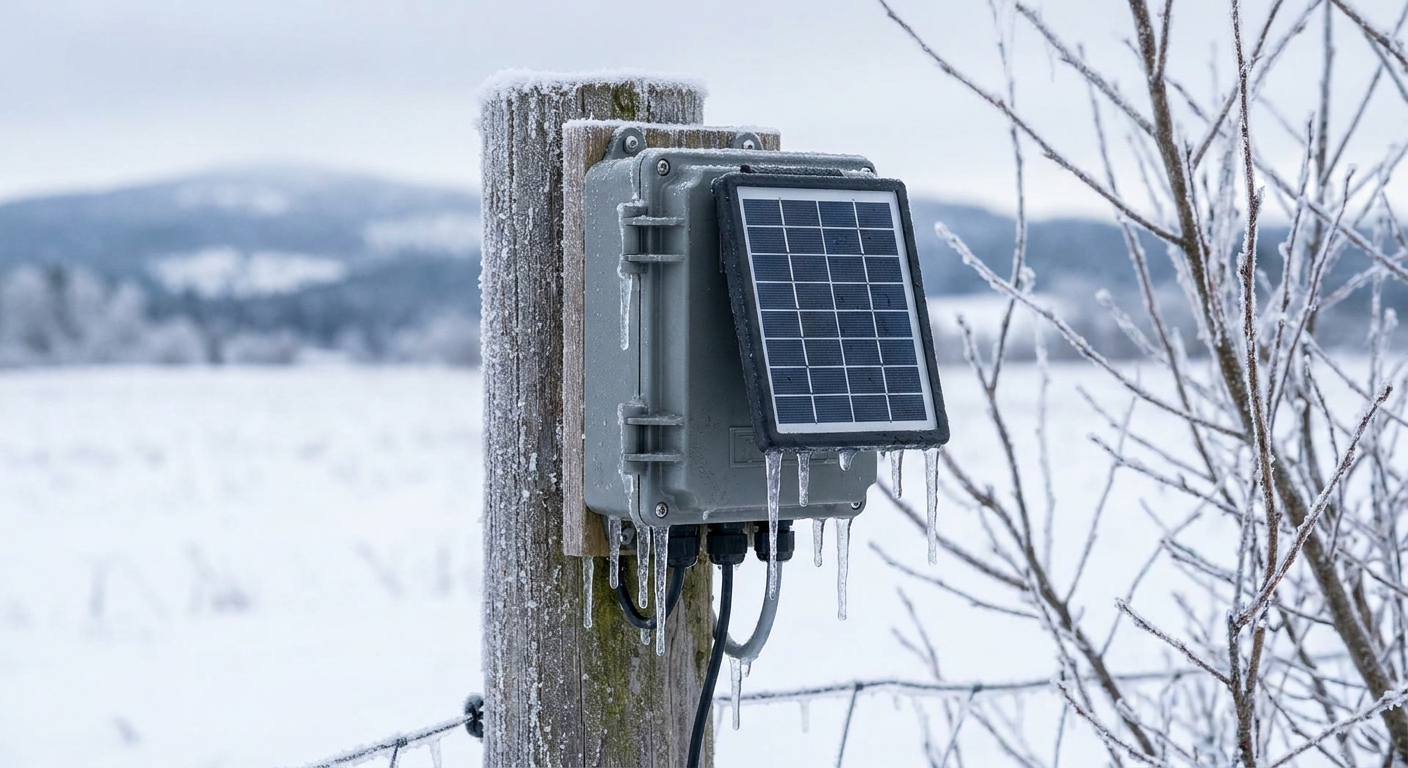
Cold kills LoRaWAN battery life faster than any firmware setting you can tune — but the right settings can claw back a year or more of runtime even at -20°C. This guide covers the concrete steps: chemistry choice, transmission interval math, spreading factor control, and physical placement, so a sensor rated for 5 years doesn't die in 14 months.
- Li-SOCl2 primary cells lose 20-40% of usable capacity below -20°C — pick chemistry rated for the actual site temperature, not room temperature.
- Stretching the transmission interval from 5 minutes to 30 minutes on a cold storage sensor can cut annual radio energy draw by roughly 80%.
- Locking spreading factor instead of letting ADR wander saves airtime and battery when a gateway is close enough to hold SF7 or SF8.
- Mounting sensors away from door sweeps and defrost cycles avoids the temperature swings that force extra transmissions and battery drain.
- A sensor reporting 2.1V instead of 3.6V nominal in cold storage is a voltage-sag warning, not a dead battery — check before replacing.
Why this matters
A LoRaWAN sensor's battery spec is almost always tested at 20-25°C. Drop that same sensor into a -18°C freezer room and two things happen at once: the battery chemistry loses usable capacity, and the radio still has to push the same uplinks through the same walls.
Most field failures blamed on "bad batteries" in 2026 deployments are actually a mismatch between transmission settings and the thermal environment. Facilities teams replace a battery, get another 8 months, and repeat the cycle — without ever touching the interval or spreading factor that's driving the drain. Fixing the settings once beats swapping batteries every quarter.
Kilo IoT's device management platform surfaces battery voltage trends per sensor, which makes it possible to catch a cold-induced voltage sag before a device drops off the network entirely.
What you'll need
- A multimeter or the platform's battery voltage graph to baseline current battery health
- The sensor's datasheet — specifically battery chemistry (Li-SOCl2, Li-MnO2, or alkaline) and its rated temperature floor
- Access to the sensor's device profile to adjust transmission interval and spreading factor
- A thermal log of the site (walk-in freezer, dock, outdoor cabinet) covering at least one full day/night or defrost cycle
- 15-30 minutes per sensor for reconfiguration, more if you're doing a fleet rollout across multiple sites
The steps
1. Confirm the battery chemistry matches the temperature range
Standard alkaline cells lose most of their capacity below 0°C and are a poor fit for cold storage or outdoor winter deployments. Lithium thionyl chloride (Li-SOCl2) cells are the common choice for industrial LoRaWAN sensors because they hold usable capacity down to -40°C, though even they derate 20-40% below -20°C compared to their 20°C rating.
Check the datasheet before assuming the problem is settings. A sensor running the wrong chemistry for -25°C cold storage will underperform no matter how conservative the transmission interval is.
Common mistake: assuming all "industrial" sensors ship with cold-rated cells — some ship with standard lithium primary cells rated only to -20°C, which is marginal for blast freezers running colder.
2. Stretch the transmission interval to match the alert requirement, not the default
Many sensors ship with a 5-minute default reporting interval, which is overkill for most cold storage monitoring and one of the biggest avoidable battery drains. If the compliance requirement is catching a door left open or a 8°C excursion for 10 minutes, a 15- or 30-minute interval still catches it with margin.
Each uplink costs airtime, and airtime costs battery — cutting from every 5 minutes to every 30 minutes is roughly an 83% reduction in transmission count per day. Set the interval through the device profile and confirm the change reflects in the next uplink payload before moving to the next sensor.
Common mistake: setting every sensor in a facility to the same aggressive interval regardless of what's actually being monitored — a slow-moving cold room doesn't need the same cadence as a blast freezer during defrost.
3. Lock spreading factor instead of letting ADR run unmanaged
Adaptive Data Rate (ADR) is designed to optimize airtime automatically, but in a fixed indoor deployment with a stable gateway distance, it can settle on a higher spreading factor than necessary — and higher SF means longer airtime per packet, which drains batteries faster in the cold when internal resistance is already up.
If the gateway is within reliable range (test at SF7 or SF8 first), lock the spreading factor manually rather than leaving ADR to hunt. Review the industrial LoRaWAN gateway placement relative to the sensor before locking — a gateway too far away will force a higher SF regardless of setting.
Common mistake: locking SF7 on a sensor at the edge of coverage, which then fails uplinks and burns battery on retransmissions — worse than letting ADR find SF9 or SF10.
4. Physically isolate the sensor from thermal swings and door sweeps
A sensor mounted directly in a door sweep or under a defrost heater cycles through temperature swings dozens of times a day, and every swing that crosses an alarm threshold can trigger an extra uplink outside the normal schedule. That's unplanned battery drain on top of the scheduled interval.
Mount temperature and humidity sensors away from door paths, evaporator fans, and defrost elements, positioned instead where they represent the actual product zone temperature. This also improves data accuracy, not just battery life.
Common mistake: mounting sensors near the door for "easy access" during installation, which is exactly where temperature swings are most extreme.
5. Reduce payload size where the sensor firmware allows it
Some LoRaWAN sensors let you configure which fields get transmitted — temperature only versus temperature, humidity, and battery voltage on every uplink. Fewer bytes per payload means shorter airtime, even at the same interval and spreading factor.
If humidity isn't part of the compliance requirement for a given cold room, dropping it from the payload trims airtime on every single transmission over the sensor's multi-year life.
Common mistake: leaving diagnostic fields (like signal strength or full battery telemetry) in every uplink when they only need to be checked occasionally, not on every cycle.
6. Set battery voltage alarms before the sensor goes dark
A Li-SOCl2 cell's voltage curve stays flat for most of its life, then drops fast near the end — and cold temperatures accelerate that final drop. Waiting for a sensor to stop reporting means missing the warning window entirely.
Build an alarm on the rules engine at a voltage threshold specific to the chemistry — for a 3.6V nominal Li-SOCl2 cell, an alarm at 3.0-3.1V under cold load gives lead time to schedule a swap before the next reading is silence.
Common mistake: using a generic "low battery" flag from the sensor firmware instead of a voltage-based alarm, which often triggers too late in cold conditions where voltage sag is temporary but real depletion is close behind.
7. Stagger deployment and replacement schedules across a fleet
If every sensor at a multi-site cold storage operation gets installed the same week, they'll all approach end-of-life the same week — creating a maintenance spike instead of a steady trickle. Staggering install dates during rollout, or noting install date per device in the platform, spreads replacement labor out.
This matters more at scale: a facility running 40+ sensors across several freezer rooms benefits from onboarding sensors at scale with tracked install dates rather than treating each one as an isolated device.
Check battery voltage trends across your fleet
See per-sensor voltage history and set cold-aware alarms before a device goes dark.
Troubleshooting
Sensor stops reporting entirely with no low-battery warning. Cold-induced voltage sag can drop a cell below the radio's operating threshold temporarily, then recover once temperature rises slightly. Check the last logged voltage reading before assuming the battery is fully depleted — a warm-up test at room temperature will confirm if the cell has real capacity left.
Battery life is far shorter than the datasheet claim. Datasheet life estimates almost always assume 20-25°C and a specific transmission interval, often once per hour. Compare your actual interval and site temperature against the datasheet's test conditions — a sensor rated for 5 years at 1 uplink/hour at 20°C might realistically deliver 18 months at 1 uplink/5min in a -20°C freezer.
Voltage readings look normal but the sensor missed several scheduled uplinks. This points to a network issue, not a battery issue — check gateway signal strength and spreading factor before touching the device. A weak link forces retransmissions that look like erratic reporting but are really airtime and radio range problems.
Multiple sensors in the same cold room are draining at different rates. Mounting position matters more than most installers expect — a sensor near a door or defrost element will drain faster than one in a stable zone, even with identical hardware and firmware settings.
Battery percentage reported by firmware doesn't match measured voltage. Some sensor firmware calculates "percentage remaining" using a linear model that doesn't account for the flat-then-cliff discharge curve typical of Li-SOCl2 cells. Trust the raw voltage reading and the chemistry's known curve over a firmware-calculated percentage.
Tools and resources
- Device profile settings for transmission interval and spreading factor in the sensor management platform
- A private LoRaWAN network setup reference for gateway placement and coverage planning
- Cold chain compliance sensors rated for the specific temperature floor of the site
- A voltage-based alarm rule configured through the rules engine, not a generic low-battery flag
- A thermal log or walkthrough of the site to identify door sweeps and defrost cycle timing before finalizing mounting positions
What to do next
Once interval, spreading factor, and mounting are dialed in for one cold room, the same settings profile can template across every similar zone in the facility instead of reconfiguring each sensor from scratch. For a full deployment covering multiple freezer and cooler zones, the cold storage temperature dashboard gives a single view of every sensor's battery trend alongside temperature compliance, which makes it obvious which zones need a settings revisit before summer or winter shifts change the thermal load.
FAQ
How to extend LoRaWAN sensor battery life in cold environments?
Use Li-SOCl2 battery chemistry rated for the site's actual low temperature, stretch the transmission interval to the longest cadence that still meets the alarm requirement, and lock spreading factor when gateway range allows it. Mounting sensors away from door sweeps and defrost cycles removes the temperature swings that trigger extra unplanned uplinks.
What battery chemistry lasts longest in a freezer?
Lithium thionyl chloride (Li-SOCl2) cells hold usable capacity down to -40°C and are the standard choice for industrial cold storage sensors in 2026. Standard alkaline cells lose most of their capacity below 0°C and aren't suitable for freezer deployments.
Does cold temperature actually reduce LoRaWAN battery life?
Yes — Li-SOCl2 cells can lose 20-40% of usable capacity below -20°C compared to their 20°C rating, even before accounting for radio transmission drain. The combination of cold-derated capacity and unchanged transmission settings is the most common cause of shorter-than-expected battery life.
How often should a cold storage LoRaWAN sensor transmit?
Match the interval to the actual alarm requirement rather than the factory default, which is often every 5 minutes. Most compliance thresholds (like an 8°C excursion for 10 minutes) are still caught with a 15- or 30-minute interval, and that change alone can cut annual transmission count by roughly 80%.
Should I let Adaptive Data Rate (ADR) manage spreading factor automatically?
ADR works well when gateway distance varies, but in a fixed indoor deployment with stable range, locking a lower spreading factor manually can reduce airtime and battery drain versus letting ADR settle higher than necessary. Test the locked SF for reliable delivery before leaving ADR off permanently.
How do I know if a sensor's battery is actually dying versus just cold-sagging?
Check the last logged voltage against the chemistry's known discharge curve — a Li-SOCl2 cell sitting around 3.0-3.1V under cold load may recover once temperature rises, while a cell below that threshold consistently is genuinely near end-of-life. A warm-up test at room temperature clarifies which case applies.
Does mounting position affect LoRaWAN sensor battery life?
Yes — sensors mounted near door sweeps, evaporator fans, or defrost elements experience frequent temperature swings that can trigger extra alarm-driven uplinks outside the scheduled interval. Mounting in a stable zone representative of actual product temperature reduces both drain and false alarms.
What voltage should trigger a low-battery alarm on a cold storage sensor?
For a 3.6V nominal Li-SOCl2 cell, setting an alarm around 3.0-3.1V under cold load gives enough lead time to schedule a replacement before the sensor goes silent. Generic firmware low-battery flags often trigger too late because they don't account for cold-induced voltage sag.
One last thing
The single biggest battery-life lever most teams skip isn't chemistry or mounting — it's the payload field list. Dropping unnecessary fields like humidity or full diagnostic telemetry from every uplink, when only temperature and voltage matter for a given cold room, trims airtime on every single transmission for the sensor's entire multi-year deployment. It's a five-minute firmware change that compounds for years.