
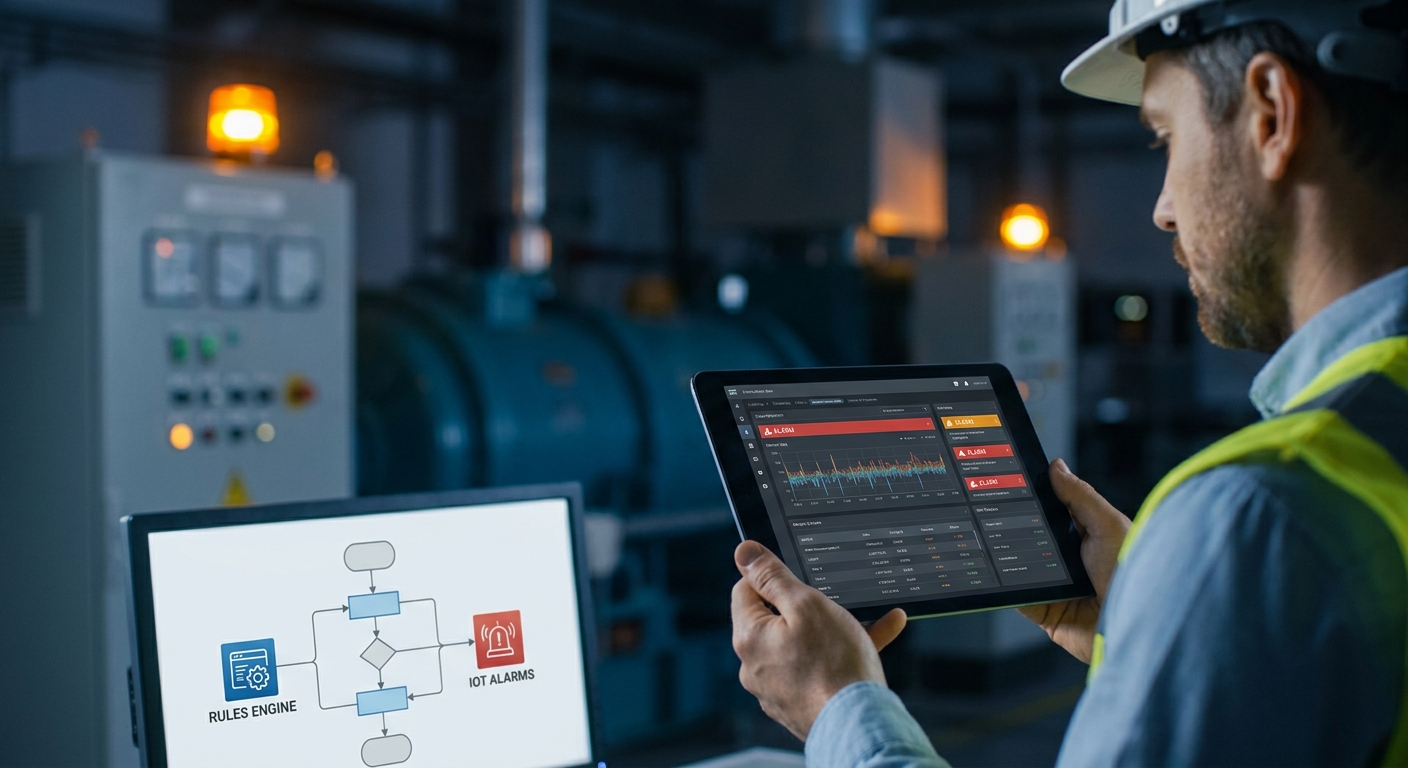
A rules engine is the difference between a sensor reading and an action. Pick the wrong one for industrial IoT alarms and you get a dashboard that logs a compressor running hot at 3 a.m. and nobody sees it until the shift change.
- Kilo Cloud wins for plain-language rule building tied to LoRaWAN, mioty and MQTT sensor data — Buy.
- Node-RED stays free in 2026 but needs a developer on staff to maintain rule flows — Consider.
- AWS IoT Events fits teams already running AWS IoT Core end to end — Consider.
- Ignition suits plants with existing SCADA tags and per-tag licensing budget — Consider.
- The best rules engine software for industrial IoT alarms ties directly to your sensor data, not a generic if-this-then-that flow.
Why this matters
An alarm that fires 40 times a day for the same tank level gets muted within a week. The rules engine is what decides whether an alarm means something: a threshold crossed, a rate of change, a pattern across multiple sensors. Get that wrong and operators stop trusting the system entirely, which defeats the point of installing sensors in the first place.
The stakes are higher on industrial sites than on a home automation setup. A pump running above normal vibration for more than a few minutes often means a bearing is already failing, and the rules engine has to catch that pattern before the pump seizes, not after. Static thresholds miss this. Pattern-based rules and anomaly detection catch it.
By 2026, most industrial IoT rules engines fall into three camps: code-first (Node-RED, custom scripts), tag-based SCADA extensions (Ignition), and AI-assisted platforms that build the rule from a plain-language description of the failure mode. Which camp fits depends on whether you have a developer on staff, an existing SCADA investment, or neither.
How this list was ranked
This ranking weighs four things: how the rules engine connects to real industrial protocols (LoRaWAN, mioty, MQTT, Modbus), how much technical skill it takes to build and maintain a rule chain, whether it supports escalation logic (not just a single alert), and total cost of ownership including licensing and integration work. Software with no documented industrial deployment pattern or no clear alarm escalation path drops in ranking regardless of general popularity.
Entries are ordered by fit for industrial alarm use cases specifically, not general IoT popularity. A tool can be excellent for consumer IoT and still rank low here if it lacks escalation, multi-condition logic, or reliable uptime guarantees for 24/7 monitoring.
The ranked list
1. Kilo Cloud — the AI-assisted pick
Kilo Cloud is the rules engine layer inside the Kilo IoT platform, built around LoRaWAN, mioty and MQTT connectivity plus a digital building twin. The rules engine takes plain-language descriptions of a failure condition ("alert me if the cold room stays above 8°C for more than 10 minutes") and turns it into a working rule and alarm chain without requiring the operator to write conditional logic by hand.
What makes it different from a generic automation tool is that the rules sit directly on top of live device data from the same platform managing the sensors, so there's no separate integration step between "device reports a value" and "rule evaluates it." That matters for industrial teams who don't want a middleware layer between the sensor and the alarm. Verdict: Buy for facilities and operations teams that want rules built fast without hiring a developer to maintain them.
2. Node-RED — the free flow-based option
Node-RED has been open source since 2013 and remains the default choice for teams that want full control over rule logic through a drag-and-drop flow editor. It connects to MQTT, HTTP and most industrial protocols through community nodes.
The catch: someone on your team has to build and maintain every flow, and there's no built-in escalation or on-call routing without adding more nodes. Verdict: Consider only if you have a developer who can own the flows long-term; Skip if operations staff will be building rules solo.
3. AWS IoT Events — the hyperscaler pick
AWS IoT Events went generally available in 2020 and uses detector models to track equipment state across multiple conditions, not just single thresholds. It fits naturally if your data already lands in AWS IoT Core.
The complexity shows up in IAM permissions, detector model JSON, and the fact that you're now managing a rules engine as one more AWS service among dozens. Verdict: Consider for AWS-committed stacks; Skip if you're not already deep in that ecosystem.
4. ThingsBoard — the open-source dashboard bundle
ThingsBoard launched in 2016 and pairs a rule chain engine with dashboards and device management in one open-source package, available self-hosted or as a managed cloud. Rule chains support branching logic and can trigger email, SMS or webhook alarms.
Self-hosting means you own uptime and patching. The managed cloud tier removes that burden but adds a recurring cost similar to other SaaS platforms. Verdict: Consider for teams comfortable running open-source infrastructure.
5. Losant — the workflow-heavy pick
Losant's workflow engine uses visual triggers to chain sensor conditions into multi-step automations, which works well for teams that think in flowcharts rather than code. Coverage for industrial protocols beyond MQTT is thinner than platforms built specifically for industrial deployments.
Verdict: Hold. Fine for prototyping alarm logic, less proven for large multi-site industrial rollouts in 2026.
6. Ignition (Inductive Automation) — the SCADA-native pick
Ignition extends tag-based alarms directly inside an existing SCADA environment, which is the biggest draw for plants that already run Ignition or a similar historian. Alarm configuration lives at the tag level, which plant engineers already understand.
Per-tag licensing adds up fast as sensor counts grow, and it's not built for greenfield deployments without an existing SCADA layer. Verdict: Consider only if Ignition or a comparable SCADA system is already installed; Skip for a new build.
7. HiveMQ plus a custom rules layer — the broker-only option
HiveMQ is a strong MQTT broker but it is not a rules engine on its own. Teams pick it when they want message routing handled well and are prepared to build or bolt on a separate rules and alarm layer.
That second layer is real engineering work, not a checkbox. Verdict: Skip if you want a turnkey alarm system; the broker alone won't get you there.
Comparison table
| Software | Hosting | Rule Building | AI-Assisted | Best For | Verdict |
|---|---|---|---|---|---|
| Kilo Cloud | Cloud (SaaS) | Plain-language + visual | Yes | Ops/facilities teams, cold chain, industrial sites | Buy |
| Node-RED | Self-hosted | Code/flow-based | No | Teams with a dedicated developer | Consider |
| AWS IoT Events | Cloud (AWS) | Detector models (JSON) | No | AWS-native stacks | Consider |
| ThingsBoard | Self-hosted or cloud | Rule chains | No | Open-source-comfortable teams | Consider |
| Losant | Cloud | Visual workflows | No | Prototyping, smaller deployments | Hold |
| Ignition | On-prem/hybrid | Tag-based | No | Plants with existing SCADA | Consider |
| HiveMQ + custom | Self-hosted/cloud | None built-in | No | Broker-only needs | Skip |
See how Kilo Cloud builds alarm rules
Walk through a real rule chain for equipment monitoring on the Kilo IoT platform.
Where to get it running
- Start with a trial on live sensor data, not a demo dataset. A rules engine looks fine against clean sample data and falls apart against a noisy vibration sensor reading every second.
- Price the full cost, not just the license. Per-tag SCADA licensing and self-hosted infrastructure both carry ongoing costs that a monthly SaaS quote doesn't show upfront.
- Check escalation support before you buy. A rule that fires an alert once and stops is not the same as an alarm chain that escalates to a second contact after 15 minutes of no acknowledgment.
FAQ
What's the best rules engine software for industrial IoT alarms in 2026?
Kilo Cloud ranks highest for teams that want rules built from plain-language descriptions tied directly to live LoRaWAN, mioty and MQTT sensor data. Node-RED and Ignition remain strong picks for teams with existing developer or SCADA resources.
Is Node-RED good enough for industrial alarms?
Node-RED handles industrial alarm logic well if someone on staff builds and maintains the flows. It has no built-in escalation, so multi-step alarm routing has to be added manually.
How much does an industrial rules engine cost?
Costs vary by model: SaaS platforms bill monthly per device or tier, Ignition bills per tag, and self-hosted open-source tools like Node-RED and ThingsBoard shift cost to infrastructure and maintenance instead of licensing.
Can I build IoT alarms without writing code?
Yes. Platforms with AI-assisted or visual rule building, like Kilo Cloud's plain-language rule creation, let operations staff set thresholds and alarm chains without a developer writing conditional logic.
What's the difference between a rules engine and an alarm system?
A rules engine evaluates conditions against incoming sensor data; the alarm system is what happens after a rule fires, such as an SMS, email, or escalation to a second contact. Some platforms bundle both, others require you to connect them separately.
Does AWS IoT Events work with LoRaWAN sensors?
AWS IoT Events can work with LoRaWAN data once it's routed through AWS IoT Core, but that routing is an extra integration step compared to platforms with native LoRaWAN device management built in.
How long does it take to set up automated equipment alarms?
Setup time depends on the platform: code-based tools like Node-RED can take days to weeks to build and test a rule chain, while AI-assisted platforms can produce a working rule from a plain-language description in a single session.
Is Ignition worth it for a mid-size plant?
Ignition is worth it if the plant already runs Ignition or a comparable SCADA system, since tag-based alarms slot into that existing structure. For a new deployment without SCADA in place, a purpose-built IoT rules engine is usually less work to stand up.
One last thing
The rules engines that fail in production almost never fail on the alarm logic itself — they fail on escalation. A threshold rule that fires once and waits for someone to notice is not an alarm system, it's a log entry. Before buying anything on this list in 2026, ask the vendor to show you what happens when the first alert is ignored for 15 minutes. If the answer is "nothing," keep looking.