
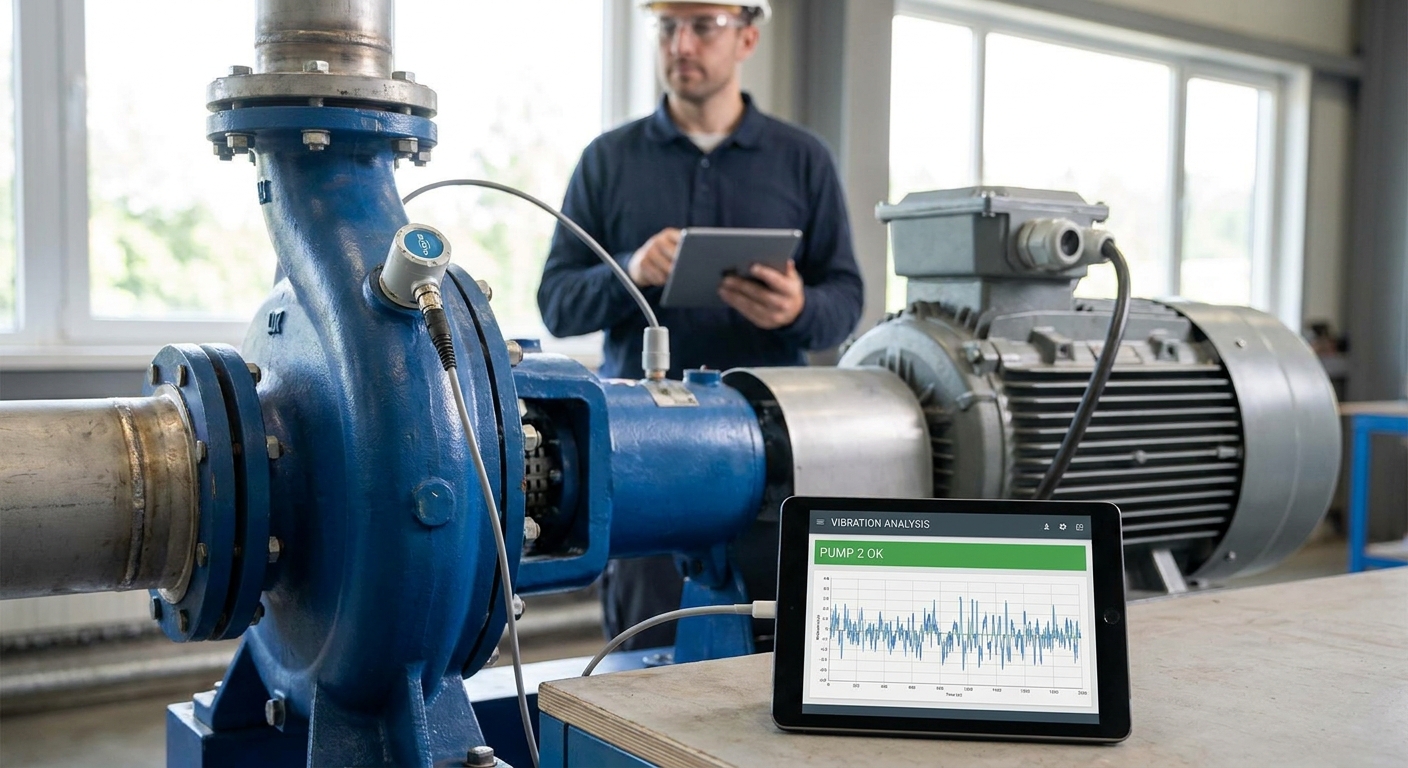
IoT vibration monitoring for pumps and motors catches bearing wear and misalignment weeks before a pump seizes or a motor windings fail. This guide breaks down what actually matters when picking a setup, not just a sensor spec sheet.
- IoT vibration monitoring for pumps and motors flags bearing wear around 4.5 mm/s RMS before failure. Buy an alarm-first setup.
- Mioty handles dense plant floors with hundreds of pumps; LoRaWAN covers spread-out sites past 10km. Pick by RF density, not brand.
- Skip any setup without a rules engine — raw vibration graphs get ignored within weeks without automated alarms.
- A predictive maintenance layer on vibration trending cuts unplanned pump downtime heading into 2026 maintenance budgets.
Why this matters
A pump bearing doesn't fail overnight — it moves through detectable stages of looseness, wear, and lubrication breakdown over weeks or months. Vibration data is the earliest signal you get, ahead of temperature, ahead of sound a technician can hear on a walk-by.
The problem most plants run into by 2026 isn't sensor availability — it's what happens after the data lands. A dashboard full of vibration charts nobody checks is worse than no monitoring at all, because it creates a false sense of coverage. The setups that actually save a pump pair sensor data with automated alarms for equipment vibration anomalies so a threshold breach reaches a maintenance tech's phone, not just a graph nobody opens.
Kilo IoT's platform approaches this the same way an operator would: sensor data feeds a rules engine, the rules engine watches trends against thresholds, and alarms fire on the exception, not on every reading.
Who this is for
This guide is for maintenance and reliability engineers running pumps and motors in manufacturing plants, water utilities, food and beverage lines, or industrial facilities where an unplanned pump failure means a production stop, not a minor inconvenience. If you're managing more than a handful of rotating assets across one or more sites and still rely on scheduled manual checks with a handheld vibration meter, this is your upgrade path.
What to look for in IoT vibration monitoring for pumps and motors
Sampling rate and frequency range
A sensor sampling at 2-4 kHz with a monitored range of roughly 10Hz to 1kHz catches the bearing defect frequencies and misalignment harmonics that actually predict failure. Anything sampling slower than that misses early-stage bearing spall, which shows up as high-frequency energy long before the 1x RPM peak moves.
Alarm logic, not just graphs
A chart of RMS velocity over time is useless if nobody's watching it daily. The setup needs a rules engine that compares readings against a baseline and against standards like ISO 10816-3, and fires an alert when a pump crosses from Zone B into Zone C. This is where automated vibration alarms separate a monitoring project from a monitoring habit.
Connectivity fit for your RF environment
A plant floor with 200 pumps packed into one building has different RF needs than a remote lift station 15km from the nearest gateway. Mioty's telegram-splitting protocol handles dense sensor counts with less collision than standard LoRaWAN, while LoRaWAN's longer range wins on spread-out sites. Match the protocol to the site, not the other way around.
Baseline period before you trust an alarm
Every pump has a normal vibration signature, and that signature is unique to its mounting, load, and age. Expect roughly 30 days of data collection before alarm thresholds stop false-triggering on startup transients and normal load swings. Skip this step and you'll get alarm fatigue by week two.
Integration with existing maintenance workflows
A vibration alert that doesn't reach a work order system is a notification, not a maintenance program. Look for a platform that can push data into your dashboard or CMMS through an open API rather than locking readings inside a proprietary app.
Battery life and mounting for the actual asset
A magnetically mounted wireless sensor on a motor housing needs to survive years without a truck roll to swap batteries, and needs to stay put through normal operating vibration — not just bench-test vibration.
“A pump that's loud in the ultrasonic range but quiet at 1x RPM is usually bearing wear, not misalignment.”
Top picks for pumps and motors
The dense-floor pick: mioty-based sensors
Mioty's telegram-splitting design handles hundreds of sensors reporting in the same RF space without the packet collisions that choke standard LoRaWAN at scale. If you're running 100+ pumps and motors inside one plant, this is the connectivity layer that keeps every sensor reporting reliably. One spec that matters: mioty's ultra-narrowband splitting lets a single gateway service far more concurrent devices than a comparable LoRaWAN deployment in the same footprint. Check the sensors built for mioty-based industrial monitoring before locking in a dense-floor deployment. Buy if your plant has more than 50 rotating assets in one building.
The alarm-first pick: rules-engine-driven setup
Skip the dashboard-only approach entirely and build the alarm logic before you even finish mounting sensors. A rules engine that watches RMS velocity trend against a 30-day baseline and fires on Zone B-to-C transitions catches degrading bearings weeks ahead of a temperature spike. Buy if your team has ignored a monitoring dashboard before — this fixes that failure mode by design.
The full-program pick: predictive maintenance layer
Vibration monitoring on its own tells you a pump is degrading. Layering that data into a broader predictive maintenance program for manufacturing plants ties vibration trends to work orders, spare parts inventory, and technician scheduling. This is the pick for plants tracking 20+ pumps and motors where unplanned downtime already has a dollar figure attached to it in 2026 budgets. Buy if reliability is a line item your operations director asks about.
The multi-asset-class pick: general industrial IoT platform
If pumps and motors are one asset class among several — tanks, cold storage, HVAC — a single platform covering all of it beats running separate point tools per asset type. The best IoT platforms for industrial manufacturers comparison covers this exact tradeoff: one dashboard across asset classes versus a specialist tool per class. Consider this pick if vibration is one piece of a larger facility monitoring rollout, not the whole project.
The bare-minimum pick: single-axis threshold alert
A basic single-axis accelerometer wired to a simple high/low threshold alert catches gross failures — a bearing seizing, a motor running dry — but misses the early-stage degradation that gives you weeks of lead time. Skip this for any pump where downtime costs more than a sensor upgrade; it's a smoke detector, not a diagnostic tool.
See the full Kilo IoT platform
Dashboards, rules engine, and alarms built around real deployments.
What to avoid
- Vibration-only sensors with no temperature channel. Bearing failure and lubrication breakdown both show up as heat, and a combined channel catches failure modes vibration alone misses.
- Cloud dashboards with no alarm export. If the platform can't push an alert to email, SMS, or your CMMS through an API, the alarm exists only inside an app nobody opens on a Saturday.
- Sensors rated for benchtop vibration only. A sensor that hasn't been validated on an actual running motor will drift or detach within months of continuous operating vibration.
Verdict comparison
| Pick | Best for | Connectivity | Verdict |
|---|---|---|---|
| Mioty-based sensors | 50+ assets in one plant | Mioty | Buy |
| Rules-engine-driven setup | Teams with alarm fatigue history | LoRaWAN/mioty | Buy |
| Predictive maintenance layer | 20+ pumps, budget-tracked reliability | LoRaWAN/mioty | Buy |
| General industrial platform | Multi-asset-class facilities | LoRaWAN/mioty/MQTT | Consider |
| Single-axis threshold alert | Low-cost, low-criticality pumps | Wired or basic wireless | Skip for critical assets |
FAQ
What is IoT vibration monitoring for pumps and motors?
It's continuous wireless tracking of vibration velocity and frequency on rotating equipment, feeding a platform that alerts on abnormal trends. It replaces or supplements manual handheld vibration checks that only happen on a scheduled walk-by.
What vibration level indicates a failing pump bearing?
ISO 10816-3 puts roughly 4.5 mm/s RMS as an alarm threshold for medium-sized rigid-mounted motors moving from acceptable to unsatisfactory. The exact number shifts by machine size and mounting, which is why a 30-day baseline per asset matters more than a single fixed number.
Is wireless vibration monitoring accurate enough for critical pumps?
Yes, when the sensor samples at 2-4 kHz across a 10Hz-1kHz range, it captures the same defect frequencies a wired system does. The gap isn't accuracy, it's mounting quality and battery reliability over years of continuous operation.
How often should vibration sensors report data?
Most industrial pump and motor monitoring runs on hourly to every-few-hours reporting intervals, with event-triggered readings when a threshold is crossed. Continuous streaming is rarely necessary and burns battery life faster than the added detection value justifies.
What's the difference between mioty and LoRaWAN for vibration sensors?
Mioty splits each transmission into fragments across frequency and time, which handles far higher sensor density in one RF space than standard LoRaWAN. LoRaWAN wins on raw range for spread-out sites with fewer concurrent devices.
Can vibration monitoring predict motor failure before it happens?
Yes — degrading bearings and windings show measurable vibration signature changes weeks before an actual failure event. That lead time is the entire value case for iot vibration monitoring pumps and motors over reactive maintenance.
Do I need a rules engine for vibration alarms?
Yes, without one you have a dashboard of numbers and no mechanism to flag an exception. A rules engine compares live readings against a baseline automatically, which is the difference between a monitoring project and a monitoring habit that survives past month two.
How much does IoT vibration monitoring cost in 2026?
Costs depend on sensor count, connectivity type, and whether hardware is bought outright or bundled with a platform subscription. Check current sensor and platform options directly rather than budgeting off a generic per-sensor figure.
One last thing
The single biggest predictor of whether a vibration monitoring rollout survives past its first year isn't sensor accuracy — it's whether an alarm reaches a person who can act on it within the same shift. Plants that wire alerts straight into existing maintenance workflows in 2026 keep the program running; plants that leave it as a standalone dashboard quietly stop checking it by month three.