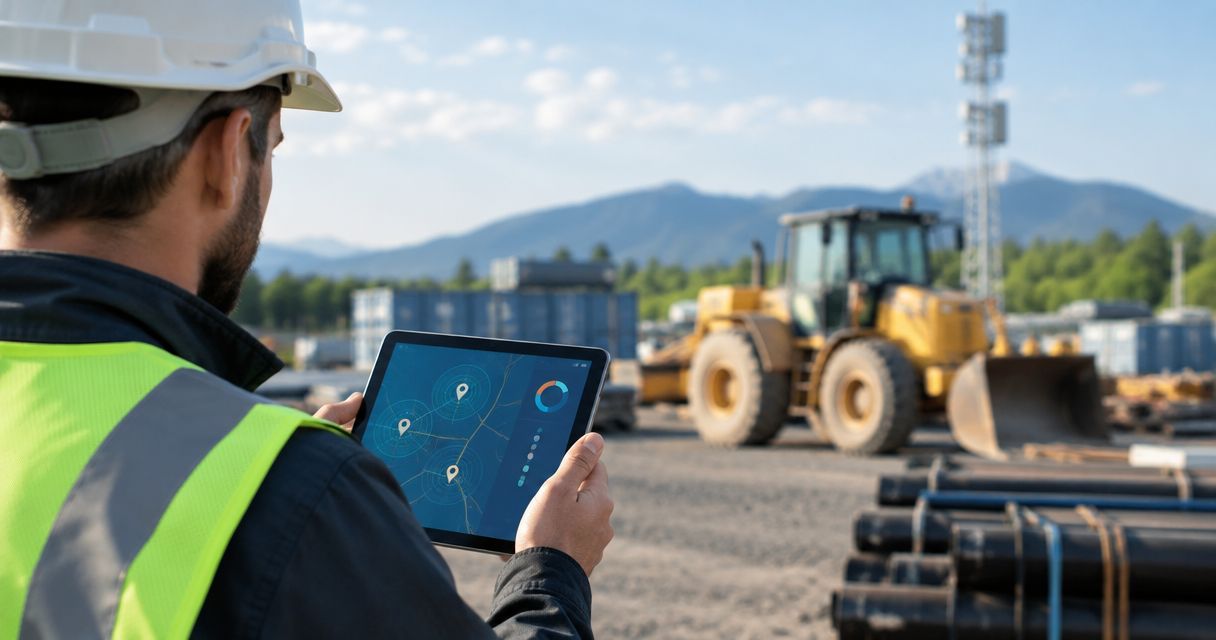
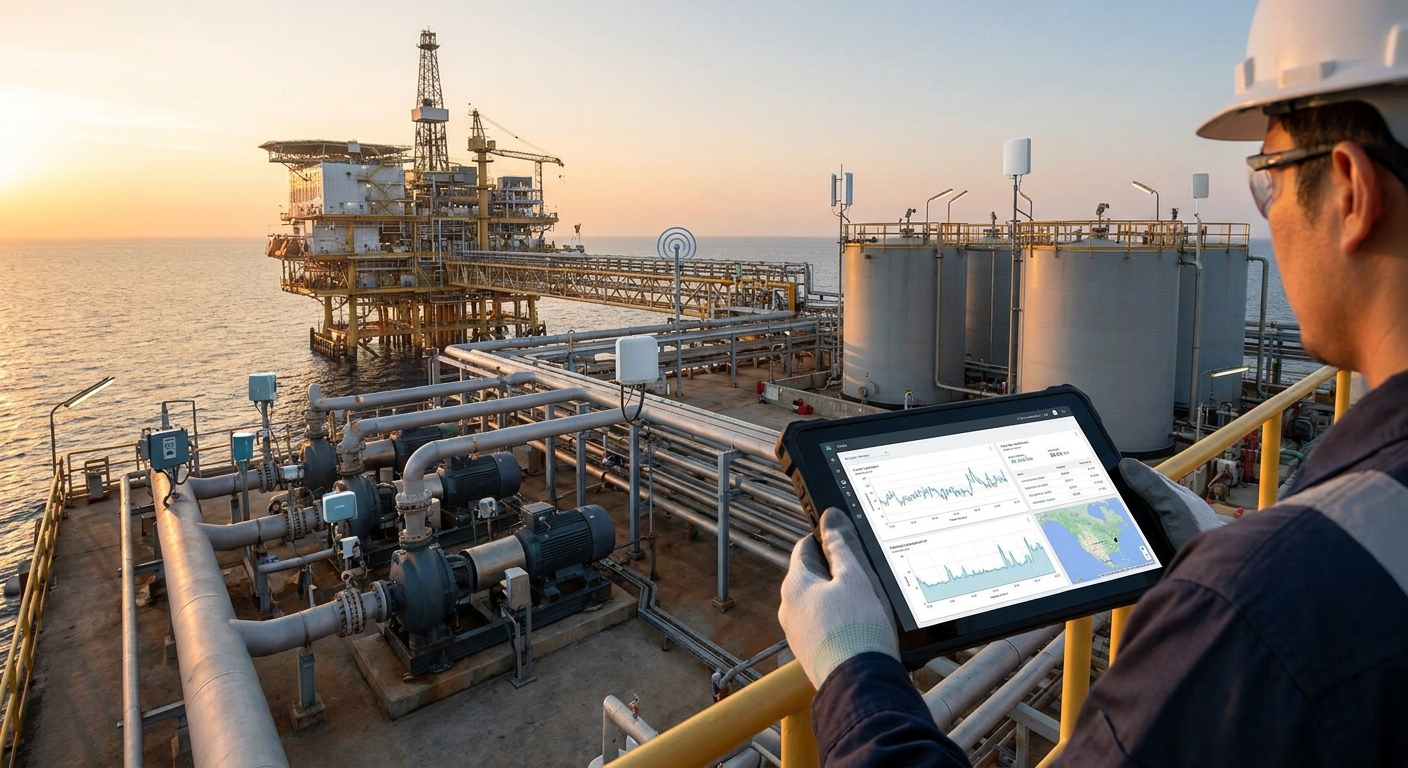
Oil and gas remote sites don't fail because the data was wrong. They fail because nobody saw the tank level slide past the low-low alarm at 3 a.m. on a pad forty miles from the nearest cell tower.
- Kilo IoT wins for oil and gas remote sites that need mioty or LoRaWAN range without cellular — Buy.
- Tank level monitoring for fuel and chemical storage needs offline buffering; cloud-only dashboards fail on connectivity drops.
- An industrial iot platform for oil and gas has to run alarms locally, not wait on a round trip to the cloud.
- Predictive maintenance on pumps and compressors only works if the rules engine fires before a shutdown, not after.
Why this matters
A remote pad, a tank farm, or a compressor station doesn't have Wi-Fi and doesn't get a technician visit every week. The Kilo IoT platform is built around LoRaWAN, mioty, and MQTT connectivity specifically because those protocols were designed for sites where a cell signal is a luxury, not a given. In 2026, the operations teams still running spreadsheets and manual gauge checks on remote assets are the ones eating the cost of a missed tank overflow or a frozen line nobody caught until the shift change.
The platforms that fail oil and gas sites aren't bad software — they're built for offices and warehouses, not for a wellhead sixty miles off a paved road. Range, battery life, and offline reliability matter more than a pretty dashboard.
Who this is for
This is for operations and facilities teams monitoring remote oil and gas infrastructure — tank farms, chemical storage, fuel distribution terminals, compressor stations, and pipeline equipment — where sites are spread across acreage with no reliable cellular backhaul and where a missed alarm means a spill, a shutdown, or a truck roll nobody budgeted for. If your sites already have fiber and a facilities team on-site every day, a lot of this guide won't apply to you.
What to look for in an industrial IoT platform for oil and gas
Connectivity that works without cell towers or Wi-Fi
Most remote pads and tank farms sit outside reliable 4G coverage. LoRaWAN and mioty were both built to move small payloads over long distances on low power, which is exactly the profile a tank level sensor or a pressure gauge needs. A platform that assumes Wi-Fi or strong cellular at every node isn't built for this environment in 2026 and won't be in 2027 either.
Battery life measured in years, not days
A sensor on a remote tank doesn't get a battery swap on a schedule — someone has to drive out and find it. LoRaWAN and mioty sensors are designed around multi-year battery life specifically because truck rolls to change batteries cost more than the sensor itself. Ask what the actual duty cycle and reporting interval do to that number before you buy anything.
Alarms and rules that fire before a spill or shutdown
A dashboard that shows you the tank was low an hour ago isn't monitoring — it's a record. The rules engine has to evaluate thresholds and fire alarms in near real time, and it has to keep working through a connectivity gap instead of waiting for a clean data stream to catch up.
Hardware rated for heat, vibration, and hazardous locations
Equipment sitting next to a compressor or bolted to a tank in chemical storage takes heat, vibration, and in some cases hazardous location classification that consumer-grade sensors were never built for. This is where pre-configured, purpose-built hardware earns its keep over a generic off-the-shelf sensor kit.
An AI layer that sets up monitoring without an integrator on-site
Kilo IoT's built-in AI integrator can provision devices, build rules, and set alarms through plain-language conversation instead of a multi-week integration project. For a remote site team that doesn't have a systems integrator on staff, that's the difference between monitoring going live in days versus a quarter.
See if Kilo IoT fits your remote sites
Check LoRaWAN, mioty, and MQTT connectivity options for oil and gas monitoring.
Top picks for oil and gas remote site monitoring
The default for tank farms — fuel tank level monitoring
The safe pick. Fuel distribution terminals and tank farms live and die on knowing exact levels without a manual gauge check every shift. The fuel tank level monitoring setup pairs level sensors with alarm rules that fire on threshold breach instead of waiting for a scheduled report. If your site runs multiple tanks across one pad, this is where you start. Buy.
The one for hazardous liquids — chemical storage tank monitoring
The specialist pick. Chemical storage carries different risk math than fuel — a slow leak or an out-of-range level can trigger a regulatory event, not just a lost shipment. Chemical storage tank monitoring is built around alarm thresholds tuned for hazardous inventory, not generic level tracking. If your site handles corrosives or reactive chemicals, this is the configuration to run, not the fuel setup. Buy.
The long-range play — mioty sensors for industrial monitoring
The wildcard. mioty was designed on an ETSI standard specifically to handle dense sensor deployments and long transmission range with minimal interference, which matters when a site has dozens of monitoring points spread across acreage. Sensors built for mioty-based industrial monitoring are worth the look when LoRaWAN density starts getting tight on a large pad. Consider.
The equipment health pick — predictive maintenance for rotating equipment
The one that pays for itself slowly. Predictive maintenance on pumps and compressors doesn't stop a failure on day one — it takes a season of baseline data before the rules engine starts flagging drift accurately. It's the right move for a site with critical rotating equipment and no budget for unplanned downtime, but it's not an instant fix. Consider, not a first purchase if you're just getting tank monitoring live.
What to avoid
- Consumer-grade Wi-Fi sensors — they look cheap upfront and fail the moment the site is more than a building away from a router, which describes most oil and gas pads.
- Cloud-only dashboards with no offline buffering — if the platform can't hold data and fire alarms through a connectivity gap, it's a reporting tool, not a monitoring system for a remote site.
- Generic asset tracking platforms rebranded for industrial use — built for pallets and trailers, not for tank levels, hazard alarms, or equipment vibration data.
“If your gateway can't reach the tank six ridges over, the platform doesn't matter.”
Verdict comparison
| Pick | Best for | Connectivity | Verdict |
|---|---|---|---|
| Fuel tank level monitoring | Tank farms, fuel terminals | LoRaWAN / mioty | Buy |
| Chemical storage tank monitoring | Hazardous liquid storage | LoRaWAN / mioty | Buy |
| mioty sensors for industrial monitoring | Dense multi-point pads | mioty | Consider |
| Predictive maintenance monitoring | Pumps, compressors | LoRaWAN / MQTT | Consider |
FAQ
What's the best industrial IoT platform for oil and gas remote sites?
An industrial iot platform for oil and gas remote sites needs LoRaWAN or mioty connectivity, offline alarm buffering, and multi-year battery life on sensors. Kilo IoT builds around all three plus an AI integrator that provisions devices without a systems integrator on-site.
Is LoRaWAN or mioty better for oil and gas monitoring?
LoRaWAN works well for moderate sensor density and is widely supported across gateways. mioty, built on an ETSI standard, handles denser sensor deployments and higher interference environments, which matters on large multi-point pads.
Do remote oil and gas sites need cellular connectivity for IoT monitoring?
No. LoRaWAN and mioty are both designed to work without cellular coverage, which is why they're the standard for pads and tank farms outside reliable 4G range.
How does tank level monitoring alarm on a low-power sensor network?
The rules engine evaluates thresholds against incoming sensor data and fires an alarm when a level crosses a set point, buffering locally through any connectivity gap so the alarm still fires once the link reconnects.
Can an AI integrator set up monitoring without an integrator on-site?
Kilo IoT's AI integrator provisions devices, builds rules, and sets alarms through plain-language conversation, which cuts out a lot of the manual integration work a remote site team would otherwise need a contractor for.
What sensors work for chemical storage tank monitoring?
Chemical storage needs sensors and alarm thresholds tuned for hazardous inventory rather than generic fuel-level tracking, since a slow leak or out-of-range reading in this setting can trigger a regulatory event.
Is predictive maintenance worth it for oil and gas compressors in 2026?
It's worth it for sites with critical rotating equipment and no budget for unplanned downtime, but it takes a season of baseline data before the rules engine starts flagging drift reliably.
How much monitoring range does a LoRaWAN gateway need for a large pad?
LoRaWAN gateways are built for long-range, low-power transmission across open terrain, which is why they're commonly deployed across tank farms and multi-well pads instead of relying on Wi-Fi mesh.
One last thing
The teams that get burned in 2026 aren't the ones without sensors — they're the ones with sensors reporting into a dashboard nobody checks between shifts. The alarm has to reach a phone, not just a screen in an office forty miles away.