
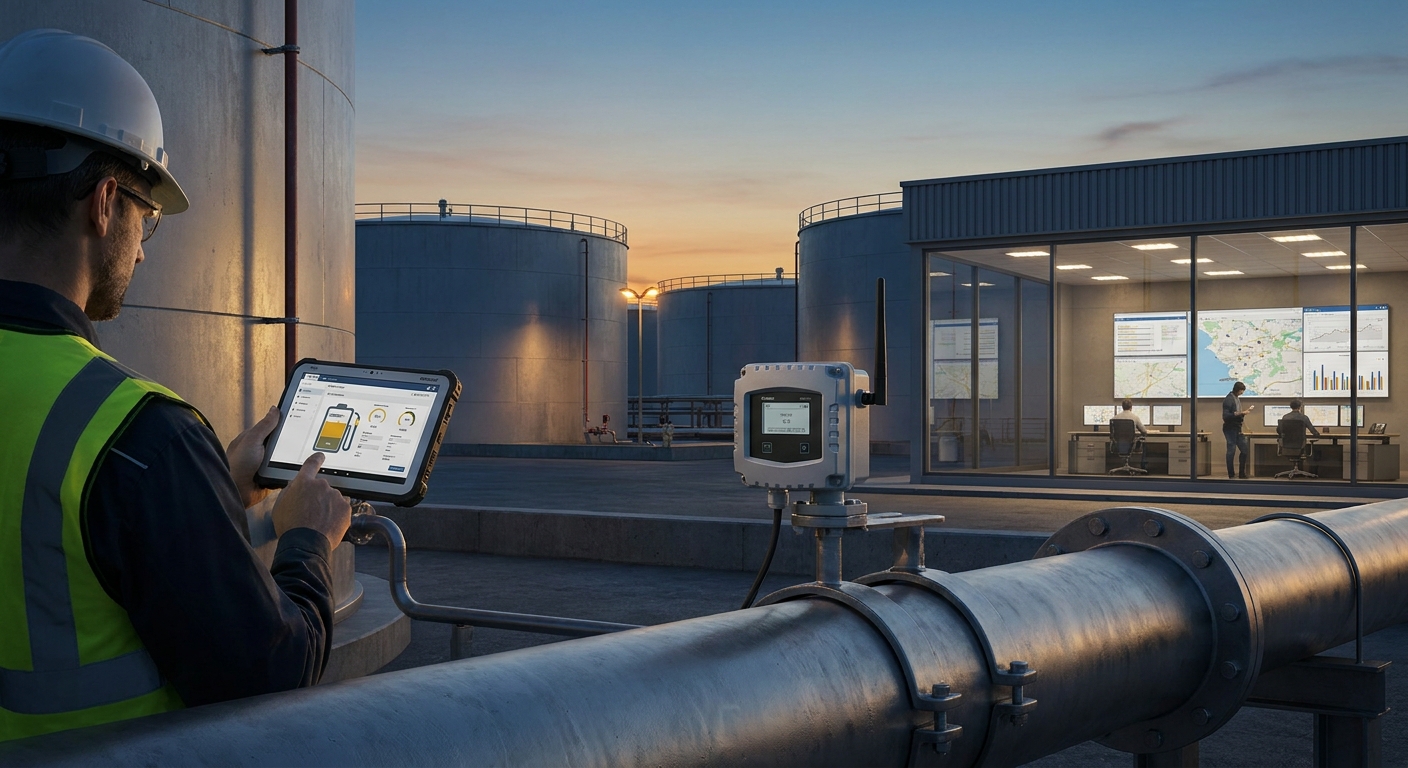
Fuel distributors running multiple tank farms need a monitoring system that reports level automatically, not a gauge someone reads on a walk-through — this guide ranks the connectivity approaches and platforms that get an alert to a phone before a tank runs dry or overflows in 2026.
- Kilo IoT's AI-first platform is the top pick for a tank level monitoring system for fuel distributors running multiple sites in 2026.
- LoRaWAN-based platforms win for open tank farms; mioty wins where steel tanks cluster and cause RF interference.
- Cellular-only telemetry pucks work for a single remote tank but get expensive past a handful of sites.
- Mechanical float gauges with local dial readout are a Skip for any distributor operating more than one site in 2026.
- DIY MQTT broker stacks look cheap until a certificate expires with nobody assigned to fix it.
Why this matters
A tank that reads full at 8am and empty at 2pm without anyone getting a signal in between isn't being monitored, it's being guessed at. Fuel distributors lose margin two ways: overfilling a tank that triggers a spill response, or running a route dry and missing a delivery window entirely.
A proper tank level monitoring system for fuel distributors closes that gap with a sensor, a connectivity layer, and an alarm rule that fires before the tank hits a threshold — not after. The connectivity choice (cellular, LoRaWAN, or mioty) and the platform on top of it determine whether that alert actually reaches someone in time.
How this list is ranked
This ranking weighs four things every fuel distributor actually cares about: whether the system reports remotely without a site visit, how it scales past one tank to a multi-site network, whether it includes an alarm/rules layer out of the box, and how much engineering time it demands after install. Mechanical gauges and DIY stacks are included because distributors still default to them out of habit or budget pressure, and both carry real costs that don't show up until month three.
The ranked list
1. Mechanical float gauges with local dial readout
The one every tank farm already has installed. It shows level only to a person standing at the tank, with zero remote alerting and no history log to check against last week's delivery. It costs nothing to keep running but it costs a route driver's time every single visit. Verdict: Skip for any distributor operating more than one site in 2026.
2. Cellular-only telemetry pucks
No gateway required — the sensor talks straight to a cellular network with its own SIM. That works cleanly for one remote tank with no other connected devices nearby, but a per-device data plan across a 40-tank network turns into a recurring line item that scales linearly with tank count. Verdict: Hold — fine for a single site, expensive as the network grows.
3. LoRaWAN-based tank monitoring platforms
The multi-site workhorse. One gateway covers a wide radius across an open tank farm, and the sensors themselves run on battery for years between swaps because they only transmit a short reading on a set interval instead of holding a connection open. This is the connectivity layer most fuel distributors should default to for above-ground tank farms without heavy steel clustering. Review a LoRaWAN network server software option before locking in a single-vendor gateway. Verdict: Buy for open, multi-tank sites.
4. mioty-based tank monitoring
For underground tanks and steel-heavy farms where standard LoRaWAN struggles with interference, mioty's telegram-splitting transmission handles a noisy RF environment better than a single continuous packet. That matters at fuel terminals where dozens of steel tanks sit close together and reflect radio signals unpredictably. Distributors running dense, older tank farms should check mioty-based industrial sensors before assuming LoRaWAN will cover every corner of the site. Verdict: Buy for interference-heavy or underground installs.
5. AI-first IoT cloud platform (Kilo IoT)
The one that also builds the alarm instead of leaving it to a rules-engine deep dive. Kilo IoT's Kilo Cloud connects LoRaWAN, mioty, and MQTT feeds from tank sensors into one dashboard, and its AI integrator sets up alarms and rules from a plain-language request — "alert me if tank 4 drops below 20% before the Thursday route" — rather than requiring a config file. Kilo Connectivity backs it with worldwide SIM options and 800+ connectivity partners for sites where cellular is the only path in. For a distributor managing tanks across several sites with one team, this collapses connectivity, dashboard, and alarm into one tank level monitoring system for fuel distributors instead of three separate vendors. Verdict: Buy — the strongest pick for multi-site fuel distributors in 2026.
“If a tank alert only reaches someone after the delivery window has already closed, the monitoring system failed at the one job it had.”
6. DIY MQTT broker plus open-source dashboard
The engineering project disguised as savings. It works fine for one tank running on a laptop in a back office, and it turns into a maintenance job the day a TLS certificate expires or the broker needs to scale past a handful of devices with nobody assigned to own it. Verdict: Skip unless the distributor already employs a dedicated IoT engineer.
Tank monitoring approaches compared
| Approach | Connectivity | Remote alerting | Multi-site scaling | Verdict |
|---|---|---|---|---|
| Mechanical float gauge | None | No | No | Skip |
| Cellular-only puck | Cellular SIM per device | Yes | Costly at scale | Hold |
| LoRaWAN platform | LoRaWAN gateway | Yes | Strong, open sites | Buy |
| mioty-based monitoring | mioty | Yes | Strong, dense/steel sites | Buy |
| Kilo IoT (Kilo Cloud) | LoRaWAN, mioty, MQTT, cellular | Yes, AI-configured alarms | Strong, multi-site | Buy |
| DIY MQTT stack | Custom | Yes, if maintained | Weak without staff | Skip |
Where to source it
- Confirm gateway coverage against the real tank farm layout, not a vendor's coverage map — steel tanks and underground vaults change radio behavior more than open-field tests suggest.
- Require an alarms and rules layer in the base platform, not a paid add-on bolted on after the dashboard sale — a distributor needs the threshold alert on day one, not after a second contract.
- Ask whether the platform provisions new sensors itself or whether every added tank needs a manual configuration file — that answer determines whether adding site number six takes an afternoon or a week.
See the tank monitoring platform
Connect LoRaWAN, mioty, and cellular tank sensors into one dashboard with AI-built alarms.
FAQ
What's the best tank level monitoring system for fuel distributors in 2026?
Kilo IoT's Kilo Cloud platform is the strongest pick for multi-site fuel distributors in 2026 because it combines LoRaWAN, mioty, and cellular connectivity with an alarm layer built by its AI integrator instead of a manual rules engine. Distributors with a single remote tank can still get by with a cellular-only puck.
Is LoRaWAN or mioty better for fuel tank monitoring?
LoRaWAN works best for open, above-ground tank farms where a single gateway can cover the site. mioty handles dense, steel-heavy, or underground tank clusters better because its telegram-splitting transmission tolerates radio interference that trips up standard LoRaWAN.
How much does tank level monitoring cost for a multi-site fuel distributor?
Cost depends on tank count, connectivity type, and whether sensor hardware is bundled with the platform, so there's no single 2026 figure that applies across distributors. Check current sensor and platform pricing directly with the vendor before budgeting per site.
Can cellular sensors replace LoRaWAN gateways for tank monitoring?
Cellular sensors work well for a single remote tank with no gateway infrastructure nearby. Past a handful of tanks, the recurring per-device data plan usually costs more than a LoRaWAN gateway serving the same site.
How often should a tank level sensor report data?
A 15-minute reporting interval is a common default for fuel tank monitoring, balancing battery life against how quickly a rapid drop gets flagged. Faster intervals drain battery sooner; slower intervals delay the alert.
Do tank monitoring platforms need a rules engine?
Yes — a dashboard that only displays level without a rules and alarms layer requires someone to watch it manually, which defeats the point of monitoring. The alarm is what turns a reading into an action before the tank crosses a threshold.
Can one platform monitor tanks across multiple sites?
Yes, platforms like Kilo IoT's Kilo Cloud are built to handle multiple sites and connectivity types in one dashboard rather than requiring a separate system per location. That consolidation is the main reason multi-site distributors move off mechanical gauges.
What happens when a tank level sensor loses connectivity?
A properly configured platform flags a connectivity loss as its own alarm rather than staying silent, so a distributor knows the sensor went dark instead of assuming the tank simply stopped reporting because nothing changed. Without that rule, a dead sensor looks identical to a stable tank.
One last thing
The most common failure isn't the sensor going dark — it's the alarm rule nobody actually configured because the platform buried it three menus deep. A tank level monitoring system for fuel distributors only earns its keep the day it catches a threshold before a driver finds out on-site, and in 2026 that means picking a platform where setting the rule takes a sentence, not a support ticket.