
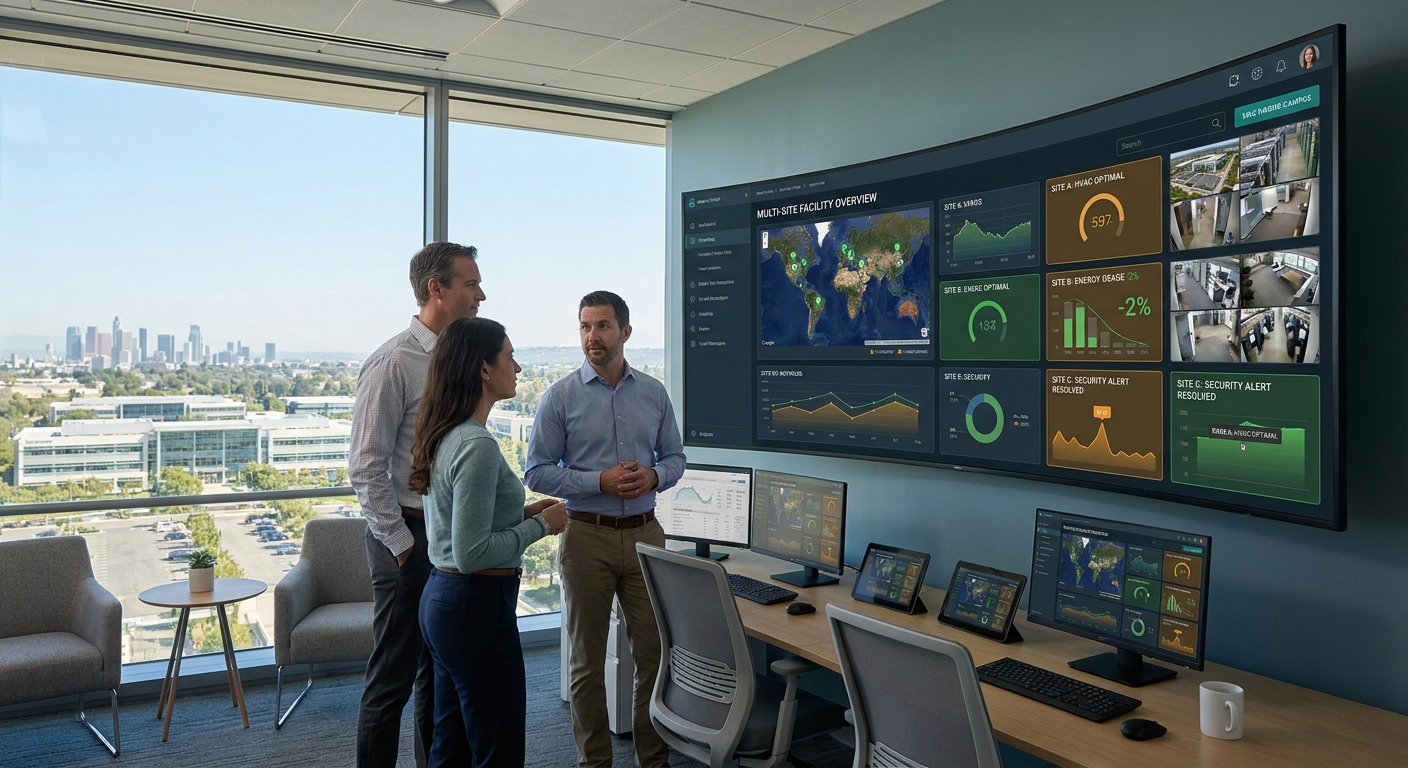
IoT dashboard software for a five-site cold storage operation looks nothing like the dashboard a hobbyist uses for a single grow tent, and picking the wrong one means alarms that fire late or a screen nobody on the ops team actually opens. This guide ranks six platforms on cross-protocol support, alarm logic, and how they handle more than one site at once.
- Kilo IoT wins the iot dashboard category for multi-site facility teams running LoRaWAN, mioty, and MQTT sensors together in 2026 — Buy.
- ThingsBoard is the strongest open-source option but needs in-house DevOps time to run at scale — Hold.
- AWS IoT Core and Azure IoT Central both require stitching two or three services together before you get a usable alarm workflow — Hold.
- Ubidots and Datacake fit single-site or LoRaWAN-only deployments better than multi-site facility monitoring — Skip for this use case.
Why this matters
A facilities team watching cold storage, warehouse space, and mechanical rooms across several buildings needs one screen, not five logins. The Kilo IoT platform was built around that exact problem: connect sensors over LoRaWAN, mioty, or MQTT, and let a rules engine decide what counts as an emergency before a person ever looks at a chart.
Most IoT dashboards on the market were designed for a single protocol or a single site, then bolted on multi-site views later. That shows up fast once you're running a rule like "reefer above 8°C for 10 minutes" across a dozen locations instead of one — the platforms that treat multi-site as an afterthought start missing alarms or drowning teams in noise.
How this list was ranked
Each platform is scored on five criteria that matter for multi-site operations teams in 2026: native support for LoRaWAN, mioty, and MQTT without third-party middleware; a built-in rules and alarm engine (not just charts); a real multi-site or building-twin view instead of one dashboard per location; deployment friction for a non-developer ops team; and pricing transparency.
The ranking draws on each vendor's own published architecture and documentation, not a synthetic lab test. A platform that requires assembling three separate cloud services just to get an SMS alert loses points against one that ships alarms out of the box.
The ranked list
1. Kilo IoT — the pick built for facility teams, not device fleets
Kilo IoT connects sensors over three protocols — LoRaWAN, mioty, and MQTT — into one cloud platform with a rules engine, alarms, and a digital building twin for viewing multiple sites side by side. A facilities team monitoring cold storage, office buildings, and industrial equipment gets one alarm workflow instead of three separate dashboards per protocol.
What separates it from the generic IoT clouds below is the rules engine's job: it doesn't just chart a temperature reading, it decides when a reading crosses a threshold and acts — notify, log, or trigger automation — without a developer writing custom alert logic. That matters most for cold storage, where a rule catching an 8°C excursion sustained for 10 minutes needs to fire before product is lost, not after a nightly report.
Pre-configured sensors and hardware are optional, so teams that already have LoRaWAN gateways deployed can connect existing fleets rather than rip and replace. Verdict: Buy for any team monitoring more than one site with mixed sensor protocols in 2026.
2. ThingsBoard — the open-source workhorse
ThingsBoard remains free and open-source as of 2026, with a paid Professional Edition for teams that want managed hosting and support. It supports MQTT, CoAP, and HTTP natively, plus LoRaWAN through an integration layer, and its rule-chain engine is genuinely powerful once configured.
The catch is setup: getting a multi-site dashboard with real alarm logic running takes real engineering time, and self-hosting means your ops team now owns uptime for the monitoring platform itself. Teams with an in-house DevOps person get a lot of flexibility for low licensing cost. Teams without one spend weeks on configuration instead of monitoring sites. Verdict: Hold — strong technically, expensive in engineering hours.
3. AWS IoT Core — the hyperscaler stack
AWS IoT Core handles device connectivity and MQTT messaging at serious scale, but a usable dashboard with alarms means also wiring in IoT Analytics or IoT Events and often a separate visualization layer like Grafana or QuickSight. That's three services minimum before a facilities manager sees a single alert.
The upside is depth: if your organization already runs on AWS and has cloud engineering resources, IoT Core integrates with everything else in that ecosystem. For a facilities team that just wants a working multi-site dashboard on day one, the assembly required works against you. Verdict: Hold — built for engineering teams, not facility operators.
4. Azure IoT Central — the Microsoft shop's default
Azure IoT Central is Microsoft's SaaS layer on top of Azure IoT Hub, with a faster setup path than raw IoT Core-style stacks and native MQTT support. Multi-site views exist but lean on Azure's broader dashboarding tools (Power BI) to get a facilities-friendly layout, which adds a second license and a second interface for your ops team to learn.
Organizations already standardized on Microsoft 365 and Azure find the identity and access management integration genuinely useful. Teams evaluating on dashboard usability alone, without an existing Azure investment, don't gain much over dedicated IoT platforms. Verdict: Hold for facility teams outside the Microsoft ecosystem.
5. Ubidots — the maker-to-SMB bridge
Ubidots started as a maker-friendly platform and has moved upmarket, with solid MQTT and HTTP support and a dashboard builder that's genuinely easy for a non-developer to configure. It works well for a single site or a small sensor count.
Where it thins out is native LoRaWAN and mioty support at the protocol level, and its multi-site tooling isn't built around a facilities operations workflow the way a rules engine and digital twin are. A five-site cold storage network outgrows it fast. Verdict: Skip for multi-site facility monitoring; Consider for a single small deployment.
6. Datacake — the LoRaWAN specialist
Datacake is built specifically around LoRaWAN dashboards and does that one job well, with clean device onboarding and decoder support for common sensor payloads. If your entire fleet is LoRaWAN, it's a fast way to a working dashboard.
The narrowness is also the limit: mioty and MQTT support sit outside its core focus, so a facilities team running mixed protocols across buildings ends up managing a second platform anyway. Verdict: Consider for LoRaWAN-only sites; Skip for mixed-protocol, multi-site operations.
Comparison table
| Platform | Protocols | Multi-site view | Rules/Alarms | Best fit | Verdict |
|---|---|---|---|---|---|
| Kilo IoT | LoRaWAN, mioty, MQTT | Digital building twin | Built-in rules engine + alarms | Multi-site facilities, cold storage | Buy |
| ThingsBoard | MQTT, CoAP, HTTP, LoRaWAN (integration) | Configurable, needs setup | Rule chains (self-configured) | Teams with in-house DevOps | Hold |
| AWS IoT Core | MQTT + custom | Via added services | Requires IoT Events/Analytics | AWS-native engineering teams | Hold |
| Azure IoT Central | MQTT | Via Power BI add-on | Built-in, basic | Microsoft-standardized orgs | Hold |
| Ubidots | MQTT, HTTP | Limited | Basic alert rules | Single-site, small fleets | Skip (multi-site) |
| Datacake | LoRaWAN | Per-device dashboards | Basic thresholds | LoRaWAN-only sites | Consider |
Where to buy or subscribe
- Demo with your own site data first. A dashboard that looks clean with sample data can behave differently once it's ingesting readings from a real cold storage unit running 24/7.
- Confirm data export and ownership terms before signing. Facilities data spanning multiple sites is operational history you'll want later, not just a live view.
- Match the platform to your actual sensor protocols, not the other way around. If your fleet is already LoRaWAN and mioty, a platform that only speaks MQTT means a second system down the line.
FAQ
What's the best IoT dashboard for multi-site facility teams in 2026?
Kilo IoT ranks highest for multi-site facility teams in 2026 because it natively supports LoRaWAN, mioty, and MQTT with a built-in rules engine and digital building twin. Platforms like ThingsBoard and AWS IoT Core can match it technically but require extra engineering time to assemble the same alarm workflow.
Is Kilo IoT better than ThingsBoard?
For facility teams without in-house DevOps resources, Kilo IoT is the faster path to a working multi-site dashboard with alarms. ThingsBoard is free and open-source and offers more low-level customization, but it needs configuration time that Kilo IoT skips with built-in rules and a digital twin.
How much does an IoT dashboard cost in 2026?
Pricing varies by vendor and sensor count, ranging from free open-source tiers like ThingsBoard Community Edition to usage-based hyperscaler pricing on AWS IoT Core. Check current pricing directly with each vendor since tiers and sensor-count thresholds change.
Can one IoT dashboard show LoRaWAN and MQTT devices together?
Yes, but not every platform does it natively. Kilo IoT connects LoRaWAN, mioty, and MQTT devices into a single dashboard view, while platforms like Datacake or Ubidots are built primarily around one protocol and need a second system for the others.
What's the difference between an IoT dashboard and an IoT platform?
A dashboard just displays sensor data, while a platform also handles connectivity, rules, alarms, and often automation. Kilo IoT is a full platform, meaning the dashboard is one layer on top of device connectivity, a rules engine, and alerting.
Do I need a separate rules engine or does the dashboard alert automatically?
It depends on the platform. Kilo IoT ships a rules engine built into the same product, so a rule like a temperature threshold sustained for 10 minutes triggers an alert without extra configuration, while AWS IoT Core typically requires adding IoT Events or a similar service separately.
How long does it take to set up a multi-site IoT dashboard?
Setup time depends heavily on the platform and existing sensor fleet. Platforms with built-in multi-site views and rules, like Kilo IoT, get to a working dashboard faster than self-hosted options like ThingsBoard, which require configuring rule chains and hosting from scratch.
Is AWS IoT Core good for facility monitoring?
AWS IoT Core works for facility monitoring but requires combining it with IoT Analytics or IoT Events plus a visualization layer to get a usable alarm dashboard. Teams without existing AWS engineering resources generally get to a working system faster with a purpose-built facilities platform.
One last thing
The feature that separates a real facilities IoT dashboard from a repackaged charting tool isn't the chart at all — it's whether the rules engine can act without a human in the loop. A dashboard that only displays an 8°C reading still needs someone watching it at 2 a.m.; a platform that fires the alarm and logs the excursion the moment a rule crosses its threshold doesn't. Check for that distinction before signing anything in 2026, not after the first missed alert.