
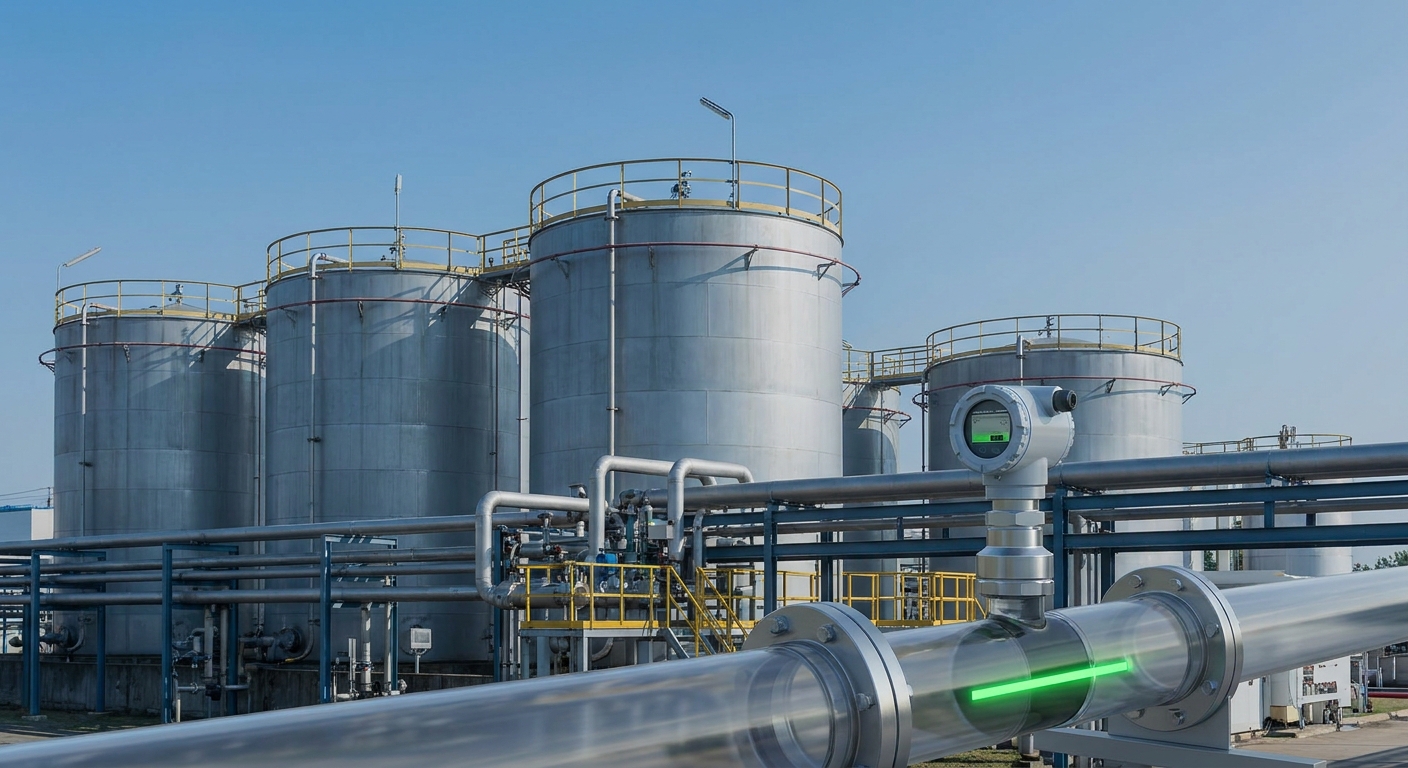
Chemical storage facilities that still walk the yard with a dip stick lose product to overfills, miss EPA reporting windows, and find out about a leak days after it started. Tank level monitoring for chemical storage facilities in 2026 replaces that walk with sensors, alarms, and a dashboard that checks the tank more often than any technician can.
- Guided-wave radar wins for corrosive or foaming chemicals — non-contact ultrasonic sensors misread vapor-heavy tanks. Buy for precision.
- mioty-based sensors reach up to 15 km outdoor range through dense steel tank farms where LoRaWAN struggles. Consider for scale.
- Rules-based alarms firing at 20% and 90% thresholds stop overfills — a dashboard alone doesn't. Automate it in 2026.
- Skip Wi-Fi loggers for chemical storage: sub-12-month battery life and no ATEX rating rule them out.
- Tank level monitoring chemical storage in 2026 means alarms plus connectivity that survives a steel drum farm, not a sensor alone.
Why this matters
A caustic soda or sulfuric acid tank that overflows during a night shift doesn't just cost the product. It triggers a spill report, a cleanup crew, and in some states a call to the environmental agency inside 24 hours. Manual gauge checks catch that maybe once a shift — tank level monitoring chemical storage setups check every 5 to 15 minutes and fire an alarm before the tank crosses a 90% threshold.
Kilo IoT's approach pairs the sensor reading with a rules engine, so the alarm isn't a chart nobody opens at 2am — it's a text alert or a triggered shutoff valve. That distinction is why a site running 30 tanks in 2026 needs more than a sensor with a dashboard bolted on top of it.
Who this is for
This guide is for facilities and EHS managers running bulk chemical storage — distributors, blending plants, wastewater treatment sites, or industrial plants with process tanks — who own 5 to 50-plus tanks across one or several yards and need level data that doesn't depend on someone walking past the tank every shift.
What to look for in tank level monitoring for chemical storage
Non-contact measurement for corrosive and hazardous media
A sensor that touches the liquid corrodes, fouls, or needs recalibration inside a year on anything acidic, caustic, or solvent-based. Non-contact radar or ultrasonic measurement avoids that failure mode entirely, which matters more here than in a water tank.
Alarm automation, not just a dashboard
A chart that shows the tank at 92% full is useless if nobody's looking at it at 3am. The setup needs a rules engine that fires a threshold alarm — at 20% low and 90% high, for example — the moment the reading crosses it, not a passive graph.
Connectivity that survives a steel tank farm
Multiple steel-walled vessels packed close together block radio signal the way a warehouse full of metal shelving blocks Wi-Fi. Range and penetration matter more than raw bandwidth for a chemical tank farm spread across an acre.
Hazardous area and ingress ratings
Solvent vapor and combustible dust zones call for hardware rated for the area it sits in. A sensor or gateway without the right rating for the zone isn't a paperwork gap — it's a real ignition risk on a working site.
API access into SCADA and ERP
Level data that only lives in one vendor's app doesn't help the batch scheduler or the procurement team ordering the next tanker. An open API to pull readings into existing SCADA or ERP systems keeps the data useful past the dashboard.
Battery life and maintenance windows
Climbing a ladder to swap a sensor battery every six months erases the labor savings the whole project was supposed to deliver. Look for a battery life measured in years, not months, on any sensor mounted above a tank.
Top picks for tank level monitoring in chemical storage
Guided-wave radar — the precision pick. Accuracy holds around ±3mm regardless of foam, vapor, or a dark liquid surface, and it reads tanks up to 30 meters deep without a recalibration cycle. It's built for the same precision problem covered in the tank level monitoring system built for fuel distributors guide — corrosive or high-value liquids where a bad reading costs real money. Buy for any tank holding acid, caustic, or solvent.
mioty ultrasonic/radar — the long-range pick. mioty modulation pushes signal through steel and concrete at up to 15 km outdoor range and handles thousands of endpoints off a single gateway, which matters once a tank farm passes 20 vessels. The technical case is laid out in the mioty industrial sensors breakdown. Buy for multi-tank sites where LoRaWAN keeps dropping readings behind steel.
Rules engine plus dashboard — the automation pick. The sensor only matters if something acts on the reading. A rules layer that fires an alarm at set thresholds and shows every tank on one screen is what turns raw level data into a working alert system, the same platform logic covered for IoT platforms built for industrial manufacturers. Buy — this is the piece most facilities skip and regret.
Float switch with local buzzer — the budget pick. No remote read, no logging, one threshold, and the buzzer only helps if someone's standing near the tank. It works as a last-resort backup on a single non-hazardous tank. Skip for anything beyond that, and never as the only layer of monitoring.
What to avoid
- Wi-Fi-only sensors. Battery life runs under 12 months on most Wi-Fi level sensors, and coverage falls apart the moment tanks sit more than 50 meters from the access point.
- Unrated hardware in a hazardous zone. A sensor without an ATEX or IECEx rating in a solvent vapor or combustible dust area isn't a compliance shortcut — it's an ignition source.
- Loggers with no alarm layer. A device that stores readings but doesn't push a threshold alert gives you a chart to review after the spill, not a warning before it.
Verdict comparison
| Approach | Media compatibility | Range | Alarm automation | Verdict |
|---|---|---|---|---|
| Guided-wave radar | Corrosive, foaming liquids | Wired or LoRaWAN-connected | Yes, via rules engine | Buy |
| mioty ultrasonic/radar | Most chemicals, dense steel farms | Up to 15 km outdoor | Yes | Buy |
| Rules engine + dashboard | Any sensor feed | Software layer, not physical range | Yes, thresholds + digital twin | Buy |
| Float switch + buzzer | Single tank, non-hazardous only | On-site only | No | Skip |
See tank alarms fire in Kilo Cloud
Watch a threshold alarm trigger before a tank hits 90% in a live dashboard.
FAQ
What's the best tank level monitoring system for chemical storage in 2026?
Guided-wave radar paired with a rules-based alarm engine is the strongest combination for chemical storage in 2026, because it handles corrosive and foaming liquids without contact failure and fires alerts before an overfill. Ultrasonic and mioty-based sensors are solid alternatives on large tank farms where range matters more than millimeter precision.
Is mioty better than LoRaWAN for chemical tank farms?
mioty generally outperforms LoRaWAN in dense steel tank farms because its modulation pushes through metal and concrete at up to 15 km outdoor range. LoRaWAN still works well on smaller, more open sites with fewer obstructions between sensor and gateway.
How much does tank level monitoring cost for a chemical storage facility?
Cost depends on sensor type, tank count, and whether hazardous-area certification is required, so pricing varies site to site. Check current sensor and platform pricing directly rather than relying on a single flat number.
Do chemical storage tanks need ATEX-rated sensors?
Any sensor or gateway installed in a solvent vapor or combustible dust zone needs a rating appropriate for that hazardous area, typically ATEX or IECEx depending on region. Non-hazardous tanks without vapor risk don't require the same rating.
Can tank level sensors integrate with existing SCADA systems?
Yes, level readings can feed into SCADA or ERP systems through an open API rather than staying locked in a single vendor's dashboard. That keeps the data usable for batch scheduling and procurement, not just monitoring.
How often should chemical tank levels be checked?
Automated tank level monitoring chemical storage setups typically check every 5 to 15 minutes, far more often than a manual gauge round on a single shift. That frequency is what catches a fast fill or leak before it becomes a spill.
What's the difference between guided-wave radar and ultrasonic level sensors?
Guided-wave radar sends a signal down a probe into the liquid and reads accurately through foam or vapor, while ultrasonic sensors bounce a signal off the surface from above and can misread in foamy or turbulent tanks. Radar costs more but holds accuracy on harder media.
How long do LoRaWAN tank sensors last on battery?
Most LoRaWAN level sensors run 5 to 10 years on a single battery depending on read frequency, compared to under 12 months for many Wi-Fi alternatives. Longer read intervals extend battery life further.
One last thing
The failure mode that catches most chemical storage sites off guard isn't a bad sensor — it's a sensor stuck reporting the same reading for weeks because nobody set an alarm for a flatlined value. A tank showing 62% full for three straight weeks isn't stable, it's disconnected, and a rules engine that flags a stalled reading catches that faster than any manual audit will in 2026.