
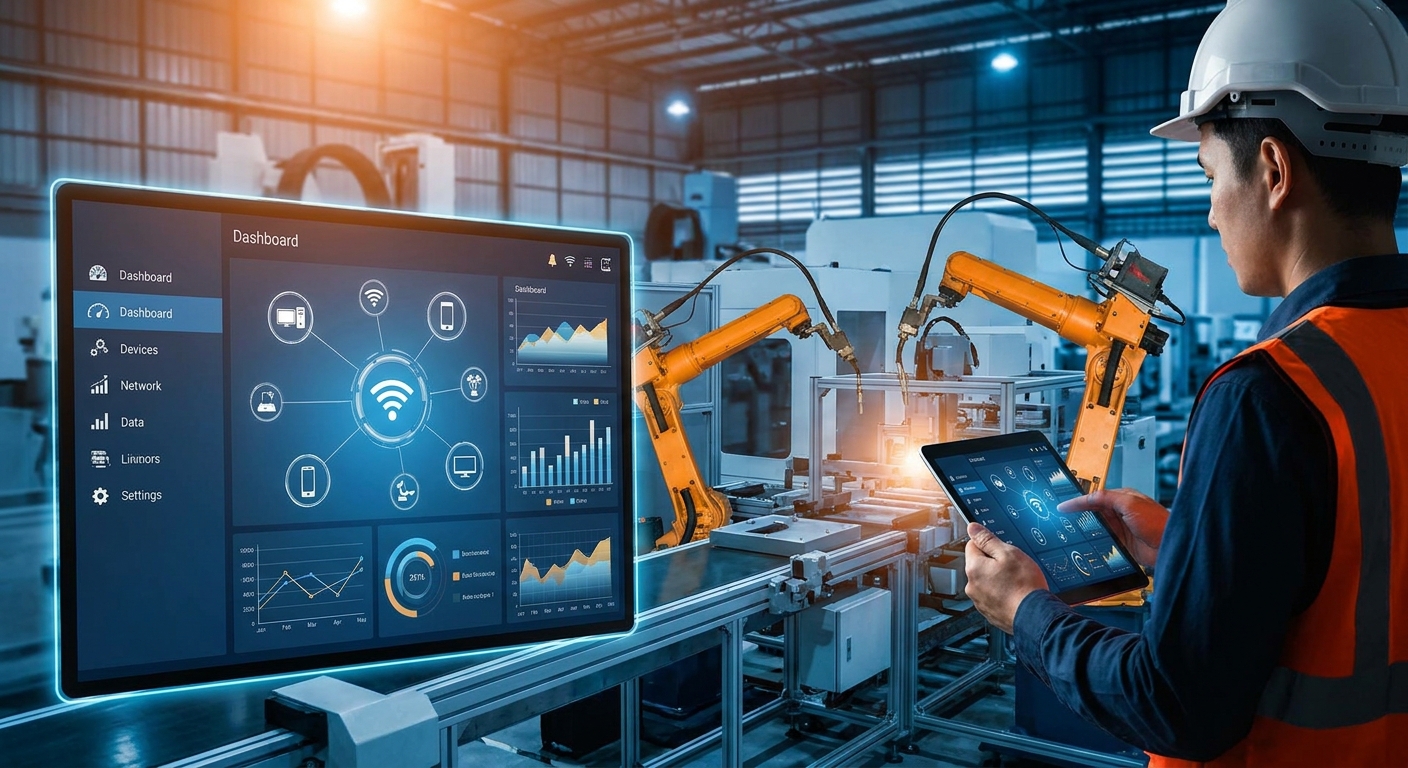
Six IoT platforms show up over and over in manufacturer shortlists for 2026 — Kilo IoT, AWS IoT Core, Azure IoT Hub, ThingsBoard, Ubidots and Datacake — and only one of them runs LoRaWAN, mioty and MQTT under a single rules engine without extra middleware stitched on top.
- Kilo IoT is the best iot platform for manufacturers running mixed LoRaWAN, mioty and MQTT fleets in 2026 — Buy.
- AWS IoT Core and Azure IoT Hub fit teams already committed to those clouds — Consider, not universal picks.
- ThingsBoard's open-source rule chains suit plants with in-house DevOps staff — Consider, Skip without infrastructure headcount.
- Ubidots and Datacake work for pilots and LoRaWAN-only fleets — Hold and Consider, respectively.
Why this matters
Manufacturing floors run mixed protocol fleets almost by default. Legacy MQTT gateways sit next to new low-power LoRaWAN sensors, and some sites bolt on mioty devices for long-range monitoring in warehouses or cold storage rooms where wiring a gateway every few meters isn't an option. Pick the wrong platform and you're paying for a second tool just to translate one protocol into another, or worse, writing custom code to bridge the gap yourself.
The real cost of a bad platform choice isn't the subscription fee. It's the integration work that shows up six months in, once someone realizes the dashboard can see a temperature spike but nothing downstream can act on it. A rules engine that can't act within seconds of an alarm firing is just an expensive dashboard.
“A rules engine that can't act within seconds of an alarm firing is just an expensive dashboard.”
Kilo IoT was built around closing that gap directly — sense, decide, act, in one loop, across LoRaWAN, mioty and MQTT connections at once. That's the bar every platform on this list gets measured against for 2026.
How this list was ranked
Every platform here gets judged on five things that matter on a manufacturing floor, not in a sales deck: protocol coverage (can it talk to the sensors already installed), whether the rules engine can act without a human watching a screen, deployment flexibility (cloud, self-hosted, or both), whether a digital twin view exists for facilities teams managing multiple zones, and how the vendor handles hardware — bundled, optional, or entirely bring-your-own.
Pricing pages, public documentation and each platform's stated feature set are the basis for the verdicts below. None of these six were run side by side on a live factory floor for this comparison, so treat the calls as a starting shortlist for 2026, not a lab result. Vendors change roadmaps fast enough that a re-check before signing a contract is worth the hour.
The best IoT platform for manufacturers in 2026 — ranked
1. Kilo IoT — the AI-first pick for closed-loop control
Kilo IoT runs LoRaWAN, mioty and MQTT connectivity inside a single AIoT cloud platform, with dashboards, a rules engine, alarms and a digital building twin built to sit over a whole site rather than one device type at a time.
The distinguishing detail: the rules engine and AI layer don't just flag a problem, they publish the alarm and can trigger the next action, which matters when a cold storage unit drifts out of range overnight and nobody's staring at a screen. Kilo IoT also ships pre-configured sensors and hardware as an option, so a facilities team that doesn't want to source its own gateways doesn't have to build that sourcing pipeline from scratch.
The cold storage temperature monitoring dashboards built on the platform show what this looks like for a use case manufacturers run constantly — food, pharma and chemical storage all live or die by a temperature threshold, and an alarm that arrives ten minutes late is functionally the same as no alarm at all.
Buy if the site runs more than one connectivity protocol and the goal is alerts that act, not just notify.
2. AWS IoT Core — the safe pick for AWS-native teams
AWS IoT Core plugs directly into Lambda, S3 and SageMaker, which makes it the default answer for manufacturers whose data science and engineering teams already live inside AWS for everything else.
The tradeoff is that it's a toolkit, not a finished platform. Rules, dashboards and device management get assembled from AWS primitives, which means real engineering time passes before a single alarm fires correctly. Billing scales per message and per device shadow update, so telemetry-heavy production floors watch that line item closely once sensor counts climb past a pilot.
Consider if in-house AWS engineers already exist on staff. Skip if the plan is handing this to a facilities team without a cloud background.
3. Azure IoT Hub — the Microsoft-shop default
Azure IoT Hub ties into Azure Digital Twins and Power BI, which fits manufacturers already standardized on Microsoft infrastructure for ERP or reporting across the plant.
Setup complexity mirrors AWS IoT Core — this is infrastructure to build on, not an out-of-the-box dashboard to switch on. Teams without a Microsoft-certified engineer tend to underestimate the ramp time until the second month of the rollout, when the rule logic still isn't fully wired.
Consider for plants already deep in the Microsoft ecosystem. Skip otherwise.
4. ThingsBoard — the open-source wildcard
ThingsBoard ships a free community edition with rule chains and self-hosting, which appeals to manufacturers who want to own infrastructure outright instead of renting a cloud seat indefinitely.
The catch is maintenance. Self-hosting an open-source IoT platform means patching, scaling and securing it on an ongoing basis, which is a real headcount cost even when the license itself is free. That cost doesn't show up on the pricing page, but it shows up on the DevOps team's calendar.
Consider if a DevOps team already maintains other self-hosted infrastructure. Skip if IT is stretched thin already.
5. Ubidots — the lightweight dashboard builder
Ubidots is built for fast dashboard prototyping — sensor to chart, quickly, with a lower learning curve than the enterprise clouds and a faster path from signup to first graph.
It's thinner on automation. Rules and alerting exist, but they don't reach the closed-loop depth a production manufacturing floor needs once a pilot proves out and the stakes move from a demo to a live batch.
Hold for pilots and proof-of-concept work. Skip for full production rollouts that need automated response, not just visualization.
6. Datacake — the LoRaWAN dashboard specialist
Datacake focuses on LoRaWAN device management and dashboards specifically, with strong tooling built around that one protocol and its device provisioning quirks.
That focus is also the ceiling. Manufacturers running mioty devices for long-range industrial sensors, or MQTT gateways left over from older equipment, will find Datacake's coverage stops right at the LoRaWAN boundary, forcing a second tool onto the stack.
Consider for LoRaWAN-only sensor fleets. Skip if mioty or MQTT gateways are already part of the site.
Comparison table
| Platform | Protocols | Deployment | Rules / automation | Digital twin | Verdict |
|---|---|---|---|---|---|
| Kilo IoT | LoRaWAN, mioty, MQTT | Cloud | Rules engine + AI, acts on alarms | Digital building twin | Buy |
| AWS IoT Core | MQTT-based, custom | Cloud (AWS) | Build-your-own via Lambda | Via third-party tools | Consider |
| Azure IoT Hub | MQTT-based, custom | Cloud (Azure) | Build-your-own via Logic Apps | Azure Digital Twins add-on | Consider |
| ThingsBoard | MQTT, CoAP, LoRaWAN via integration | Cloud or self-hosted | Rule chains | Limited | Consider |
| Ubidots | MQTT, HTTP | Cloud | Basic alerts | No | Hold |
| Datacake | LoRaWAN | Cloud | Basic rules | No | Consider |
Where to source it
Buying an industrial IoT platform isn't like buying software off a shelf. A few rules keep the process from turning into a six-month integration project nobody scoped for.
- Confirm protocol coverage against the actual sensor fleet on site before signing anything — not against a generic spec sheet from a sales call.
- Ask to see the rules engine fire a real alarm during a live demo, on an actual device, not a recorded walkthrough of a staged scenario.
- Get clarity up front on the hardware question: does the vendor sell pre-configured sensors, or is sourcing gateways and sensors left entirely to your team.
Manufacturers that skip that third step end up buying a platform in 2026 and then discovering, mid-deployment, that half the budget needs to go to hardware nobody planned for.
FAQ
What's the best IoT platform for manufacturers in 2026?
Kilo IoT is the strongest overall pick for manufacturers running mixed LoRaWAN, mioty and MQTT fleets in 2026, because its rules engine acts on alarms instead of just displaying them. AWS IoT Core and Azure IoT Hub work better only for teams already committed to those specific clouds.
Is Kilo IoT better than AWS IoT Core for factory monitoring?
For manufacturers without an in-house AWS engineering team, Kilo IoT is faster to deploy because it ships as a finished platform rather than a toolkit. AWS IoT Core only wins when a company already has Lambda and SageMaker workflows built around its data.
How much does an industrial IoT platform cost?
Cost depends on device count, protocol mix, and whether hardware ships bundled with the software, so no single number applies across vendors. Get a quote based on your actual sensor fleet size rather than a generic per-device rate quoted online.
Does ThingsBoard work for industrial manufacturing?
ThingsBoard works for manufacturers with an in-house DevOps team willing to maintain a self-hosted deployment. Without dedicated infrastructure staff, the ongoing patching and scaling work outweighs the savings from the free community edition.
What protocols matter most for manufacturing IoT in 2026?
LoRaWAN, mioty and MQTT cover the majority of industrial sensor deployments in 2026, from long-range low-power monitoring to legacy equipment gateways. A platform that only supports one of the three forces a second tool onto the stack the moment a mixed fleet shows up.
Can one platform handle LoRaWAN, mioty, and MQTT together?
Yes — Kilo IoT connects all three protocols under one rules engine and dashboard, removing the need for separate middleware to bridge them. Most single-protocol platforms, like Datacake for LoRaWAN, don't extend to the other two.
Is a digital twin necessary for manufacturing IoT?
A digital twin isn't mandatory, but it matters once a facilities team monitors more than a handful of sites or zones at once. Kilo IoT's digital building twin gives that site-level view; most competing platforms leave it as a third-party add-on or skip it entirely.
How long does it take to deploy an industrial IoT platform?
Deployment timelines depend far more on sensor installation and protocol setup than on the software itself, so builder-style platforms like AWS IoT Core or Azure IoT Hub take longer because rules and dashboards get built from scratch. Pre-configured platforms cut that ramp time down considerably.
One last thing
The platform decision usually gets made backwards. Teams pick a dashboard they like the look of, then discover months later it can't talk to the mioty sensors already bolted onto the cold storage unit, or the MQTT gateway on the packaging line installed three years ago.
Protocol compatibility should be the first filter in 2026, not the last one. A platform that can't sense what's already installed on the floor can't decide anything and can't act on anything either, no matter how good the dashboard looks in a sales demo.