
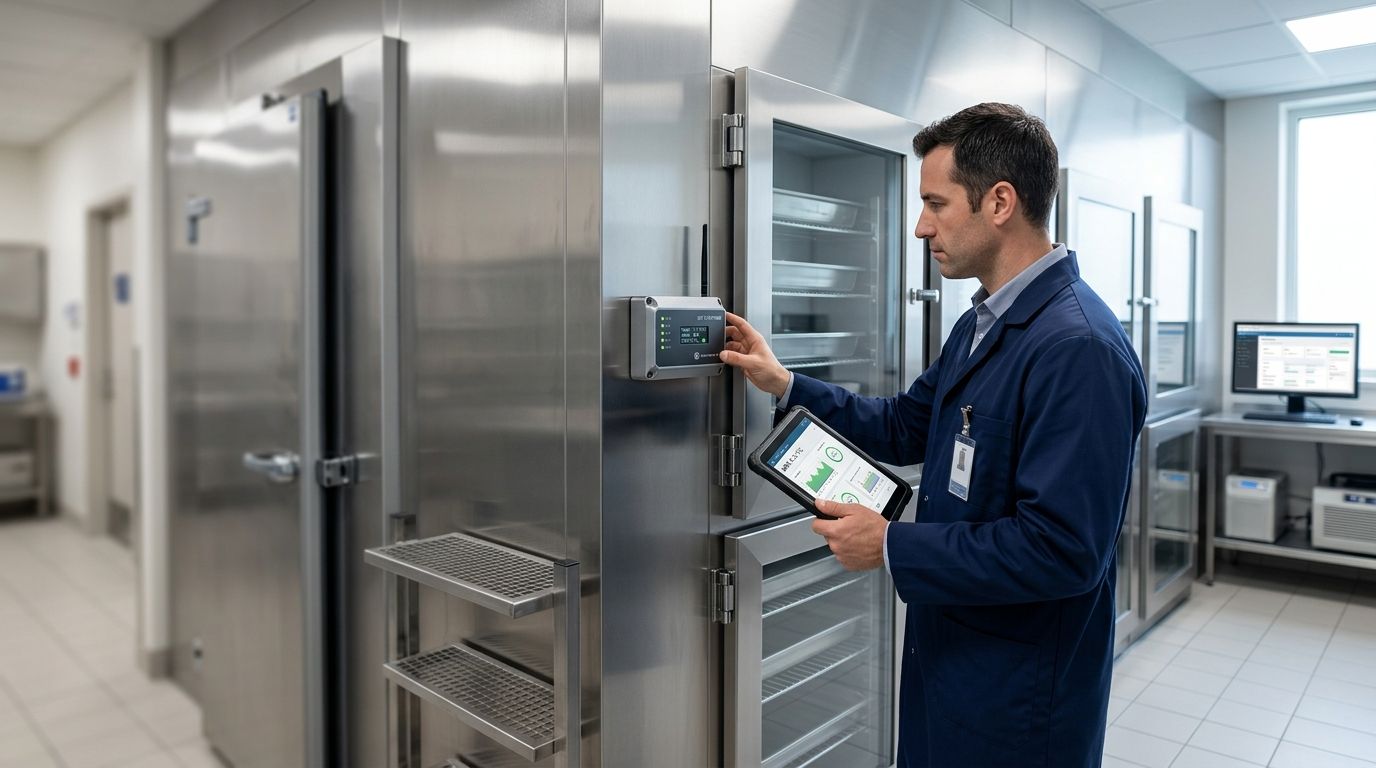
Funeral home cold storage monitoring is the use of wireless temperature sensors and automated alarms on mortuary refrigeration units so a drift above the state-mandated threshold triggers a phone call instead of showing up on the next morning's walkthrough. Funeral homes run this equipment with a fraction of the staff a hospital morgue has, often with one retention unit covering the entire building and nobody on-site between the evening viewing and the next scheduled appointment.
- Kilo IoT Platform monitors mortuary retention units with LoRaWAN or mioty sensors and alarms that escalate past quiet hours, best for funeral homes with no overnight staff.
- Most state funeral board rules require unembalmed remains refrigerated at 36F (2C) or below, commonly within 24 hours of death.
- A single retention unit failing overnight is the most common excursion a funeral home reports; escalation chains catch it before the morning shift arrives.
- Basement and windowless holding rooms need LoRaWAN or mioty, not WiFi, because concrete and rebar block WiFi signal.
Why mortuary cold storage needs automated temperature monitoring
A funeral home usually runs one or two retention units for the whole operation, unlike a hospital morgue or blood bank with redundant units and staff rotating through every shift. Losing that one unit overnight isn't a minor spoilage event. It's remains held outside a state funeral board's refrigeration rule, and repeated non-compliance is grounds most boards treat seriously during license review.
In 2026, plenty of independently owned funeral homes still track refrigeration with a paper log and a min-max thermometer checked twice a day, which means a 2 a.m. excursion isn't caught until the day shift walks in. Cold chain compliance monitoring built for pharmacies and cold storage warehouses works the same way for mortuary refrigeration: a sensor, a threshold, an alarm and a written record that holds up in an inspection.
The funeral homes that get flagged aren't usually the ones with a bad thermometer — they're the ones with a gap in the record nobody can explain.
How to set up mortuary cold storage monitoring step by step
Here's how to move a funeral home off manual logbooks and onto automated cold storage monitoring, starting with what costs nothing.
Walk your retention units and holding rooms first
- Count every retention unit and every holding room, including seasonal overflow space
- Check wall and floor construction — poured concrete and rebar basements block WiFi and cellular signal
- Note whether each unit has its own dedicated circuit or shares one with another appliance
- Confirm there's no existing alarm wired to the unit, or that it's actually connected and working
- Measure the distance from each unit to the nearest desk phone or office
Log temperatures on a fixed schedule
- Use a min-max thermometer, not a single-point gauge, so a spike between checks doesn't go unnoticed
- Log date, time, reading and initials on a sheet kept at the unit, not filed in a drawer
- Check at shift start and shift end at minimum, plus a third check on days with an overnight viewing
- Retain logs for the period your state funeral board requires for inspection
- Photograph and date-stamp any reading outside the threshold before resetting the unit
Set threshold alarms so nobody has to remember to check
A logbook only tells you about a problem after it already happened. A wireless sensor on each retention unit paired with a threshold rule tells you while the unit is still cold enough to fix. The Kilo IoT Platform runs its own LoRaWAN and mioty network server, so a funeral home doesn't need to stand up a separate network just to get sensors reporting — that matters in older buildings where the retention room sits below street level. Retrofitting older buildings with wireless sensors covers the connectivity side of exactly this kind of space.
Kilo doesn't manufacture the sensors itself. Battery-powered temperature and door sensors compatible with the platform ship worldwide through Kilo Electronics, the hardware side of the business.
- Put one battery-powered temperature sensor per retention unit, not one sensor for the whole room
- Set the alarm threshold to match your state's refrigeration requirement, not a generic default
- Use the rules engine's CEL expressions for conditional logic — alarm faster if two units drift at once, which usually means a shared circuit tripped
- Ask Kilo's built-in AI assistant to draft and deploy the rule from a plain-language description instead of configuring every field by hand
- Step through the rule on a test payload before it goes live, so the first real alarm isn't also the first test
Route alerts to more than one person
A single text to one cell phone isn't an escalation plan. Kilo's alarms run five severity tiers with multi-step escalation chains, so early drift pages the on-call embalmer while a full unit failure pages the funeral director directly, with quiet-hours settings that still let critical alarms through overnight. SMS and email alerts for critical thresholds walks through the setup.
- Set a low-severity tier for drift that's still in range but trending wrong
- Set a critical tier for anything past the state threshold, with no quiet-hours suppression
- Add a second contact per tier — the on-call person isn't always the one who answers first
- Route overnight alarms to a centralized alarm inbox so nothing gets buried in a text thread
- Confirm delivery across email, SMS and push, not just a single channel
Keep records ready for state board inspections
Paper logs work fine until an inspector asks for six continuous months of readings instead of six months of twice-daily spot checks. An automated platform keeps every reading, not just the ones a shift remembered to write down, which turns an inspection from a scramble into an export.
- Export continuous temperature history, not just logged spot checks
- Keep a record of every alarm, who it went to and when it was acknowledged
- Separate reports by retention unit if the board asks for unit-by-unit detail
- Store records for at least as long as your state's required retention period
- Include command history if a unit's setpoint was ever adjusted remotely
Plan for power and connectivity loss
A retention unit losing power at 3 a.m. on a holiday weekend is the scenario every funeral director dreads. Battery-powered LoRaWAN and mioty sensors keep reporting on local battery power even when the building loses power, which is different from a WiFi sensor that goes dark the instant the router does.
- Put the sensor gateway on the same UPS as anything else critical in the building
- Confirm the sensor's own battery life covers a multi-day outage, not just a few hours
- Test the alarm path during a planned power cut, not just on paper
- Keep a backup contact list independent of the building's phone system
- Check generator run time against how long a retention unit can safely hold without power
Build your mortuary monitoring dashboard
Set thresholds, alarms and escalation chains for every retention unit in one place.
Best options for monitoring mortuary cold storage compared
| Option | Best for | Key limitation |
|---|---|---|
| Paper log + min-max thermometer | A single-location home with one unit and staff checking every shift | No alert when nobody's looking; excursions surface after the fact |
| Consumer WiFi plug sensor with app alert | Testing automated alerts on a tight budget | WiFi dead zones in basement retention rooms; one alert channel, no escalation |
| Existing building management system | A funeral home inside a larger multi-tenant building with a BMS already installed | Adding mortuary-specific alarms to a shared BMS usually needs an integrator |
| Kilo IoT Platform with LoRaWAN or mioty sensors | A funeral home or multi-location operator that wants escalation chains, audit-ready logs and one dashboard across every room | Sensors are sourced separately through Kilo Electronics; the platform doesn't monitor embalming-room chemical exposure |
Common mortuary cold storage monitoring mistakes
- Relying on one retention unit with no separate alarm circuit — if the compressor and the alarm share a breaker, a tripped breaker kills the cooling and the warning at the same time.
- Choosing WiFi sensors for a basement holding room — concrete and rebar block WiFi reliably; LoRaWAN and mioty are built for this kind of construction.
- Sending every alarm to one cell phone — a funeral director on a call, at a service, or asleep is a funeral director who doesn't see the text.
- Treating the embalming room and the retention unit as the same problem — one is a refrigeration compliance issue, the other is ventilation and chemical safety, and conflating them means neither gets the right sensor.
- Logging twice a day and calling it continuous monitoring — a logbook with multi-hour gaps still lets a real excursion go undetected between checks, which is what a 2026 inspection tends to flag first.
FAQ
What temperature should a mortuary refrigeration unit hold?
Most state funeral board regulations require unembalmed remains held at 36F (2C) or below. Check your specific state's code, since the exact threshold and the window before refrigeration becomes mandatory both vary by jurisdiction.
How is an IoT platform for mortuary cold storage different from monitoring a restaurant walk-in?
The sensor and alarm mechanics are identical, but the compliance stakes are higher. A mortuary excursion risks a state funeral board violation rather than spoiled inventory, so escalation chains and audit-ready logs matter more than they do in food service.
Can one sensor cover two retention units?
No. Put one temperature sensor inside each retention unit, because a room-level sensor reads ambient air and misses a single compressor failing while the room stays cool.
Do wireless sensors work in a basement retention room?
LoRaWAN and mioty sensors work in basements where WiFi does not, because both use sub-GHz radio that penetrates concrete and rebar far better than 2.4 GHz WiFi. Kilo runs its own LoRaWAN and mioty network server, so there is no separate network server to deploy.
How much does the Kilo IoT Platform cost for a single funeral home?
The Free tier is 0 EUR for up to 5 devices, 1 dashboard and 1 rule, with no card required and no expiry. Starter is 25 EUR per month for up to 25 devices, and gateways are unlimited on every tier and never count toward the device limit.
Will the alarm still reach me during quiet hours?
Yes, if you set the alarm to a critical severity tier. Kilo runs five severity tiers with quiet-hours settings applied per tier, so routine drift stays silent overnight while a threshold breach still pages the on-call contact.
What records will a state inspector actually ask for?
Requirements vary by state funeral board, but continuous temperature history and a record of every alarm and its acknowledgment are the two exports worth having ready. Gaps in the record draw more scrutiny than a single documented and resolved excursion.
Does Kilo predict when a refrigeration compressor will fail?
No. Kilo fires a threshold or CEL rule when a reading crosses a limit, escalates the alarm to the right person, and can post the event out over the REST API or a webhook. It does not forecast failures.
What most mortuary monitoring plans miss
State funeral board inspectors tend to flag a gap in the record before they flag an actual temperature excursion. A continuous 2026 log with one anomaly that's documented and resolved holds up better than a spotless-looking log with unexplained gaps between manual checks. Continuity of the record is the audit target as much as the reading itself.