
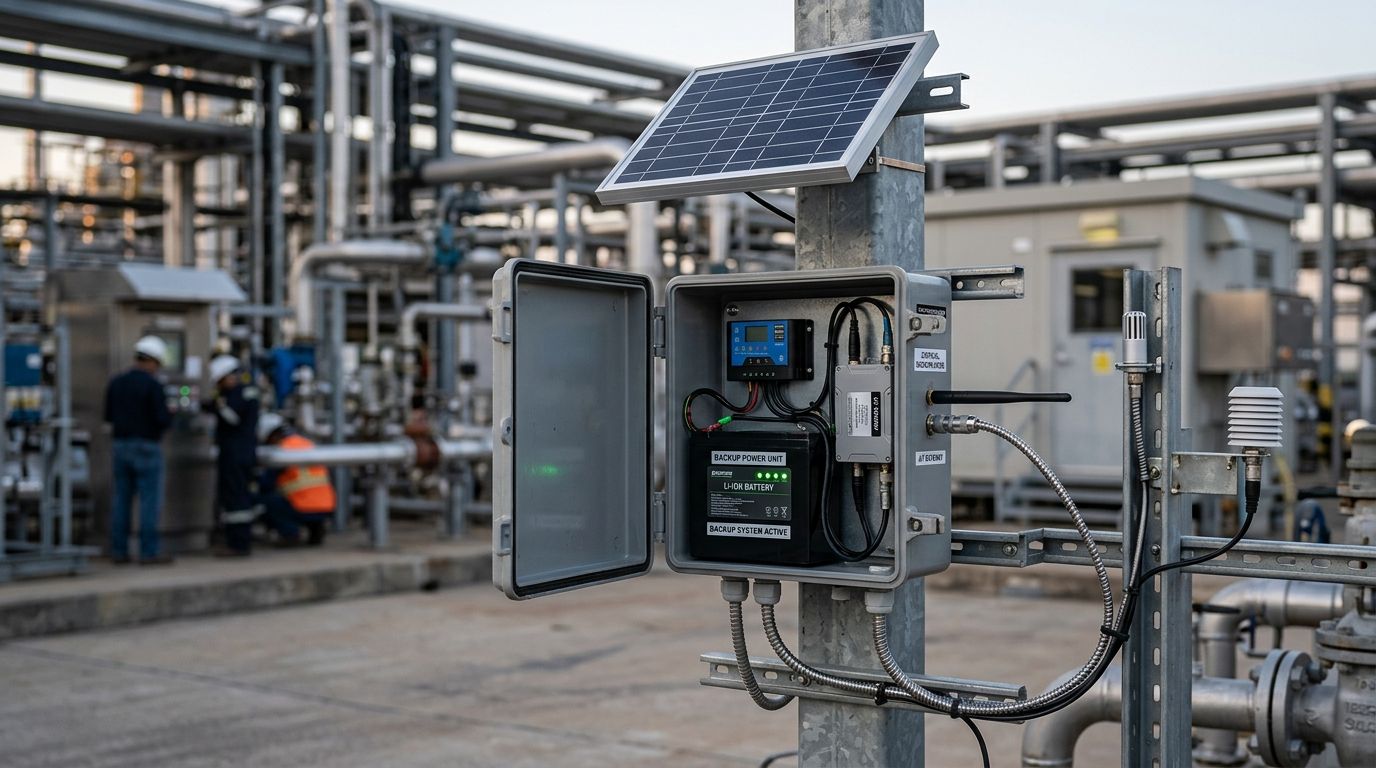
Backup power for a critical IoT sensor deployment has to cover three separate failure points: the sensor's own battery, the gateway that relays its readings, and the network path back to the platform. Miss any one layer and a temperature alarm, a tank-level warning, or a vibration alert goes silent exactly when you need it most. The fix is matching each layer's runtime to how fast utility power or a generator actually restores, not guessing at one UPS size and hoping it covers everything.
- Backup power for IoT sensor deployments has three layers: sensor battery, gateway UPS, and network backhaul failover.
- LoRaWAN and mioty end nodes already run on a primary battery, so backup power there means monitoring voltage, not adding a UPS.
- NFPA 110 Type and Class ratings give a real benchmark for gateway UPS runtime and generator sizing in 2026.
- Alarm escalation only works if it fires before the gateway battery or generator fuel runs out.
Why IoT sites lose sensors during a power outage
A site that runs its full Kilo IoT platform deployment on a single UPS at the network closet is one bad breaker away from a blackout across every connected sensor. Most facilities size backup power around the building's main load, then forget that gateways, PoE injectors, and routers sit on the same circuit as the IoT stack. When that circuit drops, the gateway goes dark even though every sensor on the floor still has battery life left in it.
The practical problem shows up as a gap in the data, not a dead device. A cold storage unit still holding 4°C reads fine on the sensor's battery, but the reading never leaves the room because the gateway lost power ten minutes into the outage. By the time facilities staff notice, the excursion window has already passed.
What layers of backup power does a critical IoT deployment need?
Backup power planning for IoT sensor deployments breaks into four layers, and each one needs a different backup mechanism because each one fails independently.
| Power layer | What it protects | Typical backup mechanism | If it fails |
|---|---|---|---|
| Sensor (end node) | The reading and its transmission | Primary battery, often lithium thionyl chloride | Sensor drops off the network, no alert fires |
| Gateway | Radio-to-IP bridge for every device in range | UPS or DC battery pack | Every sensor on that gateway goes dark at once |
| Backhaul / WAN | Path from gateway to the cloud platform | Cellular failover, dual WAN | Readings queue locally but never reach the platform |
| Facility | Switches, routers, racks, PoE injectors | Generator sized to NFPA 110 | Full site blackout, not just the sensor network |
Most deployments over-invest in the sensor layer, which already has its own battery, and under-invest in the gateway layer, which usually doesn't.
End-node battery backup: how long do LoRaWAN and mioty sensors run?
LoRaWAN and mioty end nodes don't need a separate backup power source because the battery is the primary power source, not a fallback. Vendors typically ship these devices with a primary lithium cell, most commonly lithium thionyl chloride (Li-SOCl2) chemistry, chosen for its low self-discharge rate over multi-year deployments. Actual run time depends on transmit interval, spreading factor, and how often the device wakes from deep sleep to report.
For sites with no mains power available at all, battery-powered wireless IoT sensors are built for exactly this case, running for years on a primary cell without any external power connection. The real backup power task at this layer isn't sizing a UPS, it's setting a low-battery threshold and confirming the alarm actually reaches someone before the cell dies mid-cycle.
Colder environments draw down lithium cell capacity faster than manufacturer datasheets published at room temperature, so sites monitoring freezers or unheated outdoor equipment should plan shorter replacement cycles than the headline spec suggests.
Gateway and backhaul power: sizing the UPS and failover
Gateways are the layer most backup power plans get wrong. A gateway with no battery backup takes down every sensor connected to it the instant the circuit drops, regardless of how much battery life each individual sensor has left.
NFPA 110, the Standard for Emergency and Standby Power Systems, classifies systems by Type based on how fast power has to restore: Type U has no time requirement, Type 1500 restores within 1,500 seconds (25 minutes), Type 60 within 60 seconds, and Type 10 within 10 seconds. Use these Types as a sizing benchmark for gateway UPS runtime: a Type 60-equivalent UPS bridges the gap until backup power kicks in, plus margin for the gateway's own reboot and network re-association time.
“If the sensor is battery-powered, the failure isn't the AA cell, it's the gateway you forgot has no battery at all.”
On the network side, a gateway with power but no internet path still can't reach the platform. Cellular failover routes traffic around a downed primary WAN link, and it's worth planning before an outage rather than during one.
Facility-level backup: generators, BESS, and NFPA 110 Class ratings
At the whole-site level, NFPA 110 also classifies systems by Class, based on minimum run time without refueling: Class 2 systems run at least 2 hours, Class 6 at least 6 hours, Class 48 at least 48 hours, and Class X systems are sized for indefinite run time backed by a fuel resupply plan. A generator classification that doesn't match how long utility outages actually last in your region leaves a gap between when the UPS dies and when the generator would have covered it.
Battery energy storage is increasingly the backup layer sites lean on instead of, or alongside, a diesel generator. Facilities evaluating IoT platforms for battery energy storage sites are usually solving two problems at once: monitoring the BESS itself, and using it as the facility's backup power source for the sensor network that watches everything else.
For teams sourcing the physical hardware, gateways with built-in battery backup and DIN-rail UPS modules are available worldwide through Kilo Electronics, Kilo's sister hardware company, alongside the software platform.
What factors change how much backup power an IoT site needs?
- Grid reliability at the site. A remote facility with frequent multi-hour outages needs a higher NFPA 110 Class rating than an urban site with rare, short interruptions.
- Sensor density per gateway. A gateway serving 40 devices takes 40 sensors dark on failure; a gateway serving 4 takes down 4.
- Transmit interval and duty cycle. More frequent reporting drains end-node batteries faster and shortens the replacement cycle.
- Ambient temperature. Cold storage and unheated outdoor sites reduce usable battery capacity below the room-temperature datasheet figure.
- Regulatory exposure. Cold chain, pharmaceutical, and correctional facility deployments carry compliance consequences for a missed alarm, which raises the bar on acceptable gap time.
- Criticality of the specific alarm. A tank overflow alert justifies a shorter acceptable gap than a meeting room occupancy counter.
How long should a UPS run an IoT gateway during an outage?
A gateway UPS should run at least as long as your NFPA 110 Type restoration window, plus margin for the gateway's own reboot and re-association time. Sites relying on generator backup typically size the UPS to bridge a Type 60 to Type 1500 window (60 seconds to 25 minutes), since that's the gap between grid loss and generator transfer.
Do LoRaWAN sensors need a separate battery backup?
No, LoRaWAN and mioty end nodes already run on a primary battery as their normal power source, so there's no separate backup layer to add at the sensor itself. The task at this layer is monitoring battery voltage and setting a threshold alarm well before the cell depletes, not sizing a second power source.
What happens to IoT alerts when the power goes out?
An alert only reaches someone if the alarm engine, the notification path, and the recipient's device are all still powered and connected when the threshold trips. Kilo's alarm system uses five severity tiers and multi-step escalation chains across email, SMS, and push, so a power-related alarm can bypass quiet hours and escalate to a second contact if the first doesn't acknowledge it. That escalation logic matters most in exactly the scenario backup power planning is meant to prevent: the first notice goes out right as the site loses power.
Get alerted before a battery or gateway dies
Set severity tiers and escalation chains for power and battery alarms.
FAQ
How much backup power does a critical IoT sensor deployment need in 2026?
It needs backup power at four separate layers in 2026: sensor battery, gateway UPS, network backhaul failover, and facility generator or BESS. Sizing any single layer without the others leaves a gap where sensors still work but their data never reaches the platform.
Do IoT gateways need a UPS?
Yes, a gateway with no UPS takes every connected sensor offline the moment its circuit loses power, regardless of individual sensor battery life. NFPA 110 Type classifications (10 to 1,500 seconds) give a practical benchmark for sizing that UPS runtime.
What is NFPA 110 and why does it matter for IoT backup power?
NFPA 110 is the Standard for Emergency and Standby Power Systems, and it classifies systems by Type (restoration speed, from Type U to Type 10) and Class (run time without refueling, from Class 2 to Class X). IoT deployments use these ratings as a sizing benchmark for gateway UPS and facility generator planning.
Do LoRaWAN or mioty sensors need battery backup?
No, LoRaWAN and mioty end nodes already run on a primary battery as their normal power source rather than mains power. The backup power task at this layer is monitoring battery voltage and alerting before depletion, not adding a second power source.
What happens to IoT alarms during a power outage?
An alarm only reaches a person if the alarm engine, notification path, and recipient device are all still powered when the threshold trips. Multi-step escalation chains across email, SMS, and push reduce the chance a single missed notice goes unanswered during an outage.
How does cellular failover help with IoT backup power?
Cellular failover reroutes gateway traffic around a downed primary WAN link, so a power event that also takes out the building's main internet connection doesn't stop sensor data from reaching the platform. It protects the network layer, separate from sensor or gateway battery backup.
How long should a facility generator run for a critical IoT site?
NFPA 110 Class ratings set the benchmark: Class 2 systems run at least 2 hours without refueling, Class 48 at least 48 hours, and Class X is sized for indefinite run time with a fuel resupply plan. Match the Class to how long grid outages actually last at that site.
Can an IoT monitoring platform keep working without an internet connection?
On-premise deployment keeps device management and alarm logic running locally when the connection to a cloud instance drops, which matters for sites where backhaul failure is a real risk. That's a separate resilience layer from sensor and gateway battery backup.
What most backup power plans miss in 2026
Most sites size backup power for the sensor and forget the gateway, when the gateway is almost always the weaker link. A single gateway UPS costs less to plan for than replacing every downstream sensor's runtime assumption, and it protects every device connected to that gateway at once, not just one. Check your gateway power backup before you check your sensor battery life; the sensor almost never dies first.