
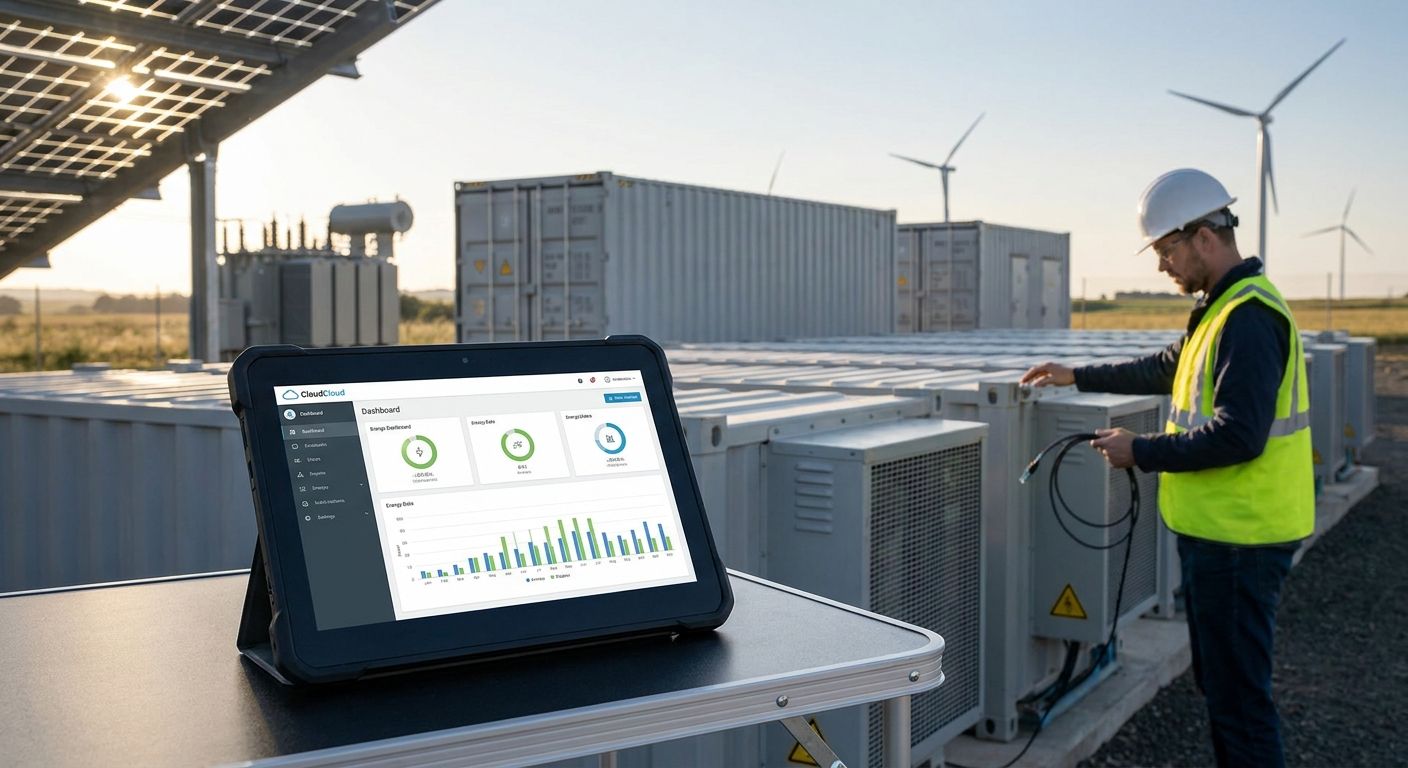
A battery energy storage site pushes an IoT platform harder than a typical facility: cell and enclosure temperature that can move from normal to thermal-runaway range in minutes, BMS and PLC data that has to reach a rules engine in real time, and alarms that can't sit unread on a dashboard. This guide covers what actually matters when picking the best IoT platform for battery energy storage sites, not just what a vendor's homepage claims.
- The best IoT platform for battery energy storage sites connects BMS data over MQTT and runs alarms through a rules engine, not just a dashboard.
- Kilo's rules engine runs CEL expressions against live telemetry so a cell-temperature threshold fires an escalation chain in seconds.
- Open-source self-hosted platforms like ThingsBoard or ChirpStack cut license cost but shift protocol maintenance and scaling onto your team.
- NFPA 855 (2023 edition) sets detection and spacing requirements for stationary battery storage - the platform needs auditable alarm history, not just live readings.
- Kilo's free tier covers up to 5 devices with no card required, enough to pilot alarm rules on one BESS enclosure before scaling.
What does a battery energy storage monitoring platform need to track
A BESS site is not one sensor problem, it's several running at once. Cell and module temperature, ambient enclosure conditions, state of charge from the BMS, and physical access all need to land in the same place or your operations team is checking four different tools during an incident.
A platform built for battery energy storage system monitoring has to ingest all of it: wireless sensor telemetry over LoRaWAN or mioty, and BMS/PLC data over MQTT, in one pipeline that feeds the same rules engine.
Cell and module temperature
This is the number that matters most and moves fastest. NFPA 855 (2023 edition) sets spacing and detection expectations for stationary battery storage precisely because temperature excursions in lithium cells can escalate from a few degrees above baseline to thermal runaway in minutes, not hours. A platform needs a threshold rule on this metric with no manual step between the reading and the alarm.
Ambient enclosure temperature and humidity
Battery enclosures and containers run their own HVAC or passive cooling, and a failure there shows up as a slow drift long before cell temperature spikes. Tracking ambient conditions separately from cell temperature gives you an early warning layer instead of a single trip-wire.
BMS state of charge, voltage, and current
Most battery management systems already expose this data over Modbus or a proprietary protocol that feeds into MQTT. The platform's job is to normalize that feed alongside wireless sensor data so a rules engine can correlate a voltage anomaly with a temperature reading from the same rack, in the same rule.
Door and access events
Unauthorized or unexpected enclosure access is a safety and security signal, not a maintenance one. A door contact sensor tied into the same alarm inbox as temperature and BMS alerts means one escalation path instead of three separate systems to check.
Vibration on cooling fans and switchgear
Cooling system failure is one of the more common precursors to a thermal event at a BESS site, and a fan bearing or compressor starting to vibrate abnormally is detectable well before it fails outright. Platforms that support vibration monitoring on industrial pumps and motors extend the same rule logic to BESS cooling equipment.
Which alarm and rules engine features matter for battery storage risk
A dashboard tells you what happened. A rules engine decides what happens next, and for a BESS site that decision needs to happen without a human in the loop watching a screen at 3am.
The features that separate a monitoring dashboard from an operational safety layer:
- Threshold and CEL-expression rules that combine multiple inputs - cell temperature above X and ambient temperature rising and a door open event - into one correlated alarm instead of three noisy ones.
- Multi-step escalation chains across email, SMS, and push, so a level-two alarm reaches the site manager if the on-call tech doesn't acknowledge it within a set window.
- Five severity tiers, so a slow humidity drift and a cell-temperature spike don't compete for the same attention.
- Quiet hours that suppress non-critical notifications overnight without silencing anything safety-related.
- Version control and rollback on rules, so a change to a threshold during a site expansion can be tested on a captured payload before it goes live, and reverted if it misfires.
- A centralized alarm inbox across every site, so a multi-site operator isn't logging into four separate systems during a shift handoff.
Kilo's rules engine is built as a visual BPMN workflow with CEL expressions, one-click deploy and rollback, and step-through debugging against a test payload - which matters more at a BESS site than almost anywhere else, because a misconfigured rule that fires too late is a safety gap, not an inconvenience. Kilo's built-in AI assistant can draft and deploy a rule from a plain-language request - alert the on-call tech if any rack exceeds 45C for more than 2 minutes - and it confirms the rule before it goes live, scoped to what the signed-in user is permitted to change.
“If the alarm has to wait for someone to open a dashboard, the platform isn't doing its job at a battery storage site.”
Which platform approach fits a battery energy storage site
There are really four ways teams end up monitoring a BESS site, and each one trades setup effort for control.
| Approach | Connectivity setup | Rules & alarms | Integration effort | Best fit |
|---|---|---|---|---|
| Purpose-built AIoT platform (Kilo) | Built-in LoRaWAN and mioty network server, MQTT connector for BMS/PLC | Visual rules engine (BPMN + CEL), five severities, escalation chains | Low - no separate network server to deploy | Ops teams monitoring one to dozens of BESS sites without a dedicated IoT engineering team |
| Hyperscaler general-purpose IoT (AWS IoT Core, Azure IoT Hub) | You configure the network server, device shadows, and message routing yourself | Rules require custom function code per condition | High - needs in-house cloud development | Teams building a fully custom stack with existing cloud engineers |
| Open-source self-hosted (ThingsBoard CE, ChirpStack) | Self-hosted network server, manual protocol integration | Rule chains configurable, but you patch and scale the server | Medium to high - ongoing DevOps load | Teams with spare DevOps capacity and no budget for a managed platform |
| BMS/SCADA only, no IoT layer | Locked to the BMS vendor's protocol, no wireless sensor layer | Local alarms only, no cloud escalation or mobile push | Low setup, no expansion path | Single-site pilots with no plan to add ambient or enclosure sensors |
The practical difference shows up the day you add a second site. A managed platform with a built-in network server means onboarding sensors at the new location follows the same steps as the first one - covered in detail in how to onboard LoRaWAN sensors at scale across multiple sites. A self-hosted stack means repeating the server configuration and scaling work each time.
How to reduce false alarms on a battery storage monitoring deployment
Alarm fatigue is the fastest way to make a good monitoring setup useless - if the on-call tech starts ignoring pings because half of them were a sensor reporting a cold morning as a fault, the real alarm gets missed too. Correlated rules (temperature and duration and a second signal) cut noise more than tightening a single threshold ever will. The detail worth reading before you write your first rule set is how to reduce false alarms in industrial IoT alert systems, because the same correlation logic that works for a chiller plant applies directly to a battery rack.
See the platform behind these rules
Check the dashboards, rules engine and alarm inbox on the Kilo IoT Platform.
How much does an IoT platform for battery storage monitoring cost
Kilo's free tier covers up to 5 devices and 1 dashboard with no card required and never expires, which is enough to pilot a rule set on one BESS enclosure - a handful of temperature sensors, a door contact, and an MQTT feed from the BMS - before committing budget to a full rollout. The Starter plan runs 25 EUR per month for up to 25 devices, and gateways are unlimited on every tier, which matters at a BESS site where one gateway typically covers an entire container or yard regardless of how many sensor points sit inside it.
Where to source sensors for a battery energy storage deployment
The platform and the hardware are two separate decisions. Kilo does not manufacture sensors - the AI assistant recommends devices from a partner catalog, and hardware itself is sourced through Kilo Electronics, which ships worldwide. For a BESS site, that typically means temperature and humidity sensors rated for the enclosure's environment, a door contact sensor, and a vibration sensor for cooling equipment, all feeding the same LoRaWAN or mioty network.
A related read worth checking before finalizing a sensor list is renewable energy site monitoring, since battery storage sites frequently sit alongside solar or wind assets on the same network.
FAQ
What is the best IoT platform for battery energy storage sites?
A purpose-built AIoT platform that combines LoRaWAN or mioty sensor connectivity with an MQTT connector for BMS and PLC data is the strongest fit, since it puts every signal into one rules engine instead of several disconnected dashboards. Kilo is one example built specifically around this pattern, with a visual rules engine and multi-step alarm escalation.
How do you monitor battery energy storage system temperature with IoT sensors?
Wireless temperature sensors over LoRaWAN or mioty report cell and enclosure readings on a set interval, feeding a rules engine that fires an alarm when a threshold or CEL expression is crossed. NFPA 855 (2023 edition) is the standard that governs detection expectations for stationary battery storage.
Is LoRaWAN or mioty better for battery storage site monitoring?
Both are low-power wireless protocols suited to battery-powered sensors, and the right choice depends on interference tolerance and existing site infrastructure rather than one being universally better. A platform with a built-in network server for both, like Kilo, removes the need to commit to one protocol before deployment.
How much does an IoT platform for battery storage monitoring cost?
Kilo's free tier covers up to 5 devices and 1 dashboard with no card required, enough for a single-enclosure pilot. The Starter plan is 25 EUR per month for up to 25 devices, with gateways unlimited on every tier.
Can an IoT platform integrate with an existing BMS or PLC at a BESS site?
Yes - an MQTT connector lets any publishing BMS, PLC, or energy meter feed data into the same platform as wireless sensors, so state of charge and voltage sit alongside cell and ambient temperature in one rules engine.
What NFPA standard applies to battery energy storage system monitoring?
NFPA 855, most recently the 2023 edition, sets spacing, detection, and fire safety requirements for stationary battery energy storage systems. A monitoring platform supports compliance by providing auditable alarm history and detection thresholds, not by replacing the standard itself.
Does an IoT platform predict battery failure before it happens?
A rules engine fires an alarm when a threshold or correlated condition is crossed - it does not predict failure through machine learning. Kilo's AI assistant helps you build and deploy that rule through a plain-language request, then confirms it before it goes live.
How many sensors does a typical battery storage enclosure need?
There is no fixed number - it depends on rack count, cooling design, and whether the BMS already exposes voltage and state of charge over MQTT. Most deployments start with a handful of temperature points, a door contact, and a vibration sensor on the cooling system, then expand based on what the rules engine flags.
The detail that gets missed most often on a battery storage monitoring plan: teams buy the sensors first and pick the rules engine second, when it should run the other way. A sensor reading with nowhere to correlate against a BMS feed is just a number on a dashboard - the escalation chain and the CEL expression are what turn that number into someone getting paged before a thermal event, not after.