
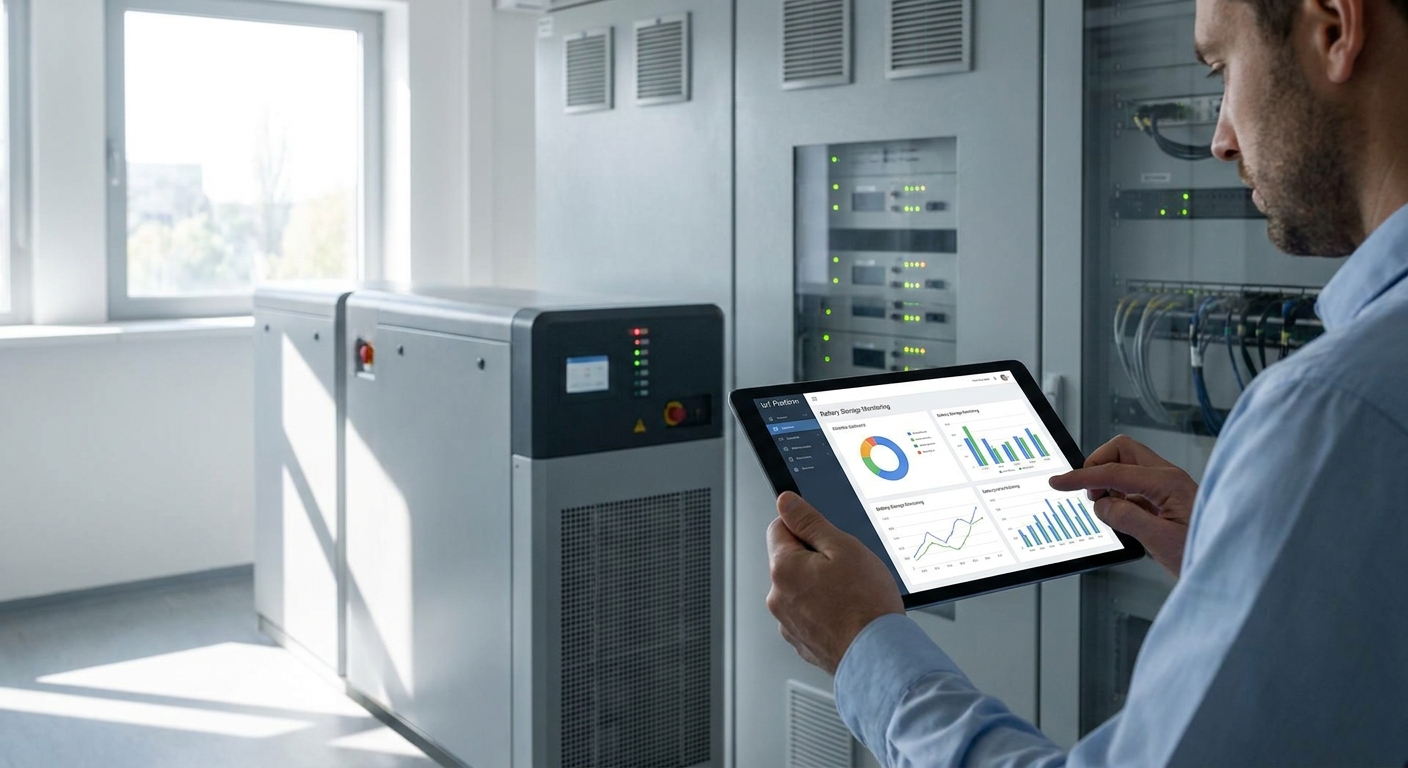
Battery energy storage systems fail quietly. A cell drifts out of thermal range, a rack loses comms, or a container's HVAC unit trips offline at 2 a.m. — and if nobody is watching a dashboard at that exact moment, you find out when the state of charge won't hold or the site trips an alarm at the utility interconnect. An IoT platform for battery energy storage monitoring exists to close that gap: constant telemetry, thresholds that fire before things get expensive, and an escalation path that actually reaches a human.
- An iot platform for battery energy storage monitoring needs LoRaWAN/mioty or MQTT ingestion, a rules engine, and tiered alarm escalation — not a dashboard alone.
- Kilo's built-in LoRaWAN and mioty network server plus MQTT connector ingest rack sensors and BMS data without a separate network server.
- Five alarm severity tiers with multi-step escalation beat a single email alert for a site nobody staffs overnight.
- The Free tier runs a full BESS pilot (5 devices, 1 dashboard, 1 rule) at 0 EUR before you commit to a multi-site rollout.
What does an IoT platform for battery energy storage monitoring actually need to do?
A BESS site is a rack of cells, an inverter, an HVAC or liquid-cooling loop, and usually a battery management system (BMS) already publishing data somewhere. The monitoring layer sits on top: it pulls telemetry off sensors and the BMS, applies rules to that data, and tells the right person when a number crosses a line. That's the whole job in 2026 — no more, no less.
The same pattern shows up on renewable energy site monitoring deployments generally: solar, wind and storage assets sit in remote or unstaffed locations, and the platform's real value is catching a problem between site visits, not after the next scheduled inspection.
Who runs battery energy storage system monitoring day to day?
The buyer is usually an operations or asset management team responsible for a fleet of storage containers or a single large site tied to a solar or wind array. They're not battery chemists — they're the people who get the 3 a.m. page when SOC drifts or a container overheats, and they need that page to be accurate, not a false alarm that trains them to ignore it.
A second buyer type is the integrator or EPC building the site who needs a monitoring layer that ingests whatever protocol the BMS and inverter already speak, without months of custom development.
What to look for in an IoT platform for battery energy storage monitoring
Native LoRaWAN, mioty or MQTT ingestion
Most BESS containers already have a BMS publishing over Modbus, and many sites add wireless temperature or door sensors around the racks. A platform with a built-in LoRaWAN and mioty network server and an MQTT connector ingests both without you standing up a separate network server first. That matters more at scale — one extra piece of infrastructure per site adds up fast across 20 or 30 locations.
Rules that run on real thresholds, not a black box
You want a visual rules engine you can read and version, not a proprietary scoring system you have to trust blind. A BPMN-based rules engine with CEL expressions lets you write "if rack temperature exceeds a set threshold for 10 minutes, escalate" and step through that logic against a test payload before it goes live. One-click deploy and rollback means a bad rule doesn't stay live overnight.
Alarm escalation that reaches an actual person
A single email alert gets missed. Five severity tiers with multi-step escalation chains — email, SMS, push, with quiet hours and a centralized inbox — mean a critical thermal event escalates past whoever's asleep to the next person on the chain. This is the difference between catching a problem at minute 15 and finding it the next morning.
A digital twin you can actually navigate
A BESS site with 40 racks across 3 containers is hard to reason about from a table of sensor IDs. A per-device digital twin plus a live 3D building twin with sensors bound to physical objects — a rack, a container, an HVAC unit — lets an operator click the object on a floor plan instead of hunting through a list. The same approach applies directly to broader digital twin software for building energy optimization use cases, where the visual layer is what makes multi-site data usable instead of just collected.
API access for whatever system already runs the site
Most BESS operators already have a SCADA screen or an energy management system. REST and gRPC APIs with scoped API keys let the monitoring platform push alarm data out instead of becoming yet another screen nobody opens. If a rule fires, it should be able to post to a webhook or your existing system, not trap the alert inside a separate app.
Multi-site device management without per-site rebuilds
If you're monitoring more than one storage site, you don't want to configure rules and dashboards from scratch each time. ABAC-based multi-tenant access control and an immutable audit trail keep permissions and rule history straight as the fleet grows, and gateways stay unlimited on every tier so hardware count doesn't drive your monthly bill.
See the platform on your own BESS data
Free tier runs up to 5 devices, 1 dashboard, 1 rule at 0 EUR — no card required.
How do these criteria play out on a real battery storage site?
Start with what you're actually watching: rack or module temperature, ambient temperature inside the container, HVAC/cooling status, door or intrusion sensors, and a comms-loss check on every device. A rule fires on each of those independently — you don't need one giant rule covering the whole site, you need six small ones you can debug separately.
When a storage site sits alongside solar or wind generation, the same platform typically also tracks inverter status and generation output, which is why storage and generation monitoring tend to live on the same dashboard rather than two separate tools. If the site also does behind-the-meter billing or tenant cost allocation, the same telemetry feeds into IoT energy submetering for commercial tenant billing without a second sensor deployment.
An AI assistant built into the platform can speed up the first pass here: it onboards the device, drafts the rule in plain language, and creates the alarm — scoped to your permissions and confirming before anything consequential goes live. That's a starting point for the rule, not a replacement for reviewing the threshold yourself.
What mistakes do teams make monitoring battery energy storage with IoT?
- Setting one alarm severity for everything. A comms-loss warning and a thermal runaway risk are not the same urgency — route them differently or the team stops trusting the inbox.
- Skipping the ROI math before scaling past a pilot. Before committing to 20 sites, run the numbers the way how to calculate ROI on an industrial IoT monitoring deployment lays out — sensor cost, install time and avoided downtime all belong in that math, not just the software line item.
- Assuming the BMS data alone is enough. A BMS reports what's happening inside the pack; it usually doesn't tell you the container's HVAC failed or the door was left open. Independent environmental sensors catch what the BMS can't see.
LoRaWAN vs mioty vs MQTT for battery storage monitoring
| Protocol | Best for | Typical range | Power draw |
|---|---|---|---|
| LoRaWAN | Wireless rack/ambient sensors across a yard or campus | Up to several km outdoors | Low — battery sensors run years |
| mioty | Dense sensor counts, high interference environments | Comparable to LoRaWAN, stronger in noisy RF | Low |
| MQTT | BMS, inverter or PLC data already being published | Wired/local network, no range limit | N/A — wired connection |
Most real BESS deployments in 2026 run all three at once: MQTT off the BMS and inverter, LoRaWAN or mioty for the environmental sensors nobody wired in at construction. A platform that only speaks one of these forces you to bolt on a second tool later.
FAQ
What is an IoT platform for battery energy storage monitoring?
It's software that ingests telemetry from BESS sensors and the battery management system, applies threshold rules, and escalates alarms when temperature, voltage or comms drift outside set limits. It sits above the hardware layer rather than replacing the BMS.
Does battery storage monitoring need LoRaWAN, mioty or cellular?
It depends on what's already publishing data. Wireless rack and ambient sensors typically run LoRaWAN or mioty for battery life; a BMS or inverter already on the network usually connects over MQTT instead.
Can an IoT platform predict battery failure?
A rules-based platform fires an alarm when a threshold or CEL condition is met — a temperature exceeding a set limit for a set duration, for example — and escalates it to the right person. It doesn't forecast failure; it catches conditions you've already defined as risky.
How much does IoT monitoring cost for a small storage site?
Kilo's Free tier covers up to 5 devices, 1 dashboard and 1 rule at 0 EUR with no card required, which is enough for a single-container pilot. The Starter tier runs 25 EUR per month for up to 25 devices as the site grows.
Do gateways count toward the device limit?
No. Gateways are unlimited on every Kilo tier and never count against the device count on your plan.
Can the platform integrate with an existing SCADA or BMS system?
REST and gRPC APIs with scoped API keys let alarm and telemetry data push out to an existing system or webhook, so the monitoring layer doesn't have to become a separate screen operators check.
What happens when a battery storage alarm fires overnight?
A multi-step escalation chain routes it through email, SMS or push in sequence until someone acknowledges it, with quiet hours configurable so low-severity alerts don't page anyone at 3 a.m.
Is a digital twin necessary for battery storage monitoring?
It's not required to catch alarms, but a 3D twin with sensors bound to physical racks and containers makes a multi-container site far faster to read at a glance than a flat list of sensor IDs.
What most BESS monitoring guides don't mention
The rule you'll actually rewrite most often isn't the thermal threshold — it's the comms-loss rule. Sensors on a busy site drop packets more than people expect, and a comms-loss alarm set too aggressively trains the team to ignore every alert within a week. Version control and rollback on the rules engine exist for exactly this: tune the threshold, watch it for a few days, roll back if it's noisy, and keep the change history so the next person doesn't repeat the same tuning cycle in 2026 or 2027.