
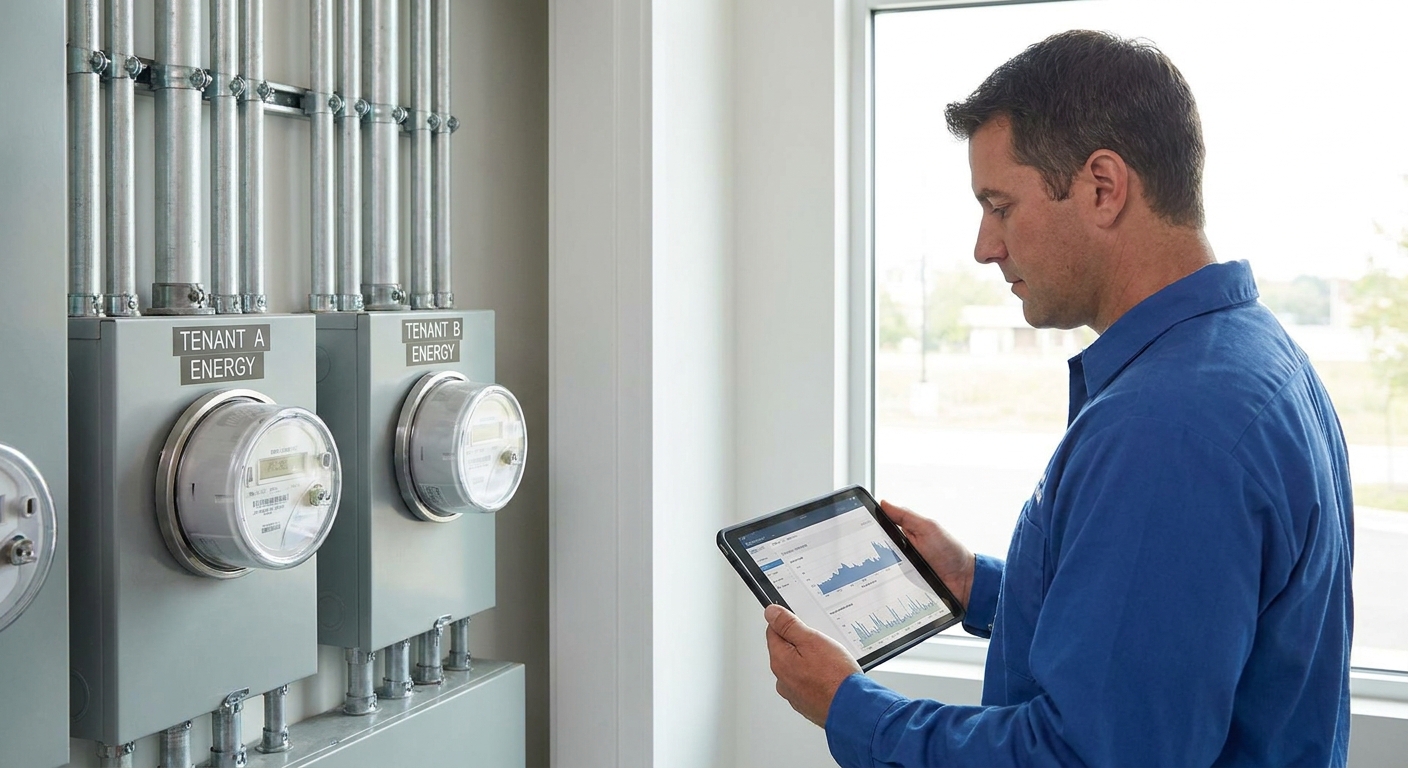
Bill a tenant for energy they didn't use and you'll hear about it at the next lease renewal. IoT energy submetering for tenant billing solves that by putting a meter — not an estimate — on every suite, floor, or unit you invoice separately.
- LoRaWAN clamp-on pulse submeters win for retrofit buildings with no rewiring budget — Buy for most multi-tenant properties in 2026.
- MQTT-integrated utility-grade meters suit new construction already wired for Class 0.5 accuracy — Buy for new builds.
- Skip smart-plug or open-source metering for tenant billing; no ANSI accuracy class means no defensible invoice.
- IoT energy submetering for tenant billing lives or dies on 15-minute interval data and an exportable audit trail, not a live number on a screen.
Why this matters
Most buildings still bill tenants through ratio utility billing — square footage divided into the master meter bill. That works until one tenant runs a server closet 24/7 and another runs a 9-to-5 office, and now you're subsidizing one lease with another's rent roll.
Submetering fixes the allocation problem, but only if the data holds up when a tenant disputes an invoice. A live dashboard reading is not evidence. A time-stamped, interval-logged, exportable record from a metering-grade sensor is. That's the line between a monitoring project and a billing system, and it's the line most IoT energy submetering for tenant billing shopping guides skip.
A platform like Kilo Cloud sits on top of the meters and turns raw pulse or Modbus reads into per-tenant consumption you can actually invoice against — but the meter and the connectivity choice underneath it determine whether that data is billing-grade in the first place.
Who this is for
This guide is for property managers and facilities operations teams converting multi-tenant office, retail, or light-industrial buildings from flat-rate or RUBS billing to metered tenant billing — including portfolios managed by property management companies running the same rollout across several sites at once. If you're choosing between competing tenants' complaints and a compliance deadline for direct metering, this is your buying checklist.
What to look for in IoT energy submetering for tenant billing
Billing-grade accuracy class
A sensor that's accurate enough for a dashboard is not automatically accurate enough for an invoice. Utility-grade submeters carry an ANSI C12.20 accuracy class (commonly 0.2 or 0.5), meaning the reading is certified within a tight tolerance — the number a tenant's attorney can't easily challenge. Anything without a published accuracy class is a monitoring sensor wearing a billing sensor's job.
Interval data granularity and retention
Tenant billing disputes hinge on "what happened at 2 a.m. on the 14th," not "what's the total this month." You need 15-minute or hourly interval logs retained long enough to cover a full billing cycle plus a dispute window — most operators keep 12 to 24 months on hand. A system that only stores a running total has already lost the argument before it starts.
Tenant-level isolation and mapping
Every submeter has to map cleanly to one tenant's leased space, not a shared panel feeding three suites. Get this wrong once — bill the wrong tenant for a shared HVAC loop — and you've handed every tenant in the building a reason to distrust the whole billing model going forward.
Connectivity that survives the retrofit
New construction gets wired meters. Existing buildings usually don't have spare conduit runs to every suite, which is where wireless connectivity earns its cost. LoRaWAN pulse counters clamp onto an existing meter or run off a dry-contact pulse output and report over a gateway with no new cabling — the same approach that works for retrofitting legacy buildings with wireless IoT sensors generally.
A rules engine that flags billing anomalies before invoices go out
A submeter that suddenly reports zero, or triples overnight, is either broken or measuring the wrong circuit. Rules and alarms that catch that before the invoice run save you from crediting a tenant after the fact and explaining why.
An exportable audit trail
Whatever platform aggregates the readings needs to spit out a clean, timestamped report per tenant per period — the artifact you hand to a tenant, a lender, or a local utility regulator when someone asks how the number was calculated. Portfolio-wide, that same aggregation is what turns per-suite readings into a real building energy picture, the kind digital twin software for building energy optimization is built to hold.
Top picks for tenant billing metering
LoRaWAN clamp-on pulse submeters — the retrofit fix. No electrician pulling new conduit, no downtime for tenants. Battery life runs 5 to 8 years on most LoRaWAN pulse counters, and they report on 15-minute intervals straight into a dashboard. Best fit for existing multi-tenant buildings converting off RUBS in 2026 without a capital rewiring project. Full approach detailed in retrofitting legacy buildings with wireless IoT sensors. Verdict: Buy.
MQTT-integrated utility-grade meters — the new-construction default. If the building is already wired with ANSI C12.20 Class 0.5 meters on the panel schedule, MQTT integration pulls that data straight into a billing dashboard without adding hardware. Works well when the electrical contractor specced billing-grade meters from day one. Verdict: Buy for new builds and major renovations, Consider for retrofits where the meters aren't already there.
Modbus/PLC main-panel branch monitoring — the whole-floor shortcut. One gateway reads dozens of branch circuits off a panel's Modbus output, which is fast to deploy but measures at the panel level, not the suite level. Fine when one tenant occupies an entire floor fed by a dedicated panel. Weak when three tenants share that panel. Verdict: Consider for single-tenant floors, Skip for granular sub-suite billing.
Cellular submeters — the no-gateway answer. Detached garages, standalone retail pads, or outbuildings outside LoRaWAN gateway range still need metering, and cellular submeters skip the gateway entirely. The tradeoff is a recurring SIM cost per meter instead of a shared gateway covering hundreds of endpoints. Verdict: Consider for edge-case structures, Skip as your primary approach across a whole property.
DIY smart plugs and open-source metering — the shortcut that backfires. No published accuracy class, no audit trail export, and usually no rules engine to catch a dropped reading before the invoice goes out. Fine for internal energy curiosity. Indefensible the first time a tenant asks how the number was calculated. Verdict: Skip for billing use.
What to avoid
- Class 2 or unrated accuracy sensors marketed as "smart meters." They look identical to billing-grade hardware on a spec sheet until you check for the accuracy class, and by 2026 most tenant lease riders require a certified class for direct billing.
- Systems with no alarm or rules layer. A meter that silently goes offline for three days and then reports a catch-up total isn't giving you a defensible reading for that gap — you need an alert the moment a device stops reporting, not a surprise at invoice time.
- Platforms that only show a live number, no interval history. If you can't pull last month's 15-minute log for suite 4B, you can't answer a dispute, full stop.
Roll out tenant submetering across a portfolio
See how multi-site property teams run per-tenant billing on one dashboard.
Verdict comparison
| Approach | Accuracy class | Retrofit friendly | Tenant-level isolation | Verdict |
|---|---|---|---|---|
| LoRaWAN pulse submeter | Certified (meter-dependent) | Yes | Yes, per suite | Buy |
| MQTT utility-grade meter | ANSI C12.20 Class 0.5 | No, needs existing wiring | Yes, per suite | Buy for new builds |
| Modbus/PLC panel branch | Panel-dependent | Partial | Panel-level only | Consider |
| Cellular submeter | Certified (meter-dependent) | Yes | Yes, per structure | Consider for edge cases |
| DIY smart plug | Unrated | Yes | Yes, but undefensible | Skip |
FAQ
What is IoT energy submetering for tenant billing?
It's metering individual tenant spaces with wireless or networked sensors so a landlord can invoice actual consumption instead of a square-footage estimate. In 2026 most rollouts use LoRaWAN pulse counters or MQTT-connected utility-grade meters feeding a billing dashboard.
Is LoRaWAN better than wired meters for tenant billing?
LoRaWAN wins for retrofits because it avoids new wiring, running 5 to 8 years on battery with 15-minute interval reporting. Wired MQTT meters make more sense in new construction where the panels already carry billing-grade meters.
How much does IoT submetering cost per tenant unit?
Cost varies by meter type, gateway coverage already in place, and site count, so get a quote specific to your building rather than relying on a generic per-unit figure.
What accuracy class do submeters need for legal tenant billing?
Most jurisdictions and lease riders expect ANSI C12.20 Class 0.5 or better for direct tenant billing. Anything without a published accuracy class is monitoring-grade, not billing-grade.
Can one gateway cover a whole multi-tenant building?
Yes — a single LoRaWAN gateway typically covers an entire building or several floors, with individual pulse submeters reporting back to it, which keeps per-unit connectivity cost low compared to cellular submeters.
How long should interval data be retained for tenant billing disputes?
Most operators retain 12 to 24 months of 15-minute or hourly interval data, enough to cover a full lease cycle plus a reasonable dispute window after an invoice goes out.
Does submetering replace the building's main utility meter?
No. Submeters allocate consumption within the building; the utility still bills the master meter, and the landlord uses submeter data to divide that bill fairly across tenants.
What happens if a submeter goes offline mid-billing-cycle?
A rules engine should alert facilities staff the moment a device stops reporting so the gap gets flagged before the invoice runs, instead of surfacing as an unexplained jump the next cycle.
One last thing
The detail most property teams miss until year two: the accuracy class matters less than the export format. A meter can be perfectly certified and still be useless in a dispute if the platform can't hand a tenant a clean, timestamped report on demand — build the audit trail into the rollout from day one, not after the first challenged invoice in 2026.