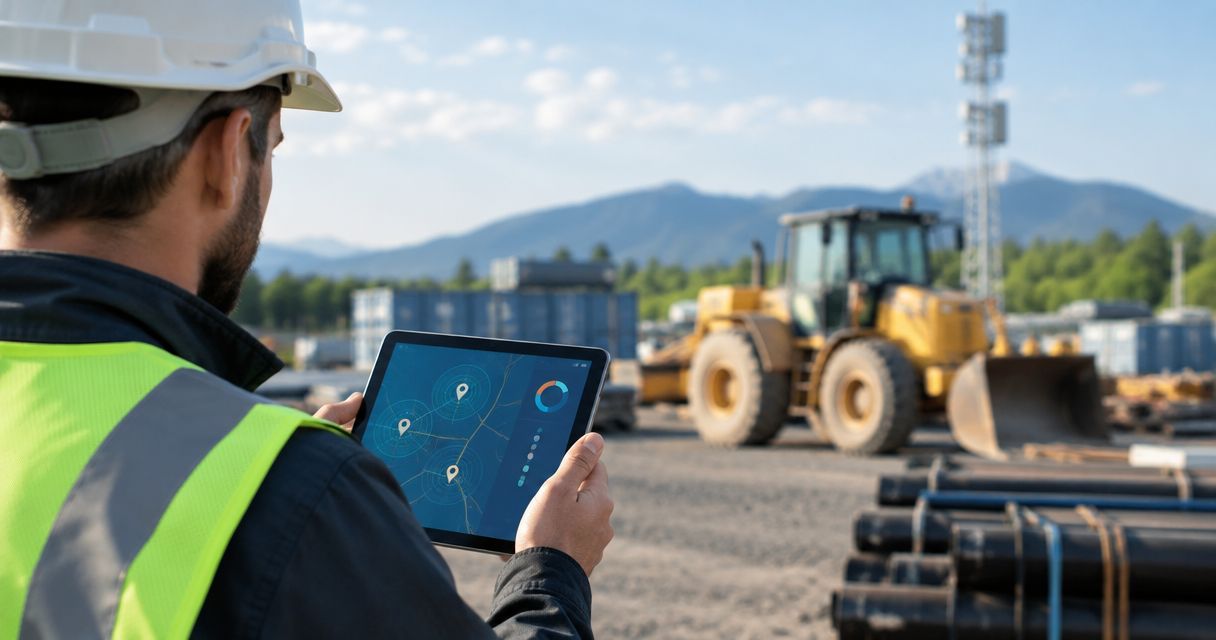
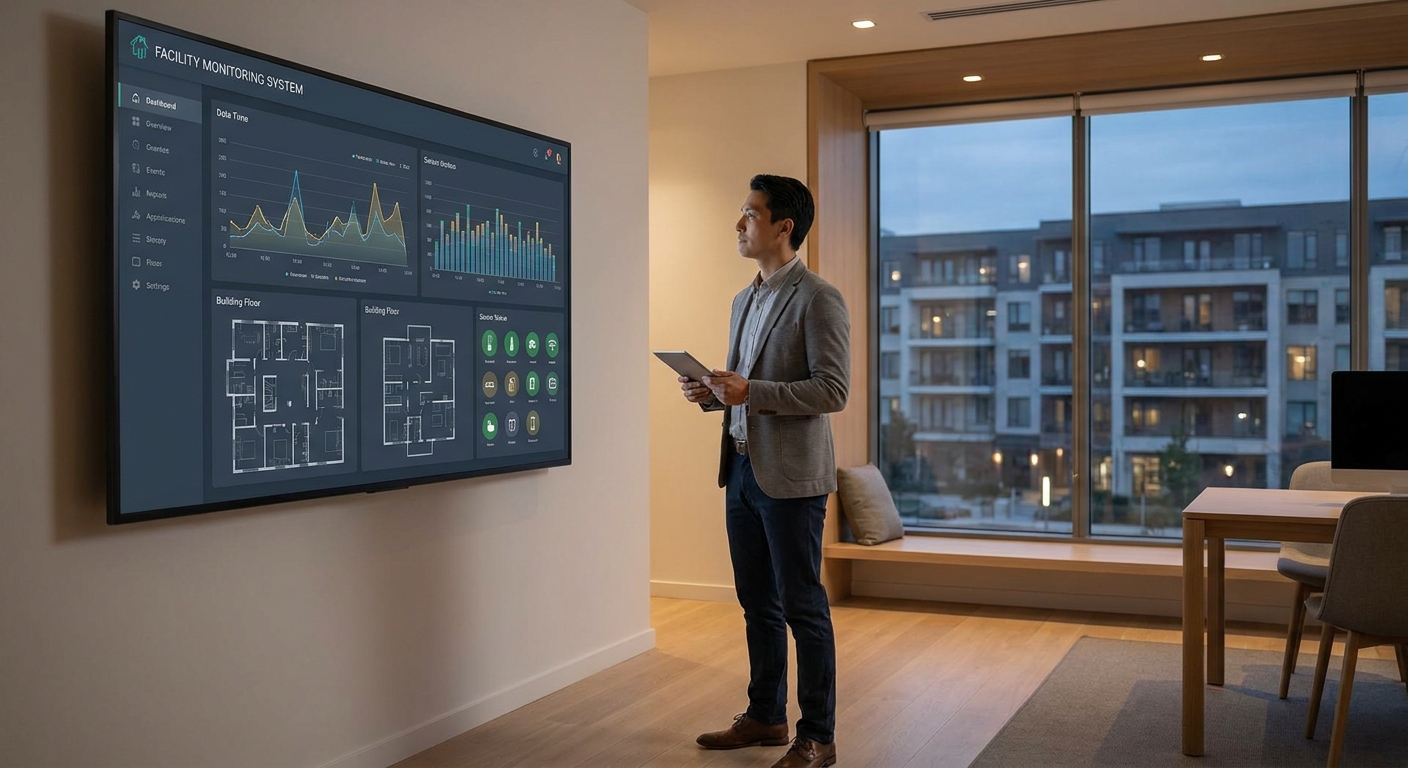
Property management companies running more than a handful of buildings can't rely on maintenance staff driving between sites to check a boiler room or a walk-in cooler. A facility monitoring system for property managers puts temperature, leak, energy and equipment data from every property into one dashboard, with alarms that reach the right person before a tenant complaint or a repair bill does.
- A facility monitoring system for property managers should show every property on one dashboard, not one app per site.
- Kilo IoT's multi-site dashboard and digital twin route alarms by building and floor, not just by device ID.
- LoRaWAN and mioty sensors cover basements and mechanical rooms where WiFi drops out — buy this over WiFi-only kits.
- Portfolios adding 3+ properties a year need device management that provisions in minutes, not a truck roll.
- Skip single-building point solutions in 2026 — they don't scale past the first property.
Why this matters
A missed alarm at one property is a maintenance ticket. A missed alarm across a 40-building portfolio is a pattern nobody notices until the insurance claim arrives. Property management margins run thin, and a burst pipe or a failed rooftop unit that runs three days before anyone checks turns a $400 fix into a $12,000 one.
The operational math for 2026 is straightforward: fewer site visits, faster alarm-to-action time, and one system that scales when the portfolio grows instead of one app per building. That's the entire pitch of a facility monitoring system for property managers — it replaces manual walkthroughs with sensor data and automated alarms.
Who this is for
This guide is for property management companies and facility operations teams overseeing multiple sites — apartment complexes, mixed-use buildings, retail portfolios, or commercial office stock — where staff can't be physically present at every property every day. If you manage a single building with an on-site engineer, a lot of this doesn't apply. If you manage five, fifteen, or fifty properties from a regional office, keep reading.
What to look for in a facility monitoring system for property managers
Single dashboard across every property
If your team needs a different login for every building, the system doesn't scale. A property manager checking 20 sites before 9am needs one view, not 20 tabs. Kilo IoT builds its cloud platform around a single-pane dashboard with per-property drill-down, so a regional manager sees portfolio-wide status and a site engineer sees just their building.
Alarm routing that matches your org chart
An alarm that goes to a general inbox gets ignored. An alarm that goes to the on-call engineer for that specific property gets acted on. Rules engines that let you set conditions like a walk-in cooler holding above 8°C for 10 minutes, then route that alert to the right person by site, are the difference between a caught problem and a flooded unit.
Connectivity that survives basements and mechanical rooms
WiFi doesn't reach a sub-basement boiler room reliably, and cellular signal drops in concrete stairwells. LoRaWAN and mioty are built for exactly this — long range, low power, and penetration through concrete and steel that WiFi-based sensors can't match. This matters more for property portfolios than almost any other vertical, because mechanical rooms are where the expensive equipment sits.
Building context, not just raw sensor feeds
A temperature reading with no floor, unit, or system context forces someone to go look up what device 4471 actually is. A digital twin ties each sensor to its physical location in the building, so an alarm reads "HVAC unit, Building C, 3rd floor" instead of a serial number.
Integration with what you already run
Property management companies already run accounting, work-order, and leasing software. A facility monitoring platform that pushes data via MQTT or a documented API into those systems avoids a second silo nobody checks.
Deployment speed when the portfolio grows
Property portfolios change — acquisitions, new builds, lease-ups. A platform that takes weeks of engineering to onboard a new property isn't built for a growing management company. Look for provisioning that takes hours, not a project.
Top picks for property management portfolios
Pick 1 — the default pick for portfolios over 5 properties. A multi-site facility dashboard gives one login across every building, with alarms and rules configured per site instead of per device. The spec that matters: a rules engine that lets non-technical staff set thresholds (temperature, humidity, water leak, power loss) without writing code. Verdict: Buy.
Pick 2 — the pick for mixed residential-commercial portfolios. A facility monitoring system built for multi-site retail chains extends the same monitoring stack to leasable commercial and retail space inside a mixed-use portfolio, which matters if your buildings have ground-floor retail alongside residential units. Verdict: Buy.
Pick 3 — the wildcard for portfolios chasing energy savings. A digital twin that maps HVAC, lighting, and metering data to building geometry lets a facilities team spot the floor that's over-cooling at 2am, not just the aggregate energy bill. This is the pick for portfolios where energy cost, not equipment failure, is the bigger line item. Verdict: Consider.
Pick 4 — the infrastructure pick when WiFi doesn't reach the boiler room. Kilo Connectivity runs on LoRaWAN and global cellular across 800+ connectivity partners, which matters for basements, parking structures, and mechanical rooms where WiFi-only sensor kits fail on day one. Verdict: Buy.
Pick 5 — the scale pick when the portfolio doubles. Device management that provisions new sensors and gateways through a plain-language AI integrator, instead of a manual configuration project, is the pick for management companies adding properties every quarter. Verdict: Consider.
See the platform across your portfolio
Check how Kilo IoT maps alarms and dashboards to your properties.
What to avoid
- WiFi-only smart plugs and consumer sensor kits. They look cheap per unit but fail in concrete basements and don't route alarms by property — fine for one apartment, wrong for a portfolio.
- Single-building point solutions. A system built for one site's dashboard doesn't have a multi-property view, and retrofitting one later means starting over.
- DIY open-source sensor stacks. They save license cost upfront but need in-house engineering to maintain rules, alarms, and integrations across every property — a burden most management companies don't have staff for in 2026.
Verdict comparison across criteria
| Pick | Multi-site dashboard | Alarm routing | Basement-grade connectivity | Building context | Verdict |
|---|---|---|---|---|---|
| Multi-site facility dashboard | Yes | Yes | Depends on sensor kit | Partial | Buy |
| Retail-chain facility monitoring | Yes | Yes | Depends on sensor kit | Partial | Buy |
| Digital twin for energy | Partial | Partial | N/A | Yes | Consider |
| LoRaWAN/mioty connectivity | N/A | N/A | Yes | N/A | Buy |
| AI-provisioned device management | Yes | Partial | N/A | N/A | Consider |
FAQ
What is a facility monitoring system for property managers?
It's a platform that pulls sensor data — temperature, water leak, energy, equipment status — from every property into one dashboard, with alarms that route to the right staff member per site. In 2026, most run on LoRaWAN or cellular sensors rather than WiFi to cover basements and mechanical rooms.
Can one dashboard really cover multiple properties?
Yes, a properly built multi-site dashboard shows portfolio-wide status with per-property drill-down, so a regional manager and a site engineer see the same data at different zoom levels. This is the core difference between a facility monitoring platform and a single-building point solution.
Is LoRaWAN or WiFi better for facility monitoring in older buildings?
LoRaWAN and mioty generally outperform WiFi in concrete basements, mechanical rooms, and parking structures because of their range and penetration. WiFi struggles in exactly the spaces where expensive equipment — boilers, chillers, electrical rooms — tends to sit.
How fast do alarms reach a property manager?
Alarm speed depends on the rules engine and notification setup, not the sensor alone — a well-configured rule fires the moment a threshold like a walk-in cooler holding above 8°C for 10 minutes is crossed. The gap to fix is routing: alarms need to hit the on-call person for that specific property, not a shared inbox.
Does a facility monitoring platform replace a building management system?
No, it complements one. A BMS typically controls HVAC and lighting equipment directly, while a facility monitoring platform adds sensor visibility, alarms, and a digital twin layer on top, often for equipment or spaces a BMS doesn't cover.
Can I add new properties without re-engineering the whole system?
With a platform built for multi-site scaling, yes — new sensors and gateways provision in hours through device management tools, not a multi-week integration project. This matters most for management companies adding properties every quarter.
What's the difference between a digital twin and a regular dashboard?
A regular dashboard shows a sensor reading tied to a device ID. A digital twin ties that same reading to the physical building — floor, unit, HVAC zone — so an alarm reads as a location, not a serial number.
How much does IoT facility monitoring cost across a portfolio?
Cost scales with sensor count and connectivity type rather than property count alone, since a single gateway can often cover many sensors per site. Check current platform and hardware pricing directly, since it varies by deployment size.
One last thing
The portfolios that get the most out of a facility monitoring system in 2026 aren't the ones with the most sensors — they're the ones that route alarms to a named person per property instead of a shared inbox. A digital twin and a rules engine are only as good as who gets the text message at 2am.