
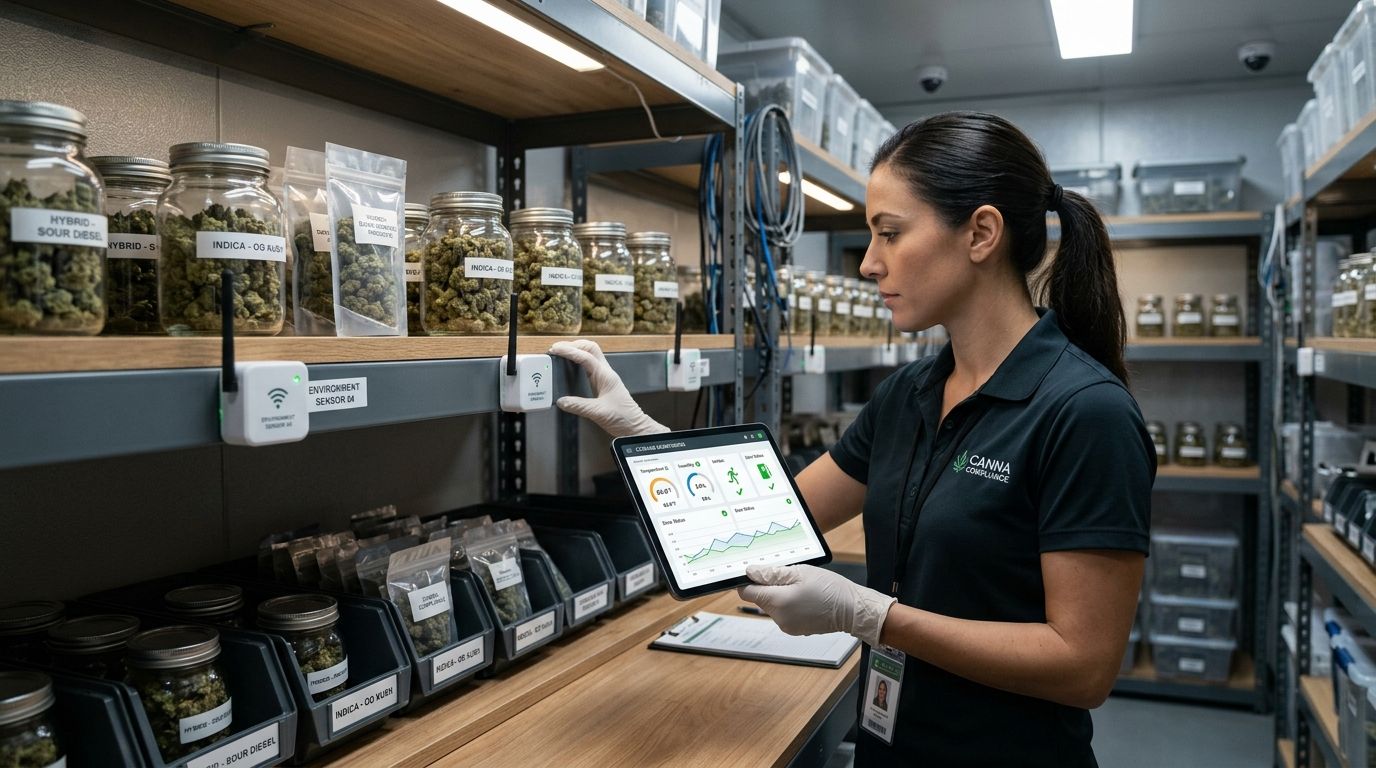
Cannabis dispensary IoT compliance monitoring is the use of connected temperature, humidity, and access sensors with automated alerts to keep vaults, walk-in coolers, and display cases inside state-mandated storage conditions, with the aim of passing inspections and protecting inventory that spoils fast when storage drifts. Federal illegality means there's no FDA oversight to lean on here — compliance runs entirely through state cannabis control boards, track-and-trace mandates like Metrc, and whatever storage records a dispensary can produce during an audit.
- IoT compliance monitoring cannabis dispensary storage means real-time temperature, humidity, and access alerts on vault and cooler zones, not just a Metrc inventory log.
- California's Department of Cannabis Control requires a minimum of 90 days of security video retention, separate from storage temperature compliance.
- Kilo's rules engine and five alarm severity tiers turn a manual daily walkthrough into an automated, audit-ready record.
- Manual logbooks and standalone data loggers still work for one small dispensary, but they miss after-hours excursions that automated sensors catch.
Why does IoT compliance monitoring matter for cannabis dispensaries?
A dispensary's storage compliance problem isn't really about temperature — it's about proof, and closing that gap is exactly what the Kilo IoT Platform is built to do: tie sensors, dashboards, and alarms into one audit trail instead of a shift-change sheet.
State cannabis control boards inspect physical storage practices on top of whatever Metrc says about inventory counts, and a locked vault sitting at 78°F for three days because an HVAC unit failed overnight doesn't show up in seed-to-sale software at all. California's Department of Cannabis Control requires licensed retailers to keep security video footage for a minimum of 90 days under its storage and security rules — a requirement that has nothing to do with temperature and everything to do with an auditor's ability to reconstruct what happened at 2 a.m.
Most state programs pair a security rule like that with separate storage and handling requirements, and neither one is satisfied by a paper log a budtender fills out once per shift. Cannabis flower also loses value fast once humidity climbs too high — mold and mildew risk rises the longer product sits in a damp vault, which is why processors and cultivators have used tight humidity control in postharvest storage for decades. A vault that drifts humid over a closed weekend is inventory shrinkage, not just a compliance flag on a checklist.
How do you set up IoT compliance monitoring for dispensary storage?
Map your state's storage and security requirements first
Cannabis storage rules vary by state and by license type, so the first step is documentation, not hardware.
- Pull the specific storage temperature, humidity, and security rules from your state cannabis control board or equivalent agency.
- List every zone that needs monitoring: flower vault, walk-in cooler, edibles storage, concentrate storage, and any display case holding product overnight.
- Separate track-and-trace requirements (Metrc or your state's system) from physical storage requirements — inspectors audit them differently.
- Note your state's video retention minimum for security cameras; several states set it around 90 days, but confirm the current 2026 figure with your regulator.
- Write down who needs to see an alert and how fast, before picking any sensor.
Monitor vault, cooler, and display case conditions in real time
The manual version of this step is a wall thermometer and a walkthrough log — it works, until the excursion happens between checks.
- Wall-mounted min/max thermometers checked on a fixed walkthrough schedule and signed by staff (fine for one small location, blind to everything between checks).
- Standalone data loggers that record temperature and humidity locally but need someone to download the file to see a trend.
- Wireless sensors on LoRaWAN or mioty that report continuously to a dashboard without a data cable run into a locked vault.
- A digital twin of each storage zone, so a facilities manager sees the vault, cooler, and display case on one floor plan instead of four spreadsheets.
- Kilo's built-in LoRaWAN and mioty network server, so sensors report straight into the platform without a separate network server to deploy first.
- Kilo Electronics, Kilo's sister hardware company, ships wireless temperature and humidity sensors with worldwide delivery if you need hardware to pair with the platform.
Automate alarm escalation so nobody misses an after-hours excursion
An alert nobody sees until Monday's opening shift is functionally the same as no alert.
- A threshold rule that fires the moment a vault crosses its temperature or humidity limit, not the next scheduled walkthrough.
- Multi-step escalation so an unacknowledged alert moves from the on-duty budtender to the store manager to a regional ops lead.
- Quiet hours settings that route routine notices differently from a genuine excursion, so overnight alerts don't get muted with everything else.
- Five severity tiers to separate "watch this" from "call someone now," instead of one generic alert for every event.
- A dedicated sms and email alert setup for critical sensor thresholds so a real excursion reaches a phone, not just a dashboard nobody's watching at 3 a.m.
Build an audit-ready log instead of a shift-change sheet
This is the step that actually satisfies an inspector, and it's the one most dispensaries skip.
- A time-stamped, exportable history of every reading, not a paper sheet that can be filled in after the fact.
- A temperature excursion report format ready to hand an inspector, covering the excursion, its duration, and who was alerted.
- An immutable audit trail on the platform side, so the record an inspector sees matches what actually happened.
- Version-controlled rules, so if a threshold changes there's a record of when and why it changed.
Track security and access events next to environmental data
A vault door left ajar and a vault running warm are the same underlying problem: nobody caught it in time.
- Door and access sensors on the vault, tied to the same dashboard as temperature and humidity, not a separate system nobody cross-checks.
- Video retention aligned to your state's minimum — often 90 days, though this varies by jurisdiction and should be confirmed against your current license terms.
- Scoped, role-based access (ABAC) so a budtender sees the display case reading and a compliance manager sees everything.
- REST and gRPC APIs if your point-of-sale or Metrc integration needs to pull environmental data into a separate compliance report.
Standardize monitoring across every dispensary you operate
A chain with four locations running four different monitoring habits fails an audit at the location with the weakest one.
- A single dashboard covering every location instead of one spreadsheet per store.
- The same alarm rules and escalation chain applied consistently, so one store isn't running on a looser standard than the others.
- Multi-site retail chain monitoring patterns built for operators who need one compliance view across locations.
- Onboarding new locations without re-deploying a separate network server per site, since the network server ships built into the platform.
Which cannabis dispensary storage monitoring option fits your compliance needs?
| Option | Best for | Key limitation |
|---|---|---|
| Manual thermometer + paper log | A single small dispensary with low inspection risk tolerance | Only as good as the last walkthrough; misses after-hours excursions entirely |
| Standalone data loggers | Dispensaries needing a defensible temperature record without live alerts | Data sits on the device until someone downloads it — no real-time notification |
| Metrc or seed-to-sale software alone | Inventory chain-of-custody and sales compliance | Doesn't monitor physical storage conditions like vault temperature or humidity at all |
| Dedicated IoT compliance monitoring (Kilo IoT Platform) | Multi-zone or multi-location dispensaries needing real-time alerts and audit-ready logs | Requires sensor installation and, for LoRaWAN or mioty, gateway coverage across the storage area |
See dispensary storage monitoring live
Walk through vault, cooler and alarm setup with Kilo.
What compliance mistakes do cannabis dispensaries make with storage monitoring?
- Treating Metrc as storage compliance. Metrc tracks product custody and sales, not vault temperature or humidity — a clean Metrc audit says nothing about storage conditions.
- Checking the vault once per shift. A single daily reading misses overnight HVAC failures, which is when most excursions actually happen.
- Running alarms without escalation. An email alert nobody reads until Monday morning behaves the same as having no alert at all.
- Confusing video retention with environmental logging. A 90-day camera archive doesn't substitute for the temperature and humidity record inspectors ask for separately.
- Swapping sensor or camera vendors mid-lease without checking retention continuity, leaving a gap in the audit trail exactly when an inspector asks for it.
FAQ
What does IoT compliance monitoring mean for a cannabis dispensary?
It means using connected sensors on storage zones like vaults, walk-in coolers, and display cases to log temperature, humidity, and access events automatically, then triggering alarms when conditions drift outside state-mandated limits. It's separate from Metrc or any seed-to-sale software, which tracks product custody, not physical storage conditions.
Does Metrc cover dispensary storage compliance?
No. Metrc tracks inventory movement and sales for state track-and-trace reporting, but it doesn't monitor vault temperature, humidity, or storage security. Those need a separate monitoring system tied to the physical storage zone.
How long do dispensaries need to keep security video footage?
It depends on the state, but California's Department of Cannabis Control sets a minimum of 90 days for licensed retailers. Check your specific state cannabis control board's current 2026 storage and security rules, since requirements vary by jurisdiction.
What humidity level puts stored cannabis flower at risk?
Mold and mildew risk rises once storage humidity climbs too high, which is why cultivators and processors have used tight humidity control in postharvest handling for decades. A real-time humidity sensor on the vault catches a drift before it turns into spoiled inventory.
Can one dashboard cover multiple dispensary locations?
Yes. A platform like the Kilo IoT Platform puts every location's vault, cooler, and display case sensors on one dashboard with a shared alarm and escalation setup, instead of one spreadsheet per store.
Is a paper logbook enough for cannabis storage compliance?
A paper logbook only proves conditions at the moment someone checked it, and most excursions happen overnight or over a closed weekend. Automated sensors with alarms catch drift the moment it happens, which is what most 2026 audits actually want to see.
What's the difference between a threshold alert and an escalation chain?
A threshold alert fires once a reading crosses a set limit. An escalation chain moves that alert from one person to the next — for example from a budtender to a store manager — if it goes unacknowledged, so a missed notification doesn't sit unread overnight.
What's the least obvious cannabis storage compliance risk in 2026?
The riskiest excursion isn't the one that happens during business hours — it's the one that starts Friday night and isn't found until Monday's opening walkthrough, by which point a weekend of humidity drift has already done its damage to flower sitting in the vault. A rules engine running 24/7 doesn't care what day it is; a paper logbook does. Dispensaries that move storage compliance onto continuous monitoring in 2026 stop finding out about excursions two days late.