
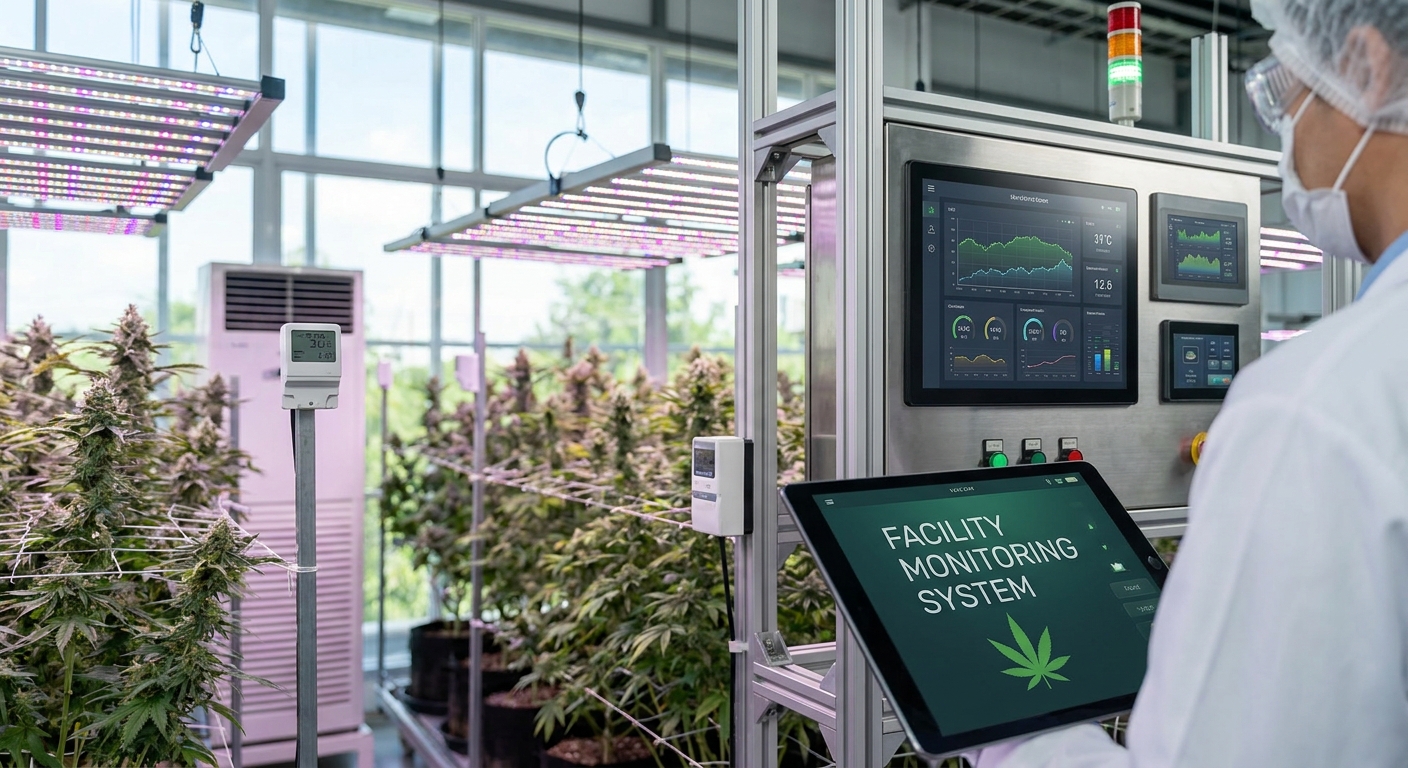
Cannabis cultivation lives and dies by vapor pressure deficit, and a facility monitoring system for cannabis cultivation facilities is the only way to catch a humidity swing before it turns into a powdery mildew outbreak in flower room three.
- A facility monitoring system for cannabis cultivation facilities tracks VPD, RH, CO2 and canopy temp per room, not per building. Buy for multi-room grows.
- LoRaWAN and mioty sensors hold signal through metal grow tents and concrete vaults where WiFi drops packets constantly.
- Alarms need to fire in minutes when dry room humidity climbs past 55% RH, not on the next morning walkthrough.
- Digital twin views map veg, flower, mother, dry and cure rooms on one screen instead of five separate logs.
- Multi-site operators need one login across every license, not a different system at every facility.
Why this matters
A cultivation facility isn't one climate zone, it's five or six running at once — mother room, veg, flower, dry, cure, and sometimes a processing area with its own humidity rules. Each room has a different tolerance band, and each one fails differently. Flower rooms bud rot at high RH during the last two weeks before harvest. Dry rooms mold at 65% RH in 2026 just as easily as they did in 2020.
The Kilo IoT platform builds monitoring around that reality: sensors per zone, rules per zone, alarms per zone, not one thermostat reading for the whole building. That's the difference between catching a dehumidifier failure at 2am and finding out when the day shift walks in and smells it.
A facility monitoring system for cannabis cultivation facilities has to do three things well: read the room accurately, alert fast enough to act, and log everything a state inspector might ask for. Miss any one of the three and you're either losing crop or failing an audit.
Who this is for
This guide is for cultivation directors, head growers, and compliance leads running licensed grow facilities with more than one room type under one roof — veg, flower, mother stock, drying, curing, or a combination across multiple buildings. If you're running a single closet grow, most of this is overkill. If you're running a commercial license with a compliance officer and a state inspection calendar, this is the difference between a clean audit and a citation.
What to look for in a facility monitoring system for cannabis cultivation facilities
Room-by-room sensor density
One sensor per building tells you the average temperature of a space that doesn't have an average temperature. Canopy-level readings in flower differ from readings near the HVAC return by several degrees, and that gap is exactly where bud rot starts. A real system puts sensors at canopy height in every room, not one reading piped from the hallway.
Alarm escalation speed
A dehumidifier failure in a sealed flower room can push RH past a mold-risk threshold within an hour, especially during lights-off when transpiration peaks. An alarm that emails someone who checks their inbox at 9am is worthless. You need SMS or push escalation that fires within minutes and re-notifies if nobody acknowledges it.
Connectivity that survives the room, not just the office
Grow rooms are lined with mylar, packed with metal racking, and often built inside concrete vaults for security and light-proofing — exactly the environment that kills WiFi and cellular signal. LoRaWAN and mioty were built for this: long range, low power, and signal that punches through concrete and metal in a way 2.4GHz radios can't.
Compliance-ready logging
State cannabis regulators increasingly want environmental data alongside seed-to-sale tracking, especially for facilities citing extended storage or curing periods. A system that logs temperature and humidity continuously, with timestamped exportable records, saves hours during an inspection versus reconstructing a paper log.
Multi-site dashboard for multi-state operators
If you're running more than one cultivation license, you don't want a different monitoring vendor or login per site. One dashboard across every facility means the same alarm logic, the same escalation rules, and the same audit trail everywhere — instead of five inconsistent systems that nobody fully trusts.
Top picks for cannabis cultivation monitoring
The climate pick — flower and veg room VPD tracking. The greenhouse and vertical farming IoT setup covers canopy-level temperature and humidity sensing built for controlled-environment agriculture, which is exactly what a cannabis flower room is. It handles VPD-relevant readings across zones rather than a single building average. Buy if you're running more than two rooms with different climate targets.
The humidity pick — dry and cure room protection. Humidity monitoring across multiple zones applies directly to dry and cure rooms, where a swing above 65% RH invites mold on cured flower sitting in totes. Zone-level alerts here matter more than in flower, because cured product has no immune response left. Buy for any facility running a dedicated dry or cure room.
The connectivity pick — sensors that survive metal grow rooms. mioty-based industrial sensors are built for dense metal environments and long battery runtime, which matters when sensors sit inside sealed vaults for months between service visits. Buy if your rooms are metal-racked or concrete-vaulted and WiFi sensors have already failed you once.
The compliance pick — the audit trail. A digital twin view of the facility (not linked separately here, folded into the platform's dashboard) maps every room's readings against its compliance threshold in one screen, which is what a state inspector actually wants to see during a walkthrough. Consider this if your last inspection flagged missing environmental records.
The multi-site pick — one login, every license. For operators running more than one facility, a single dashboard across sites keeps alarm logic consistent instead of five different systems drifting out of sync. Consider this once you cross two licensed locations; below that, a single-site setup is simpler and cheaper.
What to avoid
- Generic building management systems built for offices. They monitor HVAC uptime, not VPD or mold-risk humidity bands, and they don't alarm on the thresholds that matter to a grower.
- WiFi-only sensors in metal-racked rooms. They look cheaper on paper until half the readings drop out because the signal can't get through the racking or the mylar lining.
- A single dashboard reading per building. It hides the exact zone where a dehumidifier failed, which means someone still has to walk every room to find the problem manually.
Map your grow rooms in 2026
See VPD, RH and CO2 by zone with alarms that escalate before mold sets in.
Verdict comparison
| Pick | Best for | Key spec | Verdict |
|---|---|---|---|
| Greenhouse/vertical farming climate setup | Flower and veg VPD tracking | Canopy-level RH and temp per zone | Buy |
| Multi-zone humidity monitoring | Dry and cure rooms | Zone alerts above 65% RH | Buy |
| mioty industrial sensors | Metal-racked or vaulted rooms | Long battery life, deep signal penetration | Buy |
| Digital twin dashboard | Compliance audits | Single-screen room-by-room log | Consider |
| Multi-site dashboard | Multi-license operators | One login across facilities | Consider |
FAQ
What is the best facility monitoring system for cannabis cultivation facilities in 2026?
The best setup pairs room-by-room VPD and humidity sensors with fast alarm escalation and a compliance-ready log, rather than a single building-wide reading. Cannabis-specific monitoring needs zone data because flower, dry and cure rooms fail at different thresholds.
Is LoRaWAN better than WiFi for grow room sensors?
LoRaWAN holds signal through metal racking, mylar lining and concrete vaults where WiFi drops packets constantly. It also runs on battery for months instead of needing constant power, which matters in sealed grow rooms.
How often should humidity be logged in a flower room?
Continuous logging, not spot checks, is standard for 2026 compliance expectations. A dehumidifier failure can push RH into mold-risk range within an hour, so hourly manual checks miss the failure window entirely.
Do state cannabis regulators require environmental monitoring records?
Requirements vary by state, but regulators increasingly expect timestamped environmental logs alongside seed-to-sale data, especially for extended storage or curing claims. A monitoring system with exportable logs saves time during an inspection.
What humidity level causes mold in cured cannabis?
Cured flower commonly molds above 65% RH in storage, since cured product no longer has active transpiration to manage moisture. Dry and cure rooms need tighter alarm thresholds than active flower rooms.
Can one dashboard monitor multiple cultivation facilities?
Yes, a multi-site dashboard keeps alarm rules and audit logs consistent across every licensed facility instead of running separate systems per site. This matters most once an operator crosses two or more locations.
What's the difference between VPD and humidity monitoring?
VPD combines temperature and humidity into one number that reflects how much moisture the air can pull from the plant, while humidity alone doesn't account for temperature's effect on that pull. Growers target a VPD range, commonly 0.8-1.2 kPa in flower, rather than a fixed humidity percentage.
How much does a cannabis facility monitoring system cost?
Cost depends on sensor count, room count and connectivity type, so pricing varies by facility size and layout. Check current platform pricing directly rather than relying on a flat industry number.
One last thing
Most cultivation teams pour monitoring budget into flower rooms and treat dry and cure rooms as an afterthought — backwards, since cured product sitting in totes for weeks has zero ability to self-regulate moisture the way a living plant does. The room least watched is usually the one where a mold problem shows up last, right before the product ships.