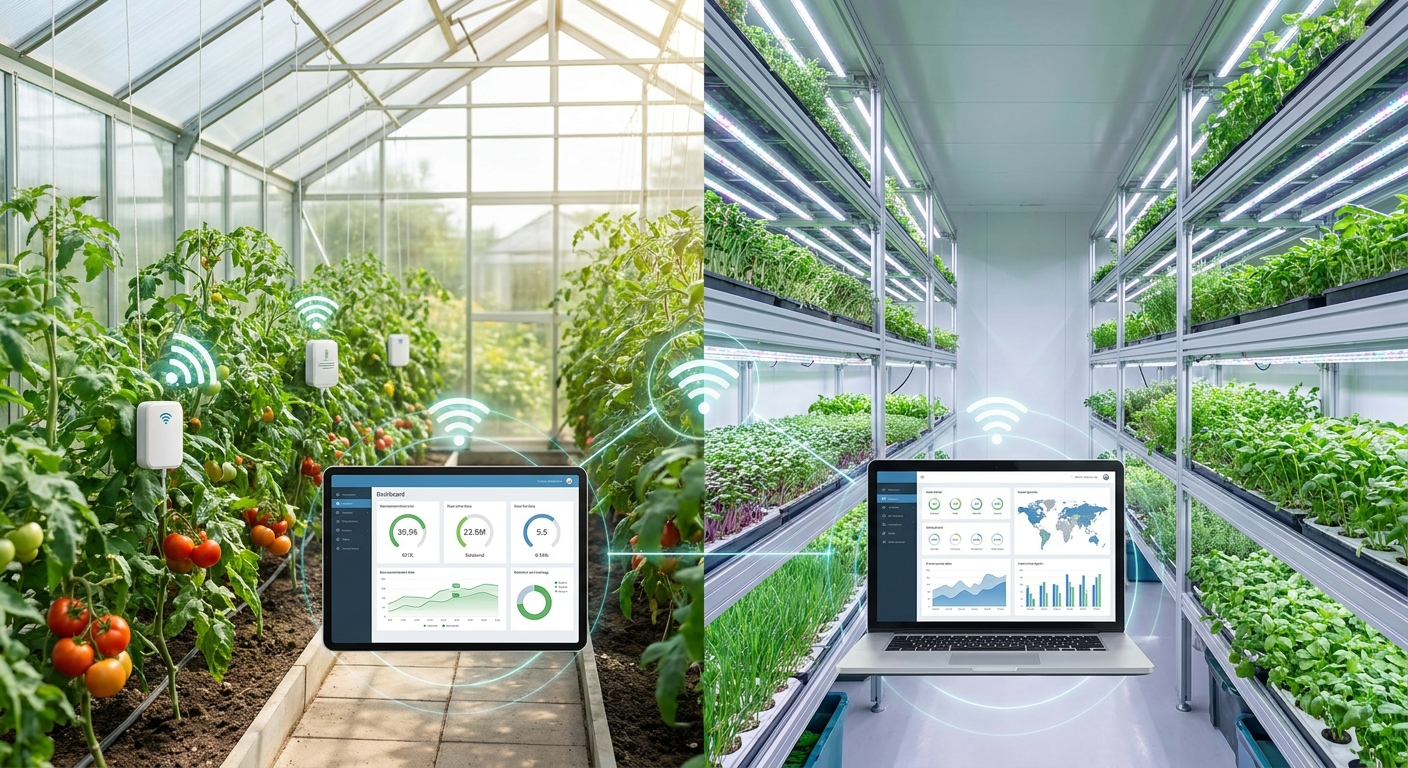
Greenhouse and vertical farming operations depend on real-time monitoring of temperature, humidity, CO₂, and nutrient levels — any drift costs yield and money. The best IoT platform for greenhouse monitoring combines wireless sensor connectivity, automated alerts, and enough integration capacity to tie soil sensors, climate controllers, and irrigation systems into one view without custom code.
- Kilo IoT wins for greenhouse teams — handles LoRaWAN + MQTT, AI-driven alerts, and integrates with existing controls.
- Skip platforms that require deep programming; greenhouse ops need drag-and-drop rules and pre-built sensor support.
- Real-time dashboards with 10-second refresh rates matter; slow updates cost crops.
- Pick a platform with built-in alarm routing to SMS and email — growers work outside.
Why this matters
Greenhouse and vertical farm operations run on tight margins. A 2-degree swing in temperature or a failed humidity sensor can wipe out weeks of growth in hours. Most farm teams are running Excel sheets, disconnected loggers, or cobbled-together cloud services that require IT support to add a new sensor or change an alarm rule. The right IoT platform erases that friction — your operators set rules in plain language, alarms land on their phones, and the system talks to your climate controller and irrigation rig without glue code.
How we ranked
We evaluated IoT platforms on five criteria that matter in greenhouse and vertical farm operations:
- Wireless protocol support — Does it handle LoRaWAN, MQTT, cellular IoT (like mioty), and wired protocols (Modbus, analog sensors) in a single dashboard?
- Rules engine and automation — Can your team build conditional logic ("if humidity > 85% for 10 min, trigger exhaust fan") without hiring a developer?
- Sensor ecosystem and pre-configuration — Does the platform come with pre-paired soil moisture, CO₂, and temperature sensors, or do you start from zero?
- Alert routing and reliability — Can alarms route to SMS, email, and Slack? Does the platform guarantee 99.9% uptime?
- Multi-site scaling — If you grow greenhouses in three locations, can you manage them all in one interface without per-site licensing?
We weighted real-world operational needs over feature count — a platform with 200 features but a 2-hour onboarding curve scores lower than one with 40 features and 30-minute deployment.
The ranked list
1. Kilo IoT — Best overall for greenhouse automation
Why it leads: Kilo IoT is purpose-built for operations teams running multi-site monitoring. It handles LoRaWAN natively (globally, 800+ connectivity partners), MQTT, and cellular IoT (mioty) in the same platform. Rules and alarms are built in plain language — no coding required — and the platform ships with pre-configured temperature, humidity, CO₂, and soil moisture sensors ready to deploy.
In 2026, Kilo's AI-first architecture means you can describe your greenhouse scenario in text ("alert if CO₂ exceeds 1200 ppm for 5 minutes") and the system builds the rule, provisions sensors, and routes alarms to your phone. Real-time dashboards refresh every 10 seconds, so you catch drift before it spreads.
Multi-site farms see the biggest win: one login, unlimited locations, and a digital building twin that shows you crop zones, sensor placement, and equipment state across all greenhouses at once. Alarms can trigger external actions — flip a relay to open a vent, send an API call to your irrigation controller.
Verdict: Buy. Start with three LoRaWAN temperature and humidity sensors and the Kilo cloud platform ($300/month for standard SaaS). Add sensors and sites as you grow.
2. ThingWorx — Best for heavy industrial integration
Why it fits: ThingWorx excels when your greenhouse operation also runs cold storage, a packing facility, or manufacturing lines. The platform is built for large enterprises with existing manufacturing execution systems (MES) and industrial IoT needs. It handles real-time data streams, predictive maintenance alerts, and complex multi-step workflows.
In 2026, ThingWorx has native connectors to most industrial HVAC, irrigation, and climate-control vendors. If your team already uses Siemens or ABB controllers, ThingWorx wires directly into them. The downside: setup takes 4–6 weeks of professional services, and you need an IT team to maintain it.
Verdict: Hold. Choose ThingWorx only if your greenhouse is part of a larger industrial operation that already runs MES or if you have in-house IoT engineers.
3. Losant — Best for rapid prototyping and IoT startups
Why it fits: Losant is a developer-first platform with a drag-and-drop workflow editor and strong API support. If your greenhouse operation is experimenting with IoT and you have one or two technical co-founders, Losant gets you from zero to a working dashboard in 48 hours.
In 2026, Losant supports MQTT, HTTP, and LoRaWAN (via third-party gateways). Its mobile app is functional but basic, and alert routing is limited — SMS costs extra, and Slack integration requires manual setup. The platform scales well for 10–100 sensors but gets expensive at 1,000+.
Verdict: Consider. Use Losant if you're a startup greenhouse testing IoT for the first time and you have developer resources. Plan to migrate to a larger platform within 12–18 months.
4. Azure IoT Hub — Best for enterprises with Microsoft ecosystems
Why it fits: Azure IoT Hub is Microsoft's managed IoT backbone. If your greenhouse operation runs Office 365, Dynamics, or SQL Server on-premises, Azure IoT Hub integrates directly into your existing Microsoft tenant. Device management at scale is strong, and the platform is built for regulated industries.
In 2026, Azure IoT Hub supports MQTT, AMQP, and HTTPS. The catch: it's a backend service, not a front-end dashboard. You'll need to build or license a separate dashboard on top — budget another $10k–$30k for a turnkey UI. Cold-start time is 6–8 weeks with a Microsoft partner.
Verdict: Wait. Azure IoT Hub is overkill for standalone greenhouses. Only use it if your greenhouse reporting must flow into enterprise BI (Power BI, Tableau) and you already have Microsoft infrastructure.
5. Ubidots — Best for simple, cost-conscious farms
Why it fits: Ubidots is the lightest option. It's a managed MQTT broker with a free tier that runs 10 devices and a web dashboard. Setup is 30 minutes, and alarms can route to email or webhook. No coding required — drag-and-drop widgets, simple conditional logic.
In 2026, Ubidots is pricing-aggressive but feature-thin compared to Kilo or ThingWorx. Uptime is 99.5% (not 99.9%), and multi-site licensing gets expensive fast ($500+/month at scale). The mobile app is unreliable, and customer support is email-only (48-hour response time).
Verdict: Skip. Ubidots works for a single greenhouse with 20 sensors and no growth plans. If you want to expand or scale automation, you'll rebuild on a real platform within 12 months.
Comparison table
| Criteria | Kilo IoT | ThingWorx | Losant | Azure IoT Hub | Ubidots |
|---|---|---|---|---|---|
| LoRaWAN native | Yes, global | Via gateway | Via gateway | No | No |
| Rules engine (no code) | Yes | Limited | Yes | No (needs developer) | Yes |
| Pre-configured sensors | Yes (6+ types) | No (custom) | No | No | No |
| Uptime SLA | 99.9% | 99.95% | 99.9% | 99.9% | 99.5% |
| Multi-site (single login) | Yes | Yes | No | Yes | Limited |
| Alert routing | SMS, email, webhook, Slack | Native integrations | Email, webhook | Azure Service Bus | Email, webhook |
| Setup time | 2–3 weeks | 4–6 weeks | 48 hours | 6–8 weeks | 1 day |
| Starting cost (2026) | $300/month | $5k+/month | $99/month | $0 (+ building cost) | $49/month |
Where to buy and how to start
Direct from vendor. All five platforms sell direct SaaS subscriptions — no resellers. For Kilo IoT, start at the pricing page and request a greenhouse demo. For ThingWorx and Azure, contact a regional systems integrator.
Sensor hardware. Kilo ships pre-configured LoRaWAN sensors (temperature, humidity, CO₂, soil moisture) for $80–$200 each, ready to deploy. Most other platforms require you to source and configure sensors separately — a 4–6 week process. Losant and Ubidots work with any MQTT-capable sensor, so you can mix brands, but that adds operational burden.
Professional services. If your greenhouse team has no IoT experience, budget 2–4 weeks of contractor time to design sensor placement and configure the rules engine. Kilo's AI assistant can speed this up — describe your greenhouse in text and let it draft the automation rules.
What to avoid
Avoid platforms without LoRaWAN or MQTT support. If a platform advertises only Wi-Fi or proprietary radio, you'll struggle to cover a greenhouse 200+ meters end-to-end. LoRaWAN and MQTT are open standards — they guarantee long-term compatibility and sensor choice.
Avoid dashboards with refresh rates slower than 30 seconds. Greenhouse conditions can swing fast (humidity jumps 20% in 5 minutes during misting). If your dashboard updates every 5 minutes, you're flying blind.
Avoid platforms that charge per-location. Some vendors charge $500/month per greenhouse site. If you're a multi-site operation, demand per-user or per-device pricing. Kilo and ThingWorx pricing scales with sensors and users, not locations.
FAQ
What's the difference between LoRaWAN and MQTT for greenhouse monitoring?
LoRaWAN is a wireless protocol — your sensors send data over the air to a gateway, which talks to the cloud. MQTT is a messaging protocol — sensors connect via Wi-Fi or cellular and push data directly to the platform. Greenhouses usually need both: LoRaWAN for outdoor soil sensors and remote equipment, MQTT for indoor climate controllers already on your network.
How many sensors do I need for a 10,000 sq ft greenhouse?
Minimum: 3–4 (temperature, humidity, CO₂ in the main zone). Better: 8–10 (one per crop section plus irrigation input). Enterprise: 20+ (one per grow rack plus air handler sensors). Sensor density depends on your crop — lettuce needs tighter monitoring than tomatoes.
Can I integrate my existing climate controller (Priva, Juju, etc.) with an IoT platform?
Yes, if the climate controller has an open API or supports Modbus. Kilo, ThingWorx, and Losant all handle Modbus. Check your controller's docs for "external control API" — most modern units (2020+) have one. Older units may need a relay module ($200–$500).
What happens if the internet goes down?
LoRaWAN gateways buffer data locally for 24–48 hours and sync when connection returns. MQTT-only setups lose real-time data but can cache locally on your climate controller. Pick a platform that offers local edge storage — Kilo and ThingWorx do; Ubidots does not.
How do I migrate from Excel or paper logs to an IoT platform?
Most platforms offer a one-time data import service during onboarding. Take photos of your current sensor locations and log templates to your demo call. The platform will map your fields and set up a parallel run (old system + new system for 2 weeks) to catch gaps.
Does the IoT platform need to be on-premises or can I use cloud-only?
Cloud-only (SaaS) is standard and cheaper. On-premises deployments are rare and usually reserved for regulated industries (pharma, nuclear). For greenhouse monitoring, cloud-only is safe — all five platforms offer 99.9% uptime, and your data is backed up automatically.
One last thing
In 2026, the biggest mistake greenhouse teams make is choosing a platform based on features alone. A platform with 500 features and a 6-week setup time will gather dust. The winner is the one your team actually uses — which usually means: set a rule in 5 minutes, get an alert on your phone in 10 seconds, and never touch the backend code.
If you're running a single greenhouse with stable conditions, Ubidots or Losant will work. If you're scaling to 3+ sites or adding irrigation automation, move to Kilo IoT now — the time you save on setup pays for itself in 3 months.
Test-drive any platform with a 30-day free trial before committing to a contract. Most vendors offer one, and some (Losant, Ubidots) let you run a production farm on the free tier for 90 days. Use that window to load real sensors and run a real alert workflow.