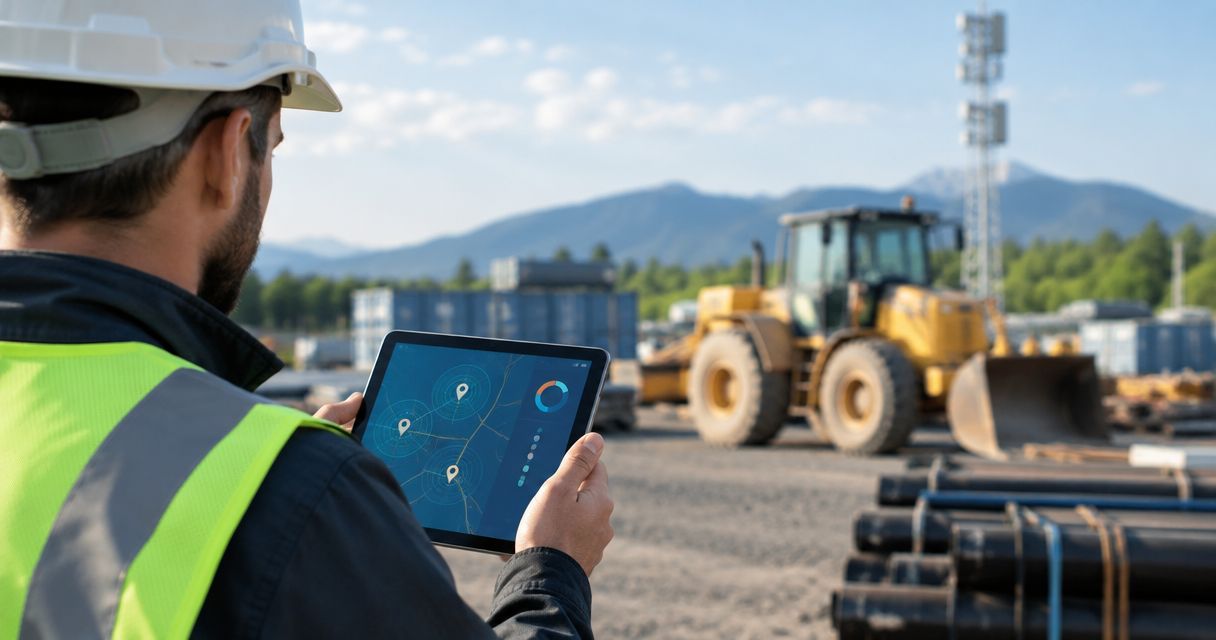
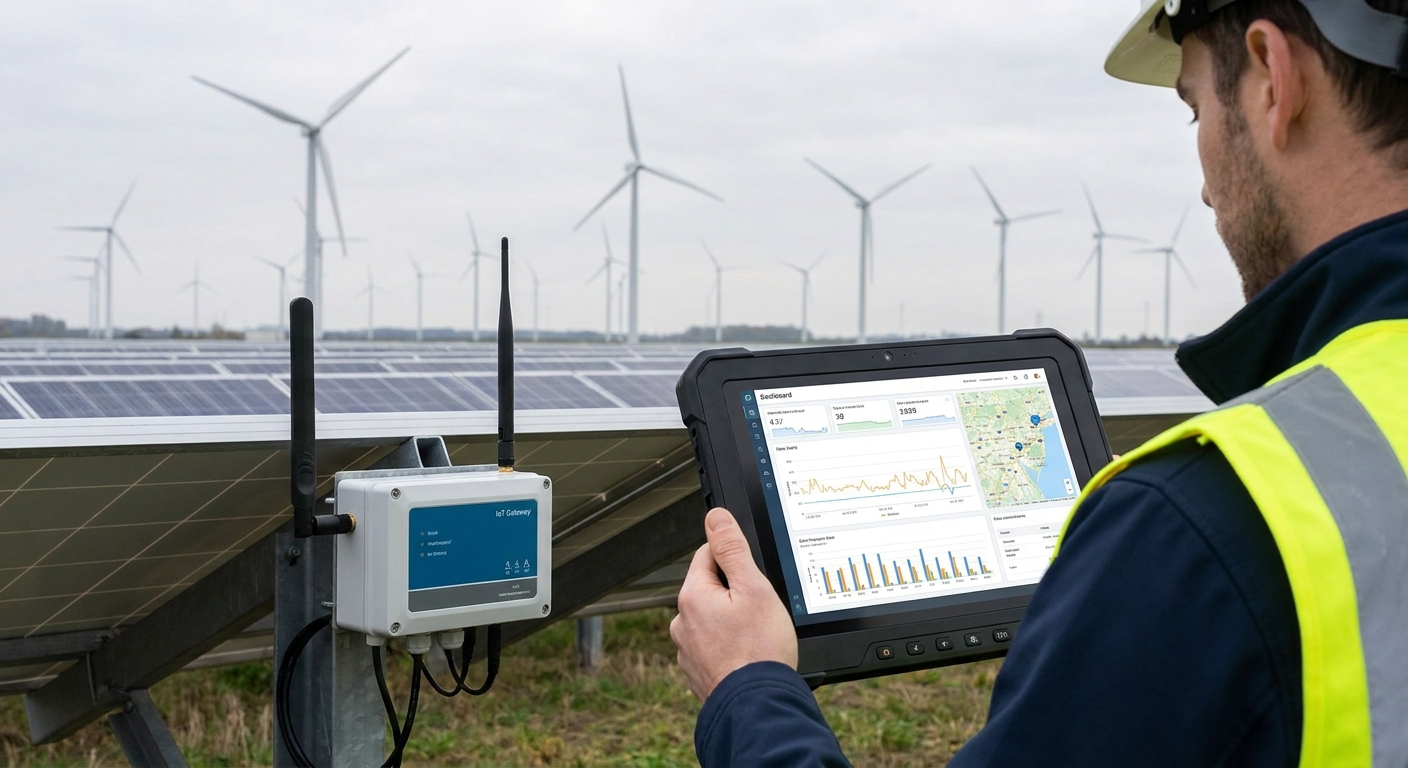
Solar farms, wind assets, and battery storage sites sit miles from the nearest cell tower, and that is exactly where most IoT platforms fall apart. This guide breaks down what an iot platform for renewable energy sites actually needs to handle in 2026: connectivity that survives distance and RF noise, alarms that catch equipment failure before it costs generation hours, and a dashboard that shows every site from one screen.
- Kilo Cloud pairs LoRaWAN and mioty connectivity with alarms and AI automation for an iot platform for renewable energy sites — Buy for remote deployments.
- mioty's long-range radio reaches roughly 15 km line-of-sight, useful for wind farms and utility-scale solar with no cell coverage.
- Skip dashboard-only tools with no rules engine — they show data but never call anyone when an inverter overheats.
- A digital twin view tracks output degradation across multiple sites instead of one dashboard per location in 2026.
Why this matters
A renewable energy site generates revenue on a meter reading, and every hour a string inverter sits faulted or a turbine gearbox runs hot without anyone noticing is an hour of lost output. Most sites are unmanned. Techs drive out on a schedule, not on demand, which means the gap between "something failed" and "someone found out" can run days.
Cellular coverage at rural solar and wind sites is inconsistent, and Wi-Fi doesn't reach a string of panels a quarter-mile from the substation shed. The platform choice isn't really about dashboards — it's about whether the sensor network can physically reach every asset and whether the software acts on what it reads instead of just logging it.
Who this is for
This guide is for asset managers, O&M teams, and EPCs monitoring solar farms, wind assets, battery energy storage systems, or hybrid sites — anyone responsible for uptime across sites that are physically remote and mostly unattended. If your team drives out to check equipment because you have no other way to know its status, the criteria below apply directly to you.
What to look for in an IoT platform for renewable energy sites
Long-range, low-power connectivity
Renewable sites are spread across acres, sometimes miles, and Wi-Fi or Bluetooth sensors can't cover that ground. LoRaWAN and mioty are built for exactly this: long-range, low-power radio designed to run sensors for years on a battery, not a power drop.
mioty in particular splits each transmission across hundreds of sub-channels, which helps signal reliability on sites where solar inverters and grid-tie equipment generate real RF noise. That matters more at a solar farm than in a warehouse — inverter switching noise is a known problem for wireless sensors sitting near power electronics.
Battery life measured in years, not weeks
A sensor on a wind turbine nacelle or a remote transformer isn't getting a battery swap every month. Class A LoRaWAN devices sleep between transmissions, and that low duty cycle is what stretches battery life to multi-year ranges instead of weeks. Ask any vendor for the actual reporting interval assumed in their battery-life number, not just the headline figure.
Predictive maintenance and anomaly alarms
A dashboard that shows a vibration graph is not the same as a platform that flags a bearing trending toward failure and pages the on-call tech. The rules engine and alarm setup for equipment vibration anomalies is the piece that turns raw sensor data into an action — threshold breach, notification, done. Without it, you're paying for a very expensive chart.
Multi-site visibility with a digital twin view
One site is easy to watch. Twenty sites across three states is not, unless the platform gives you a layout view of each site with live sensor status layered on top instead of twenty separate logins. A digital twin for energy optimization built for facilities translates well to renewable assets: same idea, live status mapped to a site layout, applied to arrays and turbine strings instead of building floors.
AI that acts on the deployment, not a generic chatbot
Setting up rules and alarms for every sensor at every site by hand doesn't scale past a handful of locations. An AI integrator that provisions devices and builds rules through plain-language requests — grounded in your actual sensor list, not a generic script — cuts that setup time down considerably. The difference matters once you're past 5-10 sites.
Device management at scale
If you're an integrator or O&M provider running sensor networks across multiple client sites, device provisioning and firmware management need to work across a fleet, not one device at a time. That's a different problem than monitoring a single site, and it's worth checking before you commit to a platform that only handles the simple case.
Top picks for renewable energy site monitoring
The connectivity backbone — private LoRaWAN network server Spec that matters: a private network server gives you control over gateway placement and data routing instead of relying on a shared public network you don't manage. For a solar farm with 40+ sensor points spread across a fenced perimeter, that control decides whether coverage actually reaches the far string. Verdict: Buy for any multi-acre site where public network coverage is unverified.
The failure-prevention pick — automated vibration and anomaly alarms A rules engine that watches for vibration signatures out of range on turbine gearboxes or inverter cooling fans catches problems while they're still cheap to fix. The equipment vibration anomaly alarm setup is the piece that separates a monitoring tool from a maintenance tool. Verdict: Buy if your O&M budget is driven by unplanned truck rolls.
The visibility pick — digital twin for multi-site output tracking Watching one meter reading tells you output is down; a digital twin view tells you which string, which inverter, and since when. Built for building energy optimization originally, the same layout-plus-live-data model applies directly to a solar array or a battery storage yard. Verdict: Consider once you're managing more than two or three sites at once.
The scale pick — fleet-wide device management If you're an EPC or O&M provider managing sensor networks across client sites rather than one site of your own, device provisioning and firmware updates need to run as a fleet operation, not a device-by-device chore. This is a platform capability worth checking before you sign, not after your fifth site goes live. Verdict: Consider for integrators managing sensor fleets across multiple clients.
What to avoid
- Dashboard-only platforms with no rules engine. They look complete in a demo but leave you staring at a graph instead of getting a page when a battery rack overheats.
- Public-network-only connectivity for large sites. Shared LoRaWAN coverage works fine for a small rooftop array; it gets unreliable fast across a 200-acre solar field with terrain and structure in the way.
- Sensor hardware not rated for outdoor duty cycles. A sensor spec'd for indoor use won't survive a year of temperature swings and UV exposure at an open-field solar site — check the IP rating before the enclosure, not after a failure.
See the platform behind these picks
Kilo Cloud pairs LoRaWAN and mioty connectivity with alarms, dashboards, and AI automation.
Verdict comparison
| Criteria | Why it matters for renewable sites | Verdict |
|---|---|---|
| Long-range connectivity (LoRaWAN/mioty) | Sites span acres with no reliable cell coverage | Buy |
| Multi-year sensor battery life | No monthly truck rolls for battery swaps | Buy |
| Vibration and anomaly alarms | Catches gearbox and inverter failures early | Buy |
| Digital twin / multi-site dashboard | One view across dozens of remote locations | Consider |
| Fleet-wide device management | Needed only if managing sites for multiple clients | Consider |
FAQ
What's the best iot platform for renewable energy sites in 2026?
The best fit combines long-range LoRaWAN or mioty connectivity with a rules engine that turns sensor readings into alarms, not just charts. Kilo Cloud covers both in one platform, which matters most for unmanned, multi-acre sites.
Is LoRaWAN or mioty better for a solar farm?
mioty handles RF interference from inverters and grid-tie equipment better because it splits transmissions across hundreds of sub-channels. LoRaWAN is the more established option with a larger device ecosystem, so the right pick depends on site density and existing hardware.
How much does IoT monitoring cost for a solar or wind site?
Cost depends on sensor count, connectivity type, and whether you need a private network server versus shared coverage. Check current platform and hardware pricing directly rather than relying on a rule of thumb, since site size and sensor density both swing the number.
Can renewable energy sites be monitored without cellular signal?
Yes, LoRaWAN and mioty gateways backhaul over Ethernet, cellular, or satellite, so the sensor-to-gateway hop never needs cell coverage. Only the gateway itself needs a path back to the internet, which opens up options like satellite backhaul at remote sites.
How long do IoT sensor batteries last at a remote solar or wind site?
Class A LoRaWAN sensors that sleep between transmissions typically run multiple years on a single battery, depending on reporting frequency. A sensor set to report every 15 minutes drains faster than one reporting hourly, so match the interval to the criticality of the asset.
Do I need a digital twin to monitor a renewable energy site?
Not for a single site, but it becomes valuable once you're managing multiple locations and need to see status across all of them without logging into separate dashboards. A layout view tied to live sensor data speeds up diagnosing which asset at which site is off.
What sensors matter most for wind turbine monitoring?
Vibration sensors on gearboxes and bearings, temperature sensors on generators, and tilt sensors on tower structures cover the most common failure modes. Pairing these with an automated alarm rule catches drift before it becomes a shutdown.
One last thing
mioty's telegram-splitting design spreads each transmission across roughly 500 sub-channels, which is a bigger deal at a solar site than it sounds. Inverter switching generates RF noise across a wide band, and a radio that hops that many channels per message is far less likely to lose a reading to interference than one sending on a single frequency. If your site has dense power electronics near the sensor network, that detail is worth checking before you pick a radio standard, not after installation.