
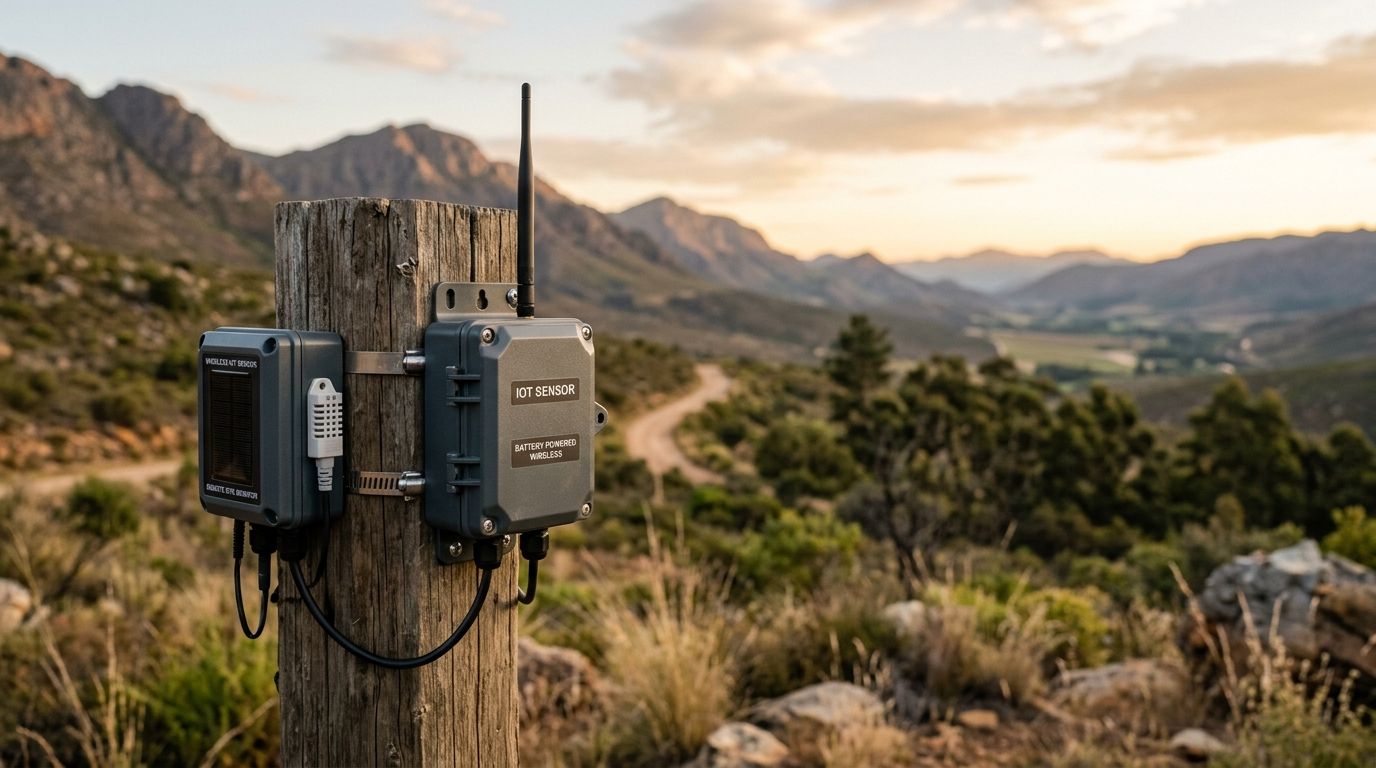
Off-grid sites -- a water tower, a telecom tower, a remote oil and gas pad, a grain terminal three miles from the nearest utility pole -- don't have mains power or a wired network drop waiting for a sensor. The sensor has to run on its own battery and talk over its own wireless link, and picking the wrong combination of the two is how a monitoring project turns into a truck roll every six weeks.
- LoRaWAN environmental sensors are the default choice for battery powered wireless IoT sensors at remote sites with open outdoor terrain.
- mioty sensors win in underground, shielded, or high-interference remote sites where LoRaWAN packets get lost.
- Satellite-relayed sensors are the only option when a site has zero terrestrial gateway or cellular coverage at all.
- Solar-assisted LoRaWAN nodes solve battery drain for sensors that sample or actuate more often than a coin-cell can sustain.
- Bluetooth mesh sensors handle indoor asset clusters inside an otherwise off-grid facility, not the outdoor perimeter.
Why remote sites need battery-powered wireless IoT sensors
Running conduit and mains power to a single tank gauge or door sensor at a remote pad can cost more than the sensor, the gateway, and three years of data combined. That's the entire reason battery powered wireless IoT sensors exist for remote sites -- they remove the trenching, the permit, and the electrician from the deployment.
The tradeoff is that the sensor now has to survive on a battery for years and get its reading back over a wireless link with no help from a wall outlet or an ethernet jack. The Kilo IoT Platform runs a built-in LoRaWAN and mioty network server, so whichever wireless protocol a remote site needs, there's no separate network server to stand up before the first sensor even reports in.
Most remote-site failures in 2026 still trace back to two mistakes: a sensor rated for indoor use bolted to an outdoor fence post, and a wireless link chosen off a marketing spec sheet instead of the site's actual terrain.
What makes the best battery powered wireless IoT sensors for remote sites
- Battery life measured in years, not months, at the sensor's real reporting interval -- not the vendor's best-case demo interval
- Ingress protection rated for outdoor exposure -- IP66, IP67, or IP68 per IEC 60529, the international ingress protection standard
- Wireless range that matches the site's actual terrain and gateway spacing, not a lab-condition number
- Interference resistance in dense metal structures, underground vaults, or RF-noisy industrial environments
- A network server and dashboard that onboard the sensor without a second vendor contract for connectivity
- Alarm and escalation logic that reaches a person even when the site has no on-duty staff
Battery powered wireless IoT sensors for remote sites: at a glance
| Sensor type | Best for | Standout feature | Key limitation |
|---|---|---|---|
| LoRaWAN environmental sensors | General remote site monitoring | Multi-year battery life on a coin cell or AA pack | Needs a gateway within range |
| mioty sensors | Underground, shielded, or high-interference sites | Telegram splitting per ETSI TS 103 357 resists interference | Fewer sensor models on the market than LoRaWAN |
| Satellite-relayed sensors | Sites with zero terrestrial network coverage | Reports with no gateway or cell tower nearby | Higher per-message data cost, larger antenna |
| Solar-assisted LoRaWAN nodes | High-frequency sampling or actuator control | Panel offsets draw so battery isn't the only power source | Needs unobstructed sun exposure, periodic cleaning |
| Bluetooth mesh sensors | Indoor asset clusters inside a remote facility | Sensor-to-sensor relay without extra gateways | Range in tens of meters, not kilometers |
Best battery powered wireless IoT sensors for remote sites in 2026
1. LoRaWAN environmental sensors: best for general remote site monitoring
LoRaWAN sensors are the default answer for battery powered wireless IoT sensors at remote sites, and for good reason: the protocol was built for exactly this -- long range, low power, low data rate. A single gateway on a tower or rooftop can pull in readings from sensors spread across a rural site, with line-of-sight range reaching up to 15 km according to the LoRa Alliance's published range figures.
LoRaWAN sensor pros:
- Widest catalog of off-the-shelf temperature, humidity, tank level, and door sensors on the market
- Multi-year battery life at typical 15-minute to hourly reporting intervals
- No monthly network fee tied to a carrier -- the gateway is the only recurring infrastructure
LoRaWAN sensor cons:
- Range drops sharply through dense metal, thick concrete, or below grade
- Requires at least one gateway with clear line of sight to the sensor field
Best for: open outdoor remote sites -- tank farms, agricultural fields, utility yards -- where a single gateway can cover the whole perimeter.
Verdict: Buy if the site has open terrain and no gateway already installed nearby.
2. mioty sensors: best for underground, shielded, and high-interference remote sites
When a remote site has underground vaults, steel tanks, or heavy RF noise from nearby industrial equipment, standard LoRaWAN packets start getting lost. mioty was standardized under ETSI TS 103 357 specifically to survive that kind of environment -- it splits each transmission into short sub-packets sent on different frequencies and time slots, so interference on one slice doesn't kill the whole reading. The mioty sensors for underground and shielded environments guide covers the deployment patterns in more detail.
mioty sensor pros:
- Telegram splitting per ETSI TS 103 357 resists narrowband interference and jamming
- Extended link budget performs well through steel and underground concrete
- Interoperates with the same network server layer as LoRaWAN on a platform built for both
mioty sensor cons:
- Smaller catalog of pre-built sensor models compared to LoRaWAN
- Fewer installers and integrators have field experience with it as of 2026
Best for: underground utility vaults, shielded industrial enclosures, and sites with heavy 900 MHz-band congestion.
Verdict: Buy if a LoRaWAN pilot at the same site already showed dropped packets or unreliable signal.
3. Satellite-relayed sensors: best for zero-coverage remote sites
Some remote sites -- a pipeline valve in open desert, a livestock water point on unfenced range -- have no gateway, no cell tower, and no realistic path to install one. Satellite-relayed sensors solve that by skipping terrestrial infrastructure entirely and reporting straight to an orbital relay.
Satellite sensor pros:
- Works where no gateway or cellular signal reaches, full stop
- No dependency on a local network buildout before the first sensor goes live
Satellite sensor cons:
- Higher data cost per message than LoRaWAN or mioty
- Larger antenna and enclosure footprint than a typical field sensor
Best for: genuinely unreachable remote sites where no other wireless option gets a signal out at all.
Verdict: Buy only if a site survey confirms zero gateway or cellular coverage; Skip it otherwise, since it costs more per message than a terrestrial link.
4. Solar-assisted LoRaWAN nodes: best for high-frequency sampling or actuator control
A battery alone struggles when a sensor needs to sample every minute instead of every hour, or when it's driving a downlink command to an actuator. Pairing a small solar panel with a LoRaWAN radio offsets that draw so the battery becomes backup power instead of the only power source.
Solar-assisted node pros:
- Supports far more frequent sampling than a coin-cell-only sensor
- Can power downlink commands and closed-loop verification without draining the battery
Solar-assisted node cons:
- Needs a mounting position with real sun exposure, which isn't always available at a shaded or indoor remote asset
- Panel and enclosure need periodic cleaning to keep charging efficiently
Best for: valve actuators, pumps, or any sensor node that needs a sub-hourly reporting interval at a remote site.
Verdict: Buy for actuator or high-frequency use cases; Skip it for a simple hourly temperature reading where a coin cell already lasts years.
5. Bluetooth mesh sensors: best for indoor asset clusters inside a remote facility
Not every part of a remote site is outdoors. A remote pumping station or unmanned substation often has a cluster of indoor equipment -- panels, pumps, breakers -- close together in one room. Bluetooth mesh lets those sensors relay through each other instead of each one needing its own long-range radio.
Bluetooth mesh sensor pros:
- Sensor-to-sensor relay extends coverage without adding gateways
- Lower per-sensor cost profile for dense indoor clusters
Bluetooth mesh sensor cons:
- Range measured in tens of meters, not kilometers -- unsuitable for the outdoor perimeter
- Needs enough sensor density for the mesh to actually relay reliably
Best for: indoor equipment rooms and panel clusters inside an otherwise off-grid facility.
Verdict: Buy for the indoor equipment room; Skip it as a substitute for LoRaWAN across the outdoor site.
Plan a remote sensor rollout
See how LoRaWAN and mioty sensors onboard onto one dashboard.
How this ranking of battery powered wireless IoT sensors was built
Each category above was scored against the six criteria listed earlier: real-world battery life, IEC 60529 ingress rating, actual usable range, interference resistance, ease of onboarding onto a network server, and alarm reach when nobody's on site. No two categories compete for the same slot -- a sensor that wins on outdoor range doesn't get penalized for losing on indoor mesh relay, because they solve different problems.
Which battery powered wireless IoT sensor is best for your remote site?
For most remote sites in 2026, start with LoRaWAN environmental sensors -- they cover the largest share of use cases at the lowest ongoing cost. Move to mioty only where a site survey shows interference or shielding problems, and reserve satellite for the sites where nothing else gets a signal out. A platform with a built-in LoRaWAN and mioty network server, MQTT connector for any PLC or BMS already on site, and a rules engine that turns a threshold into an escalating alarm removes the need to run a separate stack for each protocol.
If a LoRaWAN pilot at a site is already dropping packets, that's the signal to move to mioty -- not to add more gateways.
FAQ
What are the best battery powered wireless IoT sensors for remote sites in 2026?
LoRaWAN environmental sensors cover most remote sites with multi-year battery life and up to 15 km rural range. mioty sensors are the better pick for underground or high-interference sites, and satellite-relayed sensors are the fallback where no terrestrial signal reaches at all.
Is mioty better than LoRaWAN for remote industrial sites?
Not universally -- mioty's telegram splitting under ETSI TS 103 357 gives it an edge in shielded, underground, or high-interference environments, while LoRaWAN has a wider sensor catalog and lower deployment cost for open outdoor sites.
How long do battery powered wireless IoT sensors last at remote sites?
Battery life depends heavily on the reporting interval -- a sensor reporting hourly draws far less power than one sampling every minute. Solar-assisted nodes remove the ceiling entirely for high-frequency or actuator use cases.
What IP rating do outdoor IoT sensors need for remote sites?
IP67 is the practical minimum for an outdoor remote-site sensor under the IEC 60529 ingress protection standard, meaning it's dust-tight and can survive brief submersion. Sites with wash-down or flooding risk should look for IP68.
Do battery powered wireless IoT sensors need cellular service to work at remote sites?
No -- LoRaWAN and mioty sensors report through a local gateway rather than a cellular network, which is exactly why they work at sites with no cell coverage. Satellite-relayed sensors go a step further and skip terrestrial infrastructure entirely.
Can one platform manage both LoRaWAN and mioty sensors at the same remote site?
Yes -- the Kilo IoT Platform runs a built-in LoRaWAN and mioty network server, so both protocols land in one dashboard without deploying a separate network server for each.
What happens when a remote sensor goes offline or reports an abnormal reading?
A rules engine evaluates the incoming reading against a threshold or CEL expression, and an alarm with a defined severity tier escalates through email, SMS, or push until someone acknowledges it -- including through quiet hours logic so non-critical alerts don't page someone at 3 a.m.
What most teams miss when specifying battery powered sensors for remote sites
The detail that gets skipped most often in 2026 deployments isn't the protocol -- it's the enclosure. A sensor with excellent battery life and the right wireless range still fails early if it's rated for indoor use and gets bolted to an outdoor fence post through a full freeze-thaw cycle. Check the outdoor enclosures for LoRaWAN sensor deployments guide before ordering hardware, not after the first sensor dies in month four. Sensors themselves can be sourced through Kilo's sister company, Kilo Electronics, which ships hardware worldwide.