
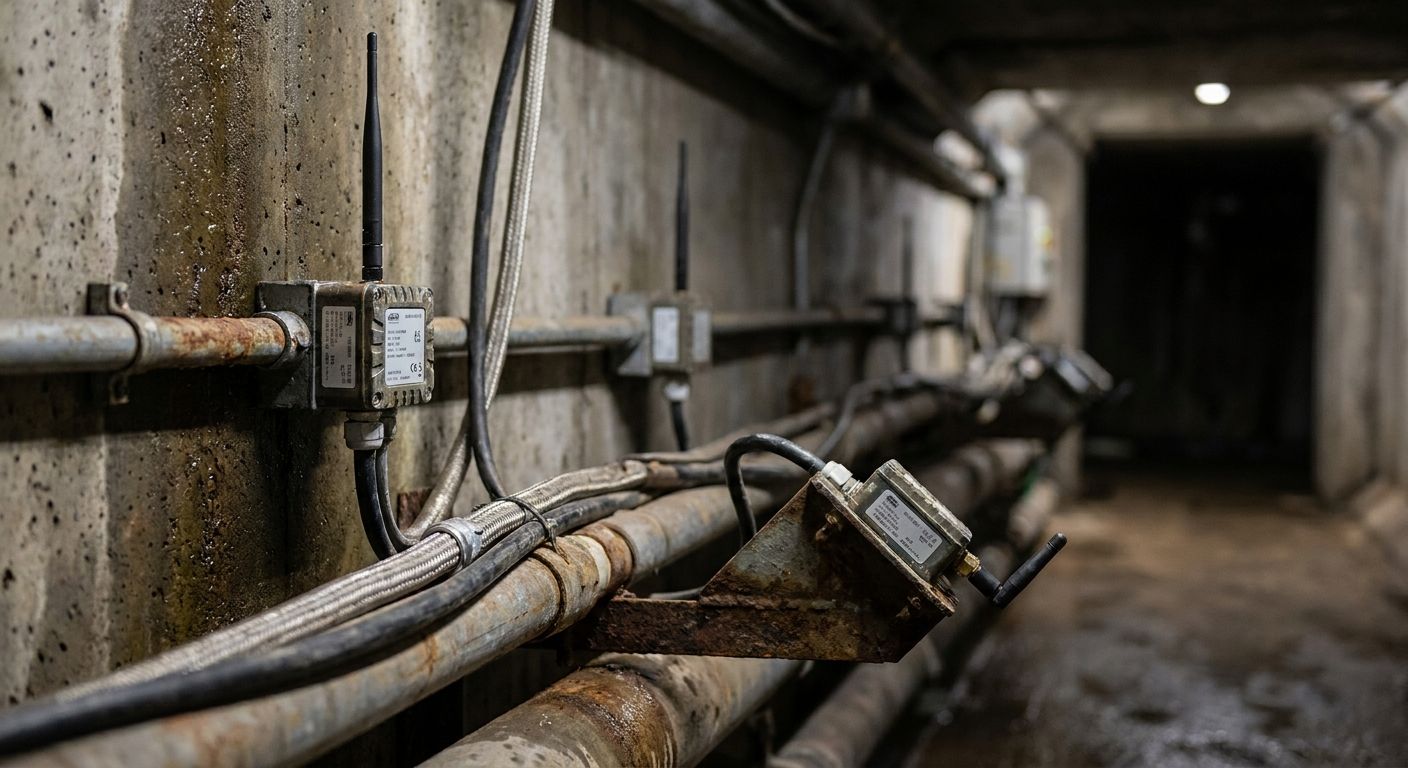
Underground vaults, buried tanks, and steel-clad basements strip most wireless signals down to nothing before they reach a gateway. Mioty's telegram splitting was built for exactly that link-budget problem, and in 2026 the sensor category you pick for an underground or shielded deployment matters more than the brand printed on the housing. This guide ranks the mioty sensor categories that hold a signal underground and inside shielded enclosures, and the tradeoffs that come with each one.
- Underground fuel and water tanks report reliably over mioty where cellular and Wi-Fi signal drops to zero.
- Vibration sensors on buried pump and lift stations flag bearing wear through a threshold rule instead of a wired BMS point.
- Rack sensors inside grounded steel server room enclosures still report because mioty's telegram splitting tolerates lost sub-packets.
- Kilo's built-in mioty network server means none of the categories ranked here need a separate network server deployed.
- Gas sensors in underground manholes supplement OSHA confined-space entry checks, they don't replace them.
How mioty's telegram splitting handles underground and shielded signal loss
Mioty was developed by the Fraunhofer Institute for Integrated Circuits (IIS) and standardized as ETSI TS 103 357 in 2020. Instead of sending one uplink packet and hoping it lands, a mioty end node splits each message into many sub-packets and scatters them across different frequencies and time slots inside the same transmission window. The receiving base station only needs enough of those sub-packets to reconstruct the full reading, so it can decode a message even when concrete, rebar, steel doors, or wet soil knock out a large share of the individual sub-packets. That's the mechanic that makes mioty sensors for industrial monitoring worth specifying over a single-packet LPWAN protocol when the deployment sits below grade or inside a shielded room.
That resilience has a limit, though. A mioty sensor that can't tolerate a missed report or two a day underground isn't ready for the vault — it's a maintenance ticket waiting to happen. Sensor selection for these sites comes down to duty cycle, enclosure rating, and whether the reading is worth the battery draw of reporting more often.
“A mioty sensor that can't tolerate a missed report or two a day underground isn't ready for the vault -- it's a maintenance ticket waiting to happen.”
What makes a mioty sensor good for underground or shielded deployments
- Telegram splitting margin — the radio should be built for the extended link budget mioty's splitting mechanism provides, not treated as a drop-in swap for a single-packet transmitter.
- IP66/67 enclosure rating — underground vaults, manholes, and tunnel walls hold condensation and standing moisture year-round.
- Multi-year battery life on a low duty cycle — hourly or slower reporting is standard for tank, vibration, and gas sensors below grade, since a battery swap in a confined space costs more labor than the sensor itself.
- Built-in mioty network server support — a platform running its own mioty and LoRaWAN network server removes a deployment step; Kilo ships this by default so there's no separate network server to stand up.
- Alarm and escalation tied to the reading — a raw feed from underground is useless until a threshold breach routes to the right person, not just a dashboard nobody checks.
Mioty sensors for underground and shielded environments at a glance
| Sensor category | Best for | Standout feature | Key limitation |
|---|---|---|---|
| Tank and level sensors | Underground fuel and water tanks with no cellular signal | Reports through soil and steel tank walls on a mioty link | Ultrasonic models still need a dry headspace to read accurately |
| Vibration sensors | Buried pump and lift stations | Amplitude trend data without running conduit for a wired sensor | Faster sampling for short transients shortens battery life |
| Temperature and humidity sensors | Underground vaults and utility tunnels | Multi-year battery life on hourly reporting | Slower reporting can miss a short thermal spike |
| Rack and room temperature sensors | Basement and shielded data center rooms | Holds a link inside grounded steel enclosures | Dense server rooms may still need a base station inside the room |
| Gas and methane sensors | Underground manholes and confined utility spaces | Continuous atmosphere data between entries | Not a substitute for a certified personal gas monitor during entry |
| Water leak and moisture sensors | Basements and underground parking structures | Point-level detection at floor drains and sump pits | Detects presence of water, not its source |
1. Tank and level sensors: best mioty sensor for underground fuel and water tanks with no cellular signal
Underground fuel tanks, water cisterns, and buried irrigation tanks sit exactly where cellular signal is weakest and running a wired level gauge means trenching. A mioty level sensor mounted in the tank riser reports through the surrounding soil and steel wall using the base station's extended link budget, and because most tank readings only change a few times a day, hourly or slower reporting keeps battery life in years instead of months. Sites already dealing with dead cellular zones on tank pads are covered in remote tank monitoring without cellular signal.
Tank and level sensors pros:
- Reports through soil, concrete, and steel tank walls where cellular and Wi-Fi don't reach
- Hourly or slower reporting keeps battery replacement to a multi-year cycle
- Threshold alarms catch a low tank or a fill overshoot before it becomes a spill
Tank and level sensors cons:
- Ultrasonic models need a dry headspace above the liquid to read accurately
- Retrofitting a riser fitting on an existing tank sometimes needs a technician visit
Verdict: Buy for underground fuel, water, and irrigation tanks where running a cable isn't an option.
2. Vibration sensors: best mioty sensor for buried pump and lift stations
Lift stations and buried pump vaults fail quietly. A bearing starts wearing weeks before a pump seizes, and by the time it floods a basement or backs up a line the fix costs far more than a sensor would have. A vibration sensor mounted on the pump housing inside the vault reports amplitude data over mioty, and a threshold rule flags amplitude crossing a set level, escalating to an on-call technician instead of waiting for the pump to trip its own overload protection.
Vibration sensors pros:
- Reports amplitude data from inside a sealed pump vault without running signal cable to the surface
- A threshold rule flags abnormal vibration and escalates to an on-call technician automatically
- Multi-year battery life on typical reporting intervals for slow-changing mechanical wear
Vibration sensors cons:
- Faster sampling intervals needed to catch short transients drain the battery faster
- Mounting matters — a poorly mounted sensor reads vault vibration instead of pump vibration
Verdict: Buy for buried lift stations and pump vaults where a flood or backup is the failure mode you're trying to avoid.
3. Temperature and humidity sensors: best mioty sensor for underground vaults and utility tunnels
Utility tunnels, cable vaults, and underground mechanical rooms need condensation and heat tracked, especially where high-voltage gear or steam lines run through a confined space. A mioty temperature and humidity sensor reports from inside the vault without a hardwired BMS point, and the Kilo IoT Platform runs five alarm severity tiers, so a slow drift pages a different person than a sudden spike.
Temperature and humidity sensors pros:
- Monitors condensation risk in a confined vault without hardwired BMS wiring
- Five alarm severity tiers mean a slow drift routes differently than a spike
- Holds a link in tunnels and vaults where a Wi-Fi or Bluetooth sensor drops a few meters from the door
Temperature and humidity sensors cons:
- Hourly reporting can miss a fast thermal event
- A tunnel run longer than one base station's range needs multiple sensors and repeaters
Verdict: Buy for utility tunnels and vaults carrying equipment sensitive to condensation or heat.
4. Rack and room temperature sensors: best mioty sensor for basement and shielded data center rooms
Basement server rooms and data center suites built inside grounded steel enclosures are a common dead zone for standard wireless sensors, and running a dedicated BMS point to every rack is expensive. A mioty rack sensor placed inside the room, with the base station positioned to cover the enclosure, reports even where signal loss through the shielding would kill a weaker protocol. The same signal problem, from a different angle, is covered in monitoring server room temperature without a dedicated BMS.
Rack and room temperature sensors pros:
- Reports from inside grounded steel enclosures that block most 2.4 GHz wireless signal
- No dedicated BMS point needed per rack
- Escalation chains route a cooling failure to facilities staff before it becomes a hardware incident
Rack and room temperature sensors cons:
- Dense equipment rooms may still need a base station physically inside the room rather than one floor up
- Rack-level granularity means more sensors than a single room-level reading
Verdict: Buy for basement or shielded server rooms without an existing BMS temperature point.
5. Gas and methane sensors: best mioty sensor for underground manholes and confined utility spaces
Underground manholes, lift station wet wells, and confined utility vaults carry gas risk that OSHA's confined space standard, 29 CFR 1910.146, requires monitoring before entry. A mioty gas sensor gives facilities continuous atmosphere data between entries, flagging a rising trend before a technician opens the hatch.
Gas and methane sensors pros:
- Continuous atmosphere data between confined-space entries
- Threshold alarms escalate a rising gas reading to the right person immediately
- Reports from underground manholes where cellular coverage is typically weakest
Gas and methane sensors cons:
- Not a substitute for a certified personal gas monitor carried during entry
- Calibration and replacement intervals follow the manufacturer's schedule, not the reporting interval
Verdict: Buy as a continuous supplement to entry monitoring, not a replacement for it.
6. Water leak and moisture sensors: best mioty sensor for basements and underground parking structures
Basements and underground parking structures flood quietly. A cracked pipe or a failed sump pump can run for hours before anyone notices standing water. A point-level moisture sensor placed at floor drains, sump pits, and low corners reports the moment water reaches the probe, and mioty's link budget covers areas where a Wi-Fi leak sensor would already have dropped its connection.
Water leak and moisture sensors pros:
- Detects standing water at the point it's placed, independent of Wi-Fi coverage in the structure
- Multi-year battery life since the sensor only transmits on a state change or a scheduled check-in
- Escalation chains push the alert to a phone or inbox instead of relying on someone walking the level
Water leak and moisture sensors cons:
- Point detection only — a sensor placed in the wrong corner won't catch a leak on the other side of the room
- Doesn't identify the source of the water, only its presence
Verdict: Buy for basements, parking structures, and any underground space where standing water is expensive to find late.
How to evaluate mioty sensors for underground and shielded deployments
Ranking sensors for underground and shielded sites comes down to matching the failure mode to the reporting interval, not to a spec sheet claiming the longest range. A tank overflow and a basement flood both cost money if caught late, but the sensor that catches each one reports on a different schedule and mounts in a different spot. Mioty hardware built for these categories ships through Kilo Electronics, Kilo's sister hardware company, with worldwide shipping.
Which mioty sensor should you deploy underground first?
If a site has one underground or shielded space with the highest cost of a missed reading, start there instead of trying to cover the whole facility in one pass. A lift station that floods a basement or a fuel tank that runs dry without warning usually justifies the first mioty deployment faster than a temperature sensor in a tunnel nobody walks through daily. Tank and level sensors and vibration sensors on buried pump stations are the two categories worth deploying first in 2026, because the failure they catch is expensive and the reporting interval that works for them is forgiving on battery life.
See underground sensor data in one dashboard
Bring mioty readings from vaults, tunnels and basements into the Kilo IoT Platform.
FAQ
What is the best mioty sensor for underground tanks?
A mioty tank and level sensor mounted in the riser is the best fit for underground fuel, water, or irrigation tanks in 2026, since it reports through soil and steel walls where cellular signal typically fails.
Does mioty work better than LoRaWAN underground?
Mioty's telegram splitting gives it a link-budget advantage through concrete, steel, and soil compared to a single-packet LoRaWAN transmission, though both share unlicensed sub-GHz spectrum and base station placement still decides most of the outcome.
Do mioty sensors need a base station inside a basement or vault?
Not always. A well-placed base station on a higher floor or roof often covers underground rooms in the same building, but dense steel enclosures like data center rooms may still need one positioned inside.
How long do mioty sensor batteries last underground?
Multi-year battery life is typical on hourly or slower reporting intervals for tank, temperature, and gas sensors. More frequent reporting, like vibration sampling, shortens that.
Can mioty sensors detect water leaks in basements?
Yes. Point-level moisture sensors reporting over mioty are used for basements and underground parking structures, detecting standing water at floor drains and sump pits.
What network server does a mioty sensor need?
Kilo runs a built-in mioty and LoRaWAN network server, so there's no separate network server to deploy alongside the sensors.
Is mioty a good fit for confined-space gas monitoring?
Mioty gas sensors give continuous atmosphere data between entries, which supplements OSHA's confined space standard, 29 CFR 1910.146, but they don't replace a certified personal gas monitor carried during entry.
What's the one detail that decides whether mioty works underground?
Base station placement decides more than sensor choice. Mioty's telegram splitting extends the link budget, but it doesn't erase physics — a base station mounted above the deepest vault or centered on a tunnel run still outperforms one bolted to the wrong corner of a building. Walk the site with the deployment plan before ordering sensors, not after.