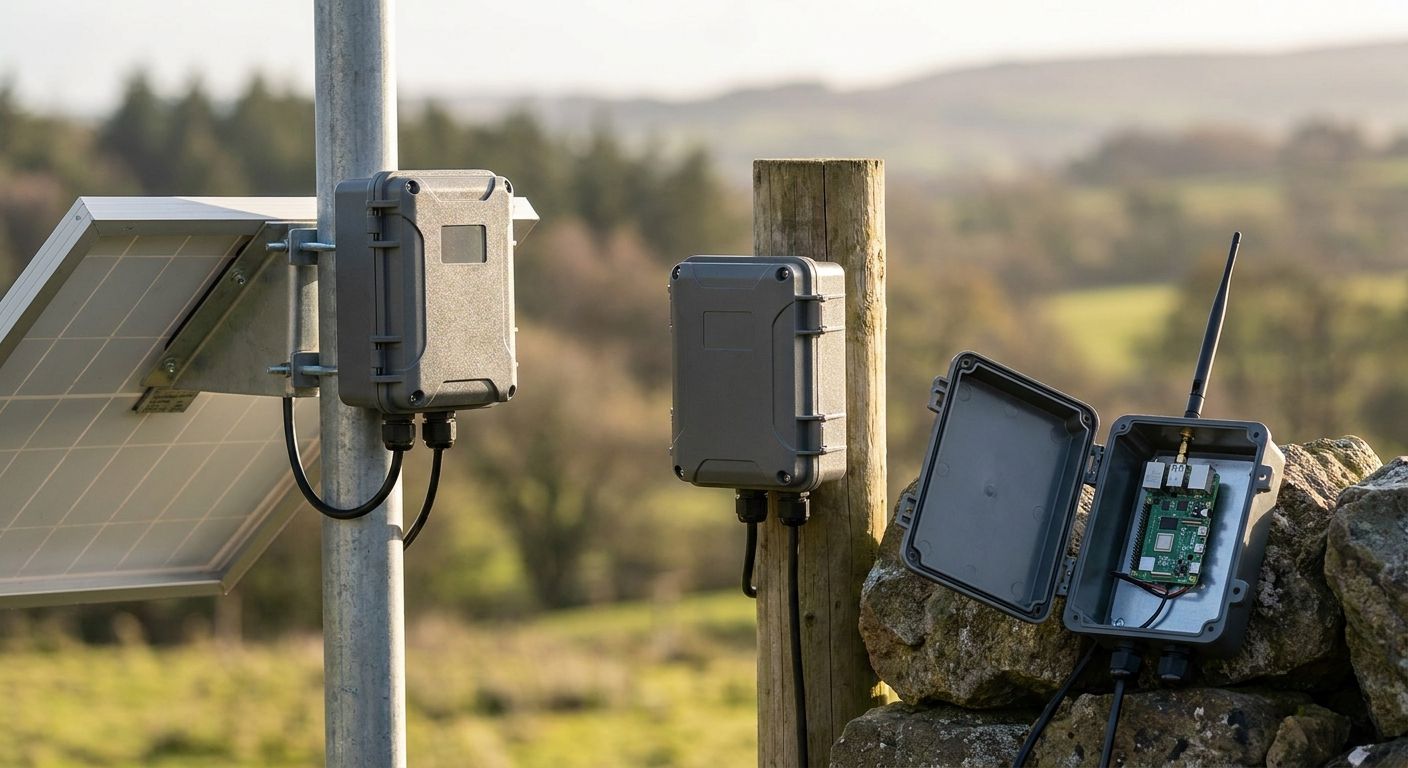
Outdoor LoRaWAN sensors rarely die because the radio failed — they die because water found a way past a gasket, or a metal lid killed the antenna's line of sight to the gateway. Picking the right enclosure is one of the highest-leverage decisions in an outdoor LoRaWAN sensor deployment, and it gets less attention than the sensor spec sheet itself.
- IP67 UV-stabilized polycarbonate is the default pick among outdoor enclosures for LoRaWAN sensors in 2026 — buy it for most sites.
- NEMA 4X die-cast aluminum wins on vibration-heavy industrial sites, not on RF transparency.
- Skip painted mild-steel boxes on LoRaWAN nodes — metal housings attenuate 868/915 MHz uplinks.
- IP68 potted enclosures earn their premium only on submersible tank-level and water-tower deployments.
- Match enclosure material to the antenna path before you match it to the weather.
Why outdoor LoRaWAN sensor enclosures need more than an IP rating
An IP67 sticker on a datasheet tells you the box survives a splash. It says nothing about whether the same box will pass a 868 MHz or 915 MHz signal to a gateway 2 km away, or whether the gasket will still seal after 18 months of UV exposure and thermal cycling. Sites choosing sensors for outdoor industrial IoT deployments in extreme weather run into this gap constantly: the sensor itself is rated for the environment, but the enclosure around it isn't matched to the same conditions.
Three failure modes show up repeatedly in outdoor LoRaWAN deployments: RF attenuation from metal or foil-lined housings, condensation building up inside a sealed box after a temperature swing, and UV-embrittled plastic cracking at the mounting ears within two summers. None of these are sensor problems. They're enclosure problems, and they're fixable before installation, not after a truck roll.
How these outdoor LoRaWAN enclosures were ranked
Each category below is scored against four things that actually predict field survival: the ingress protection rating per IEC 60529, the enclosure standard per NEMA 250-2020 where applicable, RF transparency at LoRaWAN's 868 MHz (EU) and 915 MHz (US) bands, and UV stability referenced against ASTM G154 accelerated weathering testing. Flammability rating (UL 94) is noted where it affects placement near electrical equipment. This isn't a brand comparison — it's a category comparison, because the enclosure category you pick constrains everything else about the install: mounting method, cable gland size, and whether you need an external antenna at all.
Best outdoor enclosures for LoRaWAN sensor deployments
1. IP67 UV-stabilized polycarbonate — the default pick
Polycarbonate rated IP67 under IEC 60529 tolerates temporary immersion up to 1 meter for 30 minutes, which covers driving rain, snowmelt pooling, and pressure washing near the mount. UV-stabilized grades resist the yellowing and cracking that untreated plastic shows after a year or two outdoors, tracked against ASTM G154 weathering cycles. It's RF-transparent, light enough for pole or wall mount without a bracket redesign, and cheap enough to standardize across a fleet of dozens or hundreds of nodes. Buy — this is the right default for temperature, humidity, and most outdoor asset sensors in 2026.
2. NEMA 4X die-cast aluminum — the industrial workhorse
NEMA 4X per NEMA 250-2020 adds protection against windblown dust and hose-directed water on top of corrosion resistance, and die-cast aluminum survives impact and vibration that would crack a polycarbonate box. The tradeoff is RF: aluminum attenuates the antenna signal unless the enclosure ships with an external antenna port or RF-transparent window. It's the right call for compressor rooms, loading docks, and anywhere forklifts or equipment could clip the housing. Buy for high-impact industrial zones, but only with an external antenna gland — not as a blanket standard.
3. RF-transparent ASA/ABS blend — for internal-antenna sensors
Most compact LoRaWAN sensors ship with an internal PCB antenna, and that antenna needs a housing that doesn't detune it. ASA and ABS blends pass RF cleanly at both 868 MHz and 915 MHz, unlike metal or carbon-filled plastics, and ASA specifically resists UV yellowing better than plain ABS over multi-year outdoor exposure. This is the category most vendors use for their standard outdoor sensor housing. Buy whenever the sensor has no external antenna connector — there's no reason to fight RF loss on a box that doesn't need to.
4. IP68 potted or fully sealed enclosure — for submersible sites
IP68 goes past IP67: continuous submersion at a depth the manufacturer specifies, rather than a 30-minute dunk. That level of sealing matters for tank-level probes, water tower monitoring, and any node mounted below grade or inside a wet well. Potted units trade field serviceability for the seal — you generally can't open them to swap a battery. Buy for submersible or below-grade installs, Skip for anything wall- or pole-mounted where IP67 already covers the exposure.
5. 316 stainless steel — coastal and corrosive environments
Standard 304 stainless corrodes near salt spray or chemical fumes faster than most installers expect; 316 stainless adds molybdenum specifically for chloride resistance, which is why marinas, coastal facilities, and chemical storage sites specify it over 304 or painted steel. It's heavier and pricier than polycarbonate, and like aluminum it needs an external antenna path. Buy for marine, coastal, and corrosive-atmosphere sites in 2026; Skip it inland where the corrosion resistance buys nothing.
6. Pole-mount gateway enclosure with external antenna gland
Gateway enclosures carry different requirements than end-device enclosures: more heat to dissipate, a PoE or power cable entry, and almost always an external antenna requiring a weatherproof N-type or SMA gland. Sites planning industrial LoRaWAN gateways should budget for a dedicated pole-mount enclosure rather than reusing a sensor-grade box — gateway thermal loads and cable counts are higher. Buy a purpose-built gateway enclosure; don't repurpose an end-device box.
7. Solar radiation shield enclosure — for exposed temperature/humidity sensors
A sealed box in direct sun can read several degrees warmer than ambient air due to solar heating of the housing itself, which is why weather stations use louvered radiation shields rather than solid enclosures for temperature and humidity probes. For outdoor LoRaWAN temperature sensors mounted in full sun, a shield reduces this bias without sacrificing the IP rating underneath. Cold-climate sites should also check extending LoRaWAN sensor battery life in cold environments, since enclosure choice and battery chemistry interact more than most installers expect. Buy for exposed ambient sensors; Skip for shaded or enclosed mounting where solar loading isn't a factor.
Outdoor LoRaWAN enclosure comparison table
| Enclosure type | Rating | RF transparent | Best for | Verdict |
|---|---|---|---|---|
| IP67 UV polycarbonate | IP67 (IEC 60529) | Yes | General outdoor sensors | Buy |
| NEMA 4X die-cast aluminum | NEMA 4X | No (needs external antenna) | High-impact industrial | Buy with antenna port |
| ASA/ABS blend | IP66-67 | Yes | Internal-antenna sensors | Buy |
| IP68 potted | IP68 | Yes | Submersible/below-grade | Buy for submersion only |
| 316 stainless steel | IP66-67, corrosion-rated | No | Coastal/corrosive sites | Buy for corrosion exposure |
| Gateway pole-mount enclosure | IP65-67 | External antenna | LoRaWAN gateways | Buy, purpose-built |
| Solar radiation shield | Varies (louvered) | Yes | Exposed ambient sensors | Buy for sun exposure |
Where to buy outdoor enclosures for LoRaWAN sensors
Check the datasheet, not the marketing copy, for the actual IP or NEMA test certificate — a lot of listings state "IP67" without a third-party test reference. Order cable glands rated to match the enclosure, since an IP67 box with an unrated gland is only as sealed as the weakest fitting. Kilo Electronics, Kilo's hardware sister company, ships pre-configured LoRaWAN and mioty sensors already housed in outdoor-rated enclosures worldwide, which removes the gland-matching guesswork for teams that don't want to source enclosures separately.
Once sensors are in the field, the enclosure only solves half the reliability problem — you still need visibility into whether a seal has failed or a battery is dropping before it causes a gap in data. The Kilo IoT Platform's rules engine can watch uplink RSSI, battery voltage, and payload gaps per device and fire an alarm through an escalation chain the moment a threshold is crossed, which catches an enclosure or antenna problem days before a site visit would.
Monitor sensor health after install
Track RSSI, battery and uplink gaps per device with rule-based alarms.
What's the most overlooked spec in an outdoor LoRaWAN enclosure
Breather vents. A fully sealed IP67 box trapped in direct sun goes through daily thermal cycling — heating during the day, cooling at night — and that cycle pulls in humid air through microscopic gaps and condenses it inside the box once temperatures drop. A PTFE breather membrane equalizes pressure without letting liquid water through, and it's the difference between an enclosure that stays dry for five years and one that fogs up internally within one wet season. Most outdoor LoRaWAN enclosure failures reported by field teams in 2026 trace back to condensation, not a cracked seal.
FAQ
What IP rating do outdoor LoRaWAN sensor enclosures need?
IP67 is the practical minimum for outdoor LoRaWAN sensors, covering temporary submersion up to 1 meter for 30 minutes under IEC 60529. Submersible or below-grade installs need IP68 instead.
Is NEMA 4X the same as IP67?
No — NEMA 4X and IP67 are different standards that overlap but don't map one-to-one. NEMA 4X (NEMA 250-2020) covers windblown dust, hose-directed water, and corrosion resistance, while IP67 (IEC 60529) is specifically about dust-tight sealing and temporary immersion.
Do metal enclosures block LoRaWAN signal?
Yes, solid metal enclosures attenuate 868 MHz and 915 MHz LoRaWAN signals significantly unless the housing includes an external antenna port. Polycarbonate, ASA, and ABS enclosures pass RF cleanly and are the better default for internal-antenna sensors.
How cold can a LoRaWAN sensor enclosure get before performance drops?
Most industrial-grade LoRaWAN sensors and enclosures specify an operating range down to -40C, matching the standard industrial electronics temperature range. Battery chemistry, not the enclosure, is usually the limiting factor in cold climates.
What's the best enclosure material for coastal LoRaWAN deployments?
316 stainless steel is the standard choice for coastal and marine LoRaWAN deployments because its molybdenum content resists chloride-induced corrosion better than 304 stainless or painted steel. It requires an external antenna since it's not RF-transparent.
Do LoRaWAN gateways need a different enclosure than end devices?
Yes, gateway enclosures need more thermal headroom and typically an external antenna gland, unlike compact end-device sensor housings. Reusing a sensor-grade enclosure on a gateway often causes overheating or antenna gain loss.
Can I mount a LoRaWAN sensor enclosure without an external antenna?
Yes, if the enclosure material is RF-transparent, such as polycarbonate, ASA, or ABS, an internal PCB antenna performs close to its rated range. Metal or stainless enclosures need an external antenna to avoid signal attenuation.