
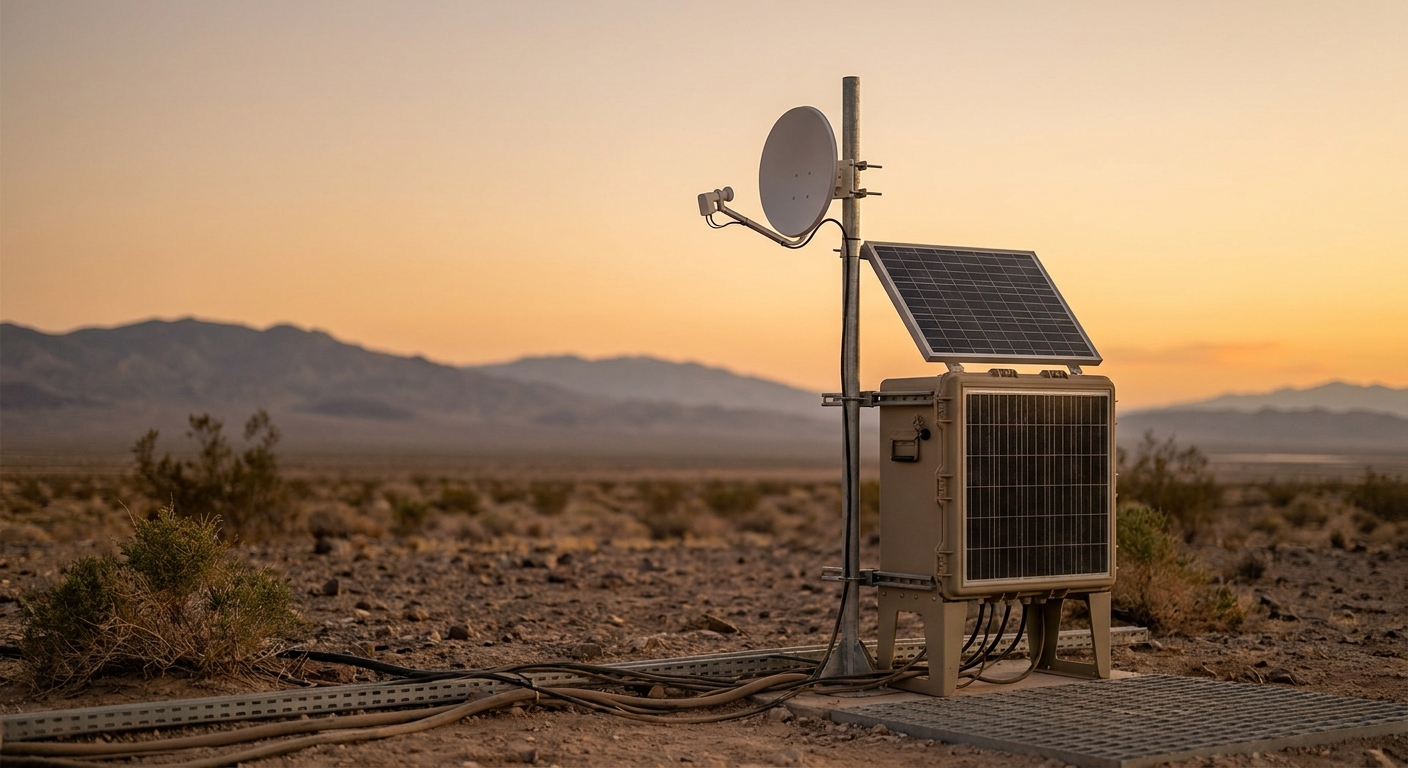
Satellite IoT connectivity for remote industrial sites means moving sensor data off a site with zero cellular coverage — a mine face, an offshore wellhead, an irrigation pivot three miles from the nearest tower — without waiting for a technician to drive out and pull a memory card.
- Hybrid LoRaWAN-plus-satellite backhaul beats satellite-only for multi-sensor sites — buy it for mining and oil and gas.
- GEO-only satellite links add latency that turns a real-time high-temp alarm into a delayed notification — skip for time-critical alerts.
- mioty handles thousands of devices per base station on wide, flat sites like irrigation fields — consider it before adding more satellite modems.
- Kilo Cloud ingests satellite-fed readings the same way it ingests LoRaWAN and mioty data, as long as the modem publishes over MQTT.
Why this matters
A remote site without connectivity isn't a monitoring gap — it's a blind spot that costs money every time something goes wrong between visits. A stuck valve, a dead generator, a tank that overflowed two days before anyone drove past it.
The fix used to be "run a cellular booster and hope." In 2026, satellite IoT connectivity for remote industrial sites is priced and packaged well enough that it's a real line item, not a science project. The industrial IoT platform for oil and gas remote sites conversation comes up constantly for exactly this reason — wellheads and gathering stations sit where fiber and towers don't reach, and a satellite link is often the only option that isn't a truck roll.
The hard part isn't picking a satellite provider. It's picking the right architecture — satellite-only, hybrid, or failover — for how many sensors you're running and how fast you need to know about a problem.
Who this is for
This guide is for operations and facilities teams running sites where cellular coverage is patchy or absent: mine sites, oil and gas fields, water infrastructure in rural counties, large-acreage agriculture, and remote industrial equipment that sits outside the reach of a normal SIM card. If your site has a Wi-Fi router and a coffee machine, you don't need this guide — you need a cellular gateway. This is for the sites where that's not an option.
What to look for in satellite IoT connectivity for remote sites
Message-based data plans, not bandwidth plans
Satellite IoT billing is almost always per-message, not per-megabyte. A sensor sending one 50-byte reading every 15 minutes costs a fraction of a sensor that pushes a photo. Match your payload size and reporting frequency to the plan before you commit — a 2026 satellite contract sized for hourly readings will blow through its message allowance fast if someone decides to poll every 60 seconds.
Power draw and battery sizing
Satellite transmission draws more power than a LoRaWAN or mioty uplink, and remote sites usually run on solar-plus-battery, not grid power. A sensor that reports every 15 minutes over satellite will drain a battery far faster than one reporting the same interval over LoRaWAN. Size the panel and battery for winter sun hours, not the summer average.
Latency tolerance for alarms
A tank overflow alarm and a monthly compliance reading do not need the same latency. GEO satellite links can add real delay to an alert — enough that a high-temperature or high-level alarm arrives well after the threshold was crossed. If the site has anything that needs a same-minute alert, plan the architecture around that requirement first, not the connectivity budget.
Integration path into your monitoring platform
A satellite modem that dumps data into a proprietary portal with no export option is a dead end. Confirm the modem or gateway can publish over MQTT or a documented API before you buy — that's what lets a platform like Kilo Cloud pull the reading into the same dashboard as your LoRaWAN and mioty devices, instead of forcing your team to check three separate systems.
Redundancy and failover design
Sites at the edge of cellular coverage — not fully dead zones — do better with cellular-primary and satellite-failover than satellite-only. It cuts message costs dramatically on the days coverage holds, and it's still there the day it doesn't.
Total cost across many sites
One satellite-connected site is a line item. Fifty satellite-connected sites across a mining or oil and gas footprint is a budget category. Model the per-site monthly message cost times device count before rolling out past a pilot.
Top approaches for satellite IoT connectivity at remote sites
Satellite-only backhaul — the baseline for zero-bar sites. One modem per site, direct to the satellite network, no local mesh. Duty cycle limits usually cap uplinks around one message every 15 to 60 minutes depending on plan tier. This is the right call for a single wellhead or an isolated mine face with a handful of sensors. Verdict: Buy for isolated sites with low sensor counts — this is exactly the pattern behind the industrial IoT platform for oil and gas remote sites use case.
Hybrid LoRaWAN mesh plus satellite gateway — the wildcard that cuts your per-message bill. Sensors talk LoRaWAN locally to one gateway on site; that gateway is the only thing that pays for satellite time. A single gateway can aggregate readings from 50 or more sensors before a single satellite uplink goes out, which turns a hundred separate satellite messages into one. Verdict: Buy for any site running more than a handful of sensors, including the equipment and haul-truck density common on the industrial IoT platform for mining operations.
mioty long-range mesh for wide, flat sites. mioty's telegram-splitting design handles thousands of devices reporting to one base station without collisions, which matters on sites measured in square miles rather than square feet — irrigation fields, large tank farms, grain operations. It doesn't replace satellite backhaul, it reduces how many devices need one. Verdict: Consider before adding more satellite modems to a wide-area site.
Cellular-primary with satellite failover — the safe pick at the edge of coverage. The gateway uses cellular when it's available and switches to satellite only when the signal drops. This is not for zero-bar sites — it's for sites where coverage is inconsistent, not absent. Verdict: Consider for sites near the edge of a coverage map, not in the middle of nowhere.
Satellite modem publishing straight to your dashboard over MQTT — the point where the pipe stops mattering. As long as the modem or gateway can publish readings over MQTT, a platform like Kilo Cloud ingests them the same way it ingests LoRaWAN and mioty data — same alarms, same rules engine, same dashboard. The connectivity choice becomes invisible to the person watching the alert. Verdict: Buy once you've picked a physical link — this is the layer that makes the choice above stop being a daily headache.
What to avoid
- Consumer satellite messengers (the kind built for hikers to text "I'm okay") are built for occasional two-way messages, not scheduled sensor telemetry at scale. They look cheap until you try to run 20 sensors on one.
- GEO-only links for time-critical alarms. A tank overflow, a cold-chain excursion, a vibration spike — these need a link that doesn't queue for minutes. Pair GEO satellite with a local mesh for anything that can't wait.
- Closed-vendor satellite clouds with no export. Connectivity without an MQTT or API path out means your data lives in someone else's portal, not your dashboard, and your rules engine and alarms never see it.
Comparison: satellite IoT approaches for remote industrial sites
| Approach | Data cost model | Latency | Power draw | Best for | Verdict |
|---|---|---|---|---|---|
| Satellite-only backhaul | Per message, low duty cycle | Moderate to high (GEO) | High per uplink | Single wellheads, isolated equipment | Buy |
| Hybrid LoRaWAN + satellite gateway | Per gateway uplink, aggregated | Moderate | Low at sensor, high at gateway | Multi-sensor mine and field sites | Buy |
| mioty mesh + satellite | Per gateway uplink, aggregated | Moderate | Low at sensor | Wide, flat, high-device-count sites | Consider |
| Cellular-primary, satellite failover | Cellular rate, satellite only on drop | Low (cellular), moderate (failover) | Low to moderate | Edge-of-coverage sites | Consider |
| MQTT-fed dashboard layer | Depends on chosen link above | Depends on chosen link above | Depends on chosen link above | Any of the above once connected | Buy |
Map your remote site's connectivity gap
See how sensor readings from any link land in one dashboard.
FAQ
What is satellite IoT connectivity for remote industrial sites?
It's a method for sending sensor readings off a site with no cellular or fiber coverage, using a satellite modem or gateway instead of a local network. It's used at mine faces, oil and gas wellheads, and rural water infrastructure in 2026 where a cell tower isn't within reach.
Is satellite IoT connectivity for remote sites expensive in 2026?
Cost depends on message frequency, not bandwidth — a sensor sending one small reading every 15 to 60 minutes costs far less than a plan sized for constant polling. Aggregating sensors through one gateway before the satellite uplink cuts per-site cost significantly.
Can satellite IoT replace cellular at a mine site?
Yes, for sites with no cellular coverage at all, satellite backhaul through a hybrid LoRaWAN gateway is the standard pattern for mining operations. It aggregates multiple sensors into one satellite uplink instead of paying per device.
Does mioty work with satellite backhaul?
mioty and satellite serve different jobs — mioty covers the local mesh across a wide site with thousands of devices on one base station, while satellite handles getting that aggregated data off-site. They're typically paired, not substituted for each other.
How much data can I send over a satellite IoT connection?
Satellite IoT plans are billed and capped per message, not per megabyte, with duty cycle limits often around one uplink every 15 to 60 minutes depending on the plan. Sizing a sensor's reporting interval to that limit before deployment avoids hitting the cap mid-month.
What's the difference between LEO and GEO satellite IoT?
LEO (low earth orbit) satellites orbit closer to earth and generally offer lower latency per pass, while GEO (geostationary) satellites sit fixed relative to the ground but add more delay per message. For time-critical alarms, the latency difference matters more than the coverage map.
Can I monitor tank levels with satellite connectivity where there's no cellular signal?
Yes, tank level sensors paired with a satellite-backed gateway report readings on a schedule even with zero cellular signal on site. This is the exact scenario covered in setting up remote tank monitoring without cellular signal.
Does Kilo IoT support satellite-connected sensors?
Kilo Cloud ingests data over MQTT, LoRaWAN, and mioty, so a satellite modem or gateway that publishes readings over MQTT lands in the same dashboard, rules engine, and alarms as any other connected device in 2026.
One last thing
Most remote-site connectivity failures aren't the satellite link — they're a sensor sitting on-site showing "waiting for first data" in the dashboard because nobody confirmed the mount and antenna orientation before the crew left. Check that status screen before the truck drives away, not after the first missed reading three weeks later.