A cellular failover plan for critical IoT site connectivity needs three things: a monitored primary connection, a backup WAN path that takes over automatically, and an alarm that fires the moment the primary drops, not once data resumes. The part most plans miss isn't the switch itself — it's the data gap during the switch, and whether anyone actually gets notified before that gap turns into a blind spot. Get it wrong and you don't just lose connectivity for a few minutes; you lose the readings that would have shown a walk-in freezer creeping past 8°C before the compressor actually failed. In 2026, that gap is what an audit or an insurance claim looks at, not whether the site had a backup connection on paper.
- A cellular failover plan needs a monitored primary path, an automatic backup WAN link, and an alarm on the switch itself.
- The real cost is the data gap during failover, not the outage — treat it as a monitoring event, not a network event.
- Cellular failover applies to a gateway's backhaul, not to the LoRaWAN or mioty sensors talking to that gateway.
- Kilo's rules engine can alarm on a connectivity loss the moment the primary path drops, with five severity tiers and escalation.
- An untested failover path is not a working failover path — pull the primary connection on a schedule and confirm it.
Why does a critical IoT site need a cellular failover plan?
A site earns the label "critical" when a connectivity gap costs money, product, or safety margin — not because someone decided it sounds important. A cold storage compressor that fails silently for two hours, a tank that overflows because the level alarm never reached anyone, a cleanroom pressure differential that drifts out of spec unnoticed: none of those failures care whether the outage was the ISP's fault or a router reboot.
Off-site assets face a related version of the same problem, minus the choice. A delivery truck has no wired backhaul to fail over from in the first place — the cellular link is the only path, which is why cellular connectivity for mobile asset tracking is designed cellular-first, covering more than 2,000 preconfigured tracker templates across vehicle and equipment types. A fixed site has an option a truck doesn't: a primary wired connection with cellular as the fallback, not the only path in.
How to plan cellular failover for critical IoT site connectivity
This is a network-architecture decision layered on top of whatever platform reads the data, not a feature you buy from a monitoring vendor. Six steps cover most sites:
- Map the measurements that can't tolerate a gap. List every sensor or PLC point where a missed reading has a real cost — cold storage compressors, tank levels, cleanroom pressure, boiler pressure. Sites without that exposure don't need failover; they need a good primary connection and nothing more.
- Identify what "primary" actually means at that site. For a private LoRaWAN or mioty deployment, sensors already talk wirelessly to a gateway or base station on-site — the vulnerable link is the gateway's own backhaul to the internet, usually ethernet. For an MQTT-connected PLC or building management system, the vulnerable link is whatever network path that device or its gateway already uses to publish out.
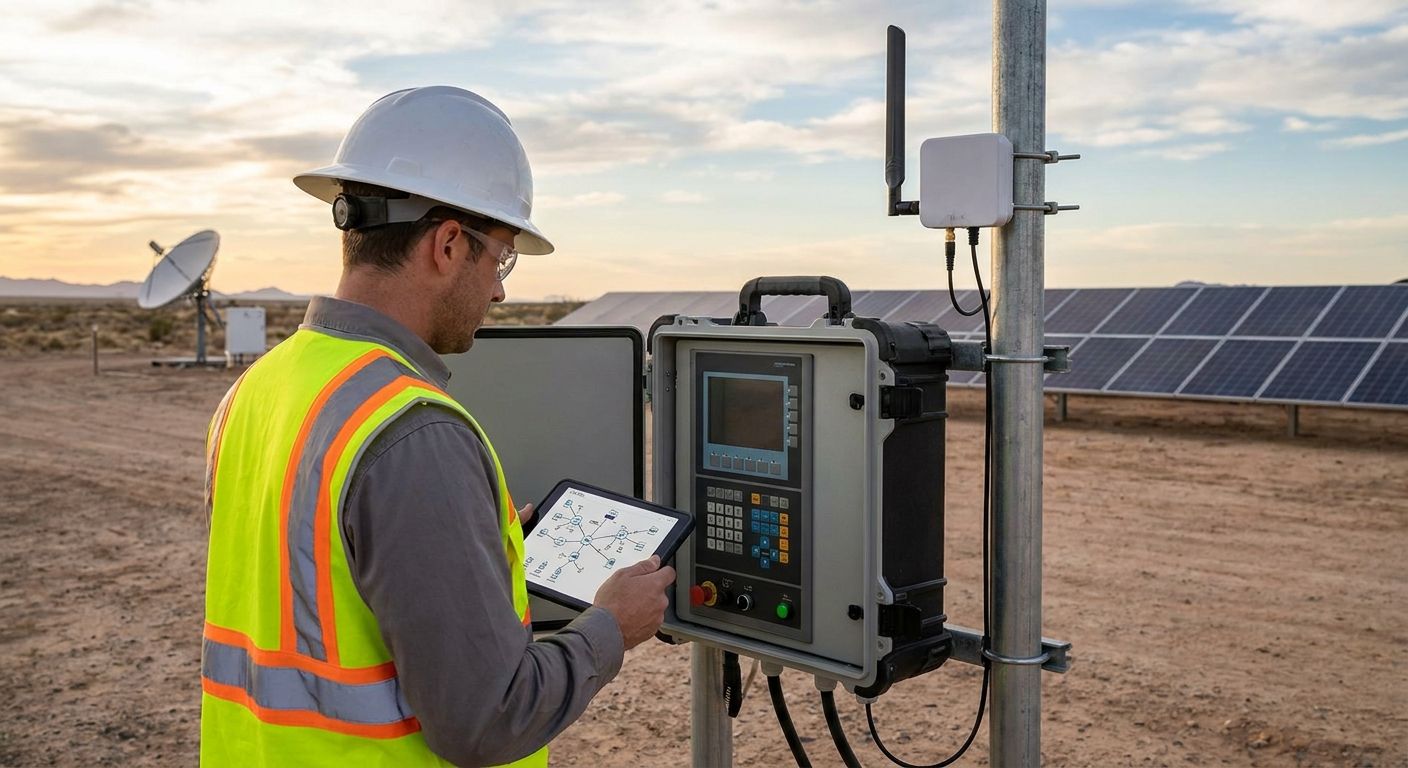
- Add a backup WAN path to the gateway, not to every sensor. A dual-WAN router or a cellular backup modem wired into the same gateway's ethernet port is the standard pattern. It's the site's internet connection that needs a second path — each LoRaWAN end device already reaches the gateway wirelessly regardless of how that gateway reaches the internet.
- Set a failover trigger shorter than your tightest alarm tolerance. If a freezer alarm needs to fire within 10 minutes of a compressor problem, the network failover has to complete well inside that window. Check the health-check interval on your router or firewall against the tightest tolerance on-site, not the loosest one.
- Alarm on the outage itself, separate from the sensor reading. A "gateway offline" alarm is a different failure mode than "temperature over threshold," and a critical site needs both — see how to set up SMS and email alerts for critical IoT sensor thresholds for the escalation side of this.
- Test the failover path on a real schedule, not just at commissioning. Pull the primary cable, confirm the switch happens, confirm the alarm fires, confirm someone actually receives the notification. A quarterly test is a reasonable baseline for any site where downtime has a real cost in 2026.
Whichever path gets the data there — primary or backup — the monitoring layer has to treat a WAN failover exactly like any other alarm condition, not a separate problem. The Kilo IoT Platform's rules engine runs on CEL expressions inside a visual, version-controlled workflow, so a "gateway last-seen greater than 5 minutes" condition triggers the same five-tier alarm escalation used for a temperature excursion, with the same quiet-hours handling and centralized inbox. Because Kilo's MQTT connector accepts data from any publishing device, a router or gateway that changes its uplink mid-outage doesn't change how the platform receives what it sends — the switch is invisible to the rules engine except for the timestamp gap it has to catch and log. The same dashboard keeps a digital twin for every device, so a gateway's connectivity history sits on the same timeline as its sensor readings instead of in a separate network log nobody checks.
If the retrofit needs new hardware to support this pattern, Kilo Electronics ships LoRaWAN and mioty gateways and sensors worldwide, including the units that typically sit at the backhaul point described above.
See how alarms handle a failover gap
Walk through Kilo Cloud's rules engine and alarm escalation.
What factors change a site's cellular failover requirements?
- Physical environment. Below-grade or shielded sites — parking structures, tunnels, metal-clad cold rooms — need failover, but cellular signal itself may struggle there; check mioty sensors for underground and shielded environments before assuming any cellular link works at all.
- Existing site infrastructure. A retrofit into an older building may not have a second internet drop available, which changes whether a cellular backup router is even feasible without new cabling.
- Alarm tolerance. A site with a 10-minute tolerance needs a faster failover trigger than a site with a same-day tolerance.
- Regulatory or compliance exposure. Distribution centers handling temperature-sensitive product face audit requirements that turn a data gap into a documented failure, not just an inconvenience.
- Number of sites. A single facility can be tested manually; a multi-site rollout needs the same failover pattern deployed identically everywhere.
- Budget for a second WAN device. A dual-WAN router or cellular backup modem is additional hardware and an additional monthly connection cost on top of the primary link.
Does cellular failover apply to LoRaWAN or mioty sensors directly?
No — LoRaWAN and mioty sensors already talk wirelessly to a gateway or base station on-site, so failover applies to that gateway's backhaul connection to the internet, not to the sensor-to-gateway hop. The sensor keeps transmitting locally even if the gateway's uplink is down; the risk is that readings queue up or get lost before they reach the cloud platform, not that the wireless network itself fails.
Is cellular failover necessary for every IoT site?
No — cellular failover for critical IoT site connectivity is worth the hardware and complexity only where a data gap has a real cost: cold storage, tank monitoring, cleanroom pressure, life-safety systems. A break-room occupancy sensor doesn't need it; a vaccine refrigerator or a chemical storage tank does.
How do you know a cellular failover connection actually works during a real outage?
You only know by testing it — pull the primary connection on a schedule, confirm the backup takes over, and confirm the connectivity-loss alarm actually reaches the right person. A failover path that has never been forced to fail over is unverified, not working.
“A cellular failover connection that has never been forced to fail over is not tested — it's a hope.”
FAQ
What is cellular failover for IoT site connectivity?
Cellular failover is a backup WAN path, usually a cellular router or modem, that takes over a site's internet connection automatically when the primary link goes down. It protects the connection between an on-site gateway or PLC and the cloud platform, not the wireless hop between sensors and that gateway.
How fast should a cellular failover switch happen?
Faster than the tightest alarm tolerance on the site. If a sensor needs to raise an alarm within 10 minutes of a problem, the network failover has to complete well inside that window, not at the edge of it.
Does a LoRaWAN network need cellular failover?
The LoRaWAN sensors themselves don't, since they already reach the on-site gateway wirelessly. What needs failover is the gateway's backhaul to the internet, since that single link can take the whole site offline.
Can an IoT platform alarm on a connectivity outage, not just a sensor reading?
Yes. Kilo's rules engine can trigger on a device or gateway going silent past a set interval, using the same five-tier alarm and escalation system used for any other threshold, with email, SMS and push notification.
What's the difference between failover and redundancy?
Redundancy is having two paths available; failover is the automatic switch between them when one fails. A site can have a second WAN connection sitting idle and still lack failover if nothing switches to it automatically.
How often should you test a failover connection?
On a recurring schedule, not just once at commissioning. Pulling the primary connection and confirming both the switch and the alarm notification actually happen is the only way to know the backup works during a real outage in 2026.
What happens to sensor data recorded during the failover gap?
It depends on the device. Some LoRaWAN and mioty end devices buffer readings locally and forward them once connectivity resumes, but the gateway's own outage window still needs to be logged as a gap, which is why a connectivity-loss alarm matters as much as the data itself.
Is a cellular backup router the same as a multi-carrier setup?
No. A cellular backup router is about having a second WAN path at all; which carriers that backup link can use is a separate decision that only matters once the failover pattern itself is in place.
What's the one part of a cellular failover plan most sites skip?
The part almost every site skips is testing the alarm, not the network switch. Plenty of dual-WAN routers switch over correctly and silently, which is exactly the problem — nobody finds out the primary link is degraded until it fails a second time and the backup has been running solo the whole time. Build the test to confirm a human actually got the SMS or email, not just that packets kept flowing through 2026 and beyond.