
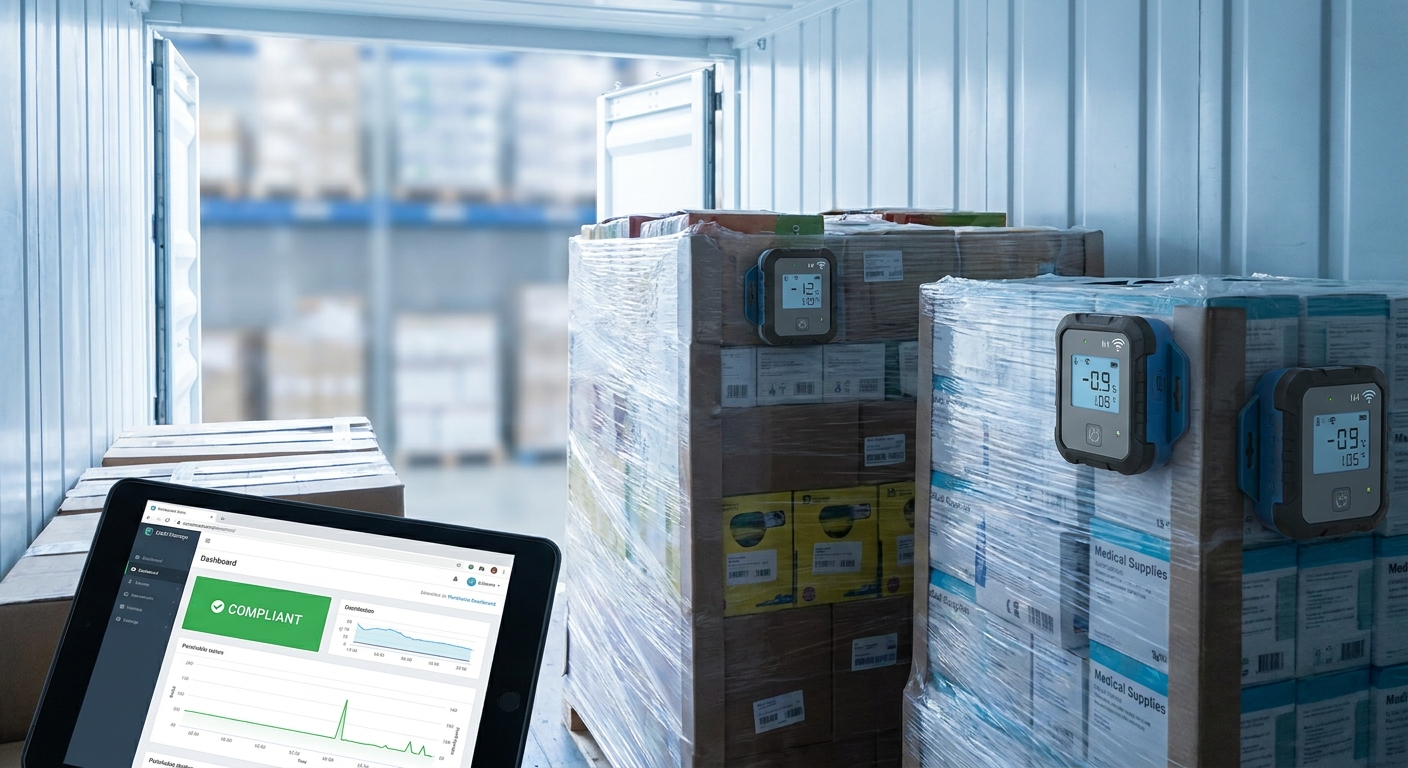
Cold chain compliance monitoring in 2026 doesn't run on one supersensor — it runs on five sensor categories doing five different jobs, and picking the wrong mix leaves gaps in your audit trail even when the fridge never actually failed.
- Probe-in-product temperature sensors are the compliance backbone for best iot sensors for cold chain compliance monitoring in 2026 — Buy for every unit that holds product.
- Door contact sensors catch human error faster than temperature drift alone — alerts inside 60 seconds beat a slow ramp every time.
- mioty-based sensors win in dense multi-freezer sites where hundreds of nodes compete for airtime — Consider once you're past 50 sensors per site.
- GPS-cellular reefer trackers close the gap between dock and destination — Buy if product ever leaves the four walls.
- Skip ambient-only sensors as your only data source; auditors want product temperature, not room temperature.
Why this matters
A cold chain audit doesn't care that your walk-in never actually exceeded spec. It cares whether you can prove it, minute by minute, for every unit that held product. FSMA-adjacent audits and most retailer HACCP reviews in 2026 want a continuous log, not a spot check from a clipboard.
The sensor you buy determines what that log looks like. An ambient air sensor bolted to the ceiling tells you the room was cold. It doesn't tell you the actual product core temperature stayed under the line during a 15-minute door-open event at shift change. That distinction is where most compliance gaps come from — not equipment failure, but data that measured the wrong thing.
How this list is ranked
Each sensor category below is ranked on one question: does it close a specific gap auditors actually flag, or does it just add another chart to a dashboard nobody reads? The ranking weighs three factors — what it measures (product vs. ambient), how fast it alerts on a deviation, and how well it survives a cold, wet, high-turnover environment without falling off the network. None of these categories require guessing at a brand name; they're the functional types any cold chain compliance program in 2026 needs to cover, regardless of vendor.
1. Probe-in-product temperature sensors — the compliance backbone
This is the sensor that actually answers the auditor's question. A probe sitting inside a glycol-filled bottle or embedded in a product surrogate reads what the product experienced, not what the air around it did. Most compliance frameworks treat product temperature as the record of truth; ambient readings are supporting evidence at best.
The number that matters here is accuracy under drift — you want a probe holding within a few tenths of a degree through repeated defrost cycles, not just at calibration. Pair it with a cold storage temperature monitoring dashboard so the readings land somewhere reviewable instead of sitting on a local logger nobody checks until the audit. Verdict: Buy — this is non-negotiable for any unit holding regulated product in 2026.
2. Ambient air temperature and humidity sensors — the redundancy layer
Ambient sensors aren't the record of truth, but they catch things probes miss: a compressor cycling wrong, a door seal failing, humidity climbing before condensation becomes a mold problem. Run these alongside probes, never instead of them.
The useful spec is log interval. A sensor reporting every five minutes catches a slow drift; one reporting every 60 minutes misses the event entirely and shows a clean chart for an hour that wasn't clean. Facilities running mixed cold storage and processing lines often deploy this tier across an industrial IoT setup for food and beverage manufacturers, where humidity swings hit product quality as hard as temperature does. Verdict: Buy as a companion sensor, Skip as your only data source.
3. Door open/close contact sensors — catches the human error
Most temperature excursions aren't equipment failures. They're a door propped open during a busy receiving shift, or a walk-in left cracked overnight. A contact sensor flags the event the moment it happens, before the temperature has drifted enough to matter.
The number to hold vendors to is alert latency — 60 seconds from open to notification is achievable and worth insisting on. Anything slower turns a preventable five-minute mistake into a logged breach. Verdict: Buy for every walk-in and reach-in with regular staff traffic.
4. Power loss and mains monitoring sensors — the one nobody budgets for
A compressor that loses power doesn't announce itself with a slow temperature climb you catch in time. It announces itself with silence, and by the time the ambient sensor reports a problem, product has already been at risk for however long the outage lasted. A dedicated power-loss sensor with its own battery reports the outage the second it starts, independent of the compressor's own control board.
Battery backup runtime is the spec to check — 72 hours covers most weekend and holiday outage scenarios without leaving a blind spot. The same alerting logic used to catch equipment failure elsewhere in a facility, like the rules built for automated alarms on vibration anomalies, applies here: define the threshold once, let the rules engine fire the alert without a human staring at a screen. Verdict: Buy for any site where a power outage during off-hours is a realistic scenario.
5. GPS-cellular reefer tracking sensors — the mobile leg
Cold chain compliance doesn't stop at the loading dock. A reefer truck that loses reefer power on a six-hour haul is a bigger compliance failure than anything that happens in a fixed facility, because there's no facilities team standing by to catch it. These sensors need their own connectivity, independent of the truck's telematics, because a dead battery in the cab shouldn't take out your temperature record too.
A ping interval of every five minutes is the practical floor for anything hauling regulated product; anything longer leaves too big a gap between the last good reading and the discovery of a problem. Fleets running refrigerated trailer and reefer truck tracking get continuous chain-of-custody data instead of a single reading logged at delivery. Verdict: Buy if product ever leaves the four walls of a fixed site.
6. mioty-based sensors for dense multi-freezer sites
Once a site passes roughly 50 sensors competing for airtime — multiple freezers, coolers, and processing zones on one property — standard LoRaWAN networks start showing collision and retry issues under load. mioty's telegram-splitting approach spreads uplinks across time and frequency, which is exactly the property that matters when hundreds of nodes are reporting on tight intervals in a metal-heavy cold storage building.
This isn't the right first purchase for a single walk-in. It's the right purchase once scale makes airtime contention a real problem. Sites weighing the switch can compare mioty-based industrial monitoring sensors against a standard LoRaWAN buildout before committing. Verdict: Consider once sensor density crosses that threshold — Skip for small single-site deployments where LoRaWAN handles the load fine.
7. Data logger sensors with local storage — the fallback, not the strategy
A standalone logger that stores readings on a chip and gets downloaded manually still shows up in smaller operations, mostly because it's cheap and doesn't need connectivity. It works as a backup for a single unit in a location with no signal. It fails as a compliance strategy the moment an auditor asks for real-time visibility instead of a spreadsheet exported after the fact.
Verdict: Hold — fine as a secondary record on one unit, not a strategy for a facility with more than one cold zone.
Side-by-side comparison
| Sensor Type | What It Catches | Alert Speed | Verdict |
|---|---|---|---|
| Probe-in-product | Actual product temperature | Continuous | Buy |
| Ambient air/humidity | Room drift, HVAC failure | 5-min intervals | Buy (companion) |
| Door contact | Human error, propped doors | Under 60 sec | Buy |
| Power loss | Compressor/mains failure | Immediate | Buy |
| GPS-cellular reefer | In-transit excursions | 5-min pings | Buy for transport |
| mioty-based | Airtime contention at scale | Continuous | Consider at scale |
| Standalone data logger | Single-point history | Manual download | Hold |
Where to source these
Three rules keep a cold chain sensor buildout from turning into a maintenance headache in 2026:
- Match connectivity to the building, not the spec sheet. A LoRaWAN sensor that works fine in a single-story warehouse can struggle in a multi-freezer facility with thick insulated walls — check real coverage before ordering in bulk.
- Buy sensors and the platform from a source that keeps calibration and support in one place. Splitting hardware and software vendors means two support tickets every time a reading looks wrong.
- Insist on exportable, timestamped data before you sign. An auditor doesn't accept a screenshot. If the platform can't produce a clean export on demand, the sensor investment doesn't actually solve the compliance problem.
Kilo IoT's platform runs LoRaWAN, mioty, and MQTT connectivity through one dashboard, which matters here specifically because cold chain sites rarely stay on a single protocol as they scale from one freezer to a multi-site network.
Map your cold chain sensor plan
See how Kilo IoT connects temperature, door, and power sensors on one dashboard.
FAQ
What are the best iot sensors for cold chain compliance monitoring in 2026?
Probe-in-product temperature sensors are the core requirement, backed by door contact sensors, power-loss sensors, and ambient air/humidity sensors as companions. GPS-cellular sensors cover the transport leg, and mioty-based sensors matter once a site scales past roughly 50 nodes.
Is mioty better than LoRaWAN for cold chain monitoring?
Not for most single-site deployments — standard LoRaWAN handles a typical freezer or cooler fine. mioty becomes the better choice once a site runs dense multi-freezer or multi-zone deployments where airtime contention causes dropped readings.
How fast should a door sensor alert on a cold storage breach?
Under 60 seconds from door-open to notification. Slower alerts turn a preventable few-minute mistake into a logged temperature excursion by the time staff respond.
Do ambient air sensors satisfy cold chain compliance requirements?
No, not on their own. Most audit frameworks want product temperature as the record of truth, with ambient sensors serving as a redundancy layer that catches equipment issues before product temperature drifts.
How much battery backup does a power-loss sensor need?
72 hours of battery backup covers most weekend and holiday outage scenarios without leaving a monitoring gap. Sites in areas with longer grid outages should size backup runtime higher.
What temperature threshold typically triggers a compliance breach?
Auditors commonly flag anything above 8°C for more than 10 minutes in refrigerated storage, though exact thresholds depend on the product category and the specific audit framework in use.
Can a single sensor cover both fixed storage and transport?
No — fixed storage sensors rely on facility power and network coverage, while transport requires an independent GPS-cellular sensor with its own battery and connectivity so a truck losing power doesn't also lose its temperature record.
Are standalone data loggers enough for a small cold storage operation?
They work as a fallback for a single unit with no connectivity, but they fail as a full compliance strategy once a facility runs more than one cold zone and needs real-time visibility instead of a manual download.
One last thing
The sensor category that gets skipped most often isn't the exotic one — it's the door contact sensor. Facilities spend the budget on precision probes and skip the $30 sensor that would have caught the actual cause of most excursions: a door left open during a busy shift. In 2026, that's still the cheapest compliance gap to close and the one most operations leave open.