Refrigerated trailers lose product the moment a compressor stalls or a door sits open at a loading dock — and by the time a driver checks the reefer, the load may already be out of range. This guide covers what actual iot tracking for refrigerated trailers and reefer trucks needs to look like in 2026 to catch that failure before it turns into a rejected shipment.
- Cellular-connected reefer trackers with door and temp sensors are the 2026 baseline for iot tracking for refrigerated trailers and reefer trucks — Buy.
- LoRaWAN-only setups drop connection once a trailer leaves gateway range — Skip for line-haul reefer routes.
- Rules-based alarms that escalate to a person beat dashboards that only log history — Buy for multi-trailer fleets.
- Dock-to-road handoff between cold storage and trailer sensors closes the biggest blind spot in cold chain claims.
Why this matters
A reefer trailer isn't a warehouse. It moves through cell dead zones, sits at docks with the reefer unit idling, and gets opened and closed a dozen times a day by people who aren't thinking about temperature. Static thresholds and manual spot-checks miss the slow drift that precedes most spoiled loads — a return-air probe reading every 5 minutes catches a 2-degree creep that an hourly walk-by check never will.
Most freight claims tied to temperature excursions aren't caused by one dramatic failure. They're caused by a door left cracked for 20 minutes, or a compressor that starts short-cycling three hours before it actually fails. IoT tracking exists to catch that pattern early, not to produce a chart someone reviews after the load is already rejected.
Who this is for
This is for fleet managers and cold chain ops leads running refrigerated trailers or reefer trucks who need proof of temperature compliance, not just a GPS breadcrumb trail. If you're moving perishables, pharma, or frozen goods across state lines in 2026 and your current setup is a driver logging temps on a clipboard, this is the gap you're closing.
What to look for in IoT tracking for refrigerated trailers and reefer trucks
Connectivity that survives the highway
A trailer isn't stationary, so the network has to follow it. LoRaWAN gateways cover a yard or a warehouse; they don't cover 400 miles of interstate. Cellular IoT connectivity for mobile asset tracking is the connectivity layer that actually works once the trailer leaves the dock — this is the single biggest differentiator between a real fleet solution and a yard-only sensor kit.
Multi-point temperature reads, not one sensor
Return-air temperature and product-core temperature can differ by several degrees, especially near the reefer unit's discharge point. A setup with only one air sensor near the front of the trailer will read fine while product at the back drifts. Look for placement flexibility, not a single fixed probe.
Door-open and compressor-fault alarms
A temperature log tells you what already happened. An alarm on door-open duration or compressor cycling anomalies tells you something is going wrong right now, while there's still time to act. That distinction is the difference between a monitoring tool and a claims-prevention tool.
Fleet-level dashboards
One trailer's temperature chart is useful. Twelve trailers' status on one screen, sorted by risk, is what actually changes how a dispatcher runs a shift. If the platform only shows you one asset at a time, it doesn't scale past a pilot.
Data retention and audit exports
Cold chain compliance means someone eventually asks for a temperature record covering the full transit window. The platform needs to hold that data and export it cleanly, not just display a live gauge that resets.
Rules and alarm routing that don't require a dashboard tab open all day
Nobody watches a screen for eight hours. The alarm needs to reach a phone, an email, or a dispatch system on its own, based on rules you set once — not on someone remembering to check.
Top picks
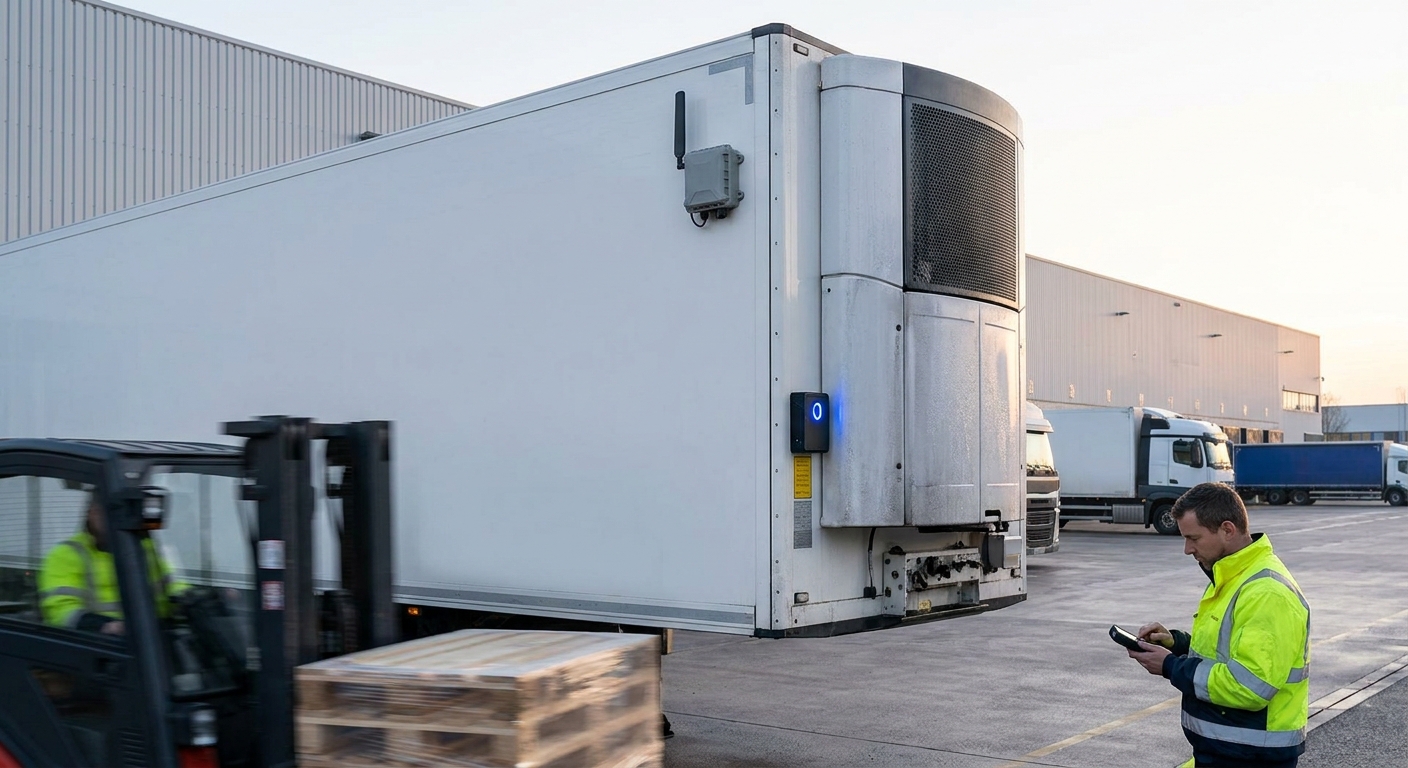
1. Cellular-connected trailer tracker — the baseline setup. Cellular connectivity plus a return-air probe and a door sensor covers the core failure modes: drift, door-open duration, and location. Cellular IoT connectivity for mobile asset tracking is built for exactly this — assets that move outside gateway range for hours at a time. Buy if trailers run regional or long-haul routes in 2026.
2. Fleet dashboard rollup — the dispatcher's pick. Once you're past 3-4 trailers, a single-asset view stops working. A logistics fleet asset tracking platform that rolls every unit into one risk-sorted view is what lets one dispatcher manage a whole yard's reefer status without opening a dozen tabs. Buy for any operation running more than a handful of reefer units.
3. Dock-to-road handoff — the cold chain integration pick. The weakest link in most cold chain setups is the gap between the cold storage facility and the trailer sitting at the dock. A cold storage temperature monitoring dashboard that shares alarm logic with the trailer sensors means nobody loses visibility during loading, which is when doors get left open longest. Consider if your trailers spend meaningful time at a facility you also monitor.
4. Intermodal container tracking — the wildcard. If reefer freight ever moves in shipping containers between rail, ship, and truck, tracking needs to survive that handoff without a gap in the record. This setup matters for intermodal-heavy operations specifically, less for pure over-the-road fleets. Consider only if intermodal is part of your lane mix; otherwise Skip and put the budget into cellular coverage on the trailers themselves.
What to avoid
- LoRaWAN-only trailer kits. They look cheap and work great in a demo at the yard, then go silent 40 miles down the highway. Fine for stationary cold storage, wrong for a moving trailer.
- Single air-sensor setups sold as "full cold chain monitoring." One sensor near the front door doesn't tell you what's happening at the back of a 53-foot trailer.
- Dashboards with no alarm escalation. A chart nobody's watching at 2 a.m. doesn't stop a compressor failure from ruining a load. If the platform can't push an alert to a phone, it's a reporting tool, not a monitoring tool.
Verdict comparison
| Setup | Connectivity | Best for | Verdict |
|---|---|---|---|
| Cellular trailer tracker | Cellular | Regional/long-haul reefer | Buy |
| Fleet dashboard rollup | Cellular + platform | 4+ trailer operations | Buy |
| Cold storage dock integration | Cellular + LoRaWAN | Facilities with dock handoff | Consider |
| Intermodal container tracking | Cellular/satellite | Rail/ship/truck mix | Consider or Skip |
| LoRaWAN-only kit | LoRaWAN gateway | Stationary yards only | Skip for moving trailers |
Kilo IoT runs the connectivity, dashboards, and rules engine behind these setups on one platform, so a trailer alarm and a dock alarm can share the same escalation logic instead of living in two separate tools.
Map out your reefer fleet's coverage gaps
See where cellular tracking and alarm rules fit your current routes.
FAQ
What's the best IoT tracking for refrigerated trailers and reefer trucks in 2026?
A cellular-connected setup with a return-air temperature probe, door sensor, and rules-based alarms is the 2026 standard. LoRaWAN-only kits work at a yard but drop out once a trailer leaves gateway range.
Is cellular or LoRaWAN better for reefer trailer tracking?
Cellular wins for any trailer that leaves a fixed yard, because it doesn't depend on gateway proximity. LoRaWAN makes more sense for stationary cold storage rooms, not moving trailers.
Can IoT tracking detect a reefer door left open?
Yes, a door sensor paired with a duration-based rule can alarm after a set number of minutes open, which is often the actual cause of a temperature excursion rather than a compressor failure.
How often should reefer temperature be logged?
Readings every 5 minutes catch slow drift that hourly checks miss. A compressor issue often shows up as gradual drift hours before it crosses an alarm threshold.
Does IoT trailer tracking work without cell signal in remote areas?
Cellular coverage has gaps on certain rural routes, so trailers running those lanes need a connectivity plan that accounts for it, since a sensor that can't transmit can't alarm.
How is IoT tracking different from a basic GPS tracker for reefer trucks?
A GPS tracker tells you where the trailer is. IoT tracking adds temperature, door status, and compressor behavior, then alarms on the ones that predict a spoiled load.
What sensors matter most for cold chain trailers?
Return-air temperature, door open/close, and location are the core three. Product-core probes add accuracy for high-value or highly sensitive loads.
One last thing
Most reefer temperature excursions don't start with the compressor dying outright — they start with short-cycling, where the unit turns on and off more frequently than normal for hours before it actually fails. A rule that flags cycling frequency, not just the temperature reading itself, catches the failure while there's still time to reroute or reload, which is exactly the gap a clipboard log can never close in 2026.