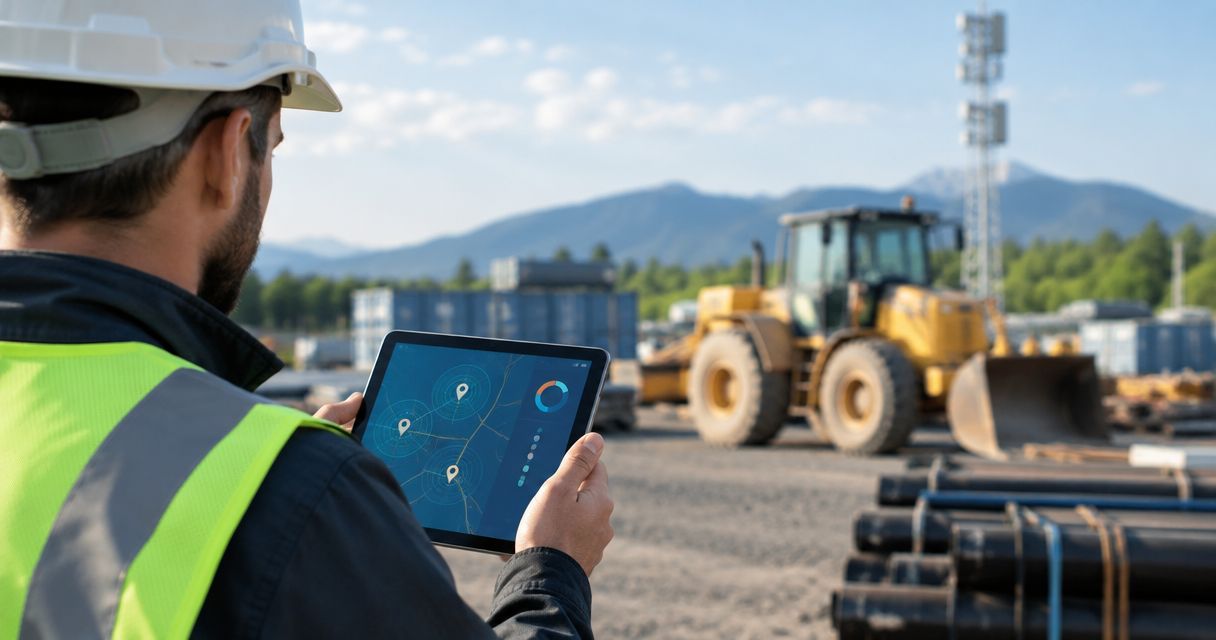
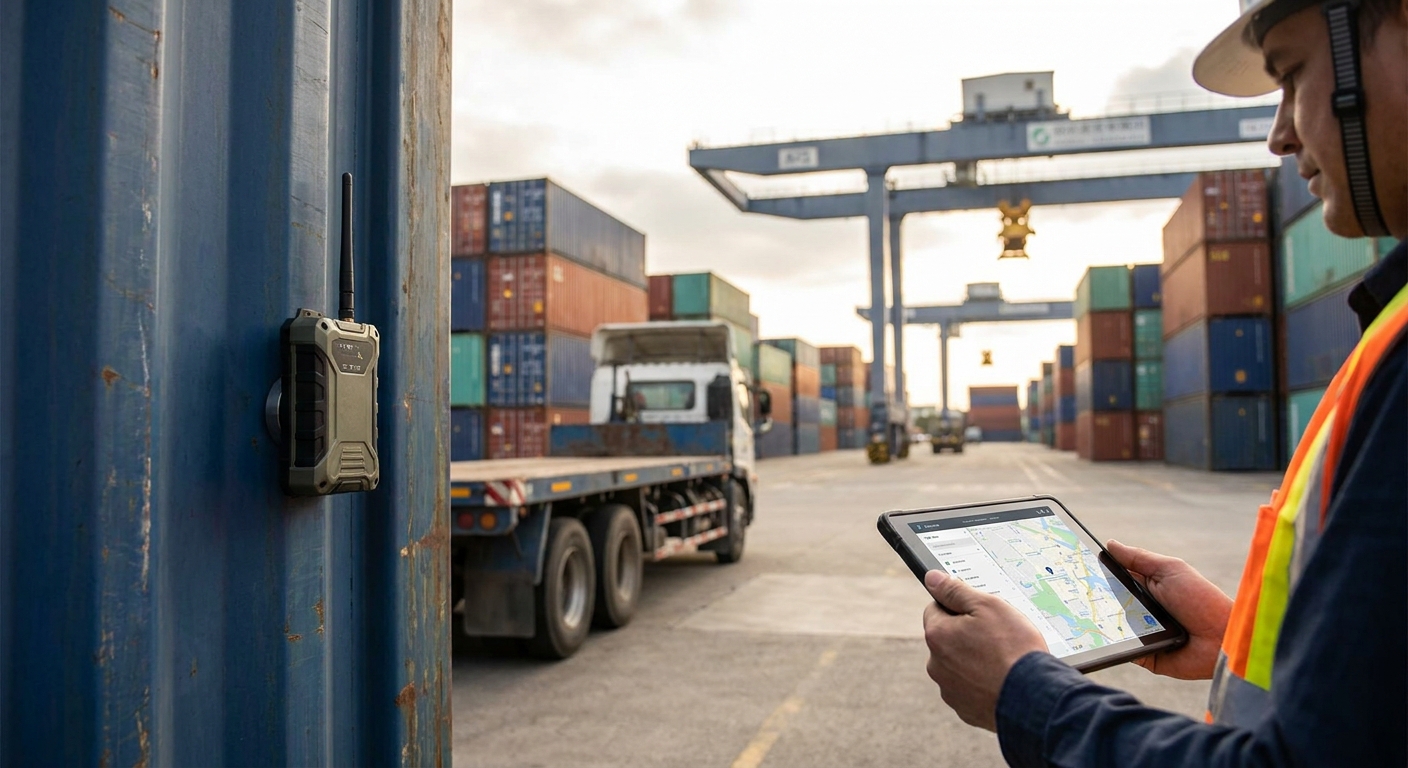
Shipping container yards move thousands of containers a day across acres of steel, concrete, and stacked steel boxes that jam every radio signal you throw at them — losing count of even a handful of units costs detention fees and angry customers. This guide breaks down what iot asset tracking for shipping container yards actually requires in 2026, who needs which setup, and which approach to skip.
- IoT asset tracking for shipping container yards in 2026 needs cellular GPS for road moves and LoRaWAN for in-yard dwell time. Buy hybrid.
- Cellular-only trackers drain within months on containers sitting idle for a year. LoRaWAN sensors run for years on one battery.
- Reefer containers need temperature alarms wired into a rules engine, not just position pings every hour.
- Device management matters more than the sensor once a yard passes 500 tracked units across multiple gates or sites.
- BLE and passive RFID fail across open yards — line-of-sight and short range don't survive stacked containers.
Why this matters
A container yard isn't a warehouse. Assets sit outdoors for weeks or months, get restacked by top-picks and reach stackers, and move between yard, rail, and road with no fixed path. A tracking system built for indoor pallets or retail shelves falls apart the first time a reefer gets buried three containers deep.
The stakes in 2026 are financial, not just operational. Demurrage and detention charges climb every day a container sits past its free time, and a misplaced reefer with a dead compressor turns into a cargo claim fast. The Kilo IoT platform approach treats tracking as one layer of a larger monitoring stack — position, temperature, and equipment health feeding the same dashboards and alarms — because a yard team needs all three to act, not just a dot on a map.
Who this is for
This guide is for terminal operations managers, container yard operators, and drayage or 3PL companies running their own storage yards who need to know where every unit sits, how long it's been there, and whether a reefer is holding temperature — without walking the rows with a clipboard.
What to look for in IoT asset tracking for shipping container yards
Connectivity that survives stacked steel
A single cellular modem loses signal fast once containers stack four or five high around it. Yards need a mix: cellular and GPS for units moving over the road, and a fixed gateway network for units parked inside the yard. Cellular IoT connectivity for mobile asset tracking covers the road-move side; the yard side needs LoRaWAN or mioty gateways that punch through steel stacks instead of relying on line-of-sight.
Battery life measured in years, not weeks
Containers can sit in a yard for 24 months or longer before their next move. A tracker built for weekly recharge cycles is dead before the container leaves the stack. LoRaWAN-class sensors are built to run for years on one battery precisely because nobody wants to climb a container stack to swap a coin cell.
Reefer temperature monitoring, not just position
A refrigerated container that drifts above setpoint for 15 minutes can spoil a full load. Position tracking alone won't catch that — the platform needs a rules engine that fires a temperature alarm the moment a reefer crosses threshold, not an hourly ping that reports the damage after the fact.
Real-time positioning granularity
Knowing a container is "somewhere in Yard B" isn't enough when a yard holds thousands of boxes across dozens of rows. Look for row-and-stack-level resolution, not just GPS coordinates that put every unit within a 50-meter circle.
Device management at scale
A yard tracking 200 containers can run on a spreadsheet. A yard tracking 5,000 across three terminals cannot. Once a fleet crosses roughly 500 tracked units, the sensor matters less than the platform managing provisioning, firmware, and alarm rules across every device — which is where an IoT device management platform for system integrators earns its keep.
Alarms tied to yard events, not just data logging
A dashboard full of charts is useless if nobody sees the alert until the next shift. The platform needs to push an alarm the moment a reefer trips temperature or a high-value chassis leaves a geofence — in 2026, that means automated rules, not a human scanning graphs at end of day.
Top picks for container yard tracking
The road-move pick: cellular + GPS hybrid trackers
The safe pick. Cellular and GPS combined trackers report position continuously while a container is in transit between yard and customer. One spec that matters: report interval — look for configurable intervals down to 5 minutes during active moves versus hourly at rest, which extends battery life without losing visibility during the trip. Buy — this is the backbone for any yard doing regular drayage. Cellular IoT connectivity for mobile asset tracking is the piece that makes this work end to end.
The scale pick: a unified logistics fleet asset tracking platform
The wildcard. Most yards start with a tracker vendor and end up bolting on a second system for reefer alarms and a third for equipment health. A single platform that handles container position, reefer temperature, and yard equipment status in one dashboard avoids that sprawl. One number that matters: fewer than 3 integrations to maintain instead of 5-plus point solutions. Consider — worth it once a yard runs multiple terminals or a mixed fleet of containers, chassis, and yard trucks. The best asset tracking IoT platform for logistics fleets is built for exactly this consolidation.
The multi-site pick: centralized device management
The unglamorous winner. Once a terminal operator runs more than one yard, provisioning new sensors by hand becomes the bottleneck, not the hardware. A platform that lets an integrator push firmware and rules to hundreds of devices at once, and lets an AI integrator provision new sensors and set alarm rules through plain-language setup rather than manual config screens, cuts onboarding time from days to hours. Buy for any operator managing more than one yard in 2026. An IoT device management platform for system integrators is the layer that makes scaling past a single yard sane.
What to avoid
- BLE-only indoor tags — Bluetooth mesh reads work in a warehouse aisle, not across an open yard where readers need line-of-sight through stacked steel every 10-30 meters.
- Passive RFID without active alerting — RFID answers "was this container here at some point" during a gate scan; it can't tell you a reefer is drifting temperature at 2am.
- Consumer GPS trackers built for cars — designed for weekly charging and dashboards meant for fleet managers watching a handful of vehicles, not thousands of containers sitting still for months.
Verdict comparison
| Approach | Battery life | Best for | Verdict |
|---|---|---|---|
| Cellular + GPS hybrid | Weeks to months (active moves) | Road moves, drayage | Buy |
| LoRaWAN fixed yard sensors | Years on one battery | In-yard dwell tracking | Buy |
| Unified logistics fleet platform | N/A (platform layer) | Multi-asset, multi-terminal | Consider |
| BLE-only indoor tags | Months | Indoor warehouses, not yards | Skip |
| Passive RFID | N/A (no onboard power) | Gate scans only | Skip |
Map out your yard's tracking stack
Walk through dashboards, alarms and device management for container inventory.
FAQ
What's the best IoT asset tracking for shipping container yards in 2026?
A hybrid setup wins in 2026: cellular and GPS trackers for containers moving over the road, paired with LoRaWAN fixed sensors for units parked in the yard. Neither technology alone covers both the transit and dwell phases of a container's life.
Is LoRaWAN better than cellular for container yards?
LoRaWAN wins for stationary yard tracking because sensors run for years on one battery and punch through stacked steel better than cellular. Cellular wins once a container leaves the yard on a truck, since it needs continuous position reporting over the road.
How much does container yard temperature monitoring cost to run?
Cost scales with the number of reefer units tracked and the report interval chosen, not a flat per-yard fee. Check current sensor and connectivity pricing directly rather than assuming a fixed number, since fleet size and reporting frequency both move the total.
Can one platform handle both container tracking and reefer temperature alarms?
Yes, a unified platform can run position tracking, reefer temperature alarms, and equipment health on the same dashboard instead of three separate systems. That consolidation matters most once a yard runs more than one terminal or a mixed fleet.
How many containers need tracking before device management becomes a problem?
Around 500 tracked units is the point where manual provisioning and spreadsheet tracking stop working. Past that threshold, a device management platform that can push firmware and alarm rules across hundreds of sensors at once becomes the bottleneck fix, not the sensor itself.
Do passive RFID tags work for container yard tracking?
Passive RFID only confirms a container passed a gate scan point — it can't report position between scans or alert on a reefer temperature drift. For continuous yard visibility in 2026, active trackers with onboard power outperform passive RFID.
What's the biggest mistake yards make with container tracking?
Buying position-only trackers and assuming that covers reefer risk. A container can show the correct GPS coordinates while its compressor fails and cargo spoils, so temperature alarms need to run independently of position pings.
One last thing
The number that trips up most yard operators isn't battery life or GPS accuracy — it's alarm latency. A reefer drifting 15 minutes above setpoint at 2am does nothing for the cargo if the alert sits in an email inbox until the morning shift checks in. Whatever tracking setup a yard picks for 2026, the rules engine pushing that alarm in real time matters more than the sensor generating the reading.