
The best mioty network server for your 2026 deployment is the one that matches your hardware, application interfaces and responsibility for running the network—not simply the one with the longest feature list. Start with three deployment models: self-hosted software for infrastructure control, a managed service for outsourced server operations, and a gateway-bundled server for a contained installation; the Kilo IoT Platform belongs in the application-layer evaluation, while its self-hosted mioty Service Center is a separate server candidate.
- Choose a mioty network server by device compatibility, application interfaces and who operates it.
- Kilo offers a self-hosted mioty Service Center; evaluate it separately from the Kilo IoT Platform.
- Self-hosted, managed and gateway-bundled deployments solve different operational problems.
- Require an end-to-end demonstration using your sensor, base station and decoded application data.
Written by Tim Kravchunovsky
A mioty server and an IoT platform solve different problems
A mioty deployment connects wireless devices to applications through receiving infrastructure and server-side services. The server terminology varies across implementations, so a product described as a service center, network server or application center needs closer inspection than its name provides. Ask which responsibilities the supplied software actually covers.
The application layer turns incoming device data into something people can use: device records, dashboards, alarms and configured automation. That distinction matters when comparing suppliers. A dashboard platform with mioty connectivity is not automatically a replacement for the services that operate the mioty network.
Kilo fits integrators who need mioty data connected to device management, dashboards, alarms and automation. Its platform proposition is broader than a network server. Conversely, choosing server software does not establish how your application will decode readings, identify locations or notify the right person.
For a 2026 shortlist, compare complete deployment paths rather than mixing server software, base stations and monitoring applications into one leaderboard. The ranking below orders deployment models by their decision-making role; it is not a benchmark of named vendors.
What makes the best mioty network server
Use these criteria before comparing deployment models:
- Hardware compatibility: Demonstrate the actual sensor and receiving equipment together. A shared protocol name does not establish compatibility with every device or interface.
- Clear server responsibilities: Identify where device registration, network administration and application-data delivery happen. Record which components are included and which are separate.
- Usable application interfaces: Inspect the output your application receives, including identifiers, timestamps and payload structure. A connection is useful only when its data is understood.
- Operational ownership: Name who installs updates, manages credentials, restores service and investigates failures. Hosting location alone does not answer these questions.
- Recovery and portability: Require a documented backup, restore and migration process for the components you will operate. Establish what happens when hardware or suppliers change.
Treat these as acceptance criteria, not a feature-counting exercise. A server that meets your application requirements and has a named operator is a stronger choice than one whose attractive specification leaves the handover undefined.
Mioty network server deployment options at a glance
| Ranked option | Best for | Standout characteristic | Key limitation |
|---|---|---|---|
| Self-hosted server, with Kilo mioty Service Center as a candidate | Integrators needing control of server infrastructure | Server operation remains within your chosen infrastructure | Your team must establish maintenance and recovery responsibilities |
| Managed mioty server service | Buyers outsourcing server operations | Server operation is assigned to a service provider | The contract must define ownership, support and data access |
| Gateway-bundled server deployment | Contained installations evaluating a combined package | Receiving hardware and server functions are assessed together | Hardware replacement and application portability need explicit proof |
These are architectural choices, not interchangeable product names. A supplier still needs to demonstrate the capabilities associated with its proposed model. Do not infer a managed offering, bundled server function or application integration from a manufacturer's logo or a protocol label.
1. Self-hosted server: best for infrastructure control
A self-hosted mioty network server puts the server deployment in infrastructure your organization or integrator operates. Kilo mioty Service Center is a self-hosted candidate for this route. Evaluate the service center's server responsibilities independently from the monitoring platform you intend to use.
This route suits projects with an existing infrastructure owner and a reason to retain control over deployment. That owner needs more than installation access: somebody must maintain the environment, manage access and recover the service after a failure.
Self-hosted server pros:
- You choose the infrastructure in which the server runs.
- You can define operational responsibilities alongside existing IT processes.
- You can evaluate the server separately from the application layer.
Self-hosted server cons:
- Installation does not remove the need for maintenance and recovery planning.
- Your team must coordinate server, receiving-equipment and application troubleshooting.
- Local hosting alone does not establish security, availability or compliance.
Best for: Integrators and organizations with a named infrastructure operator and specific deployment-control requirements.
For your 2026 evaluation, ask for a supported installation procedure, an update process and a restore demonstration. Also request the exact path from a registered device to usable application data. Do not assume that sharing a supplier automatically removes integration work between software components.
Verdict: Hold until the proposed self-hosted configuration passes compatibility and recovery checks; buy when those responsibilities are accepted.
2. Managed mioty server: best for outsourced operations
A managed server arrangement assigns server operation to a provider rather than your internal infrastructure team. Evaluate this route when you want an accountable service relationship for the server layer. The provider's proposal must specify what is actually managed.
The central question is responsibility. A hosted endpoint does not, by itself, establish who handles device onboarding, application integration, receiving-equipment faults or incident investigation.
Managed server pros:
- Server-operation responsibilities can be assigned through a service agreement.
- Your project can focus its internal work on hardware integration and applications.
- The handover can define a single operational contact for the server service.
Managed server cons:
- Application-data access depends on the provider's supported interfaces.
- Service boundaries can leave hardware or application incidents with another party.
- Changing providers requires an agreed migration and ownership process.
Best for: Buyers who need outsourced server operations and can define the required service boundaries before signing.
Ask the provider to demonstrate onboarding, data delivery and incident handling using your proposed equipment. Establish who owns device credentials and configuration, how you retrieve application data, and what happens at contract termination.
For a 2026 procurement, request a responsibility matrix rather than accepting the word managed as a complete specification. The useful comparison is the work retained by your team versus the work explicitly accepted by the provider.
Verdict: Buy only after the service scope covers your required server operations; hold if ownership or exit arrangements remain undefined.
3. Gateway-bundled server: best for a contained installation
A gateway-bundled deployment combines receiving equipment with server functions in the proposed package. Evaluate it as a complete configuration rather than assuming that every mioty base station includes a network server. Ask the supplier to identify which functions run on the equipment and which require another service.
This model is relevant when you want to assess one installation as a contained system. Its appeal depends on the demonstrated package, not on a blanket claim that bundled deployments are easier or more reliable.
Gateway-bundled server pros:
- You can test receiving equipment and server functions as one proposed configuration.
- Installation responsibilities can be specified around a defined hardware package.
- The application handoff can be inspected before expanding the deployment.
Gateway-bundled server cons:
- Hardware replacement can affect server configuration or stored information.
- Expansion requires proof that the proposed architecture supports the next deployment stage.
- An integrated package still needs a documented application interface.
Best for: Buyers evaluating a contained site installation with a clear replacement and expansion plan.
Require a replacement exercise: explain how another unit takes over, which settings must be restored and how the application recognizes devices afterward. Also inspect where credentials and configuration reside. A functioning demonstration is not yet a maintainable deployment.
Verdict: Buy for a contained installation after replacement and application handoff are demonstrated; skip a package that leaves those paths undocumented.
Test the complete path from sensor to application
Your acceptance test should follow one device reading through the proposed system. Keep the test narrow enough to diagnose problems, but include the application layer. Receiving a wireless message is not the same as displaying a meaningful measurement.
Use this sequence:
- Device identity: Register the proposed device and confirm how the system identifies it.
- Network reception: Show that the selected receiving equipment and server handle its messages.
- Payload decoding: Turn the received payload into a named measurement with the correct unit.
- Application action: Display the measurement or apply the agreed alarm condition.
- Outcome evidence: Show the available evidence that the application received and processed the reading.
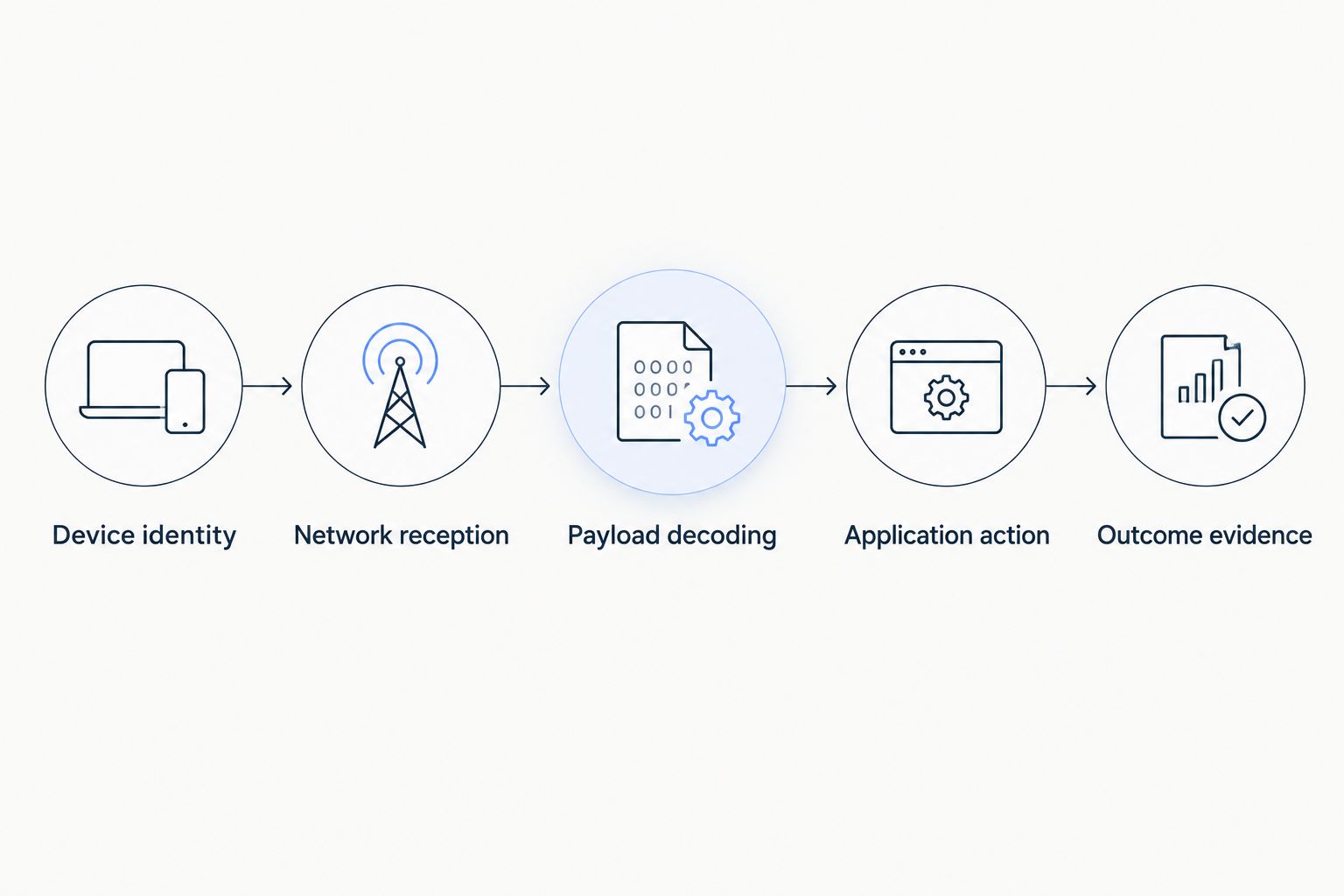
Illustrative scenario: A temperature sensor sends a reading from a storage area. The server path delivers its data, the application maps it to the correct device and location, and a configured condition creates an alarm for the responsible person. Evidence includes the decoded reading and the resulting application event; this is a proposed workflow, not a reported customer deployment.
An alarm does not prove that someone corrected the condition. If your project includes equipment control, treat that as a separate acceptance path requiring a compatible actuator, a supported command and available feedback. Accepted or delivered command status is not proof of a physical outcome.
Decide who responds when data stops arriving
A missing reading has several possible causes: the device, radio reception, receiving-equipment connectivity, server processing or application integration. Your operating plan needs a way to distinguish them. Otherwise, every incident becomes a debate about whose component failed.
Define the evidence each party can inspect and the point at which responsibility transfers. Your integrator needs enough information to trace a device message, while the person responding to an application alarm needs context that is understandable without network engineering knowledge.
This is where the Kilo IoT Platform's device records, dashboards and alarms belong in the evaluation: after establishing how mioty data reaches the application. These capabilities help organize the monitoring workflow, but they do not replace verification of the underlying server connection.
For hardware sourcing, Kilo Electronics is a separate online authorised dealer serving individual and business buyers. Purchasing compatible hardware and choosing platform software are separate decisions; neither establishes that the entire deployment has been configured correctly.
How the deployment models were ranked
The order follows operational fit rather than an unsupported overall winner. Self-hosting addresses infrastructure control, managed service addresses outsourced server operation, and a bundled deployment addresses evaluation of a contained package.
All three face the same acceptance criteria: equipment compatibility, defined server responsibilities, application interfaces, operational ownership and recovery. Use those criteria consistently in your 2026 shortlist. Do not award a higher position merely because a proposal includes dashboards, receiving hardware or additional software outside the server's scope.
FAQ
What's the best mioty network server for a private deployment?
The best fit is a server configuration that supports your actual equipment and has a named operational owner. Compare self-hosted, managed and gateway-bundled proposals using the same compatibility, integration and recovery tests.
Is the Kilo IoT Platform the same thing as a mioty network server?
No. The Kilo IoT Platform provides an application layer with mioty connectivity, device management, dashboards, alarms and automation; its self-hosted mioty Service Center is a separate server candidate to evaluate.
Does every mioty gateway include a network server?
Do not assume a mioty gateway includes a network server. Ask the supplier which receiving and server functions are included and which require separate software or services.
Should I choose a self-hosted or managed mioty server?
Choose self-hosting when you need infrastructure control and have an operator for maintenance and recovery. Evaluate a managed arrangement when you want to assign server operations to a provider through a defined service agreement.
Can a mioty network server replace my monitoring dashboard?
Server software and monitoring dashboards serve different responsibilities. Verify whether the proposed package supplies decoded application data, visualization and alarms, or whether a separate application layer is required.
What should a mioty server demonstration include?
A useful demonstration follows your actual device from registration through reception, payload decoding and an application outcome. Include recovery or hardware-replacement testing before approving the deployment.
Does receiving a command confirmation prove equipment changed state?
No. Accepted, queued or delivered status is not proof of a physical outcome; verification depends on device feedback or subsequent measurements where supported.
Which mioty server deployment should you choose?
Default to the model your team can operate and verify end to end. Choose self-hosting for infrastructure control, a managed agreement for outsourced server operations, or a bundled package for a contained installation whose replacement path has been demonstrated.
Before approving a 2026 deployment, ask one final question: can a different engineer reproduce the installation and recover it using the supplied instructions? That test exposes dependencies a successful live demonstration can hide. A server choice is complete when the next person can run it, not just when the first person gets data through.